
How to Find Reliable Stainless Steel Suppliers Near Me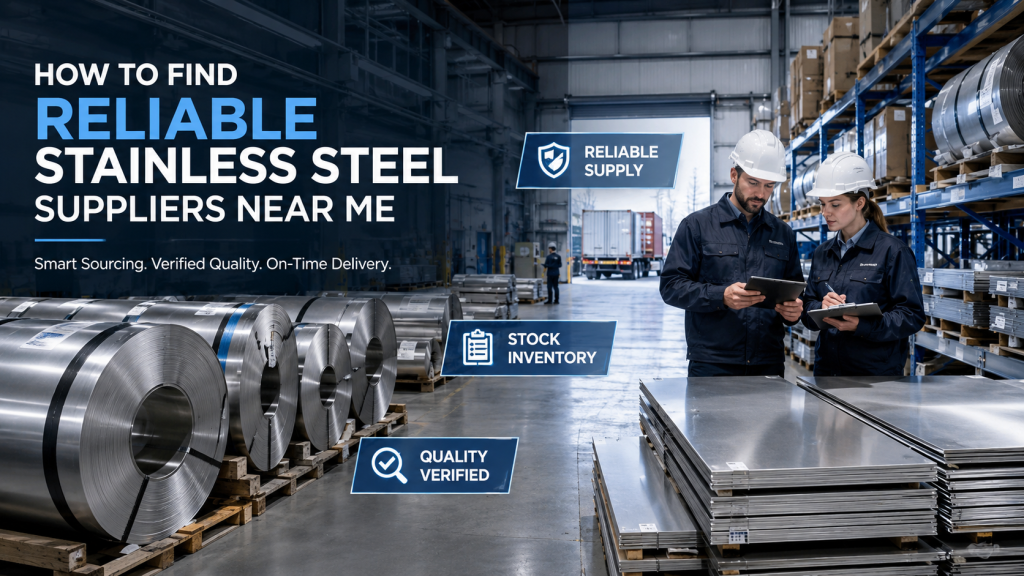
A reliable stainless steel supplier should combine material traceability, stable stock, accurate processing, quality inspection and dependable delivery.
Searching for “reliable stainless steel suppliers near me” may produce dozens of local distributors, warehouses, fabricators, online traders and international manufacturers. The closest company, however, is not automatically the safest or most economical supplier for your project.
Stainless steel procurement involves more than finding a company that has metal in stock. A qualified supplier must provide the correct grade, product standard, dimensions, surface finish, mechanical condition, material documents, processing capability and delivery commitment.
An incorrect supplier decision can lead to mixed grades, false material descriptions, poor surface quality, thickness shortages, missing certificates, damaged packaging, late shipments and unexpected fabrication problems.
This guide explains how to find and evaluate local and international stainless steel suppliers. It includes supplier-type comparisons, document verification, factory and warehouse audits, price analysis, sample-order testing, delivery evaluation, warning signs and a practical supplier scorecard.
Quick Answer: How Do I Find a Reliable Stainless Steel Supplier?
Start by preparing a complete material specification. Search for suppliers that stock or manufacture the required grade and product form, then verify their material certificates, heat-number traceability, quality procedures, processing equipment, delivery record and industry experience.
Do not compare suppliers using price alone. Compare the same grade, standard, thickness tolerance, surface finish, quantity, processing scope, inspection requirement, packaging method and delivery term.
For urgent small orders, a local stainless steel stockist may be the most convenient choice. For larger quantities, special grades or custom processing, an experienced international supplier may offer better availability, technical capability and total landed cost.
1. Define Your Stainless Steel Requirements First
A supplier cannot provide an accurate quotation if the material specification is incomplete. Before searching for stainless steel suppliers near you, define exactly what you need.
Specify the Stainless Steel Grade
Stainless steel is available in many alloy families. Common examples include:
- 201 and 202: cost-sensitive decorative and general industrial products
- 301: springs, clips and high-strength precision strip
- 304 and 304L: general fabrication, food equipment and architectural products
- 316L: chemical, pharmaceutical, coastal and chloride-bearing environments
- 317L and 904L: more aggressive chemical service
- 409L, 430, 439 and 441: ferritic stainless steel for appliances, exhaust and heat-resistant components
- 420 and 440 grades: hardenable blades, tools and wear parts
- 2205 and 2507: duplex stainless steel for higher strength and chloride resistance
If you are uncertain about the grade, provide the supplier with the service temperature, chemical environment, chloride concentration, fabrication method and required mechanical performance.
Identify the Product Form
| Product Form | Typical Applications | Important Purchasing Details |
|---|---|---|
| Tôle d'acier inoxydable | Panels, enclosures, tanks, kitchen equipment and architectural products | Thickness, width, length, finish, flatness and protective film |
| Stainless steel plate | Pressure vessels, structural parts, flanges and heavy equipment | Thickness tolerance, flatness, UT requirements and cutting method |
| Bobine d'acier inoxydable | Stamping, roll forming, roofing and continuous production | Coil weight, inner diameter, width, surface, edge and mechanical condition |
| Feuilles d'acier inoxydable | Springs, clips, gaskets, precision parts and narrow stampings | Temper, hardness, width tolerance, camber, burr and edge condition |
| Stainless steel pipe or tube | Fluid systems, heat exchangers, structures and sanitary systems | Outside diameter, wall thickness, welded or seamless construction and testing |
| Stainless steel bar | Shafts, fasteners, machined parts and valves | Diameter, straightness, surface condition and machining allowance |
| Fabricated component | Custom tanks, brackets, housings, flanges and equipment parts | Drawing, tolerance, weld standard, finish and inspection plan |
Include the Applicable Standard
Common product standards may include ASTM, ASME, EN, JIS, GB/T or customer-specific requirements. The same commercial grade name can have slightly different limits under different standards.
A complete specification should define:
- Grade and UNS, EN or JIS designation
- Product standard
- Dimensions and tolerances
- Surface finish
- Heat-treatment or temper condition
- Mechanical-property requirements
- Edge condition
- Testing and certification
- Packaging and delivery requirements
JUDE’s
stainless steel sheet buying guide
provides additional information about grades, dimensions, finishes, tolerances and RFQ preparation.
2. Understand the Different Types of Stainless Steel Suppliers
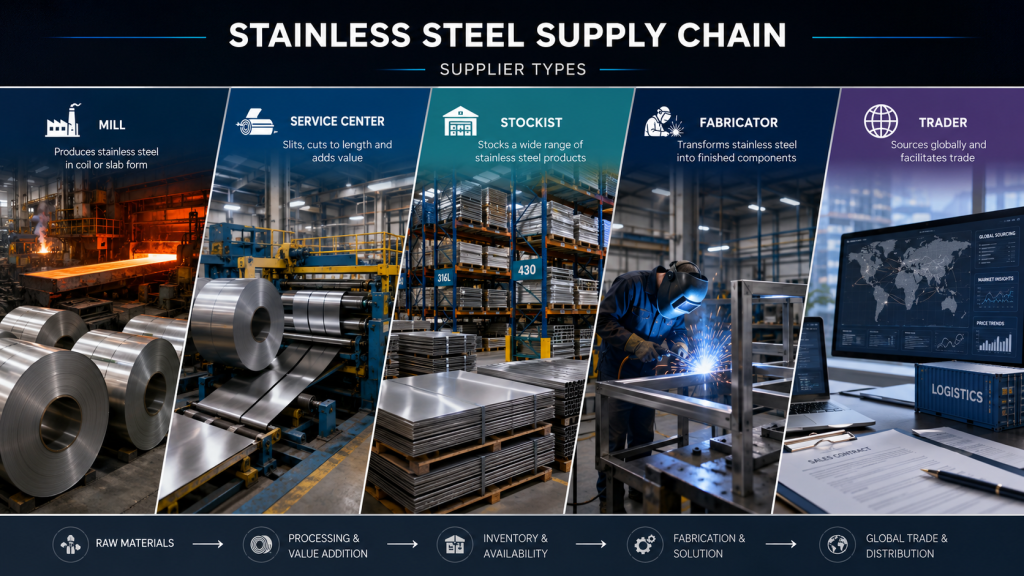
Mills, service centers, stockists, distributors and fabricators perform different roles in the stainless steel supply chain.
Stainless Steel Mill
A steel mill melts, casts, rolls and anneals stainless steel. Mills are suitable for large-volume orders, mill-specific production and special grades.
Mill orders may require higher minimum quantities and longer production schedules.
Service Center
A stainless steel service center purchases coils or plates and provides slitting, cut-to-length, leveling, polishing, protective film and other processing.
Service centers are often ideal for customized dimensions and repeat manufacturing programs.
Stockist or Distributor
A stockist maintains common grades and sizes for rapid delivery. This type of supplier is convenient for small or urgent orders.
Product range, traceability and processing capacity can vary significantly between stockists.
Fabricator
A fabricator converts stainless steel into finished or semi-finished components through cutting, bending, welding and machining.
Confirm whether the fabricator controls the raw-material source and maintains heat-number traceability.
Trading Company
A professional trader can coordinate multiple mills, product forms, inspections and export logistics.
Verify whether the trader has direct mill relationships, technical knowledge and control over inspection and delivery.
Integrated Supplier
An integrated supplier combines stock, mill access, processing, quality inspection and international delivery.
This structure can simplify procurement when an order includes multiple grades, sizes or processing operations.
3. Where Can You Find Stainless Steel Suppliers Near You?
Use more than one search channel. A supplier with strong online visibility is not automatically qualified, while a technically capable industrial supplier may have limited digital marketing.
Local Search Methods
- Search engines and map listings
- Local industrial directories
- Metalworking and manufacturing associations
- Engineering and fabrication referrals
- Industrial parks and local service centers
- Trade exhibitions
- Existing customer and subcontractor recommendations
Useful Search Phrases
- Stainless steel suppliers near me
- Stainless steel sheet suppliers near me
- Stainless steel plate suppliers near me
- Stainless steel coil service center
- 316L stainless steel supplier near me
- Stainless steel cutting services near me
- Stainless steel polishing company near me
- Precision stainless steel strip supplier
- Duplex stainless steel supplier
- International stainless steel supplier
International Search Methods
- Manufacturer websites
- Industrial sourcing platforms
- International trade fairs
- Chambers of commerce
- Import and export databases
- Third-party factory audit companies
- Freight forwarder and inspection-company referrals
A company should still be evaluated through documents, sample testing, video inspection, factory audits, customer references and trial orders.
4. Local Supplier vs International Supplier
| Evaluation Factor | Local Supplier | International Supplier |
|---|---|---|
| Small urgent orders | Often more convenient | International freight may be inefficient |
| Common stock sizes | Potentially available immediately | Available when supported by warehouse stock |
| Special grades | May have limited availability | May provide wider mill and inventory access |
| Large-volume pricing | May include multiple distribution margins | Can be more competitive when purchased near the production source |
| Custom processing | Depends on local equipment | Can offer integrated slitting, cutting and surface processing |
| Communication | Same language and time zone may be easier | Requires clear technical documents and export experience |
| Inspection | On-site inspection may be easier | Third-party inspection can be arranged before shipment |
| Lead time | Short for available local stock | Includes processing and international transit |
| Product selection | May focus on common grades | Potentially broader grade and size range |
| Total cost | Lower logistics complexity | May offer lower material cost but requires landed-cost analysis |
When Is a Local Supplier Better?
A local supplier is often preferable when:
- The quantity is small
- The material is needed immediately
- The grade and size are common
- You need to inspect the material personally
- International transport would cost more than the material
- You need local fabrication support
When Is an International Supplier Better?
An international supplier may be preferable when:
- The order quantity is large
- The grade is uncommon in the local market
- Customized dimensions or finishes are required
- You require multiple product forms in one shipment
- Local distributor margins are high
- You need direct access to mills or large service centers
- You have time to complete proper supplier verification
5. Verify Material Documents and Heat-Number Traceability
Material documentation is one of the strongest indicators of a professional stainless steel supplier.
Mill Test Certificate
A mill test certificate normally identifies:
- Steel mill or manufacturer
- Grade
- Product standard
- Heat number
- Chemical composition
- Mechanical properties
- Heat-treatment condition
- Product dimensions
- Inspection authorization
For many industrial purchases, buyers request an EN 10204 Type 3.1 inspection certificate or an equivalent document specified by the project.
The heat number shown on the certificate must match the product marking, label, coil tag, plate marking or packaging identification. A certificate without traceability does not prove that it belongs to the delivered material.
Positive Material Identification
PMI can be used to confirm that the nominal alloy chemistry matches the ordered grade. Handheld XRF is useful for verifying elements such as chromium, nickel and molybdenum.
Conventional handheld XRF cannot directly measure carbon. It cannot independently prove that a product satisfies a low-carbon designation such as 304L or 316L.
JUDE’s
guide to testing stainless steel
explains PMI, XRF, OES, hardness, corrosion and nondestructive testing methods.
Additional Documents
Depending on the order, you may also request:
- Certificate of origin
- Packing list
- Commercial invoice
- Rapport d'inspection
- PMI report
- Dimensional report
- Surface roughness report
- Corrosion test report
- Third-party inspection certificate
- Material safety documentation
- Compliance declarations
Selected documents can be reviewed on JUDE’s
inspection report page
.
6. Evaluate the Supplier’s Quality Management System
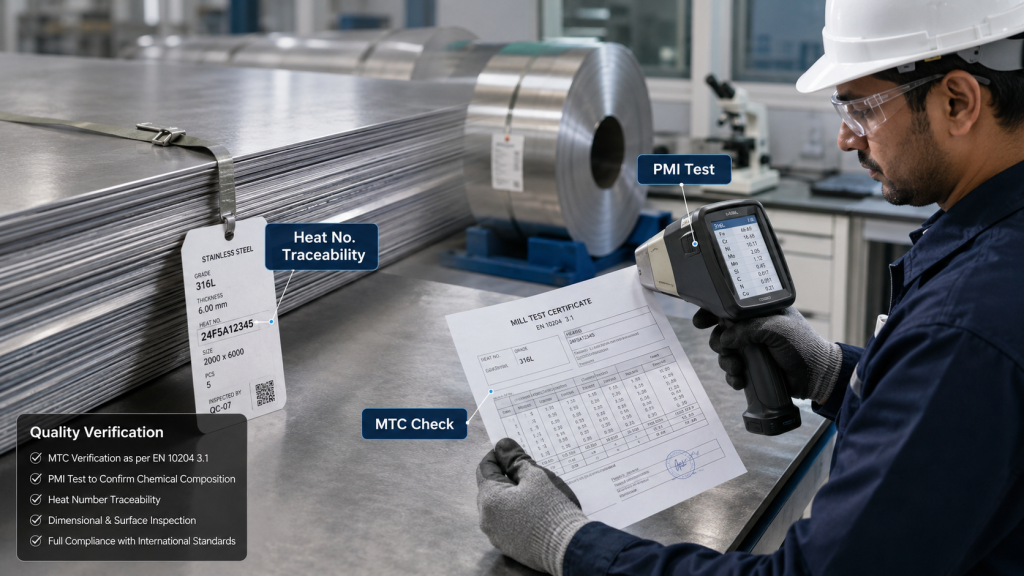
Supplier quality should be evaluated through repeatable procedures, calibrated inspection equipment and material traceability.
ISO 9001 certification can indicate that a supplier operates a documented quality management system. However, certification alone does not prove that a specific shipment has the correct grade, dimensions or surface quality.
A supplier audit should examine how the company controls:
- Incoming raw materials
- Heat-number identification
- Warehouse segregation
- Measuring equipment calibration
- Processing instructions
- Inspection records
- Nonconforming material
- Corrective actions
- Packaging and shipment release
- Customer complaints
Questions to Ask the Quality Department
- How do you prevent mixed stainless steel grades?
- How is heat-number traceability maintained after cutting?
- Which inspection equipment is calibrated?
- How often are instruments verified?
- Can you provide sample inspection reports?
- How are nonconforming products isolated?
- Can a third party inspect the goods before shipment?
- How are customer complaints investigated?
Each shipment still requires the documents and inspections defined in the purchase order.
7. Verify Real Stock and Stable Production Access
Some suppliers advertise large inventories but source material only after receiving an order. This is not necessarily a problem, but the quotation should clearly state whether the material is in stock, reserved from a mill or scheduled for new production.
Ask for Stock Evidence
For important orders, request:
- Current warehouse photographs
- Video inspection with a date and purchase-order reference
- Coil or plate tag photographs
- Heat numbers
- Available dimensions and quantities
- Expected processing schedule
- Expected shipment date
Stock Material vs Mill Production
| Factor | Stock Material | New Mill Production |
|---|---|---|
| Lead time | Usually shorter | Longer production schedule |
| Dimensions | Limited to available sizes | May allow customized dimensions |
| Quantity | Suitable for small or medium orders | Often better for larger quantities |
| Heat consistency | May include more than one heat | Can potentially be produced from controlled heats |
| Surface finish | Limited to warehouse stock | Can be scheduled to the required production route |
| Price | Influenced by warehouse inventory cost | Influenced by mill quantity and production schedule |
8. Check Processing and Fabrication Capabilities
Buying raw material from one company and arranging processing with several subcontractors can increase transport cost, handling damage and traceability risk.
An integrated supplier may provide:
- Slitting
- Cut-to-length processing
- Leveling
- Shearing
- Découpe au laser
- Découpe au plasma
- Waterjet cutting
- Pliage
- Roulant
- Beveling
- Polissage
- Brossage
- Protective-film application
- Welding and fabrication
Processing Capability Questions
- What is the minimum and maximum thickness?
- What is the maximum sheet or plate size?
- What width tolerance can be achieved?
- Can strip edges be deburred or rounded?
- Can the supplier control flatness and camber?
- What surface finishes are available?
- How is material identified after cutting?
- Are inspection records maintained for processed parts?
JUDE provides
stainless steel strip processing
including uncoiling, slitting, leveling, rewinding and customized packaging.
For custom profiles and complex parts, JUDE also offers
waterjet cutting
and other processing services.
9. Evaluate the Supplier’s Technical Knowledge
A professional supplier should do more than repeat a grade name and price. The sales and engineering teams should understand how grade, product form, surface finish and processing affect the final application.
A Qualified Supplier Should Be Able to Explain:
- The difference between 304, 304L, 316L and duplex grades
- Why molybdenum improves chloride resistance
- The difference between sheet, plate, coil and strip
- Cold-rolled and hot-rolled product conditions
- Surface finishes such as No.1, 2B, BA, No.4 and mirror
- Thickness and flatness tolerances
- Annealed, hardened and temper-rolled conditions
- Welding and post-weld cleaning considerations
- Suitable testing methods
- Export packing and delivery options
Warning Signs of Weak Technical Support
- The supplier recommends a grade without asking about the application.
- The quotation does not identify a material standard.
- The supplier cannot explain surface-finish terminology.
- The supplier treats 304 and 316 as interchangeable.
- The supplier guarantees that all stainless steel will never rust.
- The supplier cannot explain the certificate or heat number.
10. Request Samples or Place a Trial Order
A sample or small trial order can reveal problems that are difficult to identify through documents and online meetings.
What Should Be Evaluated?
- Grade and chemistry
- Thickness and dimensional tolerance
- Surface appearance
- Flatness
- Hardness and mechanical condition
- Edge burr
- Forming performance
- Welding performance
- Polishing consistency
- Packaging quality
- Document accuracy
Sample Limitations
A good sample does not guarantee that every future production batch will be identical. The purchase order should define how production material will be inspected and how traceability will be maintained.
Approve the supplier’s process and acceptance criteria, not only one attractive sample.
11. Compare Stainless Steel Prices Correctly
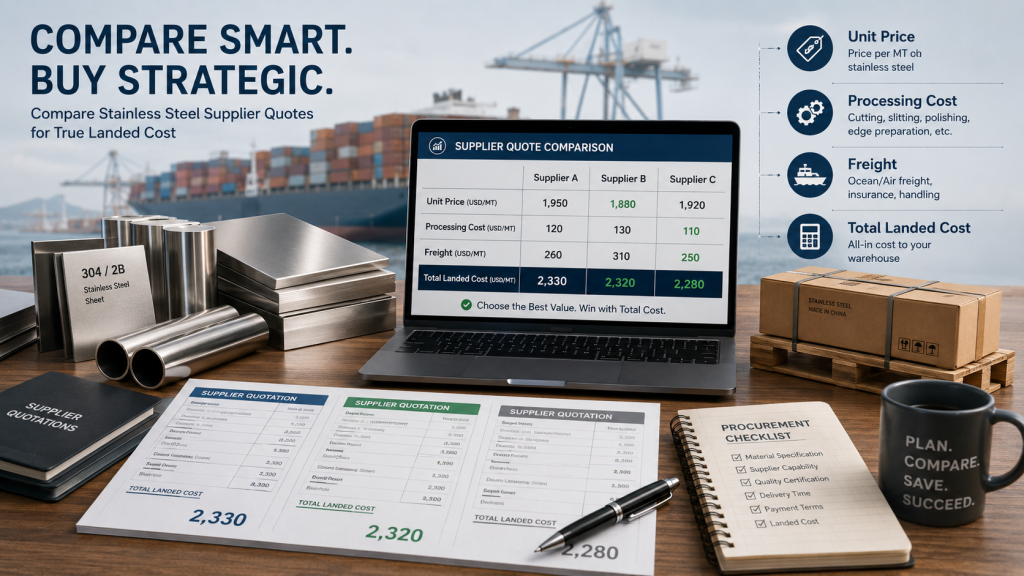
Stainless steel quotations should be compared using identical specifications and total landed cost rather than unit price alone.
A low price may result from a different grade, lower thickness, wider tolerance, secondary material, incomplete processing, weaker packaging or excluded delivery costs.
Compare the Same Specification
Each quotation should identify:
- Grade
- Standard
- Mill or material origin
- Thickness and tolerance
- Width and length
- Surface finish
- Edge condition
- Quantity and weight basis
- Processing scope
- Certificate requirement
- Packaging
- Delivery term
- Payment term
- Lead time
Calculate Total Landed Cost
Total landed cost may include:
- Material price
- Alloy surcharge
- Cutting or slitting
- Surface processing
- Testing and third-party inspection
- Export packaging
- Inland transport
- Port and documentation charges
- Ocean or air freight
- Insurance
- Import duty
- Customs clearance
- Local delivery
- Financing and payment cost
Possible causes include incorrect grade, under-thickness material, nonstandard tolerances, secondary-quality products, missing documents or excluded charges.
12. Evaluate Lead Time, Packaging and Delivery Reliability
A supplier should provide a realistic schedule rather than promising an impossible delivery date.
Ask the Supplier to Separate:
- Material reservation time
- Production or processing time
- Inspection time
- Packaging time
- Inland transport time
- Port and customs time
- International transit time
Packaging Requirements
Stainless steel packaging may include:
- Water-resistant wrapping
- Protective film
- Interleaving paper
- Steel or wooden pallets
- Edge protectors
- Moisture barriers
- Desiccants
- Secure strapping
- Coil-eye protection
- Clear grade and heat-number labels
Packaging must be suitable for the product form, transport route, handling method and expected storage conditions.
Read JUDE’s
MOQ, packing and delivery guide
for additional export-procurement information.
13. Assess Communication and Commercial Reliability
Supplier communication is a practical indicator of how the company may handle production questions, inspection issues and delivery changes.
Positive Communication Signs
- The supplier asks detailed technical questions.
- The quotation is complete and clearly formatted.
- Replies are consistent rather than contradictory.
- The company explains what is and is not included.
- The supplier identifies risks before production.
- Problems are documented instead of hidden.
- The team can communicate with engineering, quality and logistics departments.
Commercial Information to Confirm
- Legal company name
- Registered address
- Bank-account name
- Currency
- Payment schedule
- Quotation validity
- Delivery term
- Warranty or claim procedure
- Inspection and rejection procedure
Treat unexpected bank-account changes as high risk. Confirm any change using an independently verified telephone number or existing company contact.
14. How to Verify a Stainless Steel Supplier Found Online
Online supplier verification should combine public information, direct evidence and independent checks.
Review the Supplier’s Website
Look for:
- Clear legal company information
- Physical address
- Product range
- Factory or warehouse photographs
- Processing capability
- Material-grade pages
- Inspection documents
- Telephone and email contacts
- Technical articles and product knowledge
Complete Independent Checks
- Confirm business registration.
- Verify the company address.
- Check certification validity.
- Review import and export history where legally available.
- Request customer references when appropriate.
- Arrange a live factory video call.
- Use an independent inspection company.
- Check whether the bank beneficiary matches the contracting company.
Factory Video Call Checklist
Ask the supplier to show:
- Building entrance and company name
- Warehouse inventory
- Coil and plate labels
- Processing equipment
- Inspection instruments
- Packaging area
- Finished products
- Purchase-order-specific material where available
15. Red Flags When Choosing a Stainless Steel Supplier
Stop or investigate further when a supplier:
- Refuses to provide a material certificate
- Cannot show heat-number traceability
- Uses a personal bank account
- Changes the bank account without a formal explanation
- Quotes far below all comparable suppliers
- Will not identify the material standard
- Guarantees impossible lead times
- Refuses third-party inspection
- Uses identical photographs copied from other websites
- Provides inconsistent company names or addresses
- Cannot explain grade differences
- Does not define thickness tolerance
- Refuses to show stock or production evidence
- Pressures the buyer to pay immediately
- Provides incomplete quotations
- Avoids written confirmation of technical requirements
Several red flags together indicate a significantly higher commercial or quality risk.
16. Stainless Steel Supplier Evaluation Scorecard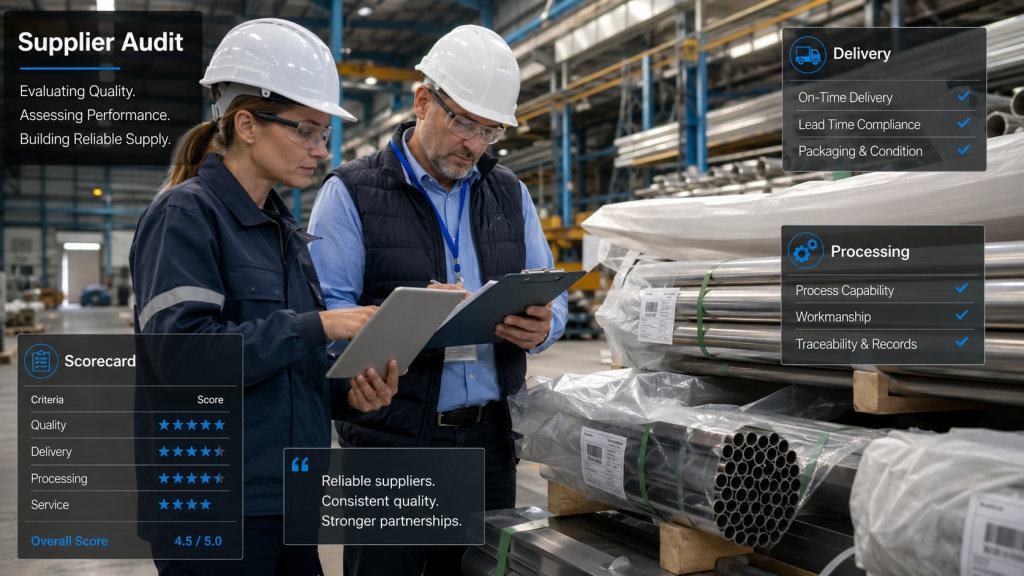 A weighted scorecard helps procurement teams compare suppliers using quality, capability, cost and delivery criteria.
| Evaluation Category | Suggested Weight | Questions to Evaluate |
|---|---|---|
| Material quality | 20% | Does the material meet grade, standard, chemistry, mechanical and surface requirements? |
| Traceability and documents | 15% | Are MTCs, heat numbers, inspection reports and markings complete and consistent? |
| Processing capability | 15% | Can the supplier achieve the required size, finish, flatness, edge and fabrication tolerances? |
| Technical support | 10% | Does the supplier understand the material and application? |
| Price and total cost | 15% | Is the quotation competitive, complete and based on the same specification? |
| Delivery performance | 10% | Is the lead time realistic, and does the supplier have a history of on-time delivery? |
| Communication | 5% | Are responses professional, consistent and timely? |
| Financial and commercial risk | 5% | Are the legal entity, bank account and payment terms verifiable? |
| After-sales support | 5% | Is there a clear process for claims, replacement and corrective action? |
Suggested Scoring Method
| Score | Meaning | Recommended Interpretation |
|---|---|---|
| 5 | Excellent | Complete evidence, strong capability and low identified risk |
| 4 | Good | Meets requirements with minor limitations |
| 3 | Acceptable | Usable with additional controls or clarification |
| 2 | Weak | Significant gaps requiring corrective action |
| 1 | Unacceptable | Insufficient evidence or high commercial and quality risk |
Procurement teams can multiply each category score by its weighting to create a more objective supplier ranking.
17. How to Write a Clear Stainless Steel RFQ
A complete request for quotation reduces communication time and helps ensure that all suppliers quote the same requirement.
RFQ Checklist
- Grade:
Specify the complete grade and designation. - Standard:
Identify ASTM, ASME, EN, JIS, GB/T or customer specification. - Product form:
Sheet, plate, coil, strip, tube, pipe, bar or component. - Dimensions:
Thickness, width, length, diameter, coil weight and tolerances. - Surface finish:
No.1, 2D, 2B, BA, No.4, hairline, mirror or another finish. - Edge condition:
Mill edge, slit edge, deburred edge, rounded edge or machined edge. - Mechanical condition:
Annealed, hardened, temper rolled or specific mechanical properties. - Quantity:
Number of sheets, coils, pieces or total weight. - Processing:
Slitting, cutting, polishing, bending, drilling, welding or fabrication. - Inspection:
MTC, PMI, dimensional inspection, mechanical testing, corrosion testing or third-party inspection. - Packaging:
Pallet type, protective film, interleaving paper and moisture protection. - Delivery location:
Factory address, warehouse, port or final destination. - Delivery term:
State the required commercial delivery term clearly. - Delivery date:
Identify the required arrival date rather than only the shipment date. - Application:
Explain the end use and important service conditions.
Example RFQ
Product: Cold-rolled stainless steel sheet
Grade: ASTM 316L / UNS S31603
Standard: ASTM A240
Size: 2.0 × 1219 × 2438 mm
Thickness tolerance: As specified in the purchase order
Surface: 2B with protective film
Quantity: 20 metric tons
Documents: EN 10204 Type 3.1 certificate and packing list
Inspection: PMI and dimensional inspection before shipment
Packaging: Seaworthy export pallets with edge protection
Destination: [Insert port or delivery address]
Required delivery: [Insert required arrival date]
18. Recommended Supplier-Selection Workflow
Prepare the Technical Specification
Define grade, standard, size, tolerance, finish, quantity, processing, testing and delivery requirements.
Create a Supplier Longlist
Identify local stockists, service centers, mills, fabricators and qualified international suppliers.
Complete Initial Verification
Review company registration, website, address, certificates, product range and contact information.
Send the Same RFQ to Each Supplier
Use identical specifications so that price, lead time and service can be compared fairly.
Review Technical Responses
Confirm that each quotation identifies the grade, standard, dimensions, tolerance, finish, processing and documents.
Verify Quality Evidence
Review sample certificates, heat-number traceability, inspection reports and instrument capabilities.
Conduct a Video or On-Site Audit
Inspect stock, processing equipment, laboratories, packaging and material-identification controls.
Order Samples or a Trial Batch
Test chemistry, dimensions, surface quality, forming and packaging before approving a large order.
Approve a Quality and Inspection Plan
Define inspection points, sampling, reports, acceptance criteria and nonconformity procedures.
Place the Purchase Order
Ensure that the purchase order contains all technical, commercial and delivery requirements.
Inspect Before Shipment
Verify quantity, dimensions, grade, surface, packaging, labels and documents before release.
Measure Supplier Performance
Track quality, delivery, communication, claim rate and total cost for future supplier decisions.
Why Consider JUDE as Your Stainless Steel Supplier?
JUDE is a stainless steel supplier and processing-service provider based in Wuxi, China. The company supplies common and special stainless steel grades in sheet, plate, coil, strip and customized product forms.
Buyers can source:
Stainless steel sheet and plate
Bobine d'acier inoxydable
Precision stainless steel strip- 200-series stainless steel
- 300-series stainless steel
- 400-series stainless steel
- Duplex and super duplex grades
- High-alloy and special stainless steel
- Custom-cut and processed products
JUDE supports material selection, dimensional review, processing, inspection documentation, export packaging and international delivery.
Visit the
JUDE stainless steel supplier page
to review available grades, products and processing capabilities.
Final Recommendation
The best stainless steel supplier is not always the closest supplier and is rarely the supplier with the lowest headline price.
A reliable supplier should provide the correct grade, complete documents, heat-number traceability, accurate dimensions, stable processing, realistic delivery schedules and clear commercial terms.
For urgent, small and standard orders, a nearby stockist may provide the most efficient solution. For larger orders, special alloys, customized dimensions or integrated processing, a qualified international service center may provide a wider product range and lower total cost.
Reduce procurement risk by comparing suppliers with the same RFQ, verifying documents, completing a factory or video audit, testing samples and using a written inspection plan before shipment.
Frequently Asked Questions
How do I find reliable stainless steel suppliers near me?
Search local directories, map listings, industrial associations, trade fairs and manufacturer websites. Then verify each supplier’s grade range, stock, certificates, heat-number traceability, processing equipment, inspection capability and delivery record.
How do I know whether a stainless steel supplier is reliable?
A reliable supplier provides clear quotations, material standards, mill test certificates, heat-number traceability, inspection evidence, realistic lead times and professional technical communication.
Is it better to buy from a local stainless steel supplier?
A local supplier is often better for small, urgent and common-grade orders. An international supplier may be better for large quantities, special grades, custom processing or lower total material cost.
What documents should a stainless steel supplier provide?
Common documents include a mill test certificate, packing list, invoice, heat-number identification and inspection report. Critical projects may also require PMI reports, corrosion tests or third-party inspection certificates.
What is an EN 10204 Type 3.1 certificate?
It is an inspection certificate issued by the manufacturer’s authorized inspection representative. It declares conformity with the order and provides the test results required by the relevant product specification or purchase order.
Does ISO 9001 prove that the stainless steel is good quality?
ISO 9001 indicates that the supplier operates a quality management system. It does not independently prove that a specific shipment has the correct grade or dimensions. Product documents and inspection are still required.
How can I verify a stainless steel supplier online?
Verify the legal company, address, bank account, certificates, factory evidence, product range and inspection capability. Arrange a live video audit, request sample documents and use third-party inspection when appropriate.
Can I trust stainless steel suppliers found on online marketplaces?
Marketplace presence alone is not sufficient. Complete the same legal, technical, quality and commercial verification that you would use for any other supplier.
Why do stainless steel prices vary between suppliers?
Prices vary because of grade, nickel and molybdenum content, material origin, thickness tolerance, surface finish, quantity, processing, packaging, certification and delivery terms.
Should I choose the cheapest stainless steel supplier?
Not automatically. An unusually low price may exclude processing, inspection, packaging or freight, or may be based on a different grade or tolerance. Compare total landed cost and technical compliance.
How can I confirm that the supplier has real stock?
Request dated photographs, live video, coil or plate tags, heat numbers, available quantities and a warehouse inspection. Third-party inspection can also verify stock before payment or shipment.
Should I request a stainless steel sample?
Yes, especially for surface-sensitive, precision, forming or high-volume applications. Test the sample for chemistry, dimensions, surface quality, hardness, forming and welding performance.
What information should be included in a stainless steel RFQ?
Include the grade, standard, product form, dimensions, tolerances, surface finish, edge condition, quantity, processing, testing, documents, packaging, destination and required delivery date.
What are the biggest warning signs of an unreliable supplier?
Major warning signs include missing certificates, inconsistent company information, personal bank accounts, prices far below the market, refusal of inspection, unclear standards and unrealistic delivery promises.
How should I compare several stainless steel suppliers?
Send every supplier the same RFQ and compare quality, documentation, processing, technical support, total landed cost, lead time, communication and after-sales service using a weighted scorecard.
Can an international stainless steel supplier be more economical?
Yes. Large orders, special grades and custom processing may be more economical when sourced closer to the mill or service center. Buyers should calculate freight, duty, inspection and other landed costs.
Should I arrange third-party inspection?
Third-party inspection is valuable for large, customized or critical orders. The inspection scope should be defined before production and included in the purchase order.
What should be inspected before stainless steel is shipped?
Inspect grade, heat number, quantity, dimensions, tolerances, surface finish, edge condition, mechanical condition, processing quality, packaging, labels and required documents.
Request a Stainless Steel Quotation From JUDE
Send JUDE your required grade, standard, product form, dimensions, quantity, surface finish, processing requirements, inspection documents and destination.
For special grades or critical applications, include the end use, corrosive environment, mechanical requirements and required delivery date so the material and supply plan can be reviewed accurately.
