
Stainless Steel Sheet Buying Guide: Grades, Thickness, Finishes, Tolerances and RFQ Checklist
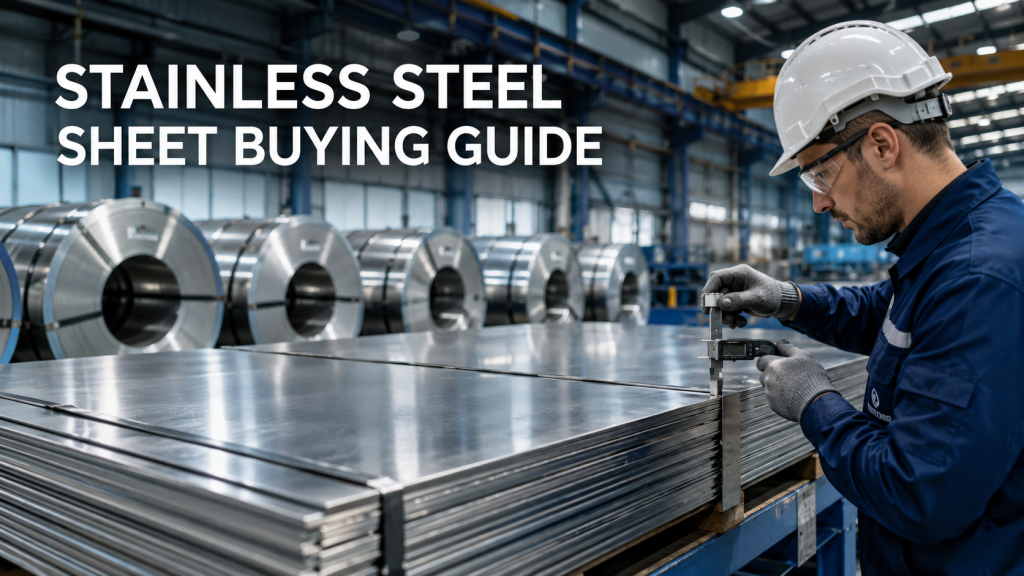
Buying stainless steel sheet involves much more than comparing a grade name and price per ton.
A technically complete purchase specification should define the operating environment, alloy grade,
product standard, dimensions, surface finish, tolerances, processing requirements, inspection documents,
packaging and delivery terms.
This stainless steel sheet buying guide helps international buyers, engineers, fabricators and sourcing
managers prepare accurate RFQs, compare quotations on a consistent basis and reduce the risk of quality
disputes after production.
Buyers can also review Jude Steel’s
stainless steel sheet and plate products
or submit a project through the
Jude Steel contact page.
Quick Answer: What Should Be Included When Buying Stainless Steel Sheet?
A professional stainless steel sheet RFQ should normally include the following information:
- Material grade and equivalent designation
- Applicable ASTM, EN, JIS or other material standard
- Cold-rolled or hot-rolled product
- Thickness, width and length
- Dimensional and flatness tolerances
- Surface finish and protected side
- Protective film requirements
- Edge condition and grain direction
- Quantity in sheets, kilograms or metric tons
- Cutting, slitting, brushing, polishing or fabrication requirements
- Mill test certificate and inspection documents
- Export packaging, destination port and Incoterm
A complete specification helps suppliers calculate the correct material yield, processing cost,
production time and packaging method. It also makes different quotations easier to compare.
1. Define the Service Environment Before Selecting a Grade
Stainless steel is a family of iron-based corrosion-resistant alloys rather than one universal material.
Different grades provide different levels of corrosion resistance, strength, formability, weldability,
heat resistance and cost performance.
Before selecting a grade, identify the following operating conditions:
- Location: indoor, outdoor, coastal, marine or industrial atmosphere
- Corrosive media: chlorides, acids, alkalis, cleaning chemicals or process fluids
- Temperature: ambient, cryogenic, cyclic or continuously elevated
- Hygiene: food processing, pharmaceutical or sanitary applications
- Mechanical loading: static, impact, vibration, abrasion or fatigue
- Fabrication: welding, bending, deep drawing, machining or polishing
- Appearance: mill finish, brushed, mirror-polished or decorative surface
- Design life: replaceable component or long-life industrial equipment
A lower-priced grade may become more expensive over the project lifecycle if it causes corrosion,
premature replacement, difficult fabrication or excessive maintenance.
For a broader alloy selection process, read
How to Choose Stainless Steel
.
2. Choose Between Stainless Steel Sheet, Plate and Cut-to-Length Material
The terms sheet and plate are sometimes used interchangeably in commercial communication,
but the production route, thickness range, surface condition and processing requirements can differ.
| Product Form | General Characteristics | Typical Applications |
|---|---|---|
| Cold-rolled stainless steel sheet | Smooth surface, relatively thin gauge and good dimensional control | Appliances, panels, cabinets, food equipment and decorative fabrication |
| Hot-rolled stainless steel plate | Thicker product for structural and heavy industrial fabrication | Tanks, pressure equipment, supports and process machinery |
| Cut-to-length sheet | Produced from coil and cut to a specified length | High-volume manufacturing and standardized blanks |
| Custom fabricated sheet metal | Cut, bent, punched, welded or machined according to drawings | OEM components, enclosures and finished equipment parts |
Custom cutting and fabrication options are available through Jude Steel’s
stainless steel sheet metal service
.
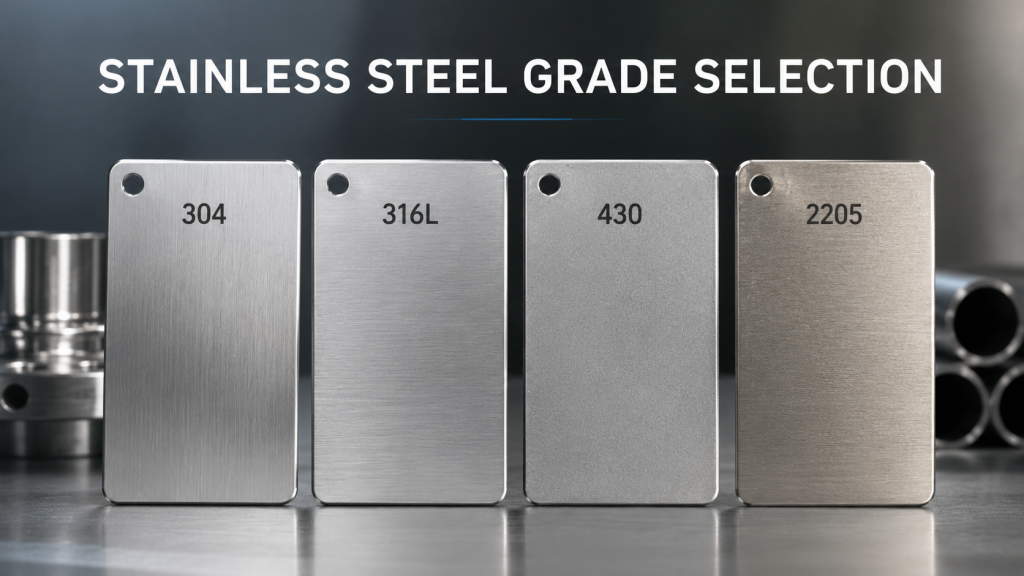
3. Select the Correct Stainless Steel Grade
Grade selection should be based on the application environment, required design life,
fabrication process and total lifecycle cost.
| Grade | Main Advantages | Typical Applications | Selection Consideration |
|---|---|---|---|
| 201 | Cost-conscious austenitic option with useful strength and formability | Indoor decoration, furniture and mildly corrosive service | Lower corrosion margin than 304 in demanding environments |
| 304 / 304L | Balanced corrosion resistance, availability and fabrication performance | Food equipment, tanks, architecture and general manufacturing | May not be sufficient for sustained chloride or marine exposure |
| 316 / 316L | Improved resistance to localized corrosion in many chloride-containing environments | Coastal projects, chemical equipment, pharmaceuticals and marine-adjacent service | Higher alloy cost than 304 |
| 321 | Stabilized austenitic grade for selected elevated-temperature applications | Exhaust systems, welded equipment and high-temperature components | Not automatically superior to 316L for chloride corrosion |
| 310S | High chromium and nickel content for elevated-temperature oxidation resistance | Furnaces, heat-treatment equipment and thermal processing | Service atmosphere and thermal cycling must be considered |
| 430 | Nickel-lean ferritic grade with useful formability and attractive cost | Appliances, interior decoration and mildly corrosive applications | Lower corrosion and welding performance than common austenitic grades |
| 2205 | Higher strength and improved chloride stress-corrosion resistance | Water treatment, chemical processing and pulp-and-paper equipment | Welding and heat input require appropriate duplex procedures |
Buyers considering ferritic grades can also review Jude Steel’s
430 stainless steel information
.
4. Specify Thickness, Width and Length Correctly
Dimensions should be stated using one unit system and in a fixed sequence:
Thickness × Width × Length
Example:
1.50 × 1219 × 2438 mm
A technically complete dimensional specification should answer these questions:
- Is the thickness nominal, minimum or restricted tolerance?
- Is the sheet supplied in a standard size or custom-cut size?
- Is the width measured before or after edge trimming?
- Is length tolerance important for automated production?
- Is special flatness required?
- Is squareness or diagonal tolerance specified?
- Does the part require a specific rolling or polishing direction?
Avoid Ordering Only by Gauge Number
Gauge terminology can vary between markets and material systems.
International buyers should state the actual thickness in millimetres or inches,
together with the applicable tolerance standard.
Specify Quantity Clearly
Quantity may be expressed in sheets, kilograms, metric tons or square metres.
For cut-to-size orders, it is useful to state both the number of sheets and the estimated total weight.
5. Choose the Correct Stainless Steel Surface Finish
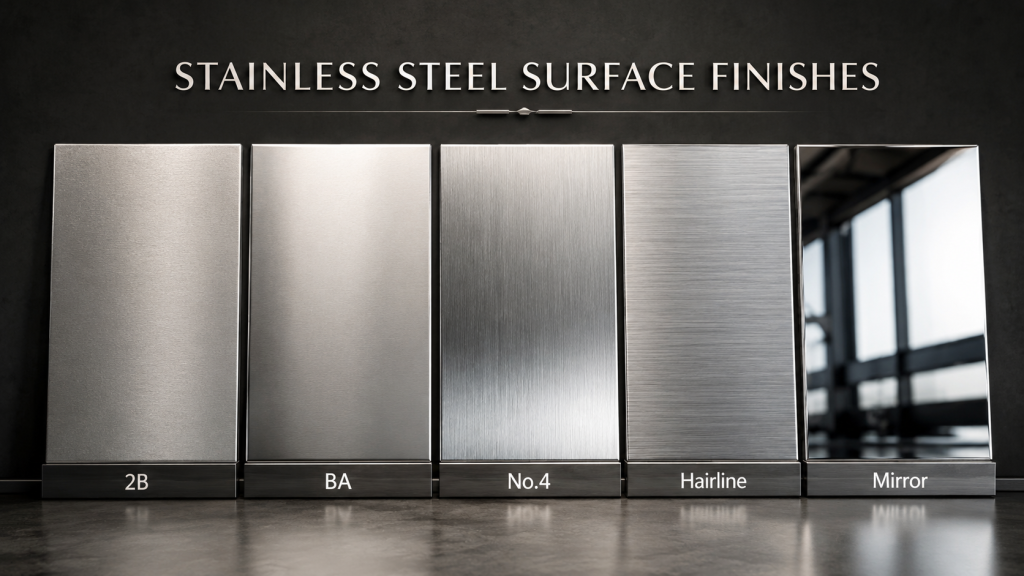
Surface finish affects appearance, cleanability, reflectivity, friction,
corrosion behaviour, fabrication performance and cost.
| Finish | Appearance | Typical Uses | Important RFQ Detail |
|---|---|---|---|
| N°1 | Hot-rolled, heat-treated and descaled | Industrial plate and heavy fabrication | Confirm acceptable surface condition |
| 2B | Smooth cold-rolled mill finish with low reflectivity | Tanks, equipment and general fabrication | State whether protective film is required |
| BA | Bright annealed and relatively reflective | Appliances and decorative equipment | Approve a sample for appearance-critical orders |
| N°4 | Directional brushed finish | Kitchens, elevators and architectural interiors | Specify grain direction and protected side |
| Hairline | Long, continuous directional texture | Elevators, panels and premium interiors | Use an approved sample or master panel |
| No.8 / Mirror | Highly reflective polished surface | Decorative architecture and premium products | Define acceptable polishing marks and reflectivity |
Decorative sheet orders should identify the visible side, grain direction,
protective film type and whether all sheets must come from the same processing batch.
6. Define the Applicable Standards and Tolerances
A purchase order should identify both the material specification and the applicable dimensional requirements.
Common international references may include ASTM A240/A240M, ASTM A480/A480M,
the EN 10088 series or corresponding JIS standards.
Important tolerance items include:
- Thickness variation
- Width and length tolerance
- Flatness
- Camber
- Squareness
- Edge condition
- Surface quality
- Residual coil-set in cut-to-length sheet
The permitted tolerance depends on the standard, thickness range, width,
product form and purchase agreement. Buyers requiring tighter performance
should state the agreed values directly in the RFQ and purchase order.
7. Define Processing Requirements Before Quotation
Processing affects yield, dimensional accuracy, edge quality, surface protection,
production time and final price.
Common processing options include:
- Cut-to-length processing
- Slitting
- Shearing
- Découpe au laser
- Plasma or waterjet cutting
- Brushing and polishing
- Protective-film application
- Bending and roll forming
- Punching and drilling
- Welding and assembly
- Deburring and edge rounding
Drawings should identify dimensions, tolerances, datum points, bend radii,
hole positions, visible surfaces and grain direction.
Custom processing enquiries can be submitted through the
Jude Steel enquiry form.
8. Inspection, Traceability and Documentation
Inspection requirements should be agreed before production begins.
Additional testing requested after completion may cause delays or require replacement material.

Common Documents
- Mill test certificate
- Heat-number traceability
- Chemical composition results
- Mechanical test results
- Dimensional inspection report
- Surface inspection photographs
- PMI report when specified
- Third-party inspection report when required
- Packing list and commercial invoice
Recommended Pre-Shipment Inspection
- Verify the grade, heat number and certificate.
- Measure thickness at several positions.
- Check width, length, diagonal and flatness.
- Inspect the surface under suitable lighting.
- Verify grain direction and protective film.
- Confirm sheet count and package weight.
- Photograph the final packaging and loading process.
Buyers can review additional quality information in the
Jude Steel inspection report section.
9. Export Packaging for Stainless Steel Sheets
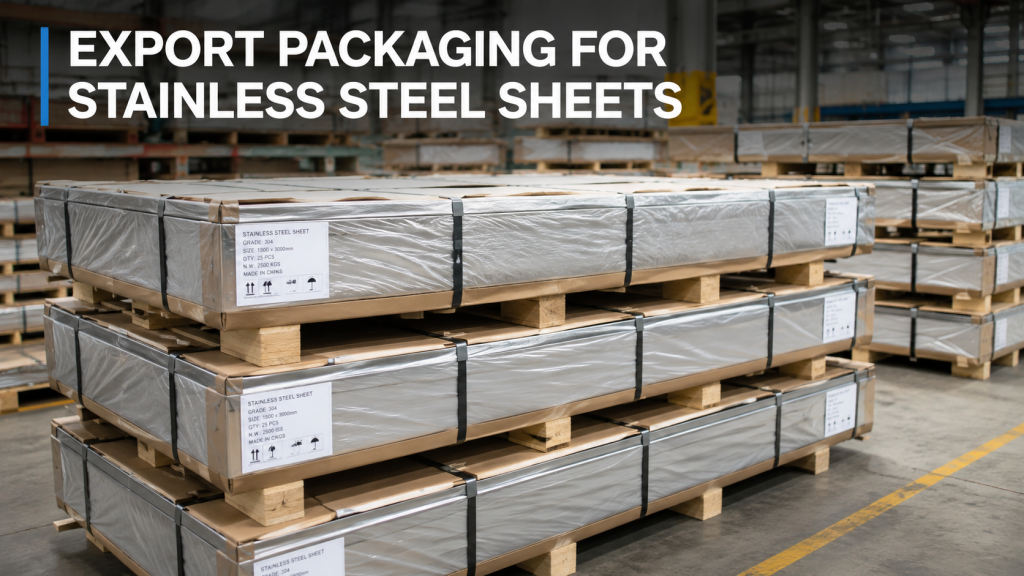
Correct material can still arrive with unacceptable scratches, dents, moisture damage
or edge deformation when packaging is inadequate.
Packaging Requirements to Confirm
- Surface film or interleaving paper
- Waterproof wrapping
- Edge and corner protection
- Wooden pallet, skid or wooden case
- Steel straps with strap protectors
- Maximum package weight
- Forklift access
- Heat-number and purchase-order labels
- Container blocking and bracing
BA, No.4, hairline and mirror sheets generally require more cosmetic protection
than industrial hot-rolled plate.
10. Stainless Steel Sheet RFQ Checklist
Use the following structure when requesting a quotation:
Product: Stainless steel sheet or plate
Grade: 304L / UNS S30403 / EN 1.4307
Standard: State the required material and dimensional standards
Production route: Cold rolled or hot rolled
Dimensions: Thickness × width × length
Quantity: Number of sheets and estimated total weight
Surface: 2B, BA, No.4, hairline, mirror or other finish
Protective film: State the required type and protected side
Edge: Mill edge, slit edge or trimmed edge
Tolerances: Standard or project-specific requirements
Processing: Cutting, polishing, bending or fabrication
Inspection: Dimensional, visual, PMI or third-party inspection
Certificate: State the required inspection certificate
Packaging: Export seaworthy packaging
Destination: Port and country
Incoterm: FOB, CFR, CIF or other agreed term
Delivery date: Required production or arrival date
11. How to Evaluate a Stainless Steel Sheet Supplier
A reliable supplier should provide more than a competitive unit price.
Evaluate whether the supplier can control material identity, processing,
surface condition, dimensions, documentation, packaging and delivery.
| Evaluation Area | Questions to Ask |
|---|---|
| Material source | Is the producing mill identified and is heat-number traceability available? |
| Technical review | Will unclear specifications be identified before quotation? |
| Processing | Are cutting, slitting and polishing controlled by the supplier? |
| Inspection | Which instruments and acceptance criteria are used? |
| Surface control | Can finish, grain direction and protective film be controlled consistently? |
| Documentation | Can certificates and inspection records be supplied before shipment? |
| Packaging | Is packaging designed for the finish and transportation route? |
| Quality claims | Is there a documented complaint and corrective-action process? |
Jude Steel supplies
stainless steel sheet,
stainless steel coil
and custom-processed products for international industrial buyers.
12. Common Stainless Steel Sheet Buying Mistakes
- Ordering by grade without identifying the standard
- Using gauge numbers without actual thickness
- Assuming all 2B or No.4 surfaces look identical
- Failing to define the visible side and grain direction
- Ignoring flatness, edge and dimensional tolerances
- Requesting certificates after production
- Comparing quotations with different material origins or processing scopes
- Selecting 304 for every environment without checking chloride exposure
- Choosing the lowest price without considering packaging risk
- Failing to approve samples for decorative projects
Final Recommendation
A reliable stainless steel sheet order begins with a technically complete specification.
Define the operating environment, select the correct grade, state the applicable standards,
specify dimensions and tolerances, approve the finish and agree on processing,
inspection and packaging before production.
Send Jude Steel your grade, thickness, width, length, finish, quantity,
processing requirements and destination port through the
online enquiry form.
Frequently Asked Questions
What is the most commonly purchased stainless steel sheet grade?
304 and 304L are widely used because they provide a practical balance of corrosion resistance,
formability, weldability and availability. The correct grade still depends on the application.
When should 316L be selected instead of 304L?
316L is often considered for coastal environments, chloride exposure,
chemical cleaning and more aggressive processing conditions.
Is delivered thickness always exactly equal to nominal thickness?
Delivered thickness can vary within the applicable standard or purchase agreement.
Restricted or one-sided tolerances should be stated before ordering.
What is the difference between 2B and No.4 finish?
2B is a smooth cold-rolled mill finish. No.4 is a directional brushed surface
produced through abrasive finishing.
Should a mill test certificate be requested?
Industrial buyers frequently request a mill test certificate for traceability
and reported chemical and mechanical properties.
Can stainless steel sheets be supplied with protective film?
Yes. Protective film is commonly applied to decorative or polished surfaces.
The film type, protected side and laser-cutting suitability should be specified.
How can scratches be prevented during shipping?
Use suitable surface protection, waterproof wrapping, edge protectors,
rigid pallets or cases, correct strapping and container bracing.
What information is needed for an accurate quotation?
Provide the grade, standard, dimensions, quantity, finish, tolerances,
processing, inspection requirements, packaging, destination and Incoterm.
