
304 vs 304L vs 316L Stainless Steel for Filling-Line Drip Trays, Splash Guards and Cut Blanks
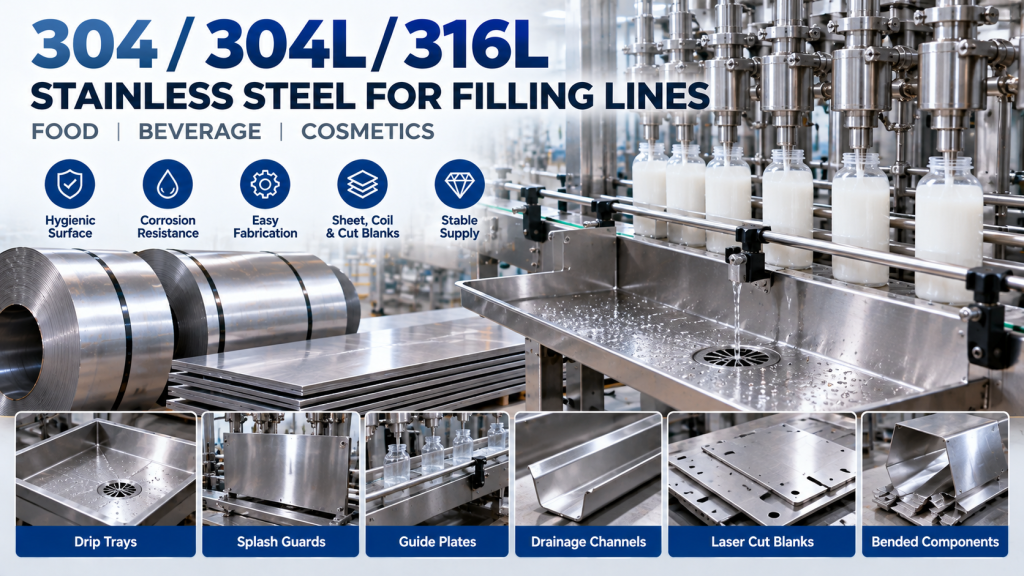 When a beverage or cosmetics filling line is assembled, much of the stainless steel purchase is not for the main product tank. It is for smaller fabricated components surrounding the filling stations: drip trays beneath nozzles, splash guards beside containers, liquid-collection gutters, removable guide plates and washdown access panels.
These parts may look simple in a finished machine, but they create different purchasing requirements. One tray may need a carefully defined fold and outlet position. A guide plate may require burr-controlled edges. A splash guard may need an approved visible finish, while a continuously wetted collection component must be evaluated for its actual liquid and cleaning exposure.
Types 304, 304L and 316L stainless steel can be considered for these applications, depending on the component design and operating conditions. None is an automatic choice for every food, beverage or cosmetics filling system.
This guide focuses on the sheet, coil and cut blanks that equipment manufacturers purchase before bending, welding, polishing and final assembly.
1. Which Filling-Line Components Create Demand for Stainless Steel Sheet?
Liquid filling systems can be used for milk-based drinks, juice, other beverages, creams, lotions, shampoos and liquid personal-care formulations. The actual equipment arrangement depends on the product, container type and filling process.
Several components may be fabricated from stainless steel flat products, subject to the equipment designer’s approval.
| Component | Potential raw material | Fabrication operation | Main purchasing requirement |
|---|---|---|---|
| Under-nozzle drip tray | Approved stainless steel sheet or cut blank | Cutting, bending, joining and drain fitting | Fluid exposure, developed blank, outlet position and finish |
| Filling-station splash guard | Stainless sheet | Laser cutting, edge finishing and forming | Grade, drawing, cleanability and exposed surface |
| Liquid-collection gutter | Sheet or formed channel blank | Bending, joining and outlet preparation | Drainage geometry, cleaning chemical and seam details |
| Container guide plate | Sheet or cut plate | Profile cutting and edge finishing | Flatness, edge safety, contact and wear conditions |
| Removable inspection cover | Stainless sheet | Cutting, bending and fastening | Hole positions, finish, cleaning access and panel rigidity |
| Filling-head mounting panel | Design-approved sheet or plate | Cutting, drilling and assembly | Loads, alignment, thickness and drawing tolerances |
| Reject chute or transfer panel | Stainless sheet or cut blank | Cutting and forming | Product contact, wear, edge condition and geometry |
These applications do not mean that every filling line uses the same material or that the raw-material supplier delivers finished drip trays, guards or assembled machines. The quotation should identify whether the scope is mill-size steel, flat blanks or an explicitly agreed processing service.
For flat-material sourcing, see JUDE stainless steel sheet and plate, stainless steel coil and stainless steel strip.
2. 304 vs 304L vs 316L: Select by the Actual Exposure
A filling-line drip tray is not exposed to the same conditions as a dry exterior panel. It may collect product drips, rinse water and cleaning residues at different stages of operation.
The corrosion decision must therefore consider more than the name of the finished product. A line filling cosmetic lotion, for example, may handle a mild formulation during production but experience a different exposure during cleaning or sanitization.
| Grade | Common identifiers | Why it may be evaluated | Important limitation |
|---|---|---|---|
| 304 | UNS S30400; EN 1.4301; SUS304 | General formed sheet-metal components in compatible environments | Cleaning chemistry, welding history and localized corrosion must be assessed |
| 304L | UNS S30403; commonly EN 1.4307; SUS304L | Low-carbon option for welded fabricated components | Low carbon is not a general improvement in chloride-pitting resistance |
| 316L | UNS S31603; EN 1.4404; SUS316L | Molybdenum-bearing option for greater localized-corrosion resistance in many relevant environments | Not immune to pitting, crevice corrosion or chloride stress-corrosion cracking |
304 for Compatible General-Purpose Components
Type 304 may be considered for covers, splash panels and certain collection trays when the actual corrosion and fabrication requirements are satisfied.
It is not automatically unsuitable simply because the component is welded. The responsible fabricator must review welding, sensitization risk, subsequent environmental exposure and any required surface treatment.
For grade background, see JUDE’s 304 stainless steel information.
304L for Welded Collection Components
304L is a lower-carbon version of the 304 family. Its composition reduces susceptibility to sensitization-related intergranular corrosion after certain welding thermal histories.
This can be relevant where a collection tray is welded from several panels or where formed sheet components have multiple welded joints.
However, if the main concern is chloride-induced pitting, choosing 304L instead of 304 should not be described as a major corrosion upgrade.
316L When the Cleaning Environment Justifies It
316L contains molybdenum, which generally improves resistance to localized corrosion compared with the 304 family in many applicable environments.
For a drip tray that regularly encounters salt-containing product residues, chloride-bearing rinse water or other corrosive exposure, 316L may be worth evaluating.
The actual chemical identity, concentration, temperature, dwell time and cleaning procedure remain essential. Hot chloride solutions, concentrated chemicals and poorly drained crevices can still cause corrosion in 316L.
See JUDE’s 316L stainless steel grade information for further material background.
3. Why a Drip Tray Needs More Than the Correct Steel Grade
A filling-line collection tray has a practical job: collect unintended liquid and allow it to be removed without creating difficult-to-clean areas. Material selection supports this function but does not replace equipment design.
Drainage and Retained Liquid
A poorly positioned outlet or an unintended low point can leave residual liquid after production or washdown. The required slope, outlet position and drainage path should be defined in the approved component drawing.
For buyers ordering flat blanks, the blank dimensions must reflect the final bend lines, developed geometry and necessary fabrication allowances. The finished tray dimensions should not be mistaken for the starting flat pattern.
Corner and Seam Construction
Folded corners, welded seams and joints may become locations where cleaning liquid or product residue remains trapped.
The fabricator should select an approved joint construction and finishing method consistent with the machine’s cleaning and hygienic requirements.
Ordering a 316L sheet cannot correct a design with unacceptable crevices or inaccessible surfaces.
Removability and Maintenance
Some trays and covers must be removed for cleaning, inspection or maintenance. Their drawings should define fastening holes, clearances, edge condition and repeated-handling requirements.
Where a panel is expected to be removed frequently, the material schedule should include its required rigidity and dimensional acceptance criteria.
4. Splash Guards and Product Guide Plates: Different Manufacturing Priorities
Splash guards can reduce unintended liquid movement around selected filling operations. They may be manufactured from formed stainless steel sheet, sometimes combined with transparent shields or other materials according to the equipment design.
For stainless sheet-metal guards, typical procurement concerns include:
- The approved shape and developed blank dimensions.
- Grade, thickness and specified flat-product standard.
- Cut edges, corner radii and burr limits.
- Visible-face condition and protective film requirements.
- Mounting holes, slots and bend positions.
- Expected washdown and chemical exposure.
- Accessibility and cleaning requirements after assembly.
Container guide plates have a different priority: dimensional accuracy and interaction with moving containers. Their edge finish and flatness can be important, but the acceptable requirements must come from the machine drawing.
Stainless steel is not the only possible guide material. Some designs use approved polymers, replaceable wear components or a combination of materials to manage friction, noise and container damage.
The equipment designer should approve the final material instead of relying on the steel supplier to determine conveyor-interface performance.
5. Sheet, Coil or Cut Blanks: Which Supply Format Should an OEM Buy?
For repeat-production filling machines, the choice of purchasing format can affect workshop handling, material utilization and processing responsibility.
Mill-Size Stainless Steel Sheet
Sheet may suit manufacturers that cut and bend their own components. Buyers should confirm thickness, width, length, supplied surface finish, tolerances and packaging.
If parts have an important visible face, specify which surface must be protected during storage, cutting and handling.
Bobine d'acier inoxydable
Coil can be considered for repeat production where the OEM has suitable decoiling, leveling and blanking arrangements.
Coil purchasing should identify inside diameter, maximum outside diameter, coil weight, width, thickness and the required material condition.
For smaller repeat components, a specified slit strip may also be appropriate. Review JUDE’s stainless steel strip processing service for available options.
Laser-Cut or Sheared Blanks
Pre-cut blanks can reduce in-house cutting work when the supplier can meet the required geometry and tolerances. This is particularly useful for drip trays with drain openings, inspection panels with repeated hole patterns and guards with irregular profiles.
Send a drawing for feasibility review rather than assuming that every profile can be supplied to the same tolerance.
JUDE publishes laser cutting and custom shearing services. Processing scope, edge condition and dimensional acceptance should be confirmed in the quotation.
6. Forming Direction, Surface Protection and Finished-Part Quality
For repeated sheet-metal components, a successful quotation must address more than the nominal grade and thickness.
Approved Flat Patterns
A folded tray normally requires a blank developed from the approved bend geometry. The starting dimensions depend on the bending process, selected tooling and material condition.
For every cut-blank order, identify the drawing revision, tolerances and whether the supplier is responsible only for cutting or also for forming.
Rolling Direction and Surface Grain
When the component includes demanding bends, the relevant rolling-direction restrictions should be identified by the fabricator.
For brushed decorative surfaces, also identify the intended visual grain direction. These two considerations should not be confused, especially when a nesting layout permits component rotation.
Protective Film and Handling
For visible guards and covers, a protective film may be requested to reduce handling marks during processing and shipping. The film type, protected side and removal conditions should be agreed before ordering.
Protective film does not substitute for a defined metal surface acceptance requirement, and its suitability must be checked for the intended cutting or forming operation.
Where forming is requested, JUDE provides information about its stainless steel bending capabilities. Final component geometry and tolerance remain subject to drawing review and formal confirmation.
7. Is 2B Stainless Steel Automatically Suitable for Hygienic Filling Equipment?
No. A 2B finish is a standard cold-rolled mill surface condition. It is not, by itself, a hygienic-equipment certification.
A filling system’s cleanability depends on more than the as-received sheet finish. Welds, cut edges, contact surfaces, joint details, drainage, accessibility and post-fabrication cleaning can all affect the finished component.
Where the project imposes surface-roughness requirements, the drawing should define the relevant parameter, measurement method and acceptance criteria. A generic statement such as “sanitary mirror finish” is not sufficient.
Some applications may require an additional finishing process after forming and welding. Others may accept a properly specified mill finish for a non-product-contact external panel.
See the worldstainless overview of stainless steel surface treatments and JUDE stainless steel polishing information.
What About Food Equipment Hygienic Standards?
Where applicable, hygienic equipment requirements extend beyond material grade and surface finish. They can include joint construction, cleanability, drainability, product-contact boundaries and cleaning accessibility.
The applicable hygienic standard must be identified by the equipment designer and project specification.
For context, 3-A Sanitary Standards’ 2026 general requirements update explains the importance of hygienic design and fabrication for food and beverage processing equipment.
A sheet conforming to ASTM A240 does not automatically make the completed filling machine compliant with 3-A or any other hygienic equipment standard.
8. ASTM, EN and JIS Specifications for 304, 304L and 316L Flat Products
The material grade and purchased product form must both be identified in the purchase order.
For stainless steel sheet, plate and strip, ASTM A240/A240M is a relevant product specification. ASTM A480/A480M provides general requirements for designated stainless flat products.
For appropriate European stainless steel flat products, EN 10088-2 may be relevant. For Japanese hot-rolled and cold-rolled stainless steel flat products, JIS G 4304 and JIS G 4305 may apply, respectively.
These standards have different technical requirements. Similar alloy designations do not establish complete equivalence between ASTM, EN and JIS supply.
Official references:
- ASTM A240/A240M – Stainless Steel Plate, Sheet and Strip
- ASTM A480/A480M – General Flat-Product Requirements
Can 304 and 304L Be Dual Certified?
Some stainless steel flat products can be certified to both 304 and 304L when the actual material meets the applicable requirements for both grades.
This must be supported by the required material test certificate and product specification. A supplier should not describe material as dual certified merely because its carbon content is within the 304L limit.
Where the customer requires a specific grade or project-approved substitute, the purchase order should state it explicitly.
9. Incoming Inspection for OEM Sheet-Metal Production
Incoming inspection should follow the purchase contract and production quality plan. Relevant checks may include:
- Correct material grade, specification and required edition.
- Heat or batch identity and certificate documentation where specified.
- Sheet or coil thickness and dimensions.
- Flatness and surface condition relevant to the component.
- Cut-edge quality, burr control and blank dimensions.
- Visible-face protection and handling damage.
- Specified processing and supplementary inspection records.
Dimensional tolerance for an as-supplied sheet is not automatically the same as the tolerance for a laser-cut blank or a finished bent component.
For repeat OEM orders, separating the acceptance criteria for raw sheet, processed blank and fabricated part can prevent disputes between the steel supplier and equipment fabricator.
10. Example Material Schedule for a Filling-Line OEM
The following schedule is an illustrative RFQ structure, not the bill of materials of a named customer or factory. The actual grades, dimensions and quantities must come from approved drawings.
| Item | Finished component | Material to quote | Information to provide |
|---|---|---|---|
| 01 | Filling-head drip tray | Approved 304 / 304L / 316L sheet or blank | Grade, standard, thickness, flat pattern, finish, quantity |
| 02 | Splash guard panels | Specified stainless steel sheet | Drawing, protective face, hole locations, bends |
| 03 | Drainage channel | Formable stainless sheet | Developed dimensions, seam requirements, finish |
| 04 | Container guide plates | Cut sheet or plate blanks | Profile, flatness, edge requirement, quantity |
| 05 | Inspection covers | Approved stainless steel sheet | Thickness, surface, fastening geometry, quantity |
| 06 | Mounting and support panels | Design-approved sheet or plate | Load requirement, grade, thickness, drawing |
For large repeat orders, the buyer may request separate offers for mill-size sheet, slit coil or cut blanks. The choice should account for the OEM’s production equipment, material utilization, surface protection and agreed acceptance criteria.
11. What Should a Filling-Equipment Manufacturer Include in an RFQ?
For a useful quotation, organize the material requirement by component rather than requesting only “food-grade stainless steel.”
- Equipment: Beverage filler, dairy filling line, cosmetics filling machine or another specified application.
- Component: Drip tray, splash guard, liquid gutter, contact plate or inspection cover.
- Grade: Exact approved 304, 304L, 316L or another material designation.
- Standard: Applicable ASTM, EN, JIS or customer specification.
- Product form: Sheet, coil, strip or cut blank.
- Dimensions: Thickness, width, length, flat pattern and required tolerances.
- Surface: 2B, BA, brushed or another specified condition, plus special acceptance requirements.
- Fabrication: Cutting, bending, holes, edge preparation or other required processing.
- Documentation: Material test certificate and specified additional inspection.
- Quantity: Prototype, production batch and expected repeat-order requirements.
- Delivery: Destination, requested Incoterms, packaging and required schedule.
Example Email for an OEM Material Inquiry
Subject: RFQ – 304 / 304L / 316L Stainless Steel for Filling-Line Sheet Metal Parts
We manufacture food, beverage and cosmetics filling equipment and are sourcing stainless steel sheet and drawing-based cut blanks.
Attached are the component BOM and approved drawings for drip trays, splash guards, drainage panels and machine covers.
Please quote the specified grades, sheet dimensions, surface finishes, processing requirements and quantities. Confirm material certification, achievable cutting tolerances, protective packing, lead time and commercial delivery terms.
Please identify any proposed material substitution or deviation from the drawings before issuing the final quotation.
Frequently Asked Questions
Is 316L always required for filling-machine drip trays?
No. 304 or 304L may be suitable in compatible service. 316L may offer an advantage where the actual corrosion exposure justifies greater localized-corrosion resistance. Material selection must reflect product residues, rinse water, cleaning chemicals and temperature.
Can 304 be used for a welded splash guard?
Potentially. Welding does not automatically prohibit 304. The fabricator should evaluate the welding procedure, sensitization risk, surface treatment and service exposure. 304L may be considered where its lower-carbon requirement is relevant.
What is the difference between a drip tray and a product-contact tank?
A drip tray may collect accidental spillage, rinse water or other liquids, while a tank forms part of the intended process containment. Both may require suitable materials and cleanability, but the applicable design and regulatory requirements depend on their function and exposure.
Can JUDE supply stainless steel laser-cut drip-tray blanks?
JUDE publishes stainless steel laser-cutting services. Send the approved flat-pattern drawing, required grade, thickness, tolerance, surface condition and quantity for feasibility review. Bending, welding and finished-tray assembly should be quoted separately if required.
Is a 2B stainless steel finish sufficient for a hygienic filling line?
Not automatically. A 2B finish is a mill surface condition. The completed component may require additional surface finishing, cleanable joints, edge treatment or other project-defined acceptance criteria.
Can 304 and 304L sheet be ordered with dual certification?
Yes, where the actual material complies with both applicable designations and the mill documentation supports dual certification. The buyer must specify any dual-certification requirement in the purchase order rather than assume it is included.
Should a container guide plate use polished stainless steel?
That depends on the contact conditions and approved design. Surface smoothness, wear, friction, container damage and cleaning needs should be evaluated. Polishing is not an automatic solution to every guide-plate performance issue.
Can the same stainless steel sheet be used for all parts of a filling line?
Not necessarily. A wet drip tray, a dry outer panel and a structural mounting plate may have different corrosion, strength, finish and tolerance requirements. Material consolidation should follow engineering approval.
What should be included when requesting a pre-cut stainless steel blank?
Provide the material standard, grade, sheet thickness, flat-pattern drawing, hole and slot details, dimensional tolerances, quantity, edge condition, surface requirement and any required certificate.
Request Stainless Steel Sheet and Cut Blanks from JUDE
JUDE Steel supplies stainless steel sheet, coil and strip for industrial manufacturing and publishes a range of cutting, shearing, bending and surface-processing services.
For filling-machine production, send your approved BOM or drawings for the stainless steel flat products and blanks used in drip trays, splash guards, drainage channels, machine covers and guide plates.
For a quotation, include:
- 304, 304L, 316L or the approved material grade.
- ASTM, EN, JIS or the project-specific product standard.
- Thickness, width, length and quantity.
- Drawing-based cutting and bending requirements.
- 2B, BA, brushed or other specified surface finish.
- Material certificate and inspection requirements.
- Destination, delivery schedule and commercial terms.
Request a quotation: Contact JUDE Steel.
Email your BOM and drawings: support@jiscojude.com.
Specific material availability, processing scope, quality documentation, tolerances, lead time and export delivery feasibility must be confirmed in JUDE’s formal quotation.
Technical note: This article provides preliminary stainless steel raw-material purchasing guidance. It does not establish food-contact approval, hygienic equipment certification, material compatibility with a particular formulation or the performance of a completed filling machine. Final material and fabrication requirements must follow the approved equipment specification.
