
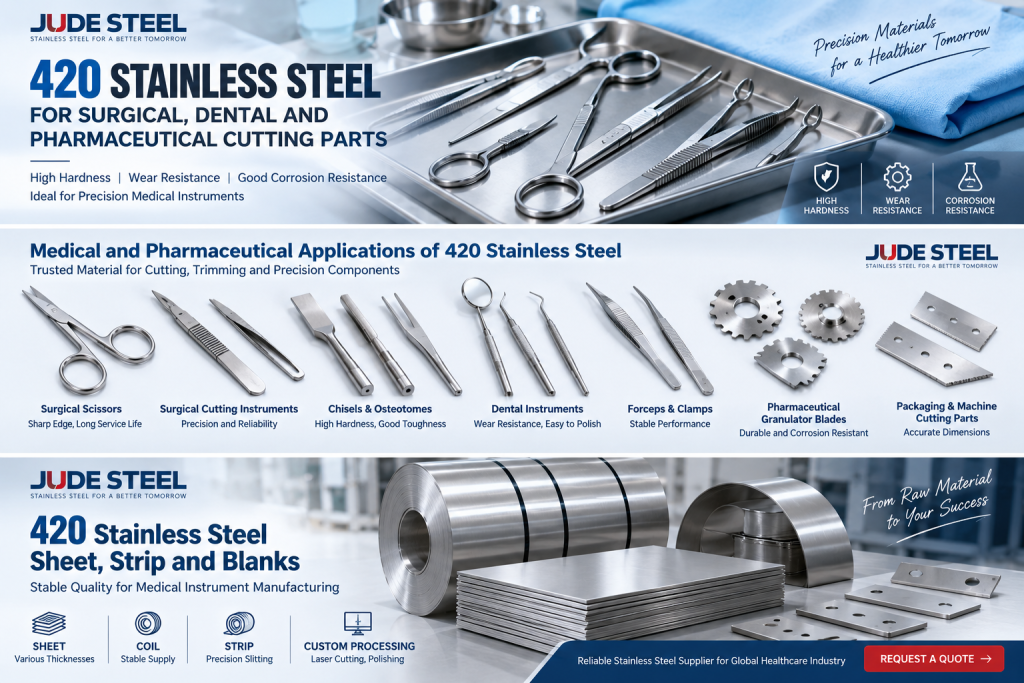
Which Surgical, Dental and Pharmaceutical Parts Use 420 Stainless Steel?
420 stainless steel is widely associated with medical instruments, but the grade should not be described simply as “medical-grade stainless steel.”
A surgical scissor blade, a dental cutting instrument and a pharmaceutical storage tank may all be used in regulated industries, but they require fundamentally different material properties.
The main advantage of the 420 martensitic stainless steel family is its ability to develop high hardness and wear resistance through controlled heat treatment while retaining useful corrosion resistance and polishability.
This makes selected 420 variants particularly relevant to surgical cutting instruments, scissors, dental tools and pharmaceutical-machine cutting or wear components.
It does not automatically make Type 420 suitable for implants, pharmaceutical process vessels or sanitary piping.
This guide connects:
finished instrument → 420 variant → raw-material form → heat treatment → hardness → surface condition → inspection → RFQ.
Quick Answer: Where Does 420 Stainless Steel Fit in Medical Manufacturing?
Selected 420-family martensitic stainless steels may be evaluated for products that require hardness, wear resistance, cutting-edge retention or repeated sharpening.
Possible applications include:
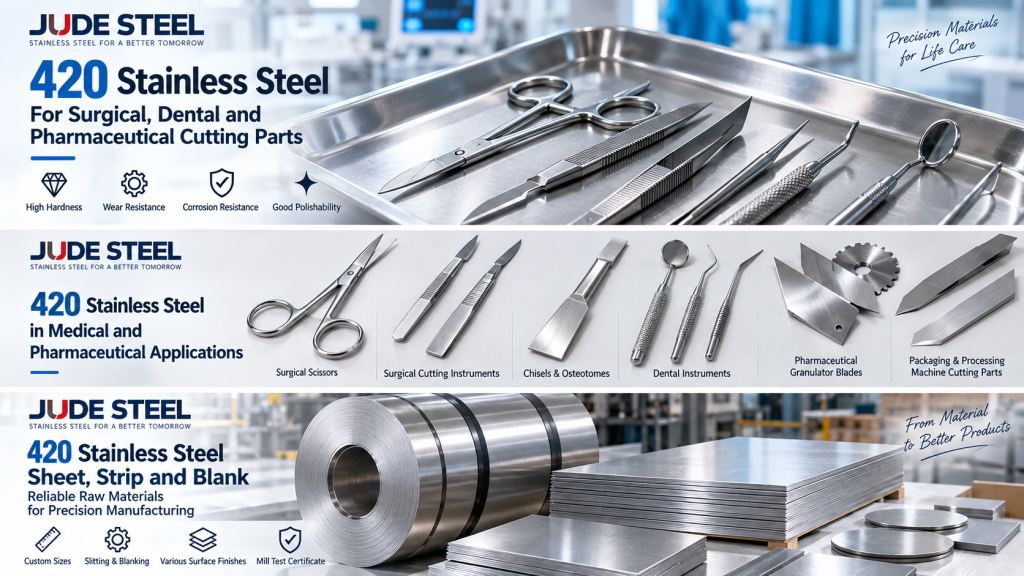
- surgical scissors
- selected surgical cutting blades
- chisels
- osteotomes
- selected dental cutting tools
- selected forceps and clamp components
- instrument tips and wear components
- pharmaceutical granulator blades
- cutter knives
- scraper blades
- packaging-machine cutting components
- selected pharmaceutical-machine wear parts
The grade should not be selected from the words “medical,” “surgical” or “pharmaceutical” alone.
Finished-part requirements such as hardness, toughness, corrosion resistance, sterilization, dimensional stability, surface finish and regulatory documentation must also be defined.
Why Is 420 Different From 304 and 316L?
Type 420 belongs to the martensitic stainless steel family.
Unlike conventional annealed 304 and 316L austenitic stainless steels, 420 can be hardened by austenitizing, quenching and tempering.
This makes it useful where a component requires:
- a cutting edge
- wear resistance
- high hardness
- strength
- polishability
- dimensional control after heat treatment
The trade-off is that conventional 420 generally provides less corrosion resistance and less fabrication tolerance than 316L in demanding wet or chloride-containing environments.
For general martensitic-grade selection, see the
JUDE Steel Martensitic Stainless Steel Application Guide.
Important: “420” Is Not One Universal International Grade
The commercial term “420 stainless steel” can refer to several related martensitic materials.
ASTM Type 420, JIS SUS420J1, JIS SUS420J2, EN 1.4021 and EN 1.4028 occupy similar material families but should not be treated as automatically interchangeable.
| Standard System | Designation | Carbon Range | General Procurement Position |
|---|---|---|---|
| ASTM / UNS | Type 420 / UNS S42000 | 0.15% minimum | Broad ASTM Type 420 chemistry; do not assume a specific JIS carbon band |
| JIS | SUS420J1 | 0.16–0.25% | Lower-carbon 420-family grade with a stronger toughness/formability balance |
| FR | 1.4021 / X20Cr13 | 0.16–0.25% | Commonly compared with SUS420J1 |
| JIS | SUS420J2 | 0.26–0.40% | Higher-carbon 420-family grade for greater achievable hardness |
| FR | 1.4028 / X30Cr13 | 0.26–0.35% | Commonly compared with SUS420J2 |
These comparisons are useful for preliminary material screening.
They should not be used as permission to mix chemistry, mechanical-property or heat-treatment requirements from different standards in one purchase order.
For JUDE Steel’s existing grade information, see:
What Does ASTM F899 Actually Mean?
ASTM F899 is a specification for wrought stainless steels used in the manufacture of surgical instruments.
The standard covers chemical requirements for stainless steels used for surgical instruments and includes martensitic stainless steel among the covered material classes.
However, the words “ASTM F899” should not be interpreted as a complete finished-instrument specification.
Hardness, heat treatment, mechanical performance, surface finish and finished-device requirements must be controlled by the appropriate material specification, purchaser requirements and instrument design.
The U.S. FDA currently recognizes ASTM F899-23 as a consensus standard for medical devices.
This does not mean that every piece of commercially supplied Type 420 stainless steel is automatically “FDA approved.”
For the current FDA recognition information, see:
FDA Recognized Consensus Standard ASTM F899-23.
ISO 7153-1:2016 is another important international reference covering metals commonly used for standard surgical instruments in general surgery, orthopaedics and dentistry.
It is not intended as a universal material approval for surgical implants.
See:
ISO 7153-1:2016 — Surgical Instruments — Materials — Part 1: Metals.
Which Medical and Pharmaceutical Parts Use 420 Stainless Steel?
1. Surgical Scissors
Surgical scissors require a combination of:
- cutting-edge hardness
- wear resistance
- toughness
- polishability
- corrosion resistance during cleaning and sterilization
Higher-carbon 420-family grades such as SUS420J2 or selected EN martensitic grades may be considered where the required edge hardness and instrument specification are compatible with the material.
The correct grade cannot be selected from hardness alone.
A very hard blade can provide strong edge retention but may also become more sensitive to chipping, grinding damage and distortion.
2. Surgical Cutting Instruments
Selected martensitic stainless steels are used in surgical instruments that require a sharpened or wear-resistant working edge.
Potential products include:
- cutting blades
- dissection instruments
- small cutting tips
- selected reusable cutting instruments
The finished instrument should be validated according to its actual device specification rather than approved solely from the raw-material grade.
3. Chisels and Osteotomes
Surgical chisels and osteotomes require hardness at the working edge together with sufficient toughness to resist brittle failure during use.
The material specification should therefore define:
- grade
- heat-treatment route
- target hardness range
- impact or toughness requirement where applicable
- edge geometry
- surface finish
Maximum achievable hardness should not be used as the only purchasing criterion.
4. Dental Cutting and Hand Instruments
ISO 7153-1 includes metals used for dental instruments within its scope for standard surgical instruments.
Selected 420-family materials may be considered for dental tools requiring hardness and wear resistance.
Possible applications include:
- selected scalers
- cutting tips
- dental chisels
- instrument blades
- selected hand-tool components
The instrument manufacturer’s validated material specification should control the final grade and hardness.
5. Selected Forceps and Clamp Components
Not every forceps or clamp requires high-carbon martensitic stainless steel.
Depending on the component design, selected 420-family material may be evaluated for parts requiring:
- wear resistance
- jaw hardness
- spring or gripping performance
- polished surfaces
Other instrument components may use different martensitic, precipitation-hardening or austenitic stainless steel grades.
6. Pharmaceutical Granulator and Cutter Blades
420-family stainless steel may also be considered for selected pharmaceutical-machine cutting parts where hardness and corrosion resistance are required.
Potential applications include:
- granulator knives
- cutter blades
- rotary cutting components
- selected mill or processing blades
The pharmaceutical process itself must be reviewed before approving the alloy.
Product chemistry, cleaning chemicals, contamination control and equipment validation may require another material.
7. Scraper Blades and Wear Parts
Thin hardened martensitic stainless steel strip can be useful for selected scraper and wear components.
Important requirements may include:
- strip thickness
- flatness
- edge condition
- hardness
- straightness
- surface finish
JUDE Steel supplies
stainless steel strip
in 420J1 and 420J2 families with slit, deburred and round-edge processing options.
8. Pharmaceutical Packaging and Processing Machine Cutting Parts
Selected pharmaceutical packaging and process equipment can contain knives, cutters and wear components that benefit from hardenable martensitic stainless steel.
Examples may include:
- film-cutting knives
- packaging cutters
- machine scraper components
- selected wear inserts
These applications should be distinguished from pharmaceutical product-contact tanks, vessels and sanitary piping.
Component-to-Raw-Material Procurement Matrix
| Finished Component | Possible Starting Material | Main Purchasing Requirement |
|---|---|---|
| Surgical scissors | 420J2 / higher-carbon martensitic sheet or strip | Heat treatment, hardness, toughness and polishability |
| Cutting instrument | Sheet / strip / blank | Edge quality, hardness and surface |
| Chisel / osteotome | Bar / plate / forged blank | Hardness-toughness balance and dimensional stability |
| Dental cutting tool | Strip / bar / blank | Instrument specification, hardness and polish |
| Forceps / clamp component | Sheet / strip | Grip, wear, toughness and surface |
| Granulator blade | Sheet / plate | Wear resistance, hardness and corrosion environment |
| Scraper blade | Precision strip | Thickness, edge, flatness and hardness |
| Packaging cutter | Sheet / strip | Edge retention and dimensional tolerance |
420J1 vs 420J2: Which One Should Buyers Choose?
| Selection Factor | SUS420J1 / 1.4021 Family | SUS420J2 / 1.4028 Family |
|---|---|---|
| Carbon | Lower | Higher |
| Achievable hardness | Moderate | Generally higher |
| Toughness / forming balance | Generally more favorable | More dependent on heat treatment and geometry |
| Cutting-edge applications | Application dependent | Often more attractive where greater hardness is required |
| Heat-treatment sensitivity | Important | Especially important |
| Typical buying question | Do I need balanced hardness and toughness? | Do I need greater edge hardness and wear resistance? |
The grade should be chosen from the required finished-instrument performance rather than the assumption that the higher-carbon version is always superior.
Heat Treatment Controls Final Performance
Raw 420 stainless steel does not automatically possess the final hardness required by a surgical or pharmaceutical cutting component.
Martensitic stainless steel normally develops final performance through a controlled sequence such as:
- austenitizing
- quenching
- tempering
- optional sub-zero treatment for selected grades and dimensional requirements
- final grinding and polishing
The heat-treatment procedure should define:
- austenitizing temperature range
- holding time
- quench medium
- tempering temperature
- number of tempering cycles
- sub-zero treatment where required
- target hardness range
- distortion allowance
Do not purchase Type 420 only by grade and assume a final HRC value.
Hardness vs Toughness: Why Maximum HRC Is Not Always Better
Hardness improves wear resistance and edge retention, but excessive hardness can reduce toughness.
A thin surgical edge may fail by chipping even when the hardness test result looks impressive.
Finished-part design should balance:
- edge retention
- chipping resistance
- impact load
- instrument thickness
- grinding geometry
- sterilization exposure
- expected service life
For this reason, the RFQ should state a target hardness range where it is already validated rather than simply requesting “maximum hardness.”
Grinding, Sharpening and Edge Quality
Grinding and sharpening are critical manufacturing steps for martensitic stainless steel instruments.
Excessive grinding heat can create:
- local over-tempering
- loss of hardness
- grinding burns
- residual tensile stress
- cracks
- distortion
A medical cutting component can therefore fail even when the raw steel chemistry and bulk hardness are correct.
Polishing, Passivation and Corrosion Performance
The corrosion performance of a 420-family instrument depends not only on chemistry but also on heat treatment and surface condition.
Smooth, properly finished surfaces generally reduce sites where residues, iron contamination and corrosion can initiate.
Depending on the instrument specification, finishing may include:
- fine grinding
- mechanical polishing
- mirror polishing
- cleaning
- passivation
JUDE Steel provides
stainless steel polishing services
for sheet and flat-product requirements.
Finished medical-device polishing and passivation should still follow the instrument manufacturer’s validated process.
Sterilization and Autoclave Resistance
The fact that a stainless steel is used for surgical instruments does not guarantee unlimited resistance to every sterilization cycle.
Performance can be affected by:
- steam quality
- chloride contamination
- cleaning residues
- surface finish
- passivation condition
- instrument geometry
- heat treatment
- drying practices
Reusable instruments should be validated according to their actual cleaning and sterilization protocol.
Why Is 420 Not the Default for Pharmaceutical Tanks and Piping?
420 stainless steel is selected primarily where hardness and wear resistance are required.
Pharmaceutical tanks, process vessels, high-purity water systems and sanitary pipelines solve a different engineering problem.
Those systems normally prioritize:
- corrosion resistance
- weldability
- surface cleanliness
- sanitary fabrication
- low contamination risk
For these reasons, 316L and other austenitic stainless steels are much more common in pharmaceutical process-contact systems.
420 should therefore be positioned in pharmaceutical manufacturing mainly as a candidate for selected:
- cutting components
- blades
- scrapers
- wear parts
- precision hardened machine components
rather than as the standard material for the entire pharmaceutical process line.
420 vs 1.4034 vs 440C vs 316L
| Material | Main Selection Reason | Typical Medical / Pharma Position |
|---|---|---|
| 420J1 / 1.4021 family | Balanced martensitic hardness, toughness and formability | Selected instruments and mechanical components |
| 420J2 / 1.4028 family | Higher carbon and achievable hardness | Scissors, cutting tools and wear components |
| 1.4034 / higher-carbon martensitic | Greater cutting-edge hardness | Selected professional blades and surgical cutting instruments |
| 440C | Very high hardness and wear resistance | Selected high-wear precision parts; lower toughness must be considered |
| 316L | High corrosion resistance and good weldability | Process-contact equipment, sanitary piping and many non-cutting medical components |
What Should a Medical 420 Stainless Steel RFQ Include?
- Finished product: surgical scissors, dental tool, blade, chisel, scraper or machine component.
- Exact grade: ASTM Type 420 / UNS S42000, SUS420J1, SUS420J2, EN 1.4021, EN 1.4028 or approved customer grade.
- Applicable standard: ASTM, JIS, EN, ASTM F899, ISO 7153-1 or customer specification as applicable.
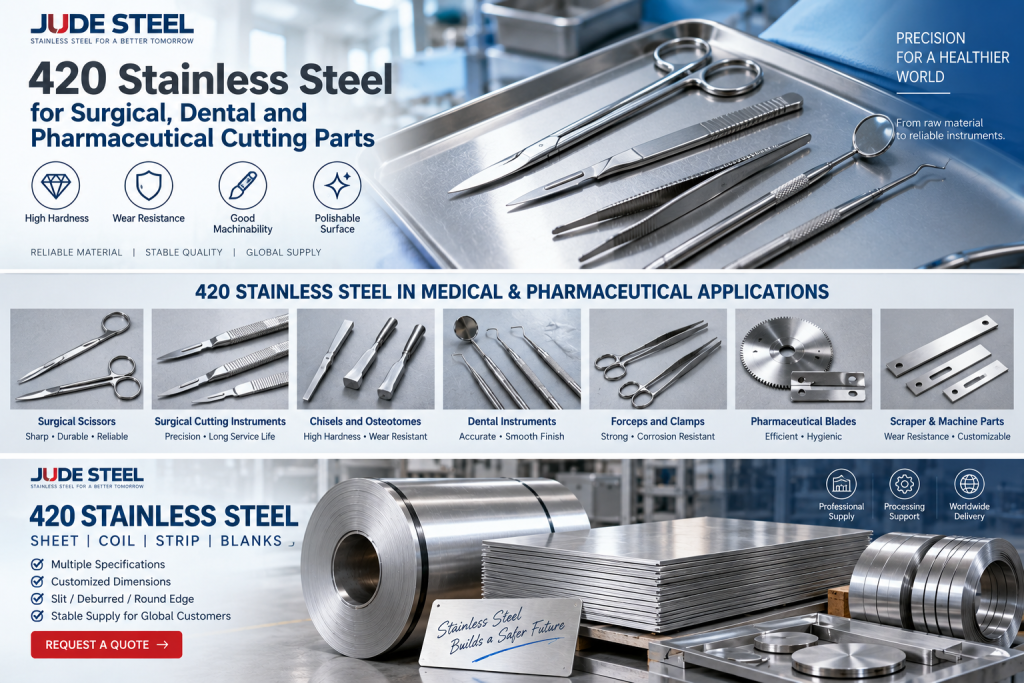
- Product form: sheet, strip, coil, plate or blank.
- Thickness: nominal value and tolerance.
- Width / length: raw or finished dimensions.
- Delivery condition: annealed, softened or another specified condition.
- Heat treatment: buyer or instrument-manufacturer specification.
- Target hardness: validated range where applicable.
- Edge condition: slit, deburred, round or unfinished blank.
- Surface finish: raw, ground, polished or another specified condition.
- Surface roughness: maximum Ra where required.
- Passivation: where specified.
- Grinding allowance: where required.
- Flatness: for precision strip or blanks.
- Medical / pharmaceutical application: state the finished use.
- Sterilization method: where relevant to material review.
- Documentation: MTC, heat traceability and customer-required certificates.
- Quantity: prototype, trial and annual volume.
- Drawing: provide drawings for blanks or cut components.
- Destination: country, port and delivery requirement.
Example SUS420J2 Surgical-Scissor Material RFQ
Application: Reusable Surgical Scissor Blade
Material: SUS420J2
Standard: Customer Material Specification + Applicable JIS Requirement
Product: Cold-Rolled Stainless Steel Strip
Thickness: 1.50 mm
Strip Width: 65 mm
Delivery Condition: Annealed / suitable for blanking and subsequent hardening
Edge: Deburred slit edge
Heat Treatment: Per customer validated procedure
Final Hardness: Customer specification attached
Surface: Suitable for post-hardening grinding and polishing
Certification: Mill Test Certificate and full heat traceability required
Trial Quantity: 2 MT
Annual Demand: 60 MT estimated
Drawing: Blade blank drawing attached
Destination: Tuttlingen, Germany
Incoming Inspection
Depending on the instrument specification, incoming inspection may include:
- grade confirmation
- heat number
- mill test certificate
- carbon and chromium content
- thickness
- width
- flatness
- surface condition
- edge condition
- annealed hardness
- traceability
After heat treatment, the instrument manufacturer may additionally verify:
- final hardness
- microstructure
- distortion
- cracks
- edge quality
- surface condition
- corrosion or sterilization performance where specified
JUDE Steel’s available inspection documentation can be reviewed on the
Inspection Report page.
How JUDE Steel Supports Medical Instrument Manufacturers
JUDE Steel supplies martensitic stainless steel flat products including 420J1 and 420J2 for international instrument, blade and precision-component manufacturers.
Relevant products include:
For blank preparation and customized dimensions, JUDE Steel also provides:
Laser-cutting suitability should be reviewed against the final heat-treatment and edge-quality requirement because thermal cutting can create a local heat-affected zone.
Specific 420-family chemistry, thickness, hardness condition, surface, tolerance, processing and certification should be confirmed for each medical or pharmaceutical project.
Frequently Asked Questions
Is 420 stainless steel a medical-grade stainless steel?
The phrase “medical grade” is too broad to define a material specification. Selected 420-family martensitic stainless steels are used for surgical and dental instruments, but the finished device must still meet the applicable material, performance, cleaning, sterilization and regulatory requirements.
Is 420 stainless steel suitable for surgical implants?
420 should not be presented as a general surgical-implant material. ISO 7153-1 primarily addresses materials for standard surgical instruments rather than serving as a universal implant-material specification.
Should I use 420J1 or 420J2 for surgical scissors?
The answer depends on the required hardness, toughness, blade thickness, edge geometry and heat treatment. 420J2 generally offers greater achievable hardness because of its higher carbon content, but that does not automatically make it the better choice for every scissor design.
What does ASTM F899 mean for surgical instruments?
ASTM F899 specifies chemical requirements for wrought stainless steels used in surgical-instrument manufacturing. It does not by itself establish every finished hardness, heat-treatment, mechanical or device-performance requirement.
Does ASTM F899 mean the steel is FDA approved?
No. The FDA recognizes ASTM F899-23 as a medical-device consensus standard, but this is not equivalent to FDA approval of every piece of steel or every finished surgical instrument made from that material.
Can 420 stainless steel withstand autoclave sterilization?
Selected properly manufactured 420-family instruments can be used in reusable surgical applications, but sterilization performance depends on grade, heat treatment, surface finish, passivation, steam quality, chlorides, cleaning residues and the validated instrument reprocessing procedure.
Why is polishing important for 420 medical instruments?
Polishing improves surface smoothness and can reduce sites that retain contamination or initiate corrosion. Final polishing and passivation should follow the medical-device manufacturer’s validated specification.
Is 420 stainless steel suitable for pharmaceutical tanks?
It is generally not the default choice. Pharmaceutical tanks and sanitary piping normally prioritize corrosion resistance, weldability and hygienic fabrication, making 316L more common. 420 is more relevant to selected blades, cutters and wear components.
What hardness should a 420 surgical blade have?
There is no universal hardness value for every 420 surgical blade. The correct hardness must balance edge retention, toughness, blade geometry and intended use and should come from the validated instrument specification.
What should I send JUDE Steel for a 420 medical-instrument quotation?
Send the instrument drawing, exact grade and standard, product form, thickness, dimensions, delivery condition, target hardness, heat-treatment route, surface requirement, edge requirement, documentation, trial quantity and annual demand.
Request 420 Stainless Steel for Medical and Pharmaceutical Cutting Parts
Manufacturing surgical scissors, dental instruments, pharmaceutical blades or precision hardened components?
Send JUDE Steel your:
Drawing + Exact Grade + Standard + Thickness + Dimensions + Delivery Condition + Quantity + Destination
For hardened instruments and cutting parts, also include:
Target Hardness + Heat Treatment + Edge Requirement + Surface / Ra + Polishing / Passivation Requirement + Annual Demand
Technical note:
This article is intended for preliminary raw-material selection and procurement. Final medical-device or pharmaceutical-equipment suitability depends on the exact alloy specification, finished instrument design, heat treatment, hardness, surface condition, corrosion resistance, sterilization procedure, validation and applicable regulatory requirements.
