
Martensitic Stainless Steel Applications: Industry Uses, Grade Selection and Buying Guide
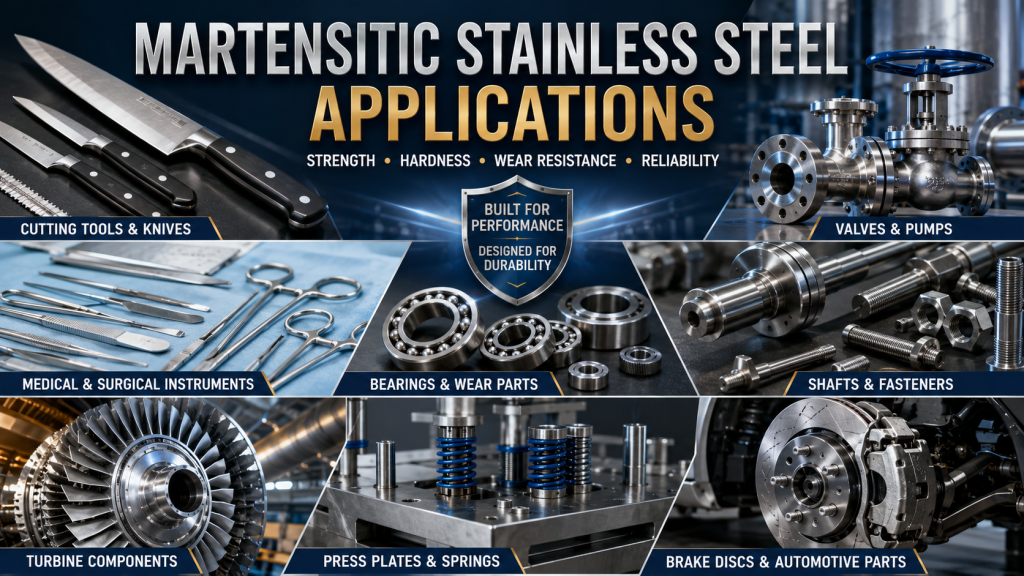
Martensitic stainless steel is used when a component requires a combination of stainless corrosion resistance, heat-treatable strength, surface hardness and wear resistance. Typical applications include knives, cutting instruments, valves, pump components, shafts, fasteners, bearings, press plates, brake discs, springs and turbine parts.
The family is not limited to one performance level. General engineering grades such as 410 emphasize strength and toughness. Free-machining 416 supports high-volume turning. The 420 family is used for cutting utensils and wear components, while 431 and 440C are evaluated for high-strength shafts and high-hardness bearing or valve parts.
The final application cannot be selected from the grade name alone. Product form, heat treatment, final hardness, surface finish, dimensional stability, corrosion environment and inspection method must be defined together.
Quick Answer: Where Is Martensitic Stainless Steel Used?
- 410:
valves, flanges, axles, pump parts, shafts, fasteners and general mechanical components. - 416:
screws, bolts, nuts, fittings, shafts and precision parts produced by high-volume machining. - 420J1 or EN 1.4021:
tableware, cutting utensils, press plates, brake discs, instruments and medium-hardness wear parts. - 420J2 or EN 1.4028:
knives, scissors, measuring tools and components requiring greater hardness and wear resistance. - EN 1.4034 and 1.4116:
professional knives, surgical cutting tools and higher-performance cutting instruments. - 431:
high-strength shafts, bolts, valve stems, axles and selected water-service hardware. - 440C:
rolling-element bearings, valve seats, bushings, high-quality blades and precision wear parts. - Low-carbon nickel-molybdenum martensitic grades:
hydraulic turbines, pumps and large energy-equipment components.
Why Is Martensitic Stainless Steel Used?
Martensitic stainless steel fills the performance gap between conventional corrosion-resistant stainless steel and hardened carbon or tool steel.
It is commonly selected when the component requires:
- Greater hardness than annealed austenitic or ferritic stainless steel
- Improved wear and edge retention
- Heat-treatable mechanical strength
- Magnetic behavior
- Moderate corrosion resistance
- A polished or ground functional surface
- Dimensional precision after hardening
The strongest advantage is not one individual property. It is the ability to adjust hardness and toughness through a controlled heat-treatment process.
The best martensitic grade is not necessarily the hardest grade. A pump shaft, knife edge, bearing race and turbine component operate under different loads and failure mechanisms.
Application Selection Criteria
1. Identify the Dominant Failure Mechanism
Determine whether the component is expected to fail from abrasive wear, edge deformation, rolling-contact fatigue, corrosion, impact, bending, torsion, cavitation or thermal cycling.
2. Define the Required Hardness
State the hardness range, test scale, test location and whether the requirement applies before or after grinding and polishing.
3. Confirm the Toughness Requirement
Review impact loading, shock, vibration, bending and the consequences of chipping or brittle fracture.
4. Describe the Corrosion Environment
Provide information about water, steam, humidity, food acids, chemicals, cleaning agents, chlorides and operating temperature.
5. Define the Manufacturing Route
State whether the material will be blanked, stamped, machined, welded, heat treated, straightened, ground, polished or sharpened.
6. Define Inspection and Traceability
Identify the required MTC, heat number, carbon verification, hardness test, microstructure, dimensions, flatness and nondestructive examination.
Martensitic Stainless Steel Grade and Application Matrix
| Grade or Family | Primary Application Strength | Typical Applications | Main Purchasing Risk |
|---|---|---|---|
| 410 / S41000 / 1.4006 | General strength and toughness | Valves, flanges, axles, pump parts, shafts and brake components | Insufficient corrosion resistance in aggressive chlorides |
| 410S / S41008 / 1.4000 | Formability and limited hardening | Press plates, thermal equipment, heat exchangers and fabricated parts | Incorrectly ordered when final martensitic hardness is required |
| 416 / S41600 / 1.4005 | High machining productivity | Screws, bolts, nuts, shafts, fittings and precision-turned parts | Reduced weldability, transverse toughness and corrosion performance |
| 420J1 / 1.4021 | Balanced forming, hardness and polishability | Tableware, instruments, press plates, springs and brake discs | Lower maximum hardness than higher-carbon variants |
| 420J2 / 1.4028 | Higher hardness and wear resistance | Knives, scissors, measuring tools and mechanical wear parts | Reduced toughness and more demanding heat treatment |
| 1.4034 | High cutting-edge hardness | Professional kitchen knives, surgical instruments and cutting tools | Distortion, grinding damage and brittle edge failure |
| 431 / S43100 / 1.4057 | High strength and useful toughness | Pump shafts, propeller shafts, valve stems, axles and high-strength fasteners | Overstating its suitability for severe seawater exposure |
| 440C / S44004 / 1.4125 | Very high hardness and contact-wear resistance | Bearings, valve seats, bushings, knife blades and precision wear parts | Low toughness, carbide segregation and heat-treatment distortion |
| Low-carbon Ni-Mo martensitic | Toughness, strength and weldability | Hydraulic turbines, pump components and large energy equipment | Complex welding, casting and heat-treatment specification |
ASTM, EN and JIS designations in this table are preliminary comparisons. They are not permission to mix chemical and mechanical requirements from different standards.
Knives, Scissors and Cutting Tools
Cutting applications are among the best-known uses of martensitic stainless steel. The material must retain a sharp edge while resisting staining, cleaning chemicals, abrasive wear and occasional impact.
Tableware and Lower-Hardness Cutting Utensils
420J1 stainless steel
and related lower-carbon 420 grades are commonly considered for table knives, utensils and parts requiring a balance of stamping, forming, polishability and moderate hardness.
Kitchen Knives and Scissors
420J2 stainless steel
,
EN 1.4028 and EN 1.4034 are commonly evaluated when greater edge hardness and wear resistance are required.
The final cutting performance depends on:
- Carbon and chromium content
- Austenitizing and tempering procedure
- Retained austenite
- Carbide size and distribution
- Blade thickness
- Edge angle
- Grinding temperature
- Polishing and passivation
Professional and High-Performance Knives
Grades such as EN 1.4034, 1.4110, 1.4116 and selected 440-series materials may be used for professional cutting applications.
Maximum hardness should not be specified without considering chipping resistance. A thinner edge or impact-loaded blade may require a tougher condition than a wear-focused industrial knife.
Surgical, Dental and Medical Instruments
Martensitic stainless steel is used for medical instruments that require a hard cutting edge, wear resistance, polishability and repeated cleaning or sterilization.
Possible applications include:
- Scalpels
- Surgical scissors
- Dental tools
- Chisels
- Osteotomes
- Retractors
- Forceps and clamps
- Measuring and cutting instruments
Typical starting grades may include selected 420 variants, EN 1.4034, EN 1.4116, EN 1.4122 and 440-series materials.
The alloy designation alone does not establish medical-device suitability. Finished instruments may also require:
- Validated heat treatment
- Controlled surface roughness
- Polishing and passivation
- Cleaning and sterilization validation
- Biocompatibility review where applicable
- Lot traceability
- Regulatory documentation
Valves, Pumps and Shafts
Valve Components
410 is widely evaluated for valve stems, seats, flanges and internal mechanical components where moderate corrosion resistance and heat-treatable strength are required.
Higher-hardness 420 or 440C may be considered for valve seats and wear surfaces, while nickel-containing 431 may be selected for highly loaded valve stems and shafts.
Pump Shafts
Pump-shaft selection depends on torque, bending, fatigue, water chemistry, seal design and shaft diameter.
Common starting options include:
- 410 for general engineering and mild environments
- 431 for high-strength shafts and improved toughness
- EN 1.4122 for higher wear and moderate corrosion requirements
- Low-carbon nickel-molybdenum martensitic grades for large water and energy equipment
Pump Wear Components
Hardened martensitic grades may be used for sleeves, valve seats, wear rings and mechanical components where abrasion and contact wear are important.
The selection should account for galling, cavitation, particles, lubrication, corrosion and the hardness of the mating surface.
Fasteners, Axles and Mechanical Parts
Fasteners
410 and 431 may be evaluated for bolts, screws and fasteners that require strength and magnetic behavior.
416 is frequently used where fasteners and precision parts are produced by high-volume machining. Its sulfur-enhanced machinability is useful for productivity, but it normally reduces weldability and corrosion resistance.
Axles and Drive Components
410 and 431 can be selected for axles, drive shafts and heavily loaded mechanical components.
The design should consider:
- Torsional strength
- Fatigue loading
- Notch sensitivity
- Section hardenability
- Surface condition
- Corrosive exposure
Precision-Machined Components
Free-machining grades are commercially attractive for fittings, threaded parts, camera or gauge components and other turned products.
For 416 and related free-machining bars, the purchase standard should be reviewed separately from the standard used for non-free-machining bars.
Bearings and Wear Components
440C is one of the best-known stainless bearing grades because it can develop very high hardness and contact-wear resistance.
Typical applications include:
- Rolling-element bearings
- Bearing races
- Balls and rollers
- Bushings
- Valve seats
- Precision wear components
- Measuring blocks and gauges
Bearing performance depends on more than bulk hardness. Critical controls may include:
- Carbide size and distribution
- Cleanliness and inclusion content
- Retained austenite
- Dimensional stability
- Surface finish
- Residual stress
- Contact-fatigue testing
Premium bearings may require ESR or VAR remelting, special inclusion limits and application-specific metallurgical specifications.
Turbines and Energy Equipment
Martensitic stainless steel is used in steam, gas and hydraulic turbine systems where strength, erosion resistance and moderate corrosion resistance are required.
Steam and Gas Turbine Components
Grades such as 403 and 410 have traditionally been used for selected turbine blades and mechanical components.
Material selection must consider:
- Operating temperature
- Steam chemistry
- Cyclic loading
- Fatigue
- Erosion
- Stress-corrosion risk
Hydraulic Turbines
Low-carbon nickel-molybdenum martensitic stainless steels are widely evaluated for hydraulic turbine runners, pump impellers and large cast or forged components.
These applications emphasize toughness, weldability, cavitation resistance and large-section properties rather than maximum knife-type hardness.
Press Plates, Springs, Brake Discs and Measuring Tools
Press Plates
410S, 420 and related grades can be used for industrial press plates where flatness, wear resistance and surface quality are important.
A press-plate RFQ should define:
- Thickness tolerance
- Flatness
- Surface finish
- Dureté
- Parallelism
- Edge preparation
Springs
Selected 420 grades can be supplied in hardened or temper-rolled conditions for springs and elastic components.
Spring design should specify tensile strength, hardness, bend performance, fatigue requirements and final heat treatment rather than only the grade name.
Brake Discs and Wear Plates
Selected 410- and 420-family materials may be used for brake and friction components where strength, wear and thermal behavior must be balanced.
Final suitability depends on the complete brake design, friction material, thermal cycle and safety requirements.
Measuring Tools
Medium- and high-hardness 420 grades are used for gauges, measuring instruments and wear-resistant precision tools.
Dimensional stability after heat treatment and grinding can be more important than maximum hardness.
Food-Processing Applications
Martensitic stainless steels are used in food-processing knives, cutting blades, grinder components, wear parts and selected machine components.
Typical examples include:
- Meat-processing knives
- Slicer blades
- Food-cutting discs
- Scissors and utensils
- Wear-resistant machine parts
- Selected pump and valve components
“Food grade” is not established by the grade name alone. The finished component must also satisfy applicable surface, hygiene, cleaning and regulatory requirements.
High-chloride brines, acidic products and aggressive cleaning chemicals may exceed the corrosion resistance of conventional 410 or 420 grades.
Water and Marine-Service Limitations
Some martensitic grades are described as resistant in water and steam, but this should not be interpreted as universal seawater resistance.
Conventional 410, 416, 420 and 440 grades are generally not the first choice for:
- Continuous seawater immersion
- Stagnant saltwater
- Hot chloride solutions
- Creviced marine assemblies
- Salt-spray environments without maintenance
431 and higher-alloy martensitic grades may provide improved performance in selected marine and water-service applications, but exposure, stress, crevices and maintenance must be reviewed.
A component may require 316L, duplex, super duplex or another alloy when chloride corrosion controls the design.
Product Forms and Manufacturing Routes
| Product Form | Typical Applications | Important Purchasing Details |
|---|---|---|
| Sheet and plate | Press plates, brake components, blanks, wear plates and fabricated parts | Grade, thickness, flatness, finish and heat-treatment condition |
| Coil | High-volume blanking, stamping, blades and spring components | Coil weight, width, ID, camber, edge and surface protection |
| Precision strip | Knives, scissors, springs, clips and precision components | Thickness tolerance, flatness, temper, slit edge and burr |
| Bar | Shafts, valve stems, fasteners, bearings and machined parts | Diameter, condition, straightness, machining allowance and standard |
| Wire | Springs, pins and formed wire components | Diameter, tensile strength, heat-treatment condition and coil form |
| Castings and forgings | Turbines, pumps, valves and large energy components | Melt practice, heat treatment, NDT, mechanical testing and repair welding |
How Heat Treatment Changes the Application
The same martensitic grade can perform very differently after different heat treatments.
Annealed or Softened Condition
Used when the material must be blanked, formed or machined before hardening.
Hardened Condition
Provides high hardness but may contain excessive residual stress and insufficient toughness for service.
Hardened and Tempered Condition
Used for most finished mechanical, cutting and wear applications because tempering adjusts the hardness-toughness balance.
Sub-Zero Treatment
May be specified for selected high-carbon grades to reduce retained austenite and improve dimensional stability.
Heat treatment should define:
- Austenitizing range
- Holding time
- Quench medium
- Tempering range
- Number of tempering cycles
- Sub-zero treatment where required
- Final hardness
- Distortion allowance
Surface Finish and Corrosion Performance
Surface condition has a direct influence on corrosion, friction, cleanability, edge quality and inspection acceptance.
Common finishing operations include:
- Grinding
- Brossage
- Fine polishing
- Mirror polishing
- Sharpening
- Passivation
Grinding after hardening must control heat. Grinding burns can locally over-temper the material, reduce hardness and create cracking or residual-stress problems.
Smooth polished and passivated surfaces normally provide better practical corrosion performance than rough or iron-contaminated surfaces.
Welding and Assembly
Traditional high-carbon martensitic stainless steels have limited weldability.
Potential risks include:
- Hard and brittle heat-affected zones
- Hydrogen-assisted cracking
- Residual stress
- Loss of corrosion resistance
- Distortion
A welding procedure may require:
- Preheating
- Low-hydrogen control
- Suitable filler metal
- Interpass control
- Slow cooling
- Post-weld tempering
- Hardness and crack inspection
High-carbon blade and bearing grades should not be selected for routine welded structures without specialized engineering review.
Application-Specific Inspection
| Application | Important Inspection Items |
|---|---|
| Knife or scissors | Hardness, edge condition, flatness, grinding burns, surface finish and corrosion test |
| Medical instrument | Grade traceability, hardness, polish, passivation, cleanliness and validated documentation |
| Shaft or axle | Chemistry, straightness, hardness profile, tensile properties and surface defects |
| Bearing component | Cleanliness, carbide distribution, retained austenite, hardness, dimensions and surface finish |
| Press plate | Thickness, flatness, parallelism, hardness, finish and edge condition |
| Turbine component | Mechanical properties, impact, NDT, heat treatment, weld records and traceability |
Handheld XRF can verify major alloying elements such as chromium, nickel and molybdenum, but it may not reliably separate grades whose main difference is carbon.
Carbon-sensitive OES, combustion analysis or another suitable laboratory method may be required for 410, 420, 440 and similar grade separation.
Review selected JUDE
stainless steel inspection reports
when defining material documentation and traceability requirements.
Common Purchasing Mistakes
The family includes soft fabrication grades, free-machining grades, knife grades, shaft grades and bearing grades.
Excessive hardness may cause edge chipping, impact fracture, grinding cracks and reduced dimensional stability.
Coil, sheet or strip may arrive annealed even when the final component requires hardened and tempered properties.
A high-carbon grade may be difficult to stamp or bend before heat treatment.
Higher chromium or nickel does not eliminate pitting, crevice corrosion or stress-related failures.
OES or another carbon-sensitive method may be required.
JUDE Product Options
JUDE’s currently published product range includes flat stainless steel products suitable for blanks, stampings, blades, press plates, springs and precision components.
Stainless steel sheet and plate
for press plates, blanks, mechanical components and fabricated parts.
Stainless steel coil
for blanking, stamping and continuous manufacturing.
Stainless steel strip
for blades, scissors, springs, clips and precision components.
Stainless steel strip processing
for slitting, leveling, rewinding and custom widths.
JUDE currently publishes dedicated grade pages for
410S,
420J1
and
420J2.
For 410, 416, 431, 440C or specialized martensitic grades, confirm the required product form, standard, minimum quantity and availability before placing the order.
Martensitic Stainless Steel Application RFQ Checklist
- Final application:
Knife, scissors, valve, pump, shaft, fastener, bearing, press plate, turbine or another component. - Primary failure risk:
Wear, impact, corrosion, fatigue, cavitation, edge deformation or contact stress. - Exact grade:
410, 410S, 416, 420J1, 420J2, 431, 440C or another specified grade. - Standard designation:
State the required UNS, EN, JIS or GB designation. - Product standard:
ASTM A240/A240M-26, ASTM A276/A276M-25, ASTM A582/A582M-22, ASTM A580/A580M-23, EN 10088-2:2024, JIS G 4304:2021 or JIS G 4305:2021. - Product form:
Sheet, plate, coil, strip, precision strip, bar, wire, blank or finished component. - Delivery condition:
Annealed, softened, hardened, hardened and tempered or another specified condition. - Required hardness:
State the range, test scale, method and test location. - Heat-treatment responsibility:
Identify whether heat treatment is completed by the mill, JUDE, component manufacturer or approved third party. - Dimensions:
Thickness, width, length, diameter and tolerances. - Flatness and straightness:
Define special requirements for blades, shafts, press plates and precision strip. - Surface finish:
No.1, 2B, BA, ground, polished, mirror or approved sample. - Edge condition:
Mill edge, slit edge, deburred, rounded, ground or sharpened. - Fabrication:
Blanking, slitting, forming, machining, welding, grinding, polishing or sharpening. - Service environment:
Water, steam, chemicals, food acids, chlorides, temperature and cleaning method. - Inspection:
MTC, heat number, OES, hardness, microstructure, retained austenite, dimensions, NDT or third-party inspection. - Quantity and delivery:
Pieces, total weight, coil data, packaging, destination and required date.
Frequently Asked Questions
What are the most common applications of martensitic stainless steel?
Common applications include knives, scissors, surgical instruments, valves, shafts, fasteners, bearings, press plates, brake discs, springs and turbine components.
Which martensitic stainless steel is best for knives?
420J2, EN 1.4028, EN 1.4034 and 1.4116 are common starting grades. The final choice depends on edge geometry, target hardness, toughness, corrosion and heat-treatment capability.
Which grade is used for bearings?
440C is widely used for rolling-element bearings, races and precision wear parts because of its high hardness and contact-wear resistance.
Which martensitic grade is used for pump shafts?
410 and 431 are common starting grades. Low-carbon nickel-molybdenum martensitic materials may be used for larger water and energy-equipment components.
Can martensitic stainless steel be used for medical instruments?
Yes. Selected 420, 1.4034, 1.4116, 1.4122 and 440-series grades are used for cutting and surgical instruments. Finished-device validation is still required.
Is martensitic stainless steel suitable for food processing?
It is used for blades, cutting discs and selected wear components. Suitability depends on the grade, surface finish, cleaning chemicals, food environment and applicable regulations.
Can martensitic stainless steel be used in seawater?
Conventional 410, 416, 420 and 440 grades are generally not preferred for continuous seawater immersion. Higher-alloy martensitic, duplex or super duplex materials may be required.
Should martensitic stainless steel be purchased annealed or hardened?
Annealed material is easier to cut, form and machine. Hardened and tempered material is appropriate when the buyer requires final mechanical properties before delivery.
Does higher hardness always improve application performance?
No. Higher hardness may improve wear and edge retention but can reduce toughness, increase distortion and create greater chipping or cracking risk.
How can buyers verify the correct grade?
Review the MTC and heat-number markings. Use PMI for major alloying elements and OES or another carbon-sensitive method when separating similar martensitic grades.
Conclusion
Martensitic stainless steel applications range from knives and surgical tools to valves, pump shafts, bearings, fasteners, press plates and turbine equipment.
410 provides a general engineering balance. 416 supports high-volume machining. The 420 family serves cutting, medical and wear applications. 431 is used for high-strength shafts and mechanical components, while 440C is selected for bearings and high-hardness wear parts.
The correct material cannot be chosen from the application name alone. Reliable performance requires the exact grade, heat-treatment condition, hardness, surface finish, manufacturing route, corrosion environment and inspection plan to be specified together.
Request a Martensitic Stainless Steel Application Review
Send JUDE the final application, required grade, product standard, product form, dimensions, delivery condition, hardness, heat treatment, finish, edge, inspection documents, quantity and destination.
For blades, shafts, bearings and precision-strip projects, also provide the dominant failure risk, flatness, straightness, hardness test location and final manufacturing route.
Technical References
ASTM A240/A240M-26 — Stainless Steel Plate, Sheet and Strip
ASTM A276/A276M-25 — Stainless Steel Bars and Shapes
ASTM A582/A582M-22 — Free-Machining Stainless Steel Bars
ASTM A580/A580M-23 — Stainless Steel Wire
Outokumpu — Martensitic Stainless Steel Properties and Applications
Outokumpu Dura — Martensitic Grades and Typical Applications
