
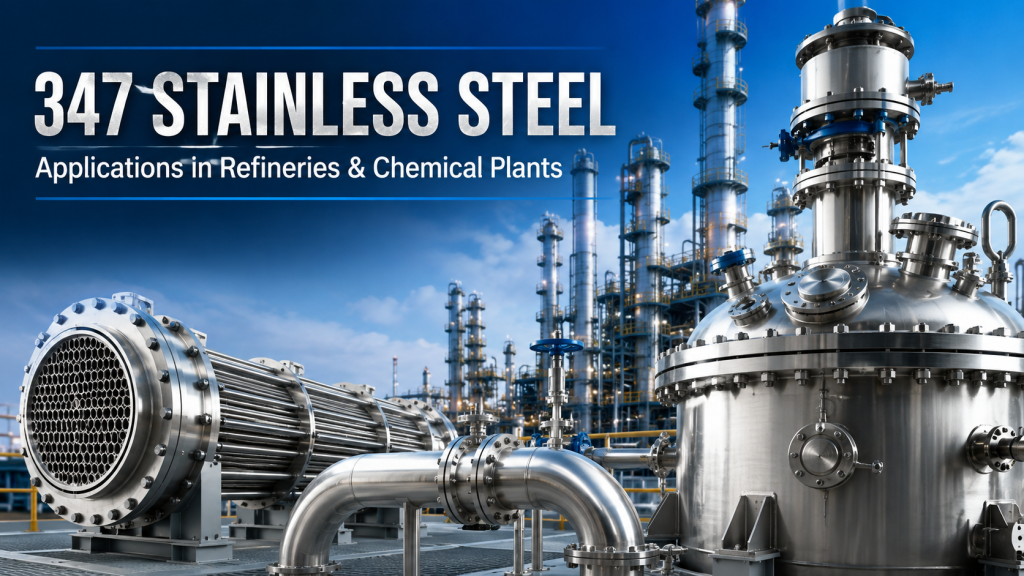
Type 347 stainless steel is not a universal “refinery stainless steel.” It is a niobium-stabilized austenitic stainless steel that becomes particularly relevant when welded equipment or components will experience elevated-temperature exposure and the material specification requires improved resistance to sensitization-related intergranular corrosion.
In petroleum refining, petrochemical processing and chemical production, 347 and its high-temperature variant 347H may be specified for selected piping, heater components, expansion joints, fittings, flanges, valve parts, heat-transfer equipment and fabricated process components.
The final material choice, however, must be based on process chemistry, metal temperature, pressure, corrosion mechanism, welding condition, design code and the project metallurgy specification. Simply operating inside a refinery does not automatically justify Type 347.
Quick Answer: What Refinery Equipment Can Use 347 Stainless Steel?
Subject to the refinery metallurgy specification, design code and actual operating conditions, Type 347 or 347H may be considered for components such as:
- high-temperature process piping and pipe spools;
- selected fired-heater tubes or associated hot components;
- heat-exchanger or thermal-service tubing where the specified product standard permits the grade;
- expansion joints and metal bellows;
- forged flanges;
- wrought piping fittings;
- selected valve bodies or valve components;
- high-temperature gaskets and fabricated components;
- selected reactor internals;
- thermowells, supports and thermally exposed internal hardware;
- chemical-production equipment exposed to repeated heating;
- welded components where stabilization is required by the project material specification.
This list describes potential applications, not a mandatory material schedule. Refinery equipment can use many different alloys depending on sulfur compounds, chlorides, acids, hydrogen service, carburization, oxidation, pressure and temperature.
What Is Type 347 Stainless Steel?
Type 347 is a chromium-nickel austenitic stainless steel stabilized with niobium. Its common designations include:
| System | Designation | Buyer Note |
|---|---|---|
| ASTM / AISI Type | 347 | Product standard must also be specified |
| UNS | S34700 | Common UNS designation for Type 347 |
| FR | 1.4550 | European material number commonly associated with Type 347 |
| EN Name | X6CrNiNb18-10 | Use together with the applicable EN product standard |
| JIS | SUS347 | Use the appropriate JIS product specification |
The niobium addition is important because it preferentially combines with carbon. This helps reduce the tendency for chromium-carbide precipitation to create chromium-depleted grain-boundary regions during certain welding and elevated-temperature exposures.
In practical terms, this makes 347 useful where a welded component must subsequently operate in a temperature regime in which sensitization would otherwise become an important material-selection concern.
Niobium stabilization should not be interpreted as a general improvement in resistance to every refinery or chemical corrosion mechanism.
Why Niobium Stabilization Matters in Refinery Service
Conventional chromium-nickel austenitic stainless steels can become susceptible to intergranular corrosion if an unfavorable combination of carbon content, time and temperature produces chromium-carbide precipitation at grain boundaries.
347 addresses this mechanism through niobium stabilization.
This becomes particularly relevant when:
- the component is welded;
- post-fabrication solution annealing is impractical;
- the component experiences repeated heating and cooling;
- the material spends significant time at elevated temperature;
- the refinery metallurgy specification specifically requires a stabilized grade;
- sensitization-related degradation during subsequent service is an engineering concern.
Material producers also identify Type 347 as useful for intermittent elevated-temperature exposure. Such published application ranges are engineering references rather than design-code allowable temperatures. Pressure equipment must still be designed using the applicable code, allowable stresses and project specification.
347 vs 347H: Do Not Order Them as the Same Grade
Type 347 and 347H belong to the same niobium-stabilized stainless steel family, but they should not be treated as interchangeable designations.
347H uses a controlled higher carbon range intended to support improved high-temperature creep and stress-rupture performance.
| Factor | 347 | 347H |
|---|---|---|
| UNS | S34700 | S34709 |
| Primary selection logic | Stabilized austenitic stainless steel for welded and elevated-temperature exposure | 347-family material for applications where high-temperature mechanical performance becomes more important |
| Carbon strategy | Standard Type 347 carbon limit | Controlled higher carbon range |
| Typical engineering concern | Sensitization and intergranular-corrosion resistance after thermal exposure | Sensitization resistance plus high-temperature creep/stress-rupture requirements |
| Automatic substitution? | No. Use the grade required by the design calculation, code and project specification. | |
For long-term high-temperature pressure service, purchasers should not downgrade a specified 347H component to standard 347 solely because the alloys appear chemically similar.
The same caution applies in the opposite direction. A project calling for Type 347 should not automatically be changed to 347H without engineering approval.
347 Stainless Steel Standards Depend on the Product You Are Buying
One of the most common purchasing errors is specifying only “ASTM 347.” ASTM 347 is not a complete purchase specification.
The governing standard changes with the product form.
| Product | Common 347 Designation | Relevant ASTM Standard | Procurement Note |
|---|---|---|---|
| Plate / Sheet / Strip | Type 347 / UNS S34700 | ASTM A240/A240M | Use for applicable stainless flat products |
| Plate / Sheet / Strip | 347H / UNS S34709 | ASTM A240/A240M | Confirm high-temperature grade requirement |
| Process Pipe | TP347 / TP347H | ASTM A312/A312M | For applicable seamless, welded and heavily cold-worked austenitic stainless pipe |
| Boiler / Superheater / Heat-Exchanger Tube | TP347 / TP347H | ASTM A213/A213M | Seamless tubing specification; do not substitute A240 plate certification |
| Wrought Pressure-Piping Fittings | WP347 / WP347H | ASTM A403/A403M | Fitting class and construction requirements also matter |
| Forged Flanges / Forged Fittings / Valve Parts | F347 / F347H | ASTM A182/A182M | Use the forging specification rather than A240 |
| EN Flat Products | 1.4550 / X6CrNiNb18-10 | EN 10088-2 | For applicable general-purpose corrosion-resistant flat products |
| JIS Hot-Rolled Flat Product | SUS347 | JIS G 4304 | Confirm required delivery condition and dimensions |
| JIS Cold-Rolled Flat Product | SUS347 | JIS G 4305 | Confirm finish, thickness and tolerance |
Important: chemical limits and mechanical-property requirements can differ between product standards. A composition table taken from an A240 plate data sheet should not automatically be used as the acceptance table for an A213 tube or A403 fitting.
The current project specification, current applicable standard edition and certified Mill Test Certificate should govern procurement acceptance.
347 and 347H for Refinery Heater Tubes and Hot Components
Refinery fired heaters operate under demanding combinations of process temperature, internal fluid chemistry, external combustion atmosphere, mechanical stress and long service periods.
347-family materials can be considered for selected heater coils, tubes, connections or associated components where the project metallurgy strategy requires a stabilized austenitic stainless steel.
For hotter pressure-containing components where creep becomes a design criterion, 347H may be specified instead of standard 347.
However, “high temperature” alone is not sufficient justification for choosing 347H.
A heater-tube material review should consider:
- tube-metal temperature;
- design pressure;
- creep life;
- process fluid;
- sulfur compounds;
- carburizing or oxidizing conditions;
- thermal cycling;
- corrosion allowance;
- welding requirements;
- applicable API, ASME and project requirements.
Other stainless steels, chromium-molybdenum steels, heat-resistant stainless steels or nickel alloys may be more appropriate in different heater environments.
347 Stainless Steel for High-Temperature Process Piping
TP347 and TP347H are established material designations for austenitic stainless steel pipe under applicable ASTM piping specifications.
In refinery and chemical-plant piping, they can be relevant when welded piping will undergo sustained or repeated elevated-temperature service and the metallurgy specification requires stabilization.
Potential applications can include selected:
- hot process lines;
- heater outlet connections;
- high-temperature transfer piping;
- reactor-associated piping;
- petrochemical process lines;
- fabricated pipe spools.
Purchasers should specify more than the nominal grade.
A useful pipe purchase description may include:
- TP347 or TP347H;
- ASTM A312/A312M or another specified product standard;
- seamless or welded construction;
- NPS or outside diameter;
- schedule or wall thickness;
- length;
- heat-treatment condition;
- NDE requirements;
- hydrostatic or nondestructive electric test requirements;
- supplementary testing where required;
- MTC and traceability requirements.
347 Stainless Steel for Expansion Joints and Bellows
Expansion joints are an established application category for niobium-stabilized 347 stainless steel.
Metal bellows can experience:
- repeated thermal cycles;
- expansion and contraction;
- welded fabrication;
- elevated-temperature exposure;
- cyclic mechanical strain.
The stabilized metallurgy of 347 can therefore be relevant when the design specification calls for this combination of thermal exposure and welded-service performance.
Material grade alone does not define bellows life. Fatigue calculation, convolution geometry, forming process, weld quality, pressure, movement cycle and process environment remain critical.
347 Stainless Steel Flanges, Fittings and Valve Components
Refinery piping systems contain several different product forms that may all be casually described as “347 stainless steel,” even though their governing specifications are different.
Examples include:
- F347 or F347H forged flanges and forged components under the applicable forging specification;
- WP347 or WP347H wrought piping fittings under the applicable fitting specification;
- selected high-temperature valve components where the project material specification permits the alloy.
This distinction matters when reviewing an RFQ or Material Test Certificate.
A plate certificate showing ASTM A240 Type 347 does not automatically certify a forged flange to ASTM A182 F347.
Likewise, a TP347 pipe certificate is not an A403 WP347 fitting certificate.
347 Stainless Steel in Heat-Transfer Equipment
347-family tubing can be used in selected thermal equipment when the required tube specification includes the grade and high-temperature stability is an important selection factor.
ASTM A213/A213M, for example, covers seamless ferritic and austenitic boiler, superheater and heat-exchanger tubes and includes TP347-family grades.
Possible applications include selected:
- high-temperature heat exchangers;
- superheater-type thermal equipment;
- process heating systems;
- hot-side exchanger components.
This should not be interpreted as meaning 347 is automatically a superior heat-exchanger material.
For aqueous chloride-containing heat exchangers, pitting, crevice corrosion and chloride stress-corrosion cracking can become more important than stabilization. A molybdenum-bearing stainless steel, duplex stainless steel or another corrosion-resistant alloy may then provide a more appropriate solution.
347 Stainless Steel for Reactor Internals and Refinery Components
Stabilized austenitic stainless steels have an established history in selected refinery systems where sensitization during elevated-temperature service is a concern.
Depending on the process licensor and refinery material specification, potential components can include:
- selected reactor internals;
- supports;
- thermowells;
- screens;
- distributor components;
- internal piping;
- thermally exposed brackets or hardware;
- selected fabricated reactor components.
One reason stabilized stainless steels receive attention in refinery systems is the relationship between sensitized austenitic stainless steel and susceptibility to certain forms of intergranular corrosion or cracking during service or shutdown.
Stabilization reduces a specific metallurgical risk. It does not make Type 347 immune to every refinery damage mechanism.
347 Stainless Steel in Chemical and Petrochemical Equipment
Outside conventional petroleum refining, Type 347 can also be used in chemical and petrochemical equipment where repeated heating, welding and sensitization resistance are important.
Potential fabricated products include:
- high-temperature reaction equipment;
- welded process vessels where specified;
- hot process ducts;
- thermal expansion components;
- high-temperature piping assemblies;
- flanges and valve components;
- specialized fabricated chemical-production equipment.
The phrase “chemical resistant stainless steel” should never be used as the sole basis for specifying 347.
Material compatibility depends on the actual chemical environment, including:
- acid type;
- acid concentration;
- water content;
- chlorides;
- sulfur compounds;
- oxidizing or reducing conditions;
- temperature;
- pressure;
- flow velocity;
- contaminants.
Where 347 Stainless Steel Should Not Be Selected Automatically
1. Chloride-Rich Service
347 does not contain the molybdenum addition that gives 316L a greater margin against chloride pitting and crevice corrosion.
If localized chloride corrosion controls the design, 316L, duplex stainless steel or a more highly alloyed material may be more appropriate.
2. Severe Acid Service
Niobium stabilization does not automatically provide resistance to every sulfuric, hydrochloric, phosphoric or mixed-acid environment.
Actual corrosion data for the specific concentration and temperature should be reviewed.
3. High-Temperature Sulfidation
Refinery sulfidation resistance depends heavily on alloy composition, temperature, sulfur activity and process conditions. Stabilization alone does not solve high-temperature sulfidation.
4. Naphthenic-Acid Corrosion
Naphthenic-acid service requires a separate metallurgy assessment. The fact that 347 is stabilized does not make it universally suitable for naphthenic-acid corrosion.
5. Extremely High-Temperature Service
For severe creep, oxidation, carburization or furnace conditions, higher-alloy heat-resistant stainless steels or nickel alloys may be required.
347 vs 321 vs 316L for Refinery and Chemical Service
| Grade | Stabilization / Alloy Strategy | Main Reason to Evaluate It | Important Limitation |
|---|---|---|---|
| 347 | Niobium-stabilized Cr-Ni austenitic stainless steel | Welded components exposed to elevated temperature and sensitization risk | Not a general chloride-corrosion upgrade |
| 347H | Higher-carbon 347-family grade | High-temperature applications where creep or stress-rupture performance becomes important | Must not be substituted solely by commercial preference |
| 321 | Titanium-stabilized Cr-Ni austenitic stainless steel | Alternative stabilized grade for welded elevated-temperature components | Titanium stabilization does not improve chloride resistance to 316L levels |
| 316L | Low-carbon Cr-Ni-Mo austenitic stainless steel | General welded chemical equipment and improved localized-corrosion resistance in many chloride environments | Different high-temperature stabilization strategy from 347 |
For a detailed discussion of the titanium-stabilized alternative, see JUDE’s 321 Stainless Steel for Chemical & Refinery Equipment.
For chemical equipment where molybdenum-assisted localized-corrosion resistance is more important, review 316L Stainless Steel for Chemical & Refinery Equipment.
Welding and Fabrication of 347 Stainless Steel
347 was developed specifically for applications where stabilization can remain important after welding and subsequent elevated-temperature exposure.
That does not eliminate the need for a qualified welding procedure.
Fabricators should control:
- base-metal identification;
- filler-metal selection;
- joint preparation;
- heat input;
- interpass temperature;
- shielding gas;
- surface contamination;
- heat tint;
- post-weld cleaning;
- NDE requirements.
347-type filler metals are widely used for welding stabilized austenitic stainless steels where required by the qualified WPS and project specification.
Final filler-metal selection must follow the welding procedure qualification, design code and engineering specification rather than a generic online recommendation.
MTC, PMI and Incoming Inspection of 347 Stainless Steel
Purchasing a high-temperature alloy without verifying material identity can create expensive fabrication and project risks.
An incoming inspection plan for 347 can include:
- Confirm Type 347, TP347, 347H, TP347H, F347, WP347 or the exact required designation.
- Verify the governing product standard.
- Review the Mill Test Certificate.
- Match the MTC heat number to the material marking.
- Verify dimensions and tolerances.
- Inspect surface condition.
- Confirm required heat-treatment condition.
- Perform PMI where specified.
- Confirm niobium-bearing alloy identity where required.
- Review required intergranular-corrosion testing.
- Check NDE documentation for pipe or tube where applicable.
- Verify project-specific supplementary requirements.
Can Handheld XRF Confirm 347H?
Handheld XRF can be useful for identifying chromium, nickel and niobium and can help distinguish a niobium-bearing 347-family material from grades such as 304.
However, conventional handheld XRF is not an appropriate method for accurately verifying carbon content.
Because carbon is one of the key differences between standard 347 and 347H, XRF alone should not be used to certify that a component is 347H.
Use the MTC and an appropriate carbon-analysis method where independent carbon verification is contractually required.
Common 347 Stainless Steel Purchasing Mistakes
Mistake 1: Ordering Only “347 Stainless Steel”
This does not define product standard, product form, dimensions, delivery condition or testing.
Mistake 2: Treating 347 and 347H as Interchangeable
347H exists for a high-temperature mechanical-performance reason. Follow the design specification.
Mistake 3: Ordering A240 Material for Every Component
ASTM A240 applies to plate, sheet and strip. Finished pipe, tube, forged flanges and wrought fittings use different product specifications.
Mistake 4: Assuming 347 Is More Corrosion Resistant Than 316L Everywhere
347 is primarily differentiated by niobium stabilization. 316L contains molybdenum and often provides a better localized-corrosion margin in chloride-containing environments.
Mistake 5: Selecting 347 Only Because the Equipment Is Hot
Temperature is only one design input. Corrosion mechanism, mechanical stress, time at temperature, pressure, atmosphere and process chemistry must also be reviewed.
Mistake 6: Calling Published Temperature Ranges “Maximum Service Temperature”
Material-producer application guidance is not the same as an ASME allowable-stress limit or guaranteed maximum operating temperature.
Mistake 7: Using XRF Alone to Distinguish 347 from 347H
The carbon difference requires documentation or an appropriate carbon-analysis method.
347 Stainless Steel Plate, Sheet, Coil and Strip
For fabricated refinery and chemical equipment, the required raw material may be purchased as flat product before downstream cutting, rolling, forming or welding.
347 Stainless Steel Plate and Sheet
Plate or sheet can be relevant to:
- welded equipment;
- liners;
- ducting;
- expansion components;
- fabricated high-temperature parts;
- selected process-equipment components.
See JUDE’s Stainless Steel Sheet and Plate page for available flat-product processing capabilities.
347 Stainless Steel Coil
Coil can be appropriate where continuous processing, forming, slitting or downstream fabrication is required.
See JUDE’s Stainless Steel Coil page.
347 Stainless Steel Strip
Narrow strip may be required for specialized formed components, gaskets or downstream fabricated parts depending on the application.
See JUDE’s Stainless Steel Strip page.
Confirm 347 / 347H Availability Before Ordering
JUDE’s public grade and supply overview currently lists 347H among its special stainless steel grades.
For Type 347, 347H, TP347, TP347H, F347 or WP347 requirements, buyers should send the exact standard, dimensions, quantity and project documentation for supply review rather than assuming every product form is available from stock.
Review the JUDE Stainless Steel Supply Overview or send the project specification directly to the sales team.
347 / 347H Stainless Steel RFQ Checklist
For a technically meaningful quotation, provide as many of the following details as possible:
- Final equipment: heater, exchanger, piping, expansion joint, reactor, valve, flange or another component.
- Industry and process unit: refinery, petrochemical, chemical plant or another process.
- Process fluid.
- Normal operating temperature.
- Maximum design temperature.
- Design pressure.
- Exposure duration: continuous, intermittent or cyclic.
- Thermal-cycle frequency.
- Corrosion concerns: sulfur, chlorides, acids, oxidation, carburization or other known mechanisms.
- Exact grade: 347, 347H, TP347, TP347H, WP347, F347, 1.4550 or another specified designation.
- Product standard: ASTM A240, A312, A213, A403, A182, EN or project specification.
- Product form: plate, sheet, coil, strip, pipe, tube, fitting or forging.
- Thickness or wall thickness.
- Width and length.
- Pipe OD / NPS and schedule where applicable.
- Surface condition.
- Dimensional tolerances.
- Welding requirements.
- Required filler-metal specification where defined.
- PMI requirement.
- Intergranular-corrosion testing requirement where applicable.
- NDE requirement.
- MTC requirement and EN 10204 document type where applicable.
- Third-party inspection requirement.
- Quantity.
- Destination port.
- Incoterm.
- Required delivery date.
Frequently Asked Questions
Why is 347 stainless steel used in refineries?
347 is niobium stabilized. It can be useful in selected welded refinery components that undergo elevated-temperature exposure where resistance to sensitization-related intergranular corrosion is an important material-selection requirement.
What refinery products are commonly made from 347 stainless steel?
Depending on the project metallurgy specification, applications can include high-temperature piping, selected heater or heat-transfer components, expansion joints, flanges, fittings, valve components, reactor internals and other thermally exposed fabricated parts.
What is the difference between 347 and 347H?
347H is a higher-carbon modification of the 347 family intended for applications where high-temperature creep and stress-rupture performance become important. It should not automatically be substituted with standard 347 in code-controlled high-temperature service.
Is 347 stainless steel better than 316L?
Not generally. They solve different material-selection problems. 347 is niobium stabilized for elevated-temperature and sensitization-related requirements, while 316L contains molybdenum and often provides a greater localized-corrosion margin in chloride-containing environments.
What is the difference between 347 and 321 stainless steel?
Both are stabilized austenitic stainless steels. 347 uses niobium stabilization, while 321 uses titanium. Both can be used in welded elevated-temperature applications, but the project material specification should determine which grade is required.
Can 347 stainless steel be used for refinery heater tubes?
347-family materials, particularly 347H in appropriate designs, can be specified for selected high-temperature heater or thermal-service components. The final material must be determined from tube-metal temperature, pressure, creep requirements, corrosion mechanism and the applicable design specification.
Can 347 stainless steel be used in heat exchangers?
Yes, TP347-family grades are included in applicable heat-exchanger-tube specifications. However, 347 should not be selected automatically for every exchanger. Chlorides, acids, process temperature and the controlling corrosion mechanism must be evaluated.
Is 347 stainless steel good for chloride service?
347 does not contain the molybdenum addition found in 316L. Where chloride pitting and crevice corrosion control material selection, 316L, duplex stainless steel or another higher-alloy material may be more appropriate.
Can PMI distinguish 347 from 304?
PMI methods such as handheld XRF can detect the niobium addition and can help distinguish a 347-family material from 304. The specific PMI procedure should follow the project quality plan.
Can XRF distinguish 347 from 347H?
Not reliably on the basis of carbon. Conventional handheld XRF does not accurately measure carbon, while carbon content is an important difference between 347 and 347H. Review the MTC or use an appropriate carbon-analysis method when verification is required.
What information should I send when requesting a 347 stainless steel quotation?
Provide the exact grade, final component, product standard, operating and design temperature, pressure, process fluid, corrosion environment, dimensions, welding requirements, testing requirements, MTC requirement, quantity, destination and delivery schedule.
Technical References
For engineering verification, purchasers and designers should refer to the applicable current project code and material standard rather than relying solely on a commercial grade guide.
- ASTM A240/A240M – Stainless Steel Plate, Sheet and Strip
- ASTM A312/A312M – Austenitic Stainless Steel Pipe
- ASTM A213/A213M – Boiler, Superheater and Heat-Exchanger Tubes
- Outokumpu Core 347/4550 Technical Information
- Nickel Institute – Role of Stainless Steel in Petroleum Refining
Request a 347 / 347H Material Review From JUDE
If your refinery, petrochemical or chemical project specifies Type 347 or 347H stainless steel, send JUDE the actual technical requirement rather than only the grade name.
Please include: equipment type, process fluid, operating and design temperature, design pressure, required grade, ASTM/EN/JIS specification, product form, dimensions, quantity, welding requirements, PMI/NDE requirements, MTC requirements, destination port and requested delivery date.
JUDE can then review whether the requested 347 / 347H plate, sheet, coil, strip or related raw-material requirement can be matched to the correct product specification and supply route.
Send Your 347 / 347H Project Specification to JUDE
Engineering note: Material selection for pressure equipment, refinery process units and high-temperature service must be approved by the responsible engineer, process licensor and applicable project/design code. This article is intended as a material-procurement guide and does not replace project-specific engineering calculations or corrosion studies.
