
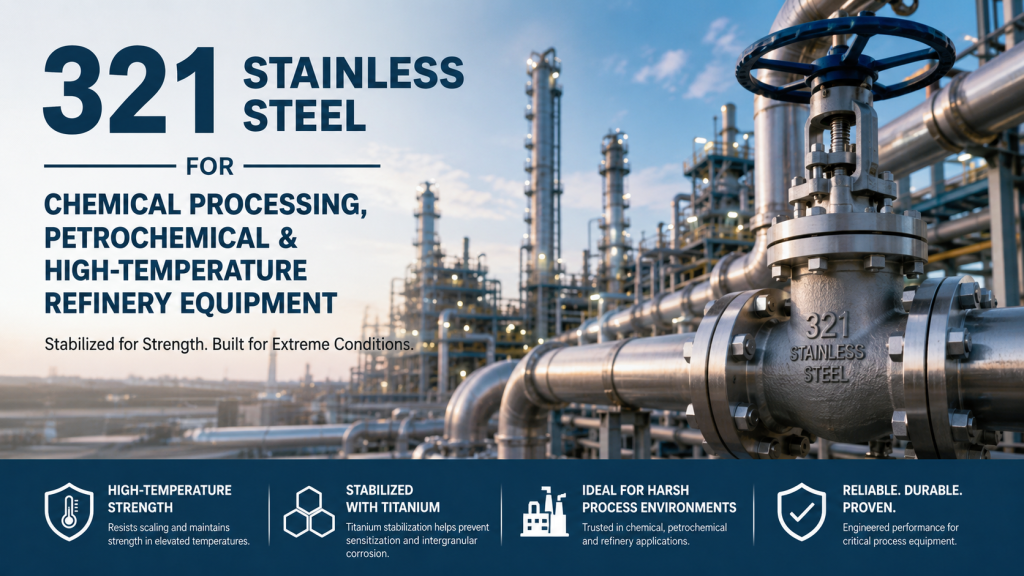
Type 321 stainless steel occupies a specific position in chemical, petrochemical and petroleum-refining equipment: it is selected primarily when welded austenitic stainless steel must retain resistance to intergranular corrosion during elevated-temperature exposure.
Its key feature is titanium stabilization rather than molybdenum alloying.
That distinction matters because Type 321 solves a different engineering problem from Type 316L.
321 should be selected when temperature history, welding, sensitization risk and process metallurgy justify a stabilized stainless steel—not simply because an application operates in a chemical plant or refinery.
Quick Answer: What Chemical and Refinery Equipment Can Use 321 Stainless Steel?
Subject to the process metallurgy specification and applicable design code, Type 321 may be considered for:
- welded pressure vessels exposed to elevated temperature;
- high-temperature process piping;
- TP321 pipe spools;
- flanges and valve components;
- stack liners and hot-gas components;
- selected refinery reactor internals;
- selected FCC reactor and regenerator components;
- hanger rods and other thermally exposed refinery parts;
- selected petrochemical process equipment exposed to repeated heating;
- other welded components where resistance to sensitization is a major design requirement.
Type 321 should not automatically replace 316L in chloride service, 321H in creep-controlled high-temperature pressure service, or higher-alloy materials in severe acid, sulfidation or refinery-corrosion environments.
What Is Type 321 Stainless Steel?
Type 321 is a titanium-stabilized chromium-nickel austenitic stainless steel.
Common international references include:
- ASTM: Type 321;
- UNS: S32100;
- EN: 1.4541;
- EN name: X6CrNiTi18-10;
- JIS: SUS321.
The chromium-nickel base chemistry places 321 within the conventional austenitic stainless steel family, while titanium provides the stabilization that differentiates it from Type 304.
JUDE has also published a separate comparison article:
321 vs 316 Stainless Steel
.
Why Does Titanium Stabilization Matter?
During exposure to a sensitizing temperature range, carbon can combine with chromium at grain boundaries and form chromium carbides.
This can reduce the chromium level immediately adjacent to the grain boundary and increase susceptibility to intergranular corrosion.
In Type 321, titanium preferentially combines with carbon and helps reduce chromium-carbide precipitation.
The advantage becomes particularly relevant when a component:
- is welded;
- cannot be solution annealed after fabrication;
- experiences repeated elevated-temperature cycles;
- operates for significant periods in a temperature range associated with sensitization.
Titanium stabilization is not a universal corrosion upgrade.
It primarily addresses sensitization and intergranular-corrosion behavior. It does not give 321 the molybdenum-enhanced chloride resistance of 316L.
321 vs 321H: Do Not Treat Them as the Same Grade
Type 321 and Type 321H belong to the same stabilized stainless steel family but are used for different design priorities.
Standard 321 is widely used where stabilization and elevated-temperature exposure are important.
321H is specifically optimized for applications where high-temperature strength, creep and stress-rupture performance become important.
High-temperature pressure service:
Do not automatically substitute standard 321 for 321H when the design code or engineering calculation is based on creep or stress-rupture properties.
321 Stainless Steel Standards and Identification
| Product / System | Common Designation | Relevant Standard | Buyer Note |
|---|---|---|---|
| ASTM flat product | Type 321 / UNS S32100 | ASTM A240/A240M-26 | For plate, sheet and strip. |
| ASTM general requirements | Flat-rolled stainless steel | ASTM A480/A480M-25b | Used with the applicable product specification. |
| EN flat product | 1.4541 / X6CrNiTi18-10 | EN 10088-2 | State the exact EN designation. |
| JIS hot rolled | SUS321 | JIS G 4304:2021 | For applicable hot-rolled flat products. |
| JIS cold rolled | SUS321 | JIS G 4305:2021 | For applicable cold-rolled plate, sheet and strip. |
| ASTM pipe | TP321 / TP321H | ASTM A312/A312M-25 | Finished pipe specification; not the raw plate standard. |
Where Does 321 Fit in Chemical and Refinery Plants?
| Equipment | Why 321 May Be Considered | Primary Engineering Check |
|---|---|---|
| Welded pressure vessel | Stabilization during elevated-temperature service | Process chemistry, pressure and design code |
| Hot process piping | Welded service plus repeated heating | Temperature, stress, corrosion mechanism and pipe specification |
| Flange / valve component | Elevated-temperature Cr-Ni stainless service | Pressure class and process fluid |
| Stack liner / hot-gas component | Thermal exposure and oxidation environment | Gas chemistry and metal temperature |
| Refinery reactor internal | Stabilized stainless strategy in selected reactor systems | Refinery metallurgy specification |
| FCC hanger rod / hot component | Established refinery application history | Temperature, stress and project metallurgy |
321 Stainless Steel for Welded Pressure Vessels
Welded pressure vessels are one of the established application categories for Type 321.
The stabilized chemistry can be useful where the completed vessel will experience elevated-temperature exposure after fabrication.
The material decision should consider:
- process medium;
- temperature profile;
- pressure;
- time at temperature;
- thermal cycling;
- weld configuration;
- design code;
- required corrosion allowance.
For pressure equipment where creep becomes a design criterion, 321H or another high-temperature grade should be evaluated rather than assuming standard 321 is sufficient.
321 Stainless Steel for High-Temperature Process Piping
TP321 pipe can be used in high-temperature and general corrosive-service piping where the process specification identifies stabilized stainless steel.
For a piping RFQ, purchasers should distinguish:
- TP321 vs TP321H;
- seamless vs welded;
- NPS / outside diameter;
- schedule or wall thickness;
- design temperature;
- design pressure;
- welding procedure;
- required supplementary testing.
Standard distinction:
ASTM A240 applies to flat products. ASTM A312 applies to finished stainless steel pipe. Do not use the two interchangeably in a purchase order.
321 Stainless Steel Flanges and Valves
Flanges and valves are established application categories for stabilized austenitic stainless steels.
However, these products may be manufactured from forgings, bar, castings, plate or other product forms.
The correct material specification must therefore match the actual manufacturing route rather than simply stating “ASTM A240 321” for every component.
Stack Liners and Hot-Gas Components
321 can also be used for selected hot-gas components such as stack liners where thermal exposure is an important design factor.
Selection should account for:
- gas temperature;
- gas chemistry;
- condensation during shutdown;
- sulfur compounds;
- thermal cycling;
- mechanical stress.
321 Stainless Steel in FCC and Refinery Equipment
Petroleum-refining experience provides several examples of stabilized austenitic stainless steels being used where elevated temperature and sensitization are important concerns.
Selected applications can include:
- FCC reactor and regenerator hanger rods;
- selected reactor components;
- reactor linings or clad sections where specified;
- selected thermally exposed piping and internal hardware.
This application history does not mean that every FCC component should be made from 321.
Refinery metallurgy specifications frequently compare 321, 347, 304L, 410 and other alloys depending on the actual corrosion mechanism and temperature.
321 for Reactor Internals
Selected reactor internals may use stabilized stainless steel where resistance to sensitization and elevated-temperature exposure is required.
Examples in refinery service can include:
- bed supports;
- distributor components;
- thermowells;
- scale baskets;
- selected nozzle and internal components.
The process licensor and refinery metallurgy specification should always govern the exact alloy selection.
321 in Petrochemical Equipment
321 can be useful in petrochemical equipment when temperature history and welded-service requirements are more important than chloride pitting resistance.
The correct selection depends on whether the controlling mechanism is:
- sensitization;
- oxidation;
- sulfidation;
- aqueous corrosion;
- chloride attack;
- high-temperature mechanical strength.
321 Is Not a General-Purpose Corrosion Upgrade
The base corrosion resistance of 321 is broadly related to the conventional chromium-nickel austenitic stainless steel family.
Its titanium addition is primarily used for stabilization.
It does not provide the molybdenum-driven localized-corrosion improvement associated with 316L.
Chloride Environments
Where pitting, crevice corrosion or chloride stress-corrosion cracking controls the design, 316L, duplex stainless steel or a more highly alloyed material may be more appropriate.
321 should not be selected simply because the equipment also operates at elevated temperature.
Acid Service
The phrase “chemical resistant” is not a sufficient basis for specifying 321.
Acid compatibility depends on:
- acid type;
- concentration;
- temperature;
- oxidizing conditions;
- chlorides;
- other contaminants.
321 and Polythionic Acid Stress-Corrosion Cracking
Polythionic acid can form during refinery shutdown when sulfur-containing corrosion products are exposed to air and moisture.
Sensitized austenitic stainless steel can be vulnerable to intergranular attack and cracking in this environment.
This is one reason stabilized stainless steels such as 321 and 347 have historically been specified in selected refinery reactor systems.
Do not interpret stabilization as immunity.
Actual resistance still depends on metallurgical condition, stress, sulfur deposits, shutdown procedure, moisture and refinery operating practice.
Other Refinery Corrosion Mechanisms
Titanium stabilization does not solve every refinery corrosion mechanism.
Separate material evaluation is required for:
- high-temperature sulfidation;
- naphthenic-acid corrosion;
- chloride-containing overhead condensate;
- wet H₂S environments;
- carburization;
- severe oxidation;
- high-temperature creep.
321 vs 304L vs 316L vs 347 vs 321H
| Grade | Main Selection Logic | Typical Reason to Choose |
|---|---|---|
| 304L | Low-carbon Cr-Ni stainless steel | General welded aqueous/process service where corrosion conditions are compatible |
| 316L | Low-carbon Cr-Ni-Mo stainless steel | Greater pitting and crevice-corrosion margin in chloride-containing service |
| 321 | Ti-stabilized Cr-Ni stainless steel | Welded components exposed to elevated temperature and sensitization risk |
| 347 | Nb-stabilized Cr-Ni stainless steel | Alternative stabilized grade widely used in high-temperature and refinery equipment |
| 321H | High-temperature 321-family grade | Evaluate when creep and stress-rupture properties control the design |
For additional JUDE comparison content, see
321 vs 316 Stainless Steel
.
For chloride-focused process applications, review
316L Stainless Steel
.
321 Plate, Sheet, Coil or Strip?
Plate and Sheet
Plate and sheet can be used for welded vessels, liners, ducts, fabricated process equipment and high-temperature components.
Review JUDE’s
Stainless Steel Sheet and Plate
range when defining dimensional and processing requirements.
Coil
Coil may be suitable where continuous processing, formed components or downstream fabrication are required.
See:
Stainless Steel Coil
.
Strip
Precision or narrow strip can be relevant to specialized fabricated parts and high-temperature components.
Welding Type 321 Stainless Steel
321 is specifically designed to retain resistance to intergranular corrosion after welding and elevated-temperature exposure.
Fabricators should nevertheless control:
- heat input;
- joint preparation;
- shielding;
- interpass temperature;
- filler-metal selection;
- heat tint;
- surface contamination.
347-type filler metals are commonly used when welding titanium-stabilized 321 because niobium stabilization is easier to retain in weld metal.
The final filler metal must follow the qualified WPS, applicable design code and project welding specification.
Post-Weld Surface Condition
Heat tint, embedded carbon-steel particles and fabrication contamination can reduce the corrosion performance of stainless steel.
Where required by the equipment specification, post-weld treatment can include:
- mechanical cleaning;
- pickling;
- passivation;
- final rinsing;
- visual inspection.
Incoming Inspection of 321 Stainless Steel
- Confirm Type 321 / UNS S32100 or required EN/JIS designation.
- Check whether the project requires 321 or 321H.
- Verify the governing product standard.
- Review the MTC.
- Match heat, plate or coil identification.
- Verify thickness and dimensions.
- Inspect surface condition.
- Confirm the titanium-stabilized material identity where required.
- Perform PMI when required by the project.
- Do not rely on handheld XRF for carbon verification.
- Review intergranular-corrosion testing requirements where specified.
- Verify design-code and pressure-equipment documentation where applicable.
For document-control examples, see JUDE’s
Inspection Reports
.
Common 321 Stainless Steel Purchasing Mistakes
Mistake 1: Ordering only “321 stainless steel.”
State the product standard, product form, dimensions, process environment and project material specification.
Mistake 2: Treating 321 and 321H as interchangeable.
321H should be evaluated where creep and stress-rupture properties govern high-temperature design.
Mistake 3: Assuming 321 is more corrosion resistant than 316L.
321 is stabilized for sensitization control; 316L contains molybdenum for improved localized-corrosion resistance.
Mistake 4: Choosing 321 only because the process is hot.
Temperature is only one parameter. Stress, atmosphere, fluid chemistry and corrosion mechanism also matter.
Mistake 5: Assuming titanium stabilization makes 321 immune to refinery corrosion.
Sulfidation, naphthenic acids, chlorides and sour environments require separate metallurgy review.
Mistake 6: Ignoring filler-metal requirements.
The welding procedure may specify 347-type filler rather than a nominally matching titanium-stabilized filler.
Mistake 7: Confusing A240 plate with A312 pipe.
Use the product standard corresponding to the actual item being purchased.
How to Source 321 Stainless Steel Through JUDE
JUDE’s current public product pages provide stainless steel sheet, plate, coil, strip and processing services.
Because the current public website does not clearly list Type 321 as a standard stocked grade, buyers should send the exact Type 321, TP321, 321H, EN 1.4541 or SUS321 requirement for supply review before placing an order.
Relevant JUDE resources include:
321 Chemical and Refinery RFQ Checklist
- Final equipment: vessel, pipe, liner, reactor internal, valve or another component.
- Industry / unit: chemical, petrochemical, FCC, hydroprocessing, refinery or another process.
- Process fluid.
- Normal operating temperature.
- Maximum design temperature.
- Time at elevated temperature.
- Thermal-cycle frequency.
- Design pressure.
- Chloride level where relevant.
- Sulfur / H₂S / acid contaminants where relevant.
- Required grade: 321, TP321, 321H, 1.4541 or SUS321.
- Product standard.
- Design code.
- Product form: plate, sheet, coil, strip or finished pipe.
- Thickness / wall thickness.
- Width / length / pipe size.
- Surface condition.
- Welding process.
- Required filler metal.
- Post-weld cleaning requirement.
- PMI requirement.
- MTC / EN 10204 requirement.
- Intergranular-corrosion testing where specified.
- Quantity.
- Destination and Incoterm.
Frequently Asked Questions
Why is 321 stainless steel used in refineries?
321 is titanium stabilized, making it useful in selected welded refinery components that experience elevated-temperature exposure and where resistance to sensitization is important.
What refinery components can use 321 stainless steel?
Selected applications can include hot process piping, welded vessels, hanger rods, reactor internals, stack liners, flanges and valves when required by the refinery metallurgy specification.
Is 321 better than 316L for chemical processing?
Not generally. 321 is selected primarily for stabilization and elevated-temperature exposure, while 316L usually provides a greater localized-corrosion margin in chloride-containing environments.
What is the difference between 321 and 321H?
321H belongs to the same stabilized family but is intended for high-temperature applications where creep and stress-rupture strength are important. Standard 321 should not automatically replace 321H in code-controlled high-temperature service.
What is the difference between 321 and 347?
Both are stabilized austenitic stainless steels. 321 uses titanium, while 347 uses niobium stabilization. Both are used in elevated-temperature and welded applications, but project specifications often favor one grade for a particular service.
Can 321 stainless steel be used for high-temperature piping?
Yes, TP321 is used for high-temperature and general corrosive service when the process and design specification permit it. TP321H should be evaluated where creep strength controls the design.
Is 321 stainless steel resistant to chlorides?
321 has general corrosion behavior similar to conventional Cr-Ni austenitic stainless steels but does not contain the molybdenum addition used in 316L. Chloride-rich environments may require another grade.
Why is 347 filler often used to weld 321?
Niobium-stabilized 347-type filler is commonly used because titanium can be lost through oxidation in the welding arc. The qualified welding procedure must determine the final filler metal.
Can 321 prevent polythionic acid stress-corrosion cracking?
Stabilization can reduce sensitization-related susceptibility and is one reason 321 and 347 are used in selected refinery systems. It should not be interpreted as complete immunity to polythionic acid cracking.
What information should I provide when requesting 321 stainless steel?
Provide the final component, project material specification, grade, temperature, pressure, process environment, product form, dimensions, welding requirements, inspection documentation, quantity and destination.
Conclusion
Type 321 stainless steel serves a specialized role in chemical, petrochemical and refinery equipment.
Its defining value is titanium stabilization, which helps welded components retain resistance to sensitization-related intergranular corrosion during elevated-temperature exposure.
This makes 321 relevant to selected welded pressure vessels, high-temperature process piping, refinery reactor components, stack liners, flanges and valves.
The correct selection sequence is:
Process Environment → Temperature History → Sensitization Risk → Corrosion Mechanism → 321 / 321H / Alternative Grade → Product Standard → Welding → Inspection.
321 is not automatically superior to 304L or 316L. When chloride corrosion dominates, a molybdenum-bearing or duplex grade may be more appropriate. When creep strength controls sustained high-temperature pressure service, 321H or another high-temperature material should be evaluated.
The refinery metallurgy specification, process engineer and applicable design code always take priority over a generic online grade recommendation.
Request a 321 / 321H Material Review for Your Project
Send JUDE your equipment drawing, process temperature, pressure, process fluid, refinery or chemical-unit specification, required 321 / TP321 / 321H designation, product form, dimensions, welding requirements, inspection documentation and quantity.
For refinery projects, also provide the project metallurgy specification and known sulfur, H₂S, chloride, acid and thermal-cycle conditions where applicable.
