
What Is MIG Welding? Process, Advantages, and Applications
MIG welding is one of the most widely used metal joining processes in modern manufacturing, construction, automotive production, stainless steel fabrication, and industrial engineering. Known for its speed, efficiency, and ease of operation, MIG welding has become an essential technology across both light fabrication and heavy industrial applications.
Whether producing stainless steel structures, carbon steel pipelines, automotive components, or precision sheet metal products, MIG welding provides reliable weld quality with high productivity. As industrial automation continues to expand globally, MIG welding systems are increasingly integrated into robotic and intelligent manufacturing lines.
This article explains the MIG welding process, equipment, advantages, limitations, material compatibility, and key industrial applications to help fabricators, engineers, and buyers better understand this important welding technology.
1. What Is MIG Welding?
MIG welding stands for Metal Inert Gas Welding. Its technical name is:
Gas Metal Arc Welding (GMAW)
MIG welding uses:
- A continuously fed consumable wire electrode
- An electric arc to generate heat
- A shielding gas to protect the weld pool from contamination
During welding, the wire electrode melts and joins the base metals together while the shielding gas prevents oxidation and atmospheric contamination.
MIG welding is widely preferred because it offers:
- Fast welding speed
- High production efficiency
- Clean weld appearance
- Good automation compatibility
- Easy operation for beginners
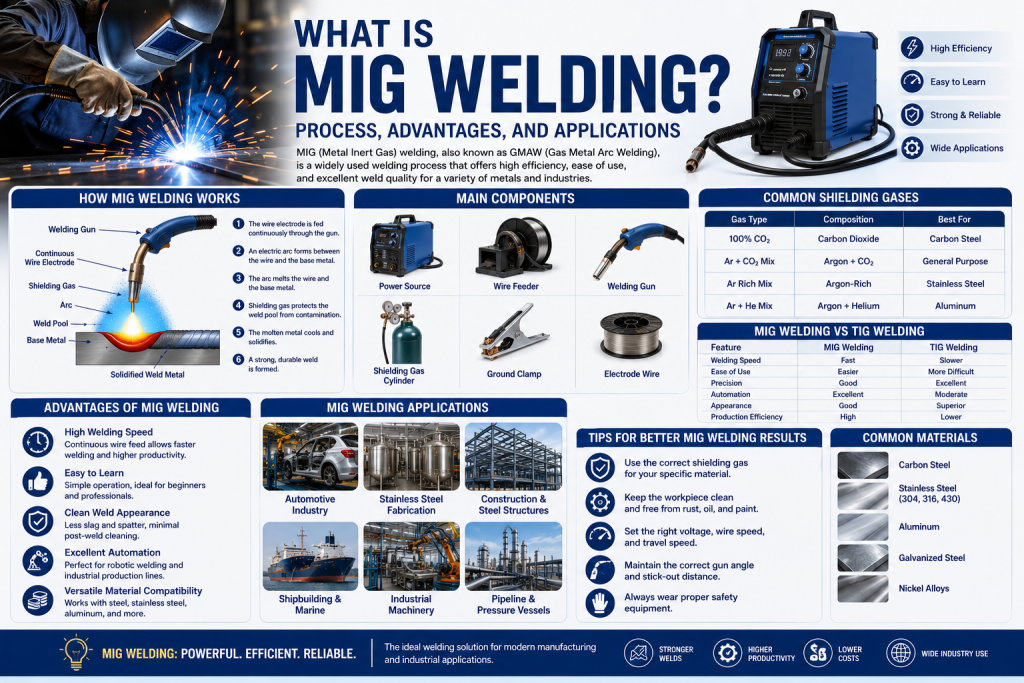
2. How Does the MIG Welding Process Work?
The MIG welding process involves several coordinated components working together.
Main Process Steps
- The welding machine supplies electrical current.
- The wire feeder continuously feeds electrode wire through the welding gun.
- An electric arc forms between the wire and the workpiece.
- The arc heat melts both the wire and base metal.
- Shielding gas protects the molten weld pool.
- The molten metal cools and solidifies into a welded joint.
The process creates strong and consistent welds suitable for both thin sheet metal and thicker industrial materials.
3. Main Components of a MIG Welding System
| Component | Function |
|---|---|
| Power Supply | Provides welding current and voltage |
| Wire Feeder | Feeds welding wire continuously |
| Welding Gun | Directs wire and shielding gas |
| Shielding Gas Cylinder | Protects weld area from contamination |
| Ground Clamp | Completes electrical circuit |
| Electrode Wire | Acts as filler metal |
4. Common Shielding Gases Used in MIG Welding
Shielding gas selection greatly affects weld quality, penetration, and spatter levels.
Common Shielding Gases
- Argon
- Carbon dioxide (CO₂)
- Argon-CO₂ mixtures
- Helium blends
Typical Applications
| Gas Type | Typical Material |
|---|---|
| 100% CO₂ | Carbon steel |
| Argon + CO₂ | General steel fabrication |
| Argon-rich mix | Stainless steel |
| Argon + Helium | Aluminum welding |
Proper shielding gas selection is critical for achieving stable arc performance and clean weld appearance.
5. Advantages of MIG Welding
High Welding Speed
MIG welding is significantly faster than many traditional welding methods because the wire is continuously fed automatically.
Easy to Learn
Compared with TIG welding, MIG welding is generally easier for beginners to master.
High Productivity
The process is ideal for:
- Mass production
- Automated welding systems
- Industrial fabrication lines
Clean Weld Appearance
MIG welding typically produces:
- Less slag
- Lower post-cleaning requirements
- Smooth weld beads
Versatile Material Compatibility
MIG welding can weld:
- Carbon steel
- Stainless steel
- Aluminum
- Nickel alloys
6. Limitations of MIG Welding
Although highly efficient, MIG welding also has certain limitations.
Sensitive to Wind
Outdoor welding can be challenging because wind may blow away shielding gas.
Requires Clean Surface
Contaminants such as:
- Oil
- Rust
- Paint
- Moisture
can negatively affect weld quality.
Equipment Complexity
MIG welding systems require:
- Gas supply systems
- Wire feeding equipment
- Electrical power sources
This makes the setup more complex than basic stick welding.
7. MIG Welding vs TIG Welding
| Feature | MIG Welding | TIG Welding |
|---|---|---|
| Welding Speed | Fast | Slower |
| Ease of Use | Easier | More difficult |
| Precision | Good | Excellent |
| Automation | Excellent | Moderate |
| Appearance Quality | Good | Superior |
| Production Efficiency | High | Lower |
MIG welding is generally preferred for production efficiency, while TIG welding is chosen for high-precision decorative or aerospace applications.
8. Industrial Applications of MIG Welding
Automotive Manufacturing
- Vehicle frames
- Exhaust systems
- Body panels
Stainless Steel Fabrication
- Kitchen equipment
- Food-grade tanks
- Decorative stainless structures
Construction Industry
- Steel structures
- Industrial buildings
- Infrastructure projects
Shipbuilding and Marine Industry
- Marine structures
- Offshore equipment
- Pipeline systems
Heavy Manufacturing
- Industrial machinery
- Pressure vessels
- Agricultural equipment
9. MIG Welding for Stainless Steel
MIG welding is widely used in stainless steel processing because it provides:
- Fast production speed
- Good corrosion-resistant welds
- Efficient fabrication for sheet metal
Common stainless steel grades welded using MIG include:
- Acier inoxydable 304
- Acier inoxydable 316L
- Acier inoxydable 430
- Duplex stainless steel
Proper shielding gas and filler wire selection are essential to maintaining corrosion resistance after welding.
10. Future Trends in MIG Welding Technology
Modern welding technology is evolving rapidly toward:
- Robotic welding systems
- AI-assisted welding control
- Smart welding monitoring
- Low-spatter pulse MIG welding
- Energy-efficient inverter systems
These innovations improve:
- Weld consistency
- Production speed
- Material efficiency
- Industrial automation capability
Frequently Asked Questions (FAQ)
What does MIG stand for in welding?
MIG stands for Metal Inert Gas welding, also known as Gas Metal Arc Welding (GMAW).
Is MIG welding good for stainless steel?
Yes. MIG welding is widely used for stainless steel fabrication because it offers fast welding speed and good productivity.
What gas is used for MIG welding?
Common shielding gases include argon, carbon dioxide, and mixed gas combinations depending on the material being welded.
Is MIG welding stronger than TIG welding?
Both processes can produce strong welds, but TIG welding often provides higher precision and cleaner appearance, while MIG welding offers higher productivity.
What industries use MIG welding?
Automotive, construction, stainless steel fabrication, shipbuilding, heavy manufacturing, and industrial engineering industries widely use MIG welding.
Conclusion: MIG welding remains one of the most important and efficient welding technologies in modern industry. Its combination of speed, automation capability, versatility, and relatively simple operation makes it ideal for large-scale manufacturing and industrial fabrication. From stainless steel processing to automotive production and structural engineering, MIG welding continues to play a critical role in global industrial development. As smart manufacturing and robotic automation continue advancing, MIG welding technology will become even more efficient, intelligent, and essential in future industrial production systems.
