
Stainless Steel vs Nickel Alloy: Composition, High Temperature Strength, Corrosion Resistance & Cost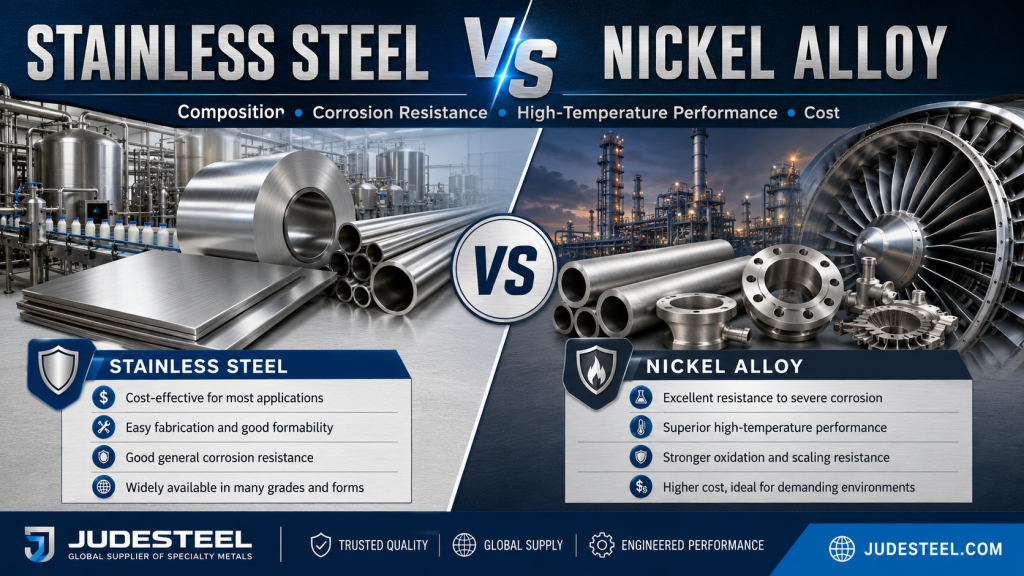
Choosing between stainless steel vs nickel alloy is an important engineering and procurement decision. Both materials are corrosion-resistant metallic materials, but they are designed for different levels of temperature, chemical exposure, mechanical stress and lifecycle performance.
Stainless steel is widely used because it offers a strong balance of corrosion resistance, strength, weldability, availability and cost efficiency. Nickel alloys are selected when the working environment becomes too severe for ordinary stainless steel, especially under high temperature, strong acids, seawater, chloride stress corrosion or failure-critical service.
This guide compares stainless steel and nickel alloy in terms of chemical composition, corrosion resistance, high-temperature strength, oxidation behavior, mechanical properties, fabrication, cost and application selection. For more material information, visit the Jude Steel Stainless Steel Grade Center.
Fast Comparison: Stainless Steel vs Nickel Alloy
| Feature | Stainless Steel | Nickel Alloy |
|---|---|---|
| Base Metal | Iron-based alloy with chromium | Nickel-based alloy system |
| Main Advantage | Cost-effective corrosion resistance and easy fabrication | Extreme corrosion resistance and high-temperature stability |
| Chromium Content | At least 10.5% | Often added for oxidation and corrosion resistance |
| Nickel Content | Low to high depending on grade | Primary element in most nickel alloys |
| High-Temperature Strength | Good in selected heat-resistant grades | Excellent in severe high-temperature environments |
| Corrosion Resistance | Good to excellent depending on grade | Excellent in aggressive chemical and seawater environments |
| Machining Difficulty | Moderate and widely understood | Difficult; strong work hardening and tool wear |
| Material Cost | Lower and more widely available | Higher due to nickel and complex alloy design |
| Typical Applications | Food equipment, tanks, pipes, architecture, general fabrication | Aerospace, chemical processing, offshore, heat exchangers, turbines |
1. What Is Stainless Steel?
Stainless steel is an iron-based alloy containing chromium. Chromium creates a thin passive oxide film on the surface, helping stainless steel resist corrosion in many atmospheric, industrial, food-grade and architectural environments.
Stainless steel is available in many families, including austenitic, ferritic, martensitic, duplex and precipitation-hardening stainless steels. Each family has different strength, corrosion resistance, magnetic behavior, weldability and cost characteristics.
Jude Steel supplies stainless steel products such as stainless steel sheet, stainless steel coil, stainless steel strip and stainless steel sheet metal.
Main Characteristics of Stainless Steel
- Good corrosion resistance in general environments
- Excellent availability in sheet, coil, strip, plate, pipe and bar forms
- Good weldability and fabrication performance
- Wide range of surface finishes, including 2B, BA, No.4, HL and 8K mirror
- Lower cost compared with most nickel alloys
- Suitable for large-scale production and commercial projects
- Performance varies significantly by grade and environment
Common Stainless Steel Grades
| Grade | Type | Typical Applications |
|---|---|---|
| 304 Stainless Steel | Austenitic | Food equipment, kitchen systems, tanks, general industrial use |
| 316L Stainless Steel | Austenitic | Marine environments, chemical equipment, chloride exposure |
| 2205 Duplex Stainless Steel | Duplex | High-strength, chloride-resistant industrial applications |
| 904L Stainless Steel | High-alloy austenitic | Acidic environments, chemical processing, severe corrosion service |
2. What Is Nickel Alloy?
Nickel alloys are high-performance metallic materials based primarily on nickel. They are commonly alloyed with chromium, molybdenum, iron, cobalt, copper, titanium, niobium or other elements to improve corrosion resistance, high-temperature strength, oxidation resistance and mechanical stability.
Nickel alloys are used when ordinary stainless steels cannot meet the required service life, safety margin or performance level. They are especially important in aerospace, chemical processing, oil and gas, marine, heat exchanger and high-temperature systems.
Main Characteristics of Nickel Alloys
- Excellent resistance to severe corrosion
- Outstanding high-temperature strength and thermal stability
- Strong oxidation and scaling resistance
- Good resistance to seawater, acids and chloride environments in selected grades
- Suitable for critical and failure-sensitive systems
- Higher material cost than stainless steel
- More difficult machining and fabrication requirements
Common Nickel Alloy Families
| Nickel Alloy Family | Typical Grades | Main Strength |
|---|---|---|
| Inconel | Inconel 600, 625, 718 | High-temperature strength, oxidation resistance, corrosion resistance |
| Incoloy | Incoloy 800, 825 | Heat resistance and chemical corrosion resistance |
| Hastelloy | Hastelloy C276, C22 | Excellent acid and chemical corrosion resistance |
| Monel | Monel 400, K500 | Seawater resistance and copper-nickel corrosion performance |
3. Chemical Composition Comparison
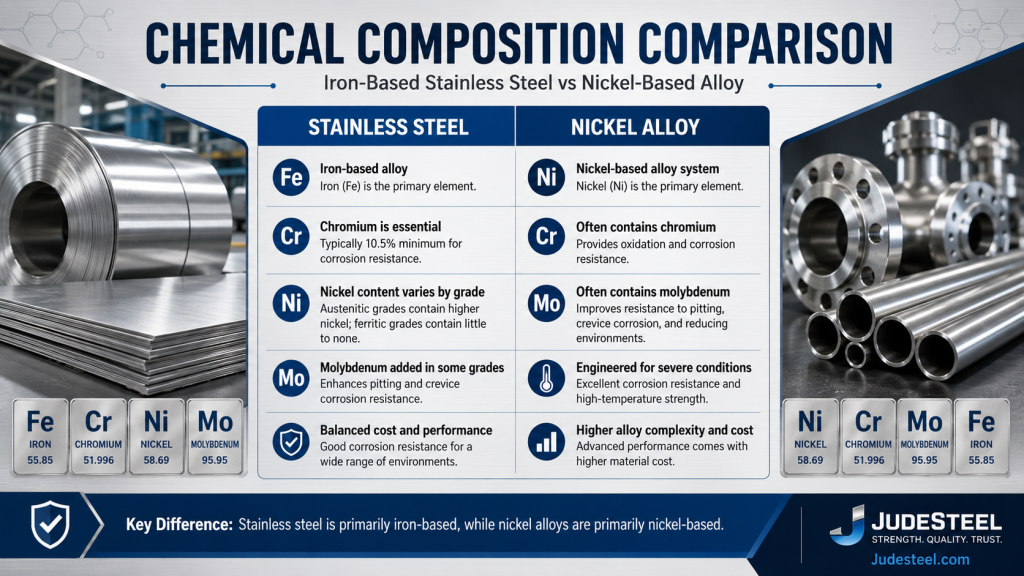
The most important difference between stainless steel and nickel alloy is the base metal. Stainless steel is primarily iron-based, while nickel alloy is primarily nickel-based. This difference affects corrosion resistance, temperature capability, mechanical stability and cost.
| Element / Feature | Stainless Steel | Nickel Alloy |
|---|---|---|
| Base Element | Iron | Nickel |
| Chromium | Essential element for passive film formation | Often added for oxidation and corrosion resistance |
| Nickel | Low to high depending on grade | Primary element in most nickel alloys |
| Molybdenum | Added in grades such as 316L, 904L and duplex stainless steels | Often added for acid, pitting and crevice corrosion resistance |
| Iron | Main base metal | May be present but usually not the main design element |
| Design Goal | Balanced corrosion resistance, formability, weldability and cost | Extreme resistance to heat, corrosion, pressure and critical service |
Why Composition Matters
The iron-chromium system gives stainless steel excellent cost-performance value. The nickel-rich alloy matrix gives nickel alloys stronger stability in aggressive chemicals, high temperatures and failure-critical environments.
4. High-Temperature Performance
High-temperature performance is one of the most important reasons engineers upgrade from stainless steel to nickel alloy. Standard stainless steel grades can lose strength, oxidize or scale at elevated temperatures, while many nickel alloys retain mechanical integrity more effectively.
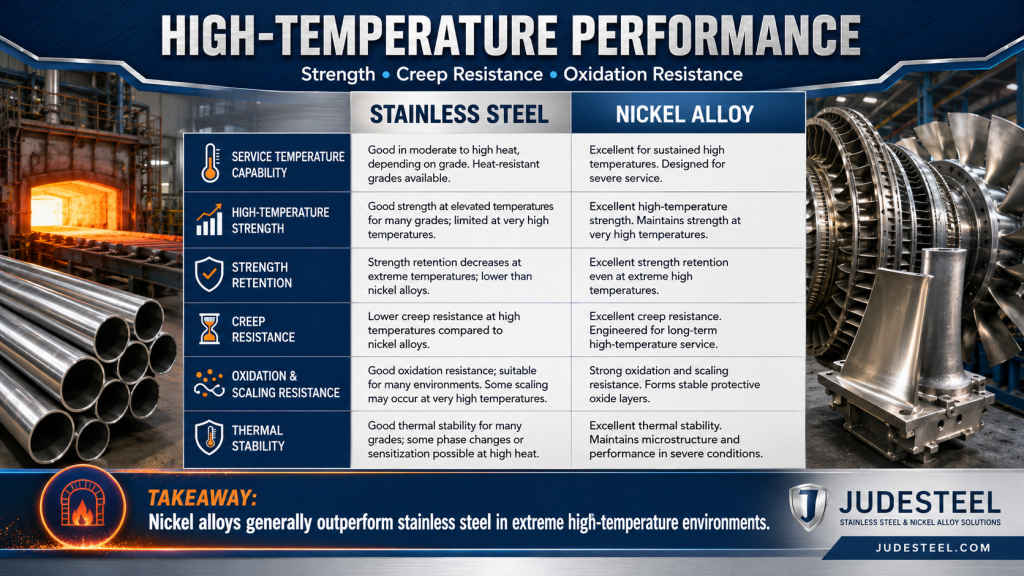 High-temperature comparison: nickel alloys usually retain strength, oxidation resistance and creep performance better than standard stainless steels.
| Performance Factor | Stainless Steel | Nickel Alloy |
|---|---|---|
| High-Temperature Strength | Good in selected heat-resistant grades | Excellent in severe high-temperature service |
| Creep Resistance | Limited in standard grades | Excellent in selected alloys |
| Oxidation Resistance | Grade-dependent | Excellent in many nickel-chromium alloys |
| Thermal Stability | Good to limited depending on grade and temperature | Outstanding in extreme environments |
| Best Use | Moderate heat, general process equipment, heat-resistant stainless grades | Turbines, aerospace engines, furnaces, high-temperature reactors |
Engineering Insight
- Stainless steel is usually enough for moderate-temperature industrial systems.
- Heat-resistant stainless steels may solve many elevated-temperature applications.
- Nickel alloys are preferred when heat, stress, oxidation and safety risk occur together.
- For severe high-temperature service, material selection should consider creep, oxidation, stress and service duration together.
5. Corrosion Resistance Comparison
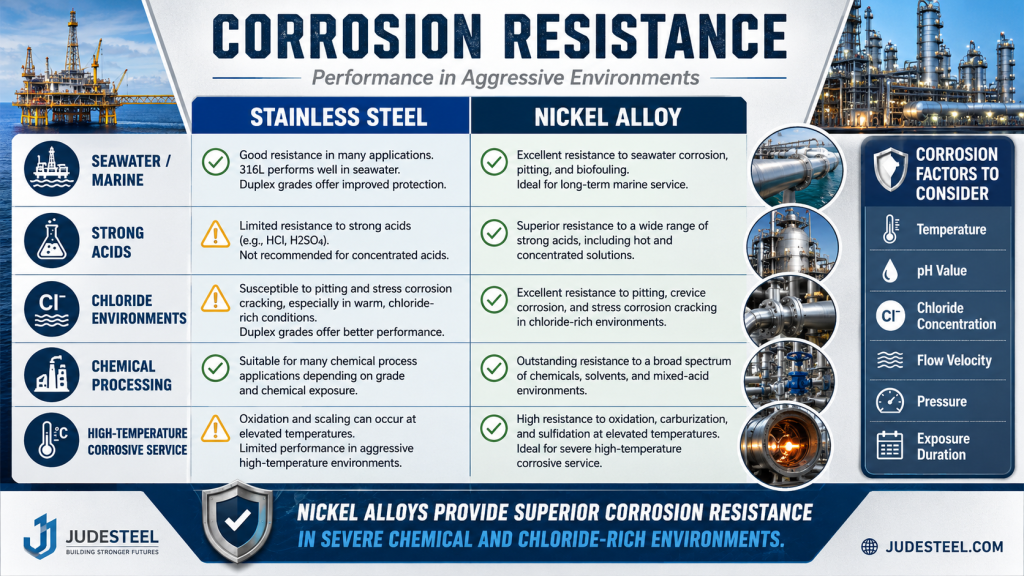
Both stainless steel and nickel alloy are corrosion-resistant materials, but they operate at different performance levels. Stainless steel performs well in general industrial, architectural, water, food and moderate chemical environments. Nickel alloys are preferred when corrosion becomes severe or combined with heat and stress.
| Environment | Stainless Steel | Nickel Alloy |
|---|---|---|
| Dry Indoor Environment | Excellent | Excellent but often unnecessary |
| Food Processing | 304 or 316L commonly used | Usually unnecessary unless chemicals or high heat are involved |
| Marine / Seawater | 316L, duplex 2205 or super duplex may be used | Excellent in suitable grades such as Monel or Inconel 625 |
| Acidic Chemical Media | Grade-dependent and sometimes limited | Excellent in selected alloys such as Hastelloy and Inconel |
| Chloride Stress Corrosion | Austenitic stainless steels may be vulnerable under certain conditions | Better resistance in many nickel alloy systems |
| High-Temperature Oxidation | Good only in selected heat-resistant grades | Excellent in many nickel-chromium alloys |
6. Oxidation and Scaling Resistance
Oxidation and scaling become critical when metal surfaces are exposed to high temperature and oxygen-containing atmospheres. If the oxide scale becomes unstable, it can crack, spall and expose fresh metal to further attack.
Nickel alloys often form more stable oxide layers at elevated temperatures, especially in nickel-chromium alloy systems. Stainless steel can also resist oxidation, but performance strongly depends on grade and service temperature.
| Factor | Stainless Steel | Nickel Alloy |
|---|---|---|
| Oxide Layer Stability | Moderate to good depending on grade | Very good in many high-temperature alloys |
| Scaling Resistance | Grade-dependent | Excellent in severe heat exposure |
| Thermal Cycling | Application-dependent | Strong performance in selected alloys |
| Maintenance Risk | May increase in high-temperature scaling environments | Lower in severe heat when correctly selected |
7. Mechanical Properties: Strength, Creep and Fatigue
Stainless steel can provide reliable mechanical strength for tanks, structures, pipelines and general fabrication. Duplex stainless steels can offer particularly high strength and good corrosion resistance.
Nickel alloys are often selected when strength must be retained under heat, pressure, fatigue or corrosive media. In applications such as aerospace engines, high-temperature fasteners, turbines and chemical reactors, nickel alloy performance may justify its higher cost.
| Mechanical Factor | Stainless Steel | Nickel Alloy |
|---|---|---|
| Room-Temperature Strength | Good to high depending on grade | High in many grades |
| High-Temperature Strength Retention | Limited in standard grades | Excellent in selected alloys |
| Creep Resistance | Moderate to limited unless special grades are used | Excellent in many high-temperature alloys |
| Fatigue Resistance | Good for general service | Excellent in demanding and safety-critical systems |
| Structural Cost Efficiency | Excellent for general industry | Only justified when service conditions demand it |
8. Fabrication, Welding and Machining
Stainless steel is usually easier and faster to fabricate. Cutting, bending, welding, polishing, brushing and forming processes are widely available and cost-effective. Jude Steel provides related processing services such as laser cutting, bending, brushing and polishing.
Nickel alloys require more process control. Many nickel alloys work harden quickly, generate heat during machining and cause higher tool wear. Welding may require stricter procedures, controlled heat input and experienced operators.
| Processing Factor | Stainless Steel | Nickel Alloy |
|---|---|---|
| Machinability | Moderate to good | Difficult |
| Welding | Generally easier with common grades | Possible but requires procedure control |
| Tool Wear | Moderate | High |
| Fabrication Cost | Lower | Higher |
| Availability | Widely available in many forms | More limited and often longer lead time |
9. Cost Comparison
Cost is one of the biggest practical differences between stainless steel and nickel alloy. Stainless steel is produced at large industrial scale and is widely available. Nickel alloy contains high nickel and alloying elements, and it requires more complex production and processing.
| Cost Factor | Stainless Steel | Nickel Alloy |
|---|---|---|
| Raw Material Cost | Low to moderate depending on grade | High |
| Processing Cost | Lower | Higher due to machining difficulty |
| Lead Time | Usually shorter | Often longer |
| Maintenance Cost | Low when correctly selected | Can be lower in extreme environments by preventing failure |
| Best Cost Scenario | General corrosion-resistant industrial projects | Failure-critical severe environments |
10. Typical Stainless Steel Applications
- Food processing equipment
- Commercial kitchen systems
- Stainless steel tanks and vessels
- Industrial pipelines
- Architectural panels and cladding
- Water treatment systems
- General sheet metal fabrication
- Marine components using 316L or duplex grades
- Structural and decorative metal products
11. Typical Nickel Alloy Applications
- Aerospace engines and turbine components
- Chemical processing equipment
- Oil and gas sour service systems
- Heat exchangers in aggressive environments
- Offshore and seawater equipment
- Nuclear and power generation systems
- High-temperature fasteners and springs
- Acid-resistant reactors and piping
- Furnace and thermal processing components
12. Stainless Steel vs Nickel Alloy: Quick Selection Guide
| Project Requirement | Recommended Material | Reason |
|---|---|---|
| General corrosion resistance at controlled cost | Stainless Steel | 304, 316L, duplex or other grades can meet many industrial needs |
| Food processing and hygiene | Stainless Steel | 304 and 316L are widely used and cost-effective |
| Extreme high-temperature strength | Nickel Alloy | Better creep, oxidation and strength retention |
| Strong acid or chemical corrosion | Nickel Alloy | Hastelloy, Inconel or other alloys may be required |
| Large-scale fabrication | Stainless Steel | Better availability and processing efficiency |
| Severe seawater or chloride exposure | Nickel Alloy or high-alloy stainless steel | Final choice depends on temperature, pressure and design life |
| Aerospace turbine components | Nickel Alloy | High heat, fatigue and safety requirements are critical |
| Architecture and decorative use | Stainless Steel | Better finish options and lower cost |
13. Which Material Should You Choose?
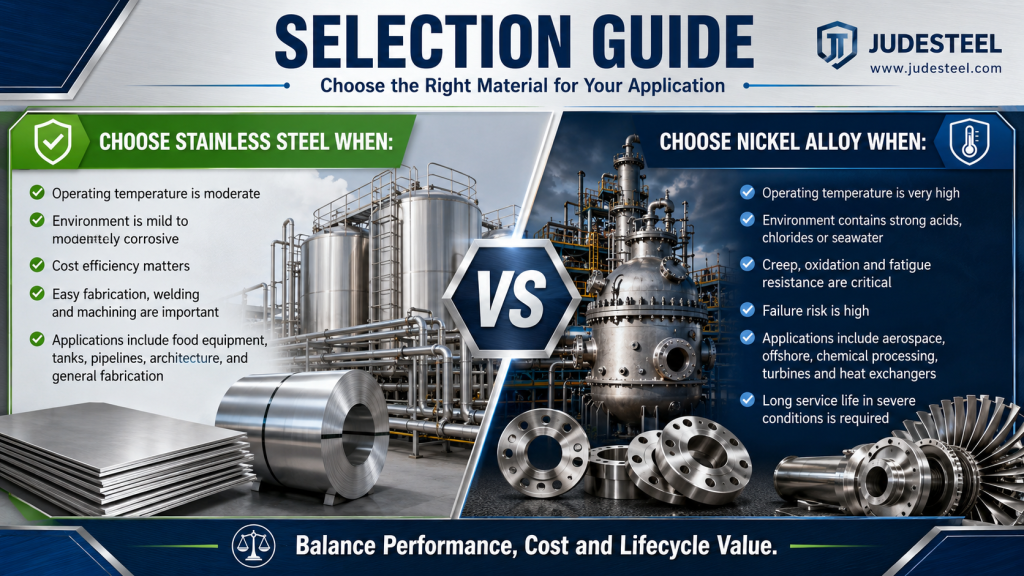
Choose Stainless Steel If:
- Budget and availability are important
- The environment is mild to moderate
- General corrosion resistance is sufficient
- The project requires easy welding, bending or forming
- The application involves food equipment, tanks, pipes or architecture
- 304, 316L, 904L, 2205 or 2507 can meet the service requirement
- Large-volume production and fast delivery are priorities
Choose Nickel Alloy If:
- The operating temperature is very high
- Strong acids, seawater, chlorides or aggressive chemicals are present
- Creep resistance and thermal stability are required
- Failure cost is extremely high
- The application is aerospace, chemical processing, offshore or high-pressure service
- Standard stainless steel cannot provide the required design life
- Performance and reliability are more important than material cost
Consider High-Alloy Stainless Steel If:
- 304 is not enough but nickel alloy may be over-engineered
- 316L provides partial but insufficient corrosion resistance
- Duplex 2205 can improve strength and chloride resistance
- 904L or super duplex grades may reduce lifecycle cost
- The project needs a balance between performance and budget
14. Common Buyer Mistakes to Avoid
- Choosing nickel alloy when stainless steel is already sufficient
- Using standard stainless steel in severe chemical environments
- Ignoring temperature when comparing corrosion resistance
- Assuming all stainless steels resist chlorides equally
- Comparing only raw material price and ignoring machining cost
- Ignoring weld procedure and fabrication difficulty
- Using decorative surface appearance as a substitute for corrosion performance
- Failing to evaluate design life, maintenance cost and failure risk
Correct material selection should consider temperature, corrosion chemistry, pressure, mechanical stress, fabrication process, expected service life and total lifecycle cost.
Frequently Asked Questions
What is the main difference between stainless steel and nickel alloy?
Stainless steel is an iron-based alloy containing chromium, while nickel alloy is primarily based on nickel and often contains chromium, molybdenum, iron or other alloying elements. Nickel alloys usually perform better in extreme heat and aggressive corrosion, while stainless steel is more cost-effective for general applications.
Is nickel alloy better than stainless steel?
Nickel alloy is better in severe environments such as high temperature, strong acids, seawater, chloride exposure and failure-critical systems. Stainless steel is better when cost, availability, fabrication and general corrosion resistance are the main priorities.
When should stainless steel be replaced by nickel alloy?
Nickel alloy should be considered when operating temperature exceeds the reliable range of stainless steel, when strong chemical corrosion is present, or when creep, oxidation, fatigue or failure risk becomes critical.
Why are nickel alloys more expensive?
Nickel alloys are more expensive because they contain high levels of nickel and other alloying elements, require more complex production, are harder to machine and are typically used in demanding applications.
Can stainless steel replace nickel alloy?
Stainless steel can replace nickel alloy only in moderate environments where temperature, corrosion and mechanical stress are not extreme. In severe chemical, high-temperature or safety-critical environments, nickel alloy is usually the safer material.
Which is better for seawater, stainless steel or nickel alloy?
For moderate marine use, 316L stainless steel or duplex 2205 may be sufficient. For severe seawater, high temperature, high pressure or long-life offshore systems, nickel alloys such as Monel or Inconel may be more reliable.
Are nickel alloys harder to machine than stainless steel?
Yes. Nickel alloys usually work harden quickly, generate heat during machining and cause more tool wear. Stainless steel is generally easier and more economical to process.
Conclusion
Stainless steel and nickel alloy are both valuable engineering materials, but they are not used for the same performance level. Stainless steel offers an excellent balance of corrosion resistance, strength, surface finish, fabrication, availability and cost. It is the practical choice for food equipment, tanks, pipelines, construction, architecture and general industrial fabrication.
Nickel alloy is designed for more severe service conditions. It provides stronger performance in high temperature, strong acid, seawater, chloride, oxidation, creep and failure-critical environments. Although nickel alloy costs more, it can prevent premature failure when stainless steel cannot provide reliable service life.
The best material is not always the most expensive one. It is the one that safely matches the operating environment, mechanical demand, corrosion risk, fabrication method and lifecycle cost. Jude Steel supplies stainless steel sheets, coils, strips and customized stainless steel processing services for global buyers. Explore more at Judesteel.com, or visit our product pages for stainless steel sheet, stainless steel coil and stainless steel strip.
