
Stainless Steel vs Black Stainless Steel: Differences, Durability, Cost & Applications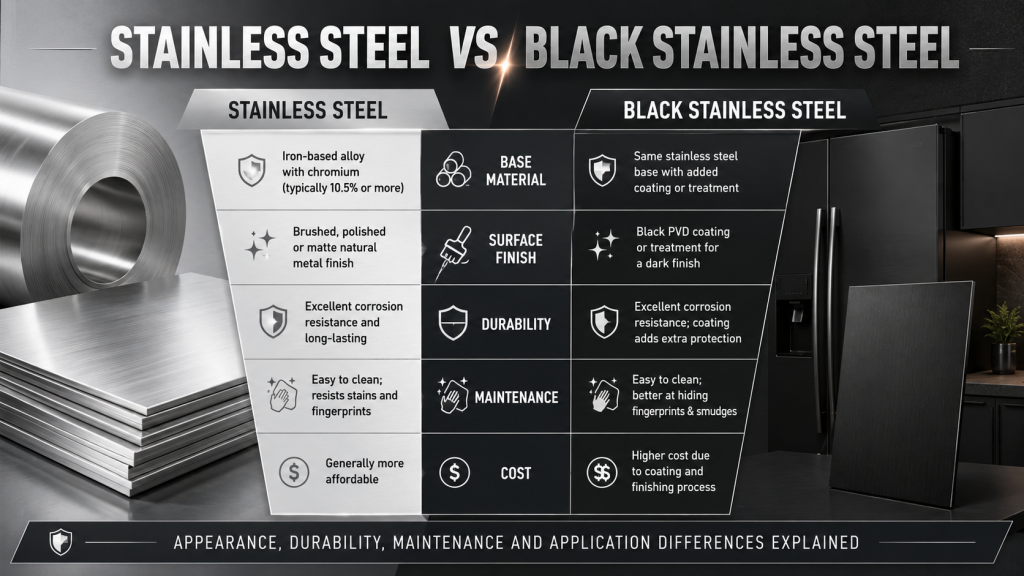
When comparing stainless steel vs black stainless steel, many buyers focus only on color. However, the real difference is not just appearance. It also involves surface treatment, scratch visibility, maintenance method, fabrication process, long-term durability and total project cost.
Standard stainless steel is a corrosion-resistant metal alloy with a silver metallic surface. Black stainless steel is usually stainless steel that has been treated with a black surface finish, coating or coloring process. In other words, black stainless steel is often not a different base metal. It is commonly stainless steel plus a black surface technology.
This guide explains the differences between stainless steel and black stainless steel in material structure, surface finish, durability, corrosion resistance, maintenance, fabrication, cost and application selection. For more material information, visit the Jude Steel Stainless Steel Grade Center.
Fast Comparison: Stainless Steel vs Black Stainless Steel
| Feature | Stainless Steel | Black Stainless Steel |
|---|---|---|
| Material Nature | Base stainless steel alloy | Stainless steel with black surface treatment |
| Typical Color | Silver, metallic, bright, brushed or mirror | Black, dark gray, matte black, brushed black or glossy black |
| Main Purpose | Durability, corrosion resistance and industrial performance | Decorative appearance, modern design and fingerprint reduction |
| Base Grade | 304, 316L, 430, 201, 202, 441 and other grades | Usually 304, 430 or other stainless steel substrate |
| Surface Technology | 2B, BA, No.4, HL, mirror, brushed, polished | PVD coating, oxide coloring, electrochemical coloring or coating system |
| Scratch Visibility | Scratches may be visible on reflective surfaces | Light marks may be less visible, but deep scratches can expose silver base metal |
| Corrosion Resistance | Depends on stainless steel grade | Depends on base grade and coating quality |
| Cleaning | Can tolerate stronger cleaning methods depending on finish | Requires gentler cleaning to protect the black surface |
| Fabrication Flexibility | High | Usually processed first, then black finished or coated |
| Cost | Lower | Higher due to additional surface processing |
| Typical Applications | Industrial equipment, food systems, tanks, pipes, architecture | Appliances, interior decoration, elevator panels, cabinets, premium consumer products |
1. What Is Stainless Steel?
Stainless steel is an iron-based alloy containing chromium. Chromium forms a thin passive oxide film on the surface, helping the material resist rust and corrosion. Different stainless steel grades contain different levels of chromium, nickel, molybdenum, carbon, manganese and other alloying elements.
Common grades include 304 stainless steel, 316L stainless steel and 430 stainless steel. Each grade has different corrosion resistance, strength, magnetic behavior, weldability and cost characteristics.
Jude Steel supplies stainless steel products including stainless steel sheet, stainless steel coil, stainless steel strip and stainless steel sheet metal.
Main Characteristics of Stainless Steel
- Strong and durable metallic material
- Good corrosion resistance depending on grade
- Available in many grades and thicknesses
- Can be cut, bent, welded, polished and brushed
- Suitable for industrial, architectural and consumer applications
- Lower cost than black stainless steel with additional finishing
- Long service life with proper material selection and maintenance
Common Stainless Steel Surface Finishes
| Finish | Appearance | Typical Use |
|---|---|---|
| 2B | Smooth, gray, semi-reflective | General sheet, equipment, further processing |
| BA | Bright annealed, reflective | Appliances, decorative parts, clean surfaces |
| N°4 | Brushed linear finish | Kitchen equipment, elevator panels, interior decoration |
| HL / Hairline | Long directional brushing | Architecture, decorative panels, premium interiors |
| Mirror / 8K | Highly reflective polished surface | Decoration, luxury panels, signage |
2. What Is Black Stainless Steel?
Black stainless steel is typically stainless steel with a black surface treatment. The base material may still be 304, 316L, 430 or another stainless steel grade, but the surface is modified to create a black, dark gray, matte or glossy finish.
The performance of black stainless steel depends on two key factors:
- The quality of the base stainless steel grade
- The quality and durability of the black surface treatment
Black stainless steel is popular in appliances, interior decoration, elevator panels, wall cladding, cabinets, commercial displays and modern architectural design.
Common Black Stainless Steel Surface Methods
- PVD coating: A physical vapor deposition process that creates a hard decorative coating.
- Electrochemical coloring: Uses controlled surface coloring to create dark tones.
- Oxide film treatment: Forms or modifies oxide layers for a dark appearance.
- Decorative coating: Applies a black coating system to stainless steel surface.
- Black brushed finish: Combines black color with directional brushing texture.
3. Core Difference: Base Material vs Surface Treatment
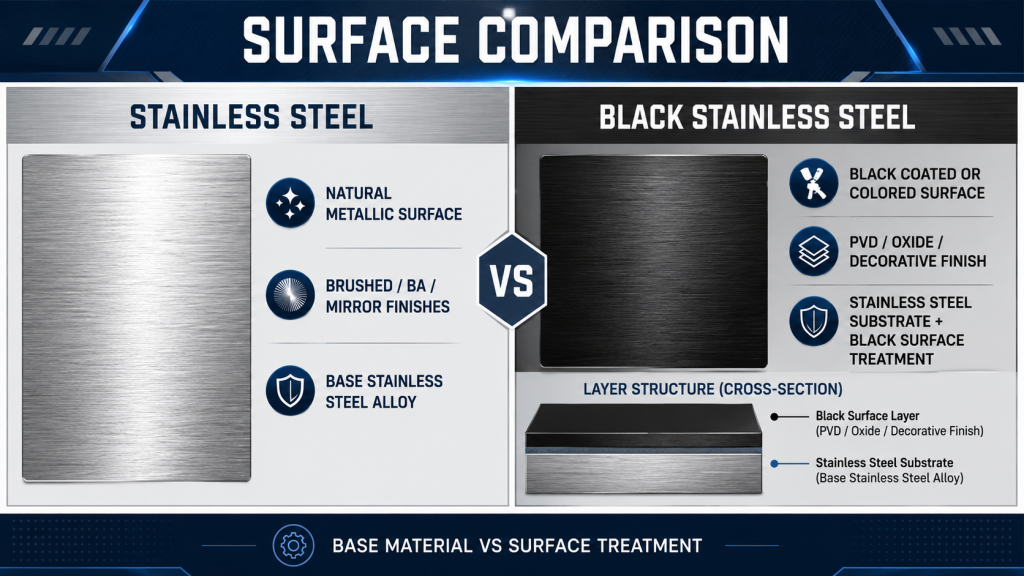
The most important concept is simple: standard stainless steel is the base material, while black stainless steel is usually the same type of material with a black surface finish. This means the core metal performance still depends on the original stainless steel grade.
| Comparison Factor | Stainless Steel | Black Stainless Steel |
|---|---|---|
| Basic Structure | Solid stainless steel alloy | Stainless steel substrate plus black surface layer |
| Color Source | Natural metallic stainless steel surface | Surface treatment, coating or coloring process |
| Performance Basis | Determined by alloy grade and surface finish | Determined by base grade plus coating durability |
| Repairability | Can often be re-polished or re-brushed | More difficult if black coating is damaged |
| Best Use | Industrial and performance-driven applications | Appearance-driven decorative applications |
Practical Meaning
- 304 black stainless steel is still based on 304 stainless steel.
- 430 black stainless steel is still based on 430 stainless steel.
- If the coating is scratched deeply, the silver base metal may become visible.
- For heavy industrial use, plain stainless steel is often more practical.
- For decorative design, black stainless steel can provide higher visual value.
4. Durability and Scratch Resistance
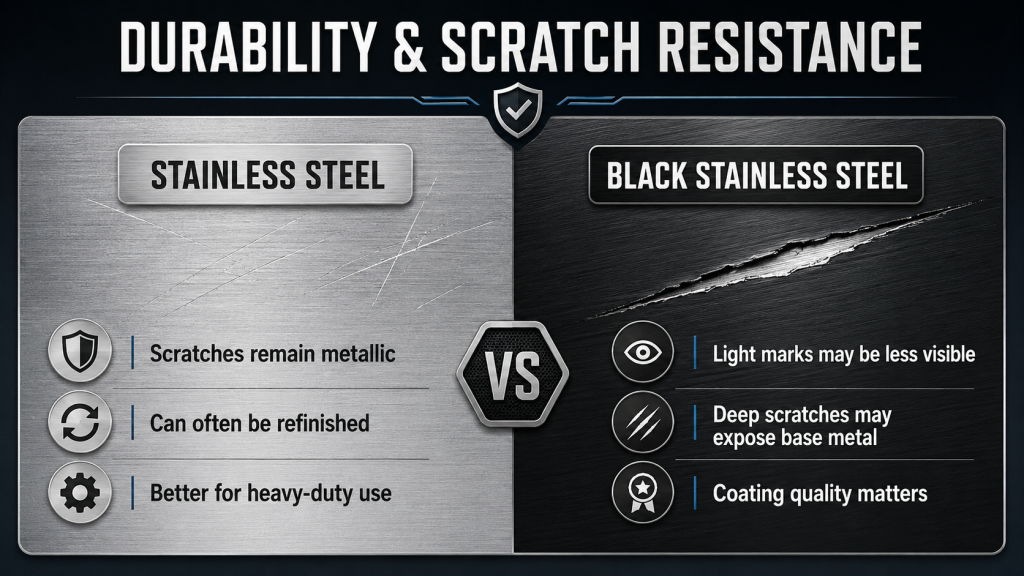
Durability is one of the most misunderstood points in the comparison between stainless steel and black stainless steel. Standard stainless steel may show scratches, especially on polished or mirror surfaces, but scratches usually do not destroy the base metal.
Black stainless steel can hide fingerprints and light marks better, but deep scratches may damage the black layer and reveal the silver stainless steel underneath. This can make scratches more obvious if the coating is not thick, uniform or durable enough.
| Property | Stainless Steel | Black Stainless Steel |
|---|---|---|
| Light Scratch Visibility | Visible on reflective surfaces | Often less visible on matte or brushed black surfaces |
| Deep Scratch Effect | Scratch remains on metallic surface | May expose silver substrate if coating is damaged |
| Long-Term Wear | Stable if properly selected and maintained | Depends strongly on coating quality and use environment |
| Repair Options | Can often be polished, brushed or refinished | Harder to repair because color matching is required |
| Industrial Abuse Resistance | Better for heavy-duty applications | Not ideal for high-wear or abrasive environments |
Key Insight
- For heavy-duty work surfaces, standard stainless steel is usually safer.
- For low-contact decorative panels, black stainless steel performs well.
- For appliances, black stainless steel can reduce fingerprint visibility.
- For outdoor or high-wear use, coating quality and base grade must be carefully specified.
5. Corrosion Resistance Comparison
Corrosion resistance depends mainly on the stainless steel grade. A black finish does not turn a low-corrosion-resistance grade into a high-performance grade. For example, 316L stainless steel usually provides better chloride resistance than 304 or 430, whether the surface is silver or black.
A high-quality black coating may provide additional surface protection, but if the coating is damaged, moisture and contaminants may accumulate at the damaged area. This can increase local corrosion risk, especially in humid, salty or chemical environments.
| Environment | Stainless Steel | Black Stainless Steel |
|---|---|---|
| Dry Indoor Environment | Excellent with proper grade | Excellent with proper grade and coating |
| Kitchen / Appliance Use | Excellent | Excellent for decorative appliance surfaces |
| Humid Indoor Environment | Grade-dependent | Grade and coating dependent |
| Outdoor Architecture | 304, 316L or higher grades recommended | Use high-quality coating and suitable base grade |
| Marine / Salt Environment | 316L or duplex grades preferred | 316L or higher substrate with durable coating required |
| Chemical / Industrial Environment | Grade selection is critical | Not recommended unless coating and substrate are engineered for service |
6. Fingerprint Resistance, Cleaning and Maintenance
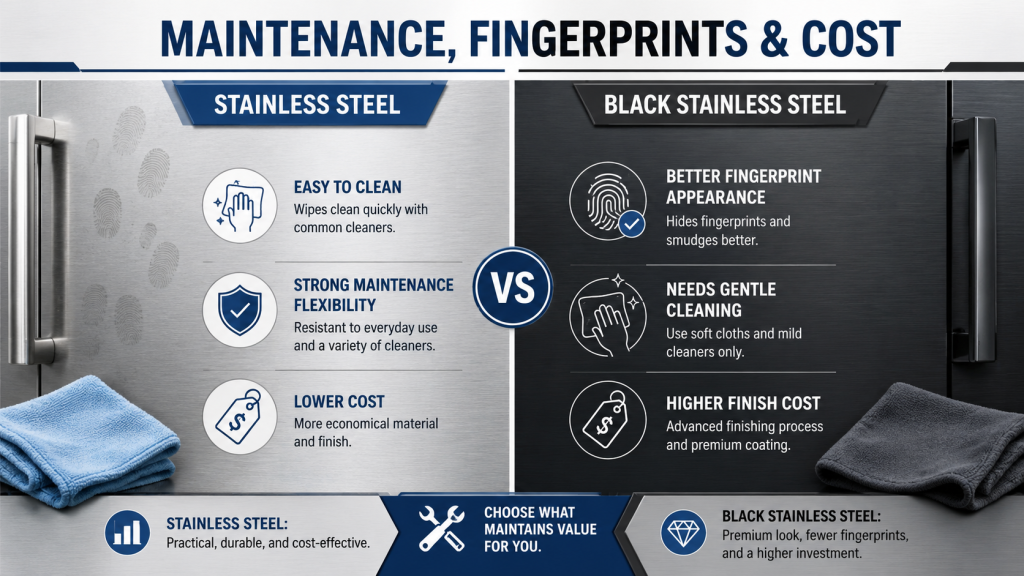
Black stainless steel is often chosen because it looks modern and can reduce fingerprint visibility. Matte black and brushed black finishes are especially effective in appliance and interior decoration markets.
However, black stainless steel usually requires more careful cleaning. Abrasive pads, harsh chemicals or aggressive polishing can damage the black layer. Standard stainless steel is generally easier to clean aggressively, especially in industrial and food-processing environments.
| Maintenance Factor | Stainless Steel | Black Stainless Steel |
|---|---|---|
| Fingerprint Visibility | More visible on bright surfaces | Usually less visible, especially on matte finishes |
| Cleaning Method | Standard stainless steel cleaners, soft cloth, mild detergent | Soft cloth and mild detergent; avoid abrasive cleaning |
| Polissage | Possible on many finishes | Not recommended unless coating system allows it |
| Repairability | Better | More difficult due to color and coating matching |
| Long-Term Appearance | Stable with proper care | Depends on coating quality and cleaning method |
Cleaning Tips for Black Stainless Steel
- Use soft microfiber cloths.
- Use mild detergent or approved stainless steel cleaner.
- Avoid steel wool, abrasive pads and harsh polishing compounds.
- Wipe in the direction of the brushing pattern if applicable.
- Test cleaning products on a hidden area first.
7. Fabrication and Processing Differences
Standard stainless steel is more flexible in fabrication. It can be cut, bent, welded, brushed, polished and formed using common industrial processes. Jude Steel provides services such as laser cutting, bending, brushing and polishing.
Black stainless steel usually requires more planning. In many cases, the stainless steel is cut, formed or fabricated first, and then black surface treatment is applied. If welding, grinding or bending is performed after coating, the black surface may be damaged.
| Processing Factor | Stainless Steel | Black Stainless Steel |
|---|---|---|
| Cutting | Easy and flexible | Preferably before black coating |
| Pliage | Good with proper tooling | May risk coating cracking if done after coating |
| Welding | Standard process by grade | Coating must be protected or removed near weld zone |
| Polishing / Brushing | Flexible after fabrication | Limited after black surface treatment |
| Surface Repair | Usually possible | More difficult due to black color matching |
| Production Planning | More flexible | Requires coating sequence control |
8. Cost Comparison
Black stainless steel is usually more expensive than standard stainless steel because it requires additional surface treatment, coating control, handling protection and visual inspection. The cost difference depends on base grade, thickness, finish type, coating technology, order volume and quality requirements.
| Cost Factor | Stainless Steel | Black Stainless Steel |
|---|---|---|
| Base Material Cost | Depends on grade and thickness | Same base material cost plus finish cost |
| Surface Treatment Cost | Standard finish cost | Higher due to black coating or coloring process |
| Processing Cost | Lower and flexible | Higher due to coating protection and handling |
| Repair Cost | Lower in many cases | Higher if coating damage occurs |
| Best Cost Scenario | Industrial, structural and large-volume projects | Premium decorative products where appearance adds value |
9. Application Comparison
Best Applications for Standard Stainless Steel
- Food processing equipment
- Chemical tanks and vessels
- Industrial pipelines
- Marine hardware
- Kitchen worktables and sinks
- Medical instruments
- Structural components
- Outdoor architectural components
- High-wear industrial surfaces
Best Applications for Black Stainless Steel
- Home appliances
- Premium kitchen panels
- Elevator decorative panels
- Interior wall cladding
- Cabinet doors and display fixtures
- Hotel and retail decoration
- Architectural feature panels
- Luxury consumer products
- Modern furniture and commercial interiors
10. Stainless Steel vs Black Stainless Steel: Selection Guide
| Project Requirement | Recommended Option | Reason |
|---|---|---|
| Lowest cost and high availability | Stainless Steel | No additional black coating cost |
| Modern dark appearance | Black Stainless Steel | Creates premium black or dark gray visual effect |
| Heavy industrial use | Stainless Steel | Better repairability and less coating risk |
| Appliances and cabinets | Black Stainless Steel | Modern appearance and lower fingerprint visibility |
| Food processing equipment | Stainless Steel | Easier cleaning, hygiene and maintenance |
| Interior decorative panels | Black Stainless Steel | High visual value and design flexibility |
| Marine or outdoor corrosion resistance | 316L Stainless Steel or black 316L with durable coating | Base grade selection matters more than color |
| Projects requiring cutting, welding and grinding after delivery | Stainless Steel | More flexible fabrication after purchase |
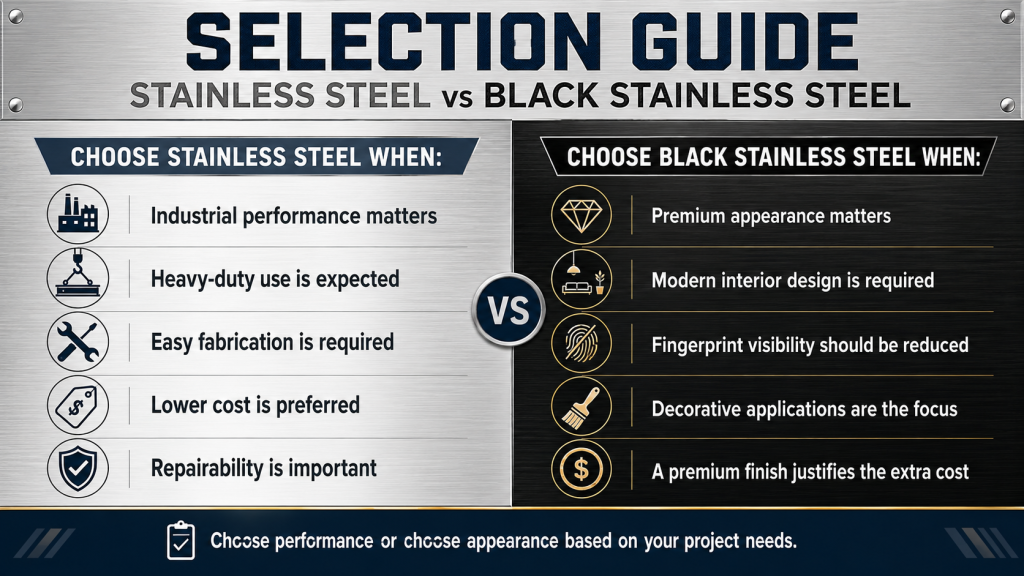
11. Which One Should You Choose?
Choose Stainless Steel If:
- Cost efficiency is important
- The project requires welding, cutting, bending or polishing
- The application is industrial or structural
- The surface may face heavy wear, impact or abrasion
- Cleaning and hygiene are top priorities
- Repairability matters
- The final appearance does not require a black finish
Choose Black Stainless Steel If:
- Modern black appearance is required
- The product is decorative or consumer-facing
- Fingerprint visibility should be reduced
- The application is indoor or low-wear
- The project involves appliances, elevator panels, interiors or retail displays
- The design value justifies the higher finishing cost
- The coating quality can be specified and controlled
Consider Higher-Grade Stainless Steel If:
- 304 is not corrosion resistant enough
- 316L is required for chloride or marine environments
- 430 is selected for cost-sensitive decorative applications
- Duplex stainless steel is needed for higher strength and corrosion resistance
- The surface finish must survive outdoor or industrial exposure
12. Common Buyer Mistakes to Avoid
- Assuming black stainless steel is a completely different alloy
- Choosing black finish without confirming the base grade
- Using black stainless steel in high-wear industrial areas
- Ignoring coating thickness and coating quality
- Cutting or welding after coating without planning for surface damage
- Using abrasive cleaners on black coated surfaces
- Assuming black color automatically improves corrosion resistance
- Comparing only appearance and ignoring lifecycle cost
The correct choice should consider base stainless steel grade, surface finish, coating quality, use environment, cleaning method, fabrication sequence and expected service life.
Frequently Asked Questions
What is the main difference between stainless steel and black stainless steel?
Stainless steel is the base metal alloy, while black stainless steel is usually stainless steel with a black surface treatment such as PVD coating, oxide film treatment, electrochemical coloring or decorative coating.
Is black stainless steel a different material?
Usually no. Black stainless steel is often the same base stainless steel grade with a black surface finish. Its performance depends on both the base grade and the quality of the black coating or coloring process.
Does black stainless steel scratch easily?
Black stainless steel can hide light fingerprints and minor marks well, but deep scratches may expose the silver stainless steel underneath. This is why coating quality and application environment are important.
Which is more corrosion resistant, stainless steel or black stainless steel?
Corrosion resistance depends more on the base grade than the color. A 316L stainless steel surface generally provides better chloride resistance than 304 or 430, whether the surface is silver or black.
Is black stainless steel good for outdoor use?
Black stainless steel can be used outdoors only when the base grade and coating system are suitable for outdoor exposure. For marine or chloride environments, 316L or higher-grade stainless steel should be considered.
Is black stainless steel more expensive?
Yes. Black stainless steel usually costs more because it requires additional surface treatment, coating process control, careful handling and appearance quality inspection.
Can black stainless steel be welded?
The stainless steel substrate can be welded, but welding after black coating may damage the surface finish. In most cases, fabrication should be completed before black finishing or coating.
Conclusion
Stainless steel and black stainless steel are closely related, but they serve different priorities. Standard stainless steel is the practical choice for industrial performance, corrosion resistance, fabrication flexibility, hygiene, repairability and cost efficiency. It is widely used in food equipment, chemical systems, tanks, pipelines, marine hardware, architecture and general fabrication.
Black stainless steel is usually stainless steel with a black surface treatment. It is selected mainly for design value, modern appearance, fingerprint reduction and premium decorative effect. It works best in appliances, interior decoration, elevator panels, cabinets, retail displays and consumer-facing products where appearance matters.
The best choice depends on your project goal. Choose standard stainless steel when performance, processing and long-term durability are most important. Choose black stainless steel when premium appearance and decorative value justify the higher surface treatment cost. Jude Steel supplies stainless steel sheets, coils, strips and customized surface processing solutions for global buyers. Explore more at Judesteel.com, or visit our product pages for stainless steel sheet, stainless steel coil and stainless steel strip.
