
Martensitic Stainless Steel Raw Materials Buying Guide
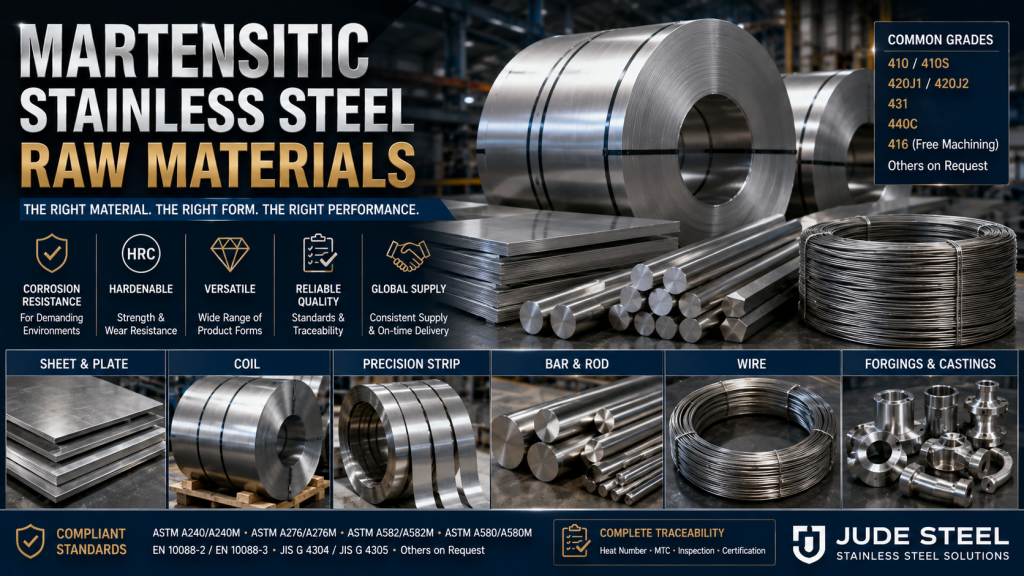 Martensitic stainless steel raw materials are supplied in several product forms, including sheet, plate, coil, precision strip, bar, rod, wire, forgings and castings. The correct raw material is defined not only by its grade but also by its governing standard, delivery condition, dimensions, tolerances, surface finish, edge condition and inspection requirements.
A 420 stainless steel coil delivered in an annealed condition is not the same purchasing product as a hardened precision strip, even when both products have a similar nominal grade designation. Likewise, a 410 bar for a valve shaft cannot be ordered using the same dimensional and mechanical requirements as a 410 sheet.
This guide explains how engineers, manufacturers and international buyers should specify, inspect and purchase martensitic stainless steel raw materials for cutting, stamping, machining, heat treatment and precision component production.
Quick Answer: How Should Martensitic Stainless Steel Raw Material Be Specified?
A complete raw-material specification should identify:
- Exact grade:
410, 410S, 416, 420J1, 420J2, 431, 440C or another specified grade. - Governing standard:
ASTM, EN, JIS, GB or a customer-specific material specification. - Product form:
Sheet, plate, coil, strip, bar, rod, wire, forging or casting. - Delivery condition:
Annealed, softened, cold rolled, hardened and tempered, or another specified condition. - Dimensions and tolerances:
Thickness, width, length, diameter, flatness, straightness, camber and edge limits. - Surface and edge:
No.1, 2D, 2B, BA, ground, polished, mill edge, slit edge, deburred or rounded edge. - Inspection:
MTC, heat number, chemical verification, hardness, dimensions, surface and third-party inspection.
The description “420 stainless steel raw material” is not sufficient for production or international procurement.
What Counts as Martensitic Stainless Steel Raw Material?
Raw material is the material supplied before the final component has completed all manufacturing operations. Depending on the project, it may be supplied directly by a steel mill, a service center, a distributor or a specialized processor.
Common martensitic stainless steel raw-material forms include:
- Hot-rolled plate and sheet
- Cold-rolled sheet
- Hot-rolled and cold-rolled coil
- Slit strip and precision strip
- Round, square, hexagonal and flat bar
- Wire and wire rod
- Forged blanks and rings
- Cast pump, valve and turbine components
- Laser-cut, waterjet-cut or stamped blanks
The original mill product can undergo slitting, leveling, cutting, grinding, polishing, annealing or heat treatment before it reaches the component manufacturer.
A mill product, a processed blank and a finished component may share the same grade, but they require different dimensional, mechanical and inspection specifications.
The Three Essential Identifiers: Grade, Product Form and Delivery Condition
1. Grade
The grade defines the permitted chemical composition and available performance range.
Examples include:
- 410 for general hardenable engineering components
- 410S for restricted hardening and fabrication
- 416 for free-machining bars
- 420J1 for moderate hardness and forming
- 420J2 for greater hardness and wear resistance
- 431 for high-strength shafts
- 440C for bearings and high-wear components
2. Product Form
Product form determines the applicable dimensional standard, production route and downstream processing.
Coil supports high-volume blanking. Precision strip supports narrow parts and blades. Bar supports shafts and turned components. Plate supports larger blanks and mechanical parts.
3. Delivery Condition
The delivery condition describes how the material has been processed before shipment.
Common conditions include:
- Hot rolled and annealed
- Cold rolled and annealed
- Softened for machining
- Cold worked or temper rolled
- Hardened and tempered
- Ground or polished after heat treatment
4. Final Application
The final application determines which combination of grade, form and condition is appropriate.
A stamped knife blank, a machined valve stem and a bearing race cannot be specified with the same raw-material requirements.
Martensitic Stainless Steel Raw Material Selection Matrix
| Raw Material Form | Typical Manufacturing Route | Common Applications | Key Purchasing Parameters |
|---|---|---|---|
| Sheet | Cold rolling, annealing, pickling or bright annealing | Stamped parts, utensils, covers, instruments and flat blanks | Thickness, width, length, finish, flatness and protective film |
| Plate | Hot rolling, annealing and descaling | Press plates, valve components, tooling blanks and large mechanical parts | Thickness tolerance, flatness, surface, ultrasonic testing and machining allowance |
| Coil | Hot or cold rolling followed by coiling | Continuous blanking, stamping, roll forming and high-volume production | Coil weight, ID, OD, width, thickness, camber, surface and welds |
| Precision Strip | Cold rolling, precision slitting and optional temper processing | Blades, scissors, springs, clips and precision stamped parts | Tight thickness tolerance, slit width, burr, edge, camber and flatness |
| Bar and Rod | Hot finishing, cold finishing, peeling, grinding or drawing | Shafts, valve stems, fasteners, fittings and turned components | Diameter, straightness, condition, surface, decarburization and machining allowance |
| Wire | Drawing, annealing, coating or final heat treatment | Springs, pins, clips and formed wire components | Diameter, tensile strength, coil form, surface and cast or helix |
| Forging | Open-die or closed-die forging followed by heat treatment | Large shafts, rings, valves and high-load mechanical parts | Reduction ratio, heat treatment, grain flow, NDT and machining allowance |
| Casting | Melting, casting, heat treatment and repair processing | Pumps, valves, turbine parts and complex housings | Casting grade, heat treatment, repair welding, NDT and pressure testing |
Martensitic Stainless Steel Sheet and Plate
Sheet and plate are flat products supplied as individual pieces. The difference between sheet and plate can vary according to producer practice, product standard and thickness.
Cold-Rolled Sheet
Cold-rolled martensitic stainless steel sheet is commonly used for stamped, formed, polished or precision components.
Typical advantages include:
- Closer thickness tolerance
- Smoother surface
- Better suitability for polishing
- Improved flatness compared with basic hot-rolled material
- Compatibility with high-volume blanking and stamping
Hot-Rolled Plate
Hot-rolled plate is commonly selected for thicker blanks, press plates, valve components and mechanical parts that will undergo machining or grinding.
A plate RFQ should define:
- Minimum and maximum thickness
- Width and length
- Flatness
- Surface condition
- Edge condition
- Machining allowance
- Ultrasonic inspection when required
A rough hot-rolled surface should not be rejected solely because it does not resemble a polished cold-rolled sheet. The acceptable surface depends on the ordered finish and subsequent manufacturing route.
Martensitic Stainless Steel Coil
Coil is selected when the customer requires continuous production, high-volume blanking or custom-width strip.
A complete coil specification should include:
- Grade and standard
- Hot-rolled or cold-rolled condition
- Thickness and tolerance
- Coil width
- Coil weight
- Coil inner diameter
- Maximum outer diameter
- Surface finish
- Edge condition
- Maximum camber
- Coil set and flatness requirements
- Permitted number and location of coil welds
JUDE stainless steel coil
is available in hot-rolled and cold-rolled product categories. Exact martensitic grade, dimensions, condition and inventory should be confirmed for each order.
Martensitic Stainless Steel Strip
Strip is narrower than the parent coil and is commonly produced through longitudinal slitting. Precision strip may undergo additional rolling, leveling, edge preparation and tension control.
Typical applications include:
- Knife and scissors blanks
- Springs
- Clips
- Measuring tools
- Medical-instrument blanks
- Precision stamped parts
Important Strip Requirements
- Thickness tolerance
- Width tolerance
- Camber
- Flatness
- Coil set
- Edge burr
- Slit-edge quality
- Rounded or deburred edge
- Surface direction
- Paper interleaving or protective film
JUDE publishes
stainless steel strip
and
strip-processing
pages covering slitting, leveling and customized strip widths.
Martensitic Stainless Steel Bar and Rod
Bars and rods are used for machined components such as shafts, valve stems, fasteners, fittings, axles and bearing parts.
Common bar forms include:
- Round bar
- Square bar
- Hexagonal bar
- Flat bar
- Ground bar
- Peeled bar
- Cold-drawn bar
Bar specifications must define the straightness, surface condition and delivery condition. A ground shaft bar has different dimensional expectations from an ordinary hot-finished bar.
Free-machining martensitic stainless steel bars such as 416 should be checked against a free-machining bar specification such as ASTM A582/A582M rather than assumed to fall under the same requirements as ordinary A276 bars.
Martensitic Stainless Steel Wire and Wire Rod
Wire is used for springs, clips, pins and formed components. Its performance may depend more on tensile strength, drawing condition and final wire diameter than on the base grade name alone.
A wire RFQ may need:
- Grade
- Wire standard
- Diameter and tolerance
- Tensile-strength range
- Dureté
- Surface coating or lubricant
- Coil, spool or carrier type
- Cast and helix limits
- Final spring or forming requirements
Spring wire may require an application-specific standard in addition to the general wire specification.
Forgings and Castings
Forged Raw Materials
Forgings are selected for highly loaded parts where grain flow, soundness and section properties are important.
Typical requirements include:
- Forging reduction
- Heat-treatment condition
- Mechanical test location
- Ultrasonic examination
- Magnetic-particle or dye-penetrant inspection
- Machining allowance
Cast Raw Materials
Cast martensitic stainless steels are used for complex valve, pump and turbine components.
Casting grades should not be ordered using a wrought flat-product designation alone. Casting chemistry, heat treatment, repair welding, pressure testing and nondestructive testing must be specified separately.
Hot-Rolled vs Cold-Rolled Martensitic Stainless Steel
| Feature | Hot-Rolled Material | Cold-Rolled Material |
|---|---|---|
| Typical thickness | Generally used for thicker coil, sheet and plate | Generally used for thinner sheet, coil and strip |
| Surface | Rougher, commonly annealed and descaled | Smoother and more suitable for decorative or precision finishing |
| Dimensional tolerance | Normally wider than cold-rolled tolerance | Normally closer thickness and dimensional control |
| Typical processing | Machining, grinding, heavy blanking and structural components | Stamping, precision blanking, polishing and narrow strip production |
| Cost direction | Often lower processing cost for comparable basic material | Additional rolling and finishing normally increase processing cost |
| Main purchasing risk | Expecting cold-rolled surface quality from a hot-rolled finish | Assuming a smooth surface automatically guarantees final flatness or hardness |
Neither production route is universally better. The correct route depends on thickness, surface, tolerance, forming, machining and final heat treatment.
Annealed, Softened and Hardened Delivery Conditions
Annealed or Softened Condition
Most raw materials intended for significant cutting, stamping, bending or machining are purchased in a softer condition.
This condition can provide:
- Lower cutting forces
- Improved tool life
- Better forming capability
- Lower cracking risk during fabrication
- Greater flexibility before final heat treatment
Hardened and Tempered Condition
Hardened and tempered material may be purchased when the raw material supplier or specialized processor is responsible for delivering final mechanical properties.
The specification must define:
- Required hardness range
- Hardness scale
- Test method
- Test location
- Flatness or straightness after treatment
- Surface condition
- Allowed decarburization
Cold-Worked or Precision-Temper Strip
Certain strip products may be supplied with controlled tensile strength, hardness or spring properties.
Cold-worked strength and heat-treated martensitic hardness are not the same property. The purchase order should state the required delivery route.
The soft condition may be intentionally supplied so that the component manufacturer can form or machine the material before final hardening.
410S, 420J1 and 420J2 Raw Material Selection
410S Raw Material
410S stainless steel
is a low-carbon, restricted-hardening modification of the 410 family.
It is commonly considered for:
- Fabricated thermal equipment
- Press plates
- Heat exchangers
- Petrochemical equipment
- Components where hardening during welding is undesirable
410S should not be selected when the final component requires the normal hardenability of standard 410.
420J1 Raw Material
420J1 stainless steel
is commonly used where moderate hardenability, forming and polishability are required.
Possible raw-material forms include:
- Cold-rolled sheet
- Hot-rolled or cold-rolled coil
- Slit strip
- Cut blanks
420J2 Raw Material
420J2 stainless steel
has a higher-carbon range than 420J1 and can develop greater hardness after qualified heat treatment.
It is commonly evaluated for:
- Knife and scissors blanks
- Cutting tools
- Medical-instrument blanks
- Wear-resistant parts
- Precision strip
These designations do not define one identical chemistry and condition. State one governing grade and standard.
Product Standards by Raw Material Form
| Product Form | Common ASTM Reference | Common EN Reference | Common JIS Reference | Important Note |
|---|---|---|---|---|
| Plate, sheet and strip | ASTM A240/A240M | EN 10088-2 | JIS G 4304 or JIS G 4305 | Confirm hot-rolled or cold-rolled product and exact grade |
| Ordinary bar and shape | ASTM A276/A276M | EN 10088-3 | JIS G 4303 | Free-machining bars may require another specification |
| Free-machining bar | ASTM A582/A582M | EN 10088-3 plus grade requirements | Applicable free-machining bar standard | Commonly relevant to 416-type materials |
| Wire | ASTM A580/A580M | EN 10088-3 or application-specific standard | Applicable JIS wire standard | Spring wire may require additional mechanical-property requirements |
| Pressure-equipment bar | ASTM A479/A479M where applicable | Applicable pressure-equipment standard | Project-specific | Confirm design code and certification requirements |
Always specify the agreed edition of the standard in the purchase contract. Do not combine chemistry from one standard with mechanical properties from another unless the supplier has accepted a written dual-certification requirement.
Dimensions and Tolerances
Sheet and Plate
- Thickness and tolerance
- Width and length
- Flatness
- Squareness
- Edge condition
- Machining allowance
Coil
- Thickness and width
- Coil ID
- Maximum OD
- Minimum and maximum coil weight
- Camber
- Coil set
- Telescoping limit
Precision Strip
- Tight thickness tolerance
- Slit-width tolerance
- Edge burr
- Camber
- Flatness
- Edge shape
Bar
- Diameter or cross-section
- Straightness
- Length
- Surface condition
- Machining allowance
- Out-of-roundness
A general dimensional standard may not be sufficient for precision blades, shafts or press plates. Add the project-specific tolerances to the purchase order.
Surface Finish and Edge Condition
| Surface or Edge | Description | Typical Use | Purchasing Note |
|---|---|---|---|
| No.1 / 1D | Hot rolled, annealed and descaled | Plate, heavy blanks and machined parts | Functional industrial surface rather than decorative finish |
| 2D | Cold rolled with a dull surface | Further processing and selected industrial parts | Confirm appearance and roughness requirements |
| 2B | Cold rolled with a smooth general-purpose finish | Sheet, coil, stamped parts and further polishing | Does not define hardness or flatness by itself |
| BA / 2R | Bright-annealed surface | Visible parts, utensils and precision components | Approve gloss and surface-defect limits |
| Ground or Polished | Mechanically finished surface | Blades, instruments and mechanical components | Specify roughness, grain direction and defect limits |
| Mill Edge | Original edge from the rolling process | Parent coil and basic sheet | Not suitable where a precision-width slit edge is required |
| Slit Edge | Edge produced by longitudinal slitting | Narrow strip and stamped components | Specify burr height and edge quality |
| Deburred or Rounded Edge | Further edge processing after slitting | Springs, blades, medical parts and handling-sensitive strip | Define edge radius or approved sample |
Who Is Responsible for Final Heat Treatment?
The purchase order should clearly state which company is responsible for final hardening and tempering.
Raw Material Supplier
The supplier may deliver annealed or softened material with chemistry, dimensions and basic mechanical properties certified.
Service Center
A service center may cut, slit, level, grind or arrange heat treatment through an approved subcontractor.
Component Manufacturer
The component manufacturer may perform final heat treatment after blanking, machining or forming.
Specialized Heat-Treatment Supplier
A qualified heat-treatment supplier may provide furnace records, hardness results, microstructure inspection and heat-treatment certification.
Do not assume that sheet, coil or strip described as “420 stainless steel” has already reached its final blade or wear-part hardness.
Mill Test Certificates and Grade Verification
A material certificate should normally identify:
- Manufacturer
- Customer or order reference
- Grade
- Product standard
- Heat number
- Chemical composition
- Mechanical properties where applicable
- Delivery condition
- Dimensions
- Authorized inspection approval
PMI and Chemical Verification
Handheld XRF can quickly identify major alloying elements such as chromium, nickel and molybdenum.
However, several martensitic grades are separated mainly by carbon content. When carbon verification is critical, use a carbon-capable method such as spark OES, suitable LIBS or laboratory analysis.
A material certificate should also be traceable to the physical coil, sheet, strip or bar through its heat number, coil number or batch identification.
Review selected JUDE
stainless steel inspection reports
when defining documentation and traceability requirements.
Incoming Raw Material Inspection
1. Check Markings and Documents
Compare the coil number, heat number, grade, standard and dimensions on the material with the purchase order and MTC.
2. Confirm the Product Form and Condition
Verify that the goods are supplied as sheet, coil, strip or another ordered form and that the delivery condition matches the contract.
3. Measure Dimensions
Check thickness, width, length, diameter, flatness, straightness or coil dimensions using calibrated equipment.
4. Inspect the Surface
Check for scratches, scale, rust staining, pits, laminations, grinding marks, dents, roller marks and protective-film problems.
5. Check Edge Quality
Inspect slit burr, edge cracks, waves, dents and the specified deburred or rounded condition.
6. Verify Chemistry When Required
Use the appropriate analytical method. Do not rely on magnet response to identify the exact grade.
7. Test Hardness or Mechanical Properties
Confirm the ordered condition and specify the test location, scale and sampling frequency.
8. Record and Isolate Nonconforming Material
Keep photographs, measurement records and identification labels. Prevent questionable material from entering production until it has been reviewed.
Common Martensitic Raw Material Defects
| Defect | Possible Cause | Potential Consequence |
|---|---|---|
| Grade mix-up | Incorrect marking, storage or order processing | Wrong heat-treatment response and component failure |
| Incorrect delivery condition | Annealed material supplied instead of hardened material or vice versa | Machining, forming or hardness problems |
| Thickness variation | Rolling or tolerance issue | Uneven stamping, grinding or final dimensions |
| Camber | Slitting or coil-processing imbalance | Feeding and alignment problems |
| Edge burr | Worn slitting knives or incorrect clearance | Handling risk, cracking or poor stamping quality |
| Rust staining | Carbon-steel contamination, moisture or poor storage | Surface rejection and corrosion complaints |
| Lamination or inclusion indication | Internal material discontinuity | Machining defects or reduced reliability |
| Decarburized surface | Improper high-temperature exposure | Low surface hardness and poor edge performance |
| Mixed coil finish | Incorrect coil identification or processing | Inconsistent appearance and downstream performance |
Packaging, Handling and Storage
Martensitic stainless steel should be protected from moisture, chloride deposits and carbon-steel contamination during transport and storage.
Recommended controls include:
- Dry, covered storage
- Clear grade and heat-number labels
- Separation from carbon-steel grinding areas
- Non-contaminating supports and lifting equipment
- Water-resistant export packaging
- Edge protection for slit strip
- Moisture barriers where required
- Protection against coil movement during transport
- Retention of original labels until material consumption
Protective film should be specified only when compatible with the surface, storage time, forming temperature and final cleaning process.
Common Purchasing Mistakes
This does not define the exact grade, chemistry, hardenability, product form or condition.
420J1, 420J2, EN 1.4021, EN 1.4028 and other 420-type grades can require different heat treatment and provide different hardness.
The correct product standard must match the supplied material form.
The supplier may deliver annealed material even though the buyer expects final hardened properties.
Precision blades, strip and press plates may require additional flatness, camber, burr and edge limits.
A carbon-capable analytical method may be required to distinguish similar martensitic grades.
A technically correct material can still become contaminated, rust stained or mixed during transport and storage.
JUDE Martensitic Stainless Steel Supply Options
JUDE’s published range focuses on stainless steel flat products and processing services.
Stainless steel sheet and plate
for blanks, press plates, stamped parts and fabricated components.
Stainless steel coil
for blanking, stamping and high-volume production.
Stainless steel strip
for knives, scissors, springs, clips and precision parts.
Stainless steel strip processing
for slitting, leveling, rewinding and customized widths.
Published martensitic and related 400-series grade pages include
410S,
420J1
and
420J2.
For other grades, long products, forgings, castings or specialized hardened strip, confirm availability, minimum quantity, standard and processing responsibility before placing the order.
Martensitic Stainless Steel Raw Material RFQ Checklist
- Final application:
Knife, scissors, spring, valve, pump, shaft, bearing, press plate or another component. - Exact grade:
410, 410S, 416, 420J1, 420J2, 431, 440C or another specified grade. - Grade system:
State the required UNS, EN, JIS or GB designation. - Product standard:
ASTM A240/A240M, A276/A276M, A582/A582M, A580/A580M, EN 10088 or another applicable standard. - Product form:
Sheet, plate, coil, strip, precision strip, bar, wire, forging, casting or blank. - Rolling route:
Hot rolled, cold rolled or precision cold rolled. - Delivery condition:
Annealed, softened, cold worked, hardened and tempered or another specified condition. - Dimensions:
Thickness, width, length, diameter and tolerances. - Coil information:
Coil weight, ID, maximum OD and permitted coil welds. - Shape control:
Flatness, straightness, camber, coil set, parallelism or runout. - Surface finish:
No.1, 2D, 2B, BA, ground, polished or approved physical sample. - Edge condition:
Mill edge, slit edge, deburred, rounded, ground or sharpened. - Hardness or strength:
State the required range, test method, scale and test location. - Heat-treatment responsibility:
Identify whether the supplier, processor or component manufacturer performs final hardening. - Further processing:
Cutting, slitting, blanking, forming, machining, grinding, polishing or sharpening. - Inspection documents:
MTC, heat number, OES analysis, hardness report, dimensional report or third-party inspection. - Packaging:
Protective film, paper interleaving, waterproof packing, pallets, edge protection and labeling. - Quantity and delivery:
Pieces, total weight, number of coils, destination, Incoterm and required date.
Frequently Asked Questions
In what forms is martensitic stainless steel raw material supplied?
It can be supplied as sheet, plate, coil, strip, precision strip, bar, rod, wire, forgings, castings and cut blanks.
Is martensitic stainless steel normally supplied annealed or hardened?
Material intended for machining or forming is commonly supplied annealed or softened. Hardened and tempered material may be supplied when final mechanical properties are required before delivery.
What is the difference between sheet and strip?
Sheet is normally supplied as a flat piece, while strip is a narrower continuous product commonly produced by slitting a parent coil. Precision strip usually has tighter width, thickness, edge and camber controls.
Is cold-rolled martensitic stainless steel better than hot-rolled material?
Not universally. Cold-rolled material normally provides a smoother surface and closer tolerances, while hot-rolled material is often more practical for thicker parts and machining blanks.
Can 420J1 and 420J2 be identified with handheld XRF?
XRF can verify major alloying elements, but the main difference between these grades may be carbon. OES, suitable LIBS or laboratory analysis may be required.
Can martensitic stainless steel coil be supplied already hardened?
Specialized hardened or tempered strip and coil products may be available, but they should not be assumed. The required hardness, flatness, width and heat-treatment responsibility must be specified.
What should a martensitic stainless steel MTC contain?
It should identify the grade, product standard, heat number, chemical composition, applicable mechanical properties, delivery condition and authorized inspection approval.
Why can new stainless steel raw material show rust spots?
Rust staining can result from carbon-steel contamination, moisture, damaged packaging or unsuitable storage. It does not automatically prove that the base material is not stainless steel.
What information is required when ordering precision strip?
Specify grade, standard, condition, thickness, width, tolerances, camber, flatness, burr, edge shape, coil dimensions, surface and packaging.
Can ASTM, EN and JIS martensitic grades be ordered as exact equivalents?
Not automatically. Their chemistry, mechanical properties and delivery requirements may differ. Select one governing standard and state any additional dual-certification requirements in writing.
Conclusion
Martensitic stainless steel raw material must be specified by more than its grade name. Product form, governing standard, delivery condition, dimensions, surface, edge, heat-treatment responsibility and inspection requirements all influence whether the material can be used successfully.
Sheet and coil support stamping and high-volume production. Precision strip supports blades, springs and narrow components. Bars support shafts and machined parts, while forgings and castings serve larger or more complex engineering components.
410S, 420J1 and 420J2 have different hardening behavior and should not be treated as interchangeable. The purchase order must identify the exact grade system and product standard.
Reliable international procurement also requires MTC traceability, appropriate carbon verification, dimensional inspection, surface control and suitable export packaging.
Request a Martensitic Stainless Steel Raw Material Quotation
Send JUDE the exact grade, product standard, product form, delivery condition, dimensions, surface finish, edge condition, hardness, processing requirements, inspection documents, quantity and destination.
For coil and precision-strip projects, also provide the coil weight, inner diameter, maximum outer diameter, camber, burr, flatness and packaging requirements.
Technical References
ASTM A240/A240M-26 — Stainless Steel Plate, Sheet and Strip
ASTM A276/A276M-25 — Stainless Steel Bars and Shapes
ASTM A582/A582M-22 — Free-Machining Stainless Steel Bars
ASTM A580/A580M-23 — Stainless Steel Wire
Outokumpu — Hot-Rolled Coil, Strip and Plate
Outokumpu — Cold-Rolled Coil, Strip and Sheet
worldstainless — Stainless Steel Categories, Grades and Product Forms
Thermo Fisher Scientific — XRF, LIBS and OES for Material Verification
