
Martensitic Stainless Steel Heat Treatment Guide
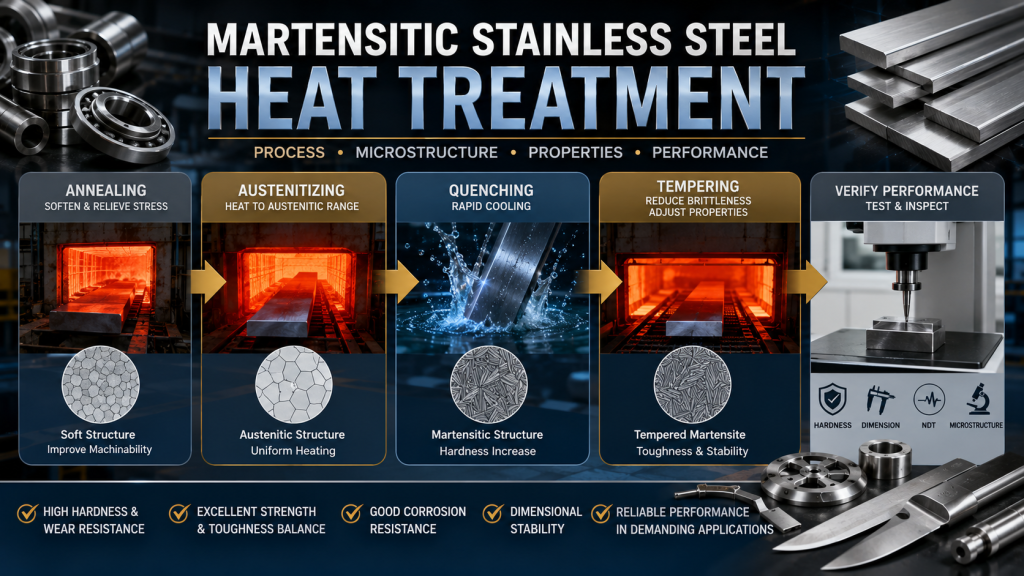 Martensitic stainless steel heat treatment is the controlled manufacturing process used to develop the final hardness, strength, toughness, wear resistance and dimensional stability of grades such as 410 and the 420 family.
Unlike conventional austenitic stainless steel, martensitic grades can be hardened by heating into an austenitic range, cooling under controlled conditions and then tempering. The final result depends on the exact alloy, section thickness, furnace uniformity, quench severity, tempering procedure and post-treatment finishing.
A grade designation alone does not guarantee final component performance. Buyers must specify the initial material condition, required hardness, heat-treatment responsibility, dimensional tolerances, surface finish and inspection requirements before production begins.
Quick Answer: How Is Martensitic Stainless Steel Heat Treated?
- Anneal or soften the material
so it can be cut, formed or machined. - Austenitize the component
at the grade-specific hardening temperature. - Quench at a controlled rate
to form a hard martensitic microstructure. - Temper the component
to reduce excessive brittleness and establish the required hardness-toughness balance. - Use sub-zero treatment when required
to reduce retained austenite in selected high-carbon grades. - Finish and inspect the component
for hardness, distortion, cracks, decarburization, surface condition and traceability.
The exact temperatures and holding times must come from the relevant material specification, mill datasheet and qualified heat-treatment procedure—not from a generic internet table.
Why Is Heat Treatment Critical?
Martensitic stainless steel is normally selected because its properties can be adjusted through heat treatment. The same grade may be supplied in a relatively soft condition for processing and later transformed into a high-strength or high-hardness component.
Heat treatment controls:
- Final hardness
- Tensile and yield strength
- Toughness
- Wear resistance
- Edge retention
- Residual stress
- Retained austenite
- Dimensional stability
- Corrosion resistance
- Grinding and polishing behavior
An unsuitable heat-treatment cycle can produce a component that meets its chemical composition requirement but still fails from cracking, distortion, low hardness, brittle fracture or premature corrosion.
The material grade defines the available performance range. The heat-treatment process determines where the finished component falls within that range.
Complete Martensitic Stainless Steel Manufacturing Route
1. Confirm the Incoming Material
Verify the grade, product standard, heat number, chemical composition, thickness and initial delivery condition.
2. Perform Cutting, Forming and Rough Machining
Complete most heavy machining, blanking and forming while the material remains in a softer condition.
3. Provide Heat-Treatment Allowance
Leave sufficient grinding or machining allowance for distortion, oxide removal and final dimensional correction.
4. Austenitize
Heat the component uniformly into the specified grade-dependent hardening range.
5. Quench
Cool the component using the approved medium and loading arrangement to develop martensite while controlling cracking and distortion.
6. Apply Sub-Zero Treatment When Specified
Selected high-carbon components may require sub-zero treatment to reduce retained austenite and improve dimensional stability.
7. Temper
Temper promptly using the specified temperature, duration and number of cycles.
8. Straighten, Grind and Finish
Correct dimensions and prepare the required ground, polished or sharpened surface without introducing excessive heat.
9. Clean or Passivate When Required
Remove iron contamination and restore a clean stainless surface using a grade-compatible process.
10. Inspect and Release the Lot
Verify hardness, dimensions, flatness, cracks, surface condition, traceability and any required metallurgical properties.
Annealing and Softening
Martensitic stainless steel is commonly supplied in an annealed or softened condition to improve machining, blanking and forming.
The soft condition helps:
- Reduce cutting forces
- Improve tool life
- Support bending and stamping
- Limit cracking during fabrication
- Prepare the structure for final hardening
“Annealed” does not automatically mean that every grade has the same hardness or microstructure. The applicable product standard and mill certificate should identify the supplied condition.
Should the Finished Component Be Purchased Annealed?
Purchase annealed material when significant machining, forming, blanking or grinding must be completed before hardening.
Purchase hardened and tempered material when the supplier is responsible for delivering the finished mechanical properties and the remaining manufacturing operations will not damage the heat-treated condition.
Austenitizing
Austenitizing heats the steel into a temperature range where the required high-temperature structure develops and part of the carbon and alloying elements enter solution.
The process must control:
- Furnace temperature uniformity
- Heating rate
- Part spacing
- Holding time
- Protective atmosphere or vacuum
- Oxidation and decarburization
- Section-thickness differences
What Happens if Austenitizing Is Too Low?
Insufficient temperature or holding time may produce incomplete solution, inadequate hardening and inconsistent hardness.
What Happens if Austenitizing Is Too High?
Excessive temperature or time may promote grain growth, retained austenite, distortion, oxidation and reduced toughness.
The correct range is grade specific. A procedure developed for 410 should not automatically be transferred to 420J2, 1.4034 or a higher-alloy knife grade.
Quenching
Quenching cools the austenitized component rapidly enough to produce martensite.
Potential quench media include:
- Air or controlled gas
- Oil
- Polymer solution
- Water in selected procedures
- Vacuum-furnace gas quenching
The appropriate medium depends on hardenability, section size, geometry, surface requirements and cracking risk.
A more severe quench may increase hardness response but can also increase thermal stress, distortion and cracking.
Factors That Influence Quench Performance
- Part thickness
- Sharp corners
- Section changes
- Holes and slots
- Component orientation
- Furnace loading
- Quench agitation
- Transfer time
- Quench-medium temperature
Tempering
Freshly quenched martensite provides high hardness but can contain excessive residual stress and insufficient toughness. Tempering adjusts the final property balance.
Lower-Temperature Tempering
Lower tempering temperatures generally preserve more hardness and wear resistance. They may be selected for knives, cutting tools and selected wear components.
Higher-Temperature Tempering
Higher tempering temperatures generally reduce hardness and improve toughness, stress relief and dimensional stability.
Why Tempering Temperature Requires Care
Certain grades can experience undesirable changes in toughness or corrosion resistance within particular tempering ranges.
Carbide precipitation during tempering may reduce chromium available in the surrounding matrix and lower practical corrosion resistance. The approved mill or heat-treatment procedure should therefore define the permitted tempering range.
Single vs Double Tempering
High-carbon and precision components may use more than one tempering cycle to improve stability and reduce the effect of retained austenite.
The number of cycles should be stated in the heat-treatment procedure rather than assumed by the supplier.
Reference Hardness of Selected Martensitic Grades
| Grade | Common Designation | Reference Achievable Hardness | Typical Performance Direction |
|---|---|---|---|
| 410 | UNS S41000 / EN 1.4006 | Project- and condition-specific | General strength and toughness rather than maximum hardness |
| 420 / 1.4021 | UNS S42000 / EN 1.4021 | Approximately 44–50 HRC | Low-to-medium hardness with useful toughness |
| 420 / 1.4028 | 420 family / EN 1.4028 | Approximately 45–51 HRC | Medium hardness and wear resistance |
| 420 / 1.4031 | 420 family / EN 1.4031 | Approximately 47–53 HRC | Medium-high hardness |
| 420 / 1.4034 | 420 family / EN 1.4034 | Approximately 49–55 HRC | High hardness for professional cutting applications |
| 1.4110 | High-alloy martensitic grade | Approximately 50–56 HRC | High hardness with improved wear and corrosion performance |
These values are published reference or achievable ranges. They are not automatic guarantees for every thickness, furnace load, quench process or finished component.
The purchase order should state:
- Required minimum and maximum hardness
- HRC, HV or HB scale
- Applicable test standard
- Number of test points
- Test location
- Whether testing occurs before or after grinding
410 and 410S Heat-Treatment Considerations
410 Stainless Steel
Standard 410 is a hardenable martensitic grade used for valves, shafts, flanges, pump components and general engineering parts.
Its heat-treatment objective is commonly a practical balance of strength, toughness and moderate hardness rather than maximum knife-edge hardness.
410S Stainless Steel
410S stainless steel
is a low-carbon modification designed to restrict hardening.
It is commonly selected for fabrication, press plates, thermal equipment and applications where the hardening response of standard 410 is undesirable.
Its low-carbon chemistry and restricted hardenability make it fundamentally different from standard 410.
420J1, 420J2 and EN 420 Variants
The term “420 stainless steel” covers several carbon levels. The exact designation must be confirmed before establishing the heat-treatment cycle.
420J1
420J1 stainless steel
is generally associated with a lower-carbon 420 range and a moderate hardness target.
It is commonly evaluated for tableware, press plates, instruments and formed parts requiring a balance of hardness and toughness.
420J2
420J2 stainless steel
contains more carbon and can achieve greater hardness and wear resistance after appropriate treatment.
It is commonly used for knives, scissors, cutting tools and wear components.
EN 1.4021, 1.4028 and 1.4034
These EN grades represent progressively higher carbon and hardness capability. They must not be treated as identical versions of one universal Type 420 specification.
The heat-treatment supplier should receive the exact EN, JIS or ASTM designation rather than only the description “420 stainless steel.”
Higher-Alloy Martensitic Grades
Grades such as EN 1.4110, 1.4116 and 1.4122 add molybdenum, vanadium or higher chromium to modify wear resistance and corrosion performance.
These additions affect:
- Austenitizing response
- Carbide dissolution
- Retained austenite
- Hardness potential
- Grinding behavior
- Corrosion resistance
A heat-treatment cycle qualified for basic 420 should not be transferred automatically to a molybdenum- or vanadium-alloyed knife grade.
Sub-Zero and Cryogenic Treatment
Selected high-carbon martensitic components may retain some austenite after quenching. Retained austenite can later transform during service, grinding or storage and cause dimensional change.
Sub-zero treatment may be used to:
- Reduce retained austenite
- Increase dimensional stability
- Support a consistent hardness response
- Improve performance in selected precision components
Sub-zero treatment is not automatically required for every 420 component. It should be part of a qualified route that specifies timing, temperature, handling and subsequent tempering.
Delays between quenching, sub-zero treatment and tempering can affect transformation, stress and cracking risk.
How to Control Heat-Treatment Distortion
Distortion occurs because the component experiences thermal expansion, thermal gradients, phase transformation and residual stress.
Common Distortion Factors
- Uneven section thickness
- Asymmetrical design
- Sharp corners
- Residual stress from machining or forming
- Uneven furnace heating
- Incorrect support or fixturing
- Non-uniform quenching
- Grinding after hardening
Distortion-Control Measures
- Use balanced component geometry where possible
- Perform rough machining before hardening
- Leave final grinding allowance
- Use suitable fixtures and loading orientation
- Control furnace uniformity
- Select the least severe effective quench
- Temper promptly
- Specify straightening limits and timing
Flat blades, long shafts, thin press plates and narrow precision strip require different distortion-control strategies.
Why Does Martensitic Stainless Steel Crack During Heat Treatment?
Cracking occurs when thermal and transformation stresses exceed the available toughness of the material.
Common causes include:
- Excessive quench severity
- Sharp corners and machining marks
- Large section changes
- Overheating
- Delayed tempering
- Surface decarburization or oxidation defects
- Hydrogen contamination
- Pre-existing cracks or inclusions
Crack Inspection
Critical components may require:
- Visual inspection
- Dye-penetrant testing
- Magnetic-particle inspection
- Ultrasonic testing for suitable sections
- Metallographic examination
Decarburization, Oxidation and Furnace Atmosphere
Exposure to an unsuitable furnace atmosphere can remove carbon from the surface or produce excessive oxide.
Decarburization can cause:
- Low surface hardness
- Poor edge retention
- Uneven wear
- Incorrect hardness-test results
- Additional grinding requirements
Control methods may include:
- Vacuum heat treatment
- Controlled atmosphere
- Protective wrapping or suitable tooling
- Machining allowance
- Post-treatment surface inspection
A hardness test performed only on a decarburized surface can misrepresent the bulk condition of the component.
Grinding, Polishing and Sharpening After Heat Treatment
Final grinding establishes dimensions, edge geometry, flatness and surface condition.
Grinding must control:
- Wheel selection
- Feed rate
- Coolant flow
- Surface temperature
- Material removal per pass
- Residual stress
What Is Grinding Burn?
Grinding burn occurs when local heat changes the hardened microstructure or creates harmful residual stress.
Potential consequences include:
- Local softening
- Rehardening and brittle layers
- Surface cracking
- Reduced fatigue life
- Premature edge failure
Critical blades, bearings and shafts may require hardness mapping, etching inspection or another validated grinding-burn detection method.
How Heat Treatment Affects Corrosion Resistance
Martensitic stainless steel corrosion resistance depends strongly on the final heat-treatment condition and surface finish.
A properly hardened and finely polished surface generally performs better than a rough, contaminated or improperly tempered surface.
Corrosion may be reduced by:
- Chromium tied up in carbides
- Unsuitable tempering conditions
- Decarburization and oxide scale
- Grinding contamination
- Rough surfaces
- Residual chlorides
- Incorrect passivation
Heat treatment cannot make a conventional martensitic grade equivalent to 316L or duplex stainless steel in aggressive chloride environments.
Welding and Post-Weld Heat Treatment
Traditional martensitic grades can form hard, brittle heat-affected zones during welding.
Higher-carbon grades are generally more difficult to weld and may require:
- Preheating
- Controlled interpass temperature
- Low-hydrogen methods
- Suitable filler metal
- Slow cooling
- Post-weld tempering
- Hardness and crack inspection
Published supplier guidance may recommend preheat and interpass control around 250–400°C for selected martensitic grades. This is not a universal welding procedure and must not replace a qualified WPS.
High-carbon knife and bearing grades are generally unsuitable for routine welded structures.
Product Forms and JUDE Supply Options
Heat-treatment planning should begin with the correct product form and initial condition.
Stainless steel sheet and plate
for blanks, press plates, brake components and fabricated parts.
Stainless steel coil
for blanking, stamping and continuous production.
Stainless steel strip
for knives, scissors, springs and precision components.
Stainless steel strip processing
for slitting, leveling, customized widths and edge preparation.
JUDE publishes dedicated material pages for
410S,
420J1
and
420J2.
Before ordering, confirm whether final heat treatment will be performed by the mill, JUDE, the component manufacturer or an approved third-party heat-treatment supplier.
Heat-Treatment Inspection and Quality Control
A professional inspection plan may include:
- Grade and product-standard verification
- Mill test certificate review
- Heat-number traceability
- OES or carbon-sensitive chemical analysis
- Heat-treatment furnace records
- Hardness testing
- Hardness mapping
- Microstructure examination
- Retained-austenite measurement
- Decarburization inspection
- Dimensional and flatness inspection
- Grinding-burn inspection
- Crack or nondestructive testing
- Surface-finish inspection
Handheld XRF can verify major alloying elements but may not reliably distinguish similar grades whose main difference is carbon. OES or another carbon-sensitive method may be required.
Review selected JUDE
stainless steel inspection reports
when defining documentation and traceability requirements.
Common Purchasing Mistakes
420J1, 420J2, EN 1.4021, 1.4028 and 1.4034 require different property expectations and may require different heat-treatment procedures.
An excessively high hardness can increase brittle fracture, distortion and grinding difficulty.
The material may arrive annealed even when the final component requires hardened and tempered properties.
Surface, edge, center and core hardness may differ, especially after decarburization or incomplete through-hardening.
A component may meet hardness requirements but fail its final dimensions after distortion correction.
Carbon-sensitive OES or laboratory analysis may be required.
Martensitic Stainless Steel Heat-Treatment RFQ Checklist
- Exact grade:
410, 410S, 420J1, 420J2, EN 1.4021, 1.4028, 1.4034 or another specified grade. - Governing standard:
State the required ASTM, EN, JIS, GB or customer specification. - Product form:
Sheet, plate, coil, strip, precision strip, bar, blank or finished component. - Initial condition:
Annealed, softened, cold rolled, temper rolled or another condition. - Target condition:
Hardened, hardened and tempered, or another specified condition. - Target hardness:
State the minimum and maximum, scale, method and test location. - Heat-treatment procedure:
State whether the supplier proposes the cycle or follows a customer-approved specification. - Sub-zero treatment:
State whether it is required and define the procedure. - Dimensions:
Thickness, width, length, diameter and machining allowance. - Distortion limits:
Flatness, straightness, parallelism, runout and allowable dimensional change. - Surface requirements:
Oxide-free, vacuum treated, ground, polished, mirror or passivated. - Edge requirements:
Slit, deburred, rounded, ground or sharpened. - Post-treatment processing:
Straightening, grinding, polishing, sharpening or passivation. - Inspection:
MTC, OES, hardness, microstructure, retained austenite, decarburization, dimensions, crack inspection or third-party inspection. - Quantity and delivery:
Pieces, total weight, coil data, packaging, destination and required date.
Frequently Asked Questions
Can martensitic stainless steel be hardened by heat treatment?
Yes. Conventional martensitic grades can be hardened by austenitizing and quenching, followed by tempering to establish the required balance of hardness and toughness.
Can 420 stainless steel reach 55 HRC?
Selected high-carbon variants such as EN 1.4034 may reach approximately 49–55 HRC under suitable final heat treatment. The result is not guaranteed for every Type 420 product.
Can 410 and 420 use the same heat-treatment cycle?
Not automatically. Their carbon content, hardenability, target properties and cracking risk differ. Each exact grade requires an approved procedure.
Why does martensitic stainless steel crack after quenching?
Common causes include excessive cooling severity, sharp geometry, section changes, overheating, delayed tempering and pre-existing surface defects.
Does tempering reduce hardness?
Tempering normally reduces some as-quenched hardness while improving toughness, stress relief and dimensional stability. The amount depends on the tempering temperature and grade.
Is sub-zero treatment always required?
No. It is mainly considered for selected high-carbon or precision components where retained austenite and dimensional stability are important.
How does heat treatment affect corrosion resistance?
Heat treatment changes carbide distribution and chromium availability. Incorrect tempering, oxide scale, decarburization and rough grinding can reduce practical corrosion resistance.
Should martensitic stainless steel be purchased annealed or hardened?
Purchase annealed material when significant forming or machining remains. Purchase hardened and tempered material when final mechanical properties are required before delivery.
How can grinding burn be detected?
Inspection may use visual examination, hardness mapping, etching methods, metallography or another validated procedure appropriate to the component.
Can XRF distinguish 420J1 from 420J2?
XRF may identify chromium and other major elements, but the main difference between these grades is carbon. OES or another carbon-sensitive method may be required.
Conclusion
Martensitic stainless steel heat treatment is not simply a hardening operation. It is a complete manufacturing system involving initial material condition, machining, austenitizing, quenching, tempering, distortion control, grinding and final inspection.
410 is commonly heat treated for a practical balance of strength and toughness. Lower-carbon 420 grades provide moderate hardness, while higher-carbon 420 variants can provide greater edge retention and wear resistance.
Reliable results require the exact grade, target hardness, treatment responsibility, allowable distortion and inspection criteria to be defined before production.
Request a Martensitic Stainless Steel Heat-Treatment Review
Send JUDE the exact grade, standard, product form, initial condition, required hardness, heat-treatment route, dimensions, distortion limits, finish, inspection documents, quantity and destination.
For blade, press-plate and precision-strip projects, also provide the final edge condition, flatness, grinding allowance, hardness test location and sub-zero-treatment requirement.
Technical References
ASTM A240/A240M-26 — Stainless Steel Plate, Sheet and Strip
ASTM A276/A276M-25 — Stainless Steel Bars and Shapes
ASTM A582/A582M-22 — Free-Machining Stainless Steel Bars
ASTM A580/A580M-23 — Stainless Steel Wire
Outokumpu Dura — Heat-Treatable Stainless Steel Range
Outokumpu Dura Range Datasheet
ISO 8075:2025 — Surface Treatment of Hardenable Stainless Steel Parts
