
Hot Rolled vs Cold Rolled Stainless Steel Explained
Stainless steel is one of the most versatile and widely used materials in modern industry. It is valued for its corrosion resistance, strength, durability, and aesthetic appearance. But when it comes to choosing stainless steel for a specific application, one of the most important decisions is whether to use hot rolled or cold rolled stainless steel. Although both are made from the same basic stainless steel grades (such as 304, 316, and 430), their manufacturing processes and resulting properties are significantly different.
What Is Hot Rolled Stainless Steel?
Hot rolled stainless steel is produced by rolling the steel at a high temperature, usually above 1,000°C (1,832°F). In this state, the steel is easier to shape and form because the heat reduces internal stress and increases ductility. Hot rolling is typically used to produce large structural components such as sheets, plates, bars, and beams.
Hot Rolling Process
- Heating: Stainless steel slabs or billets are heated in a furnace to high temperatures.
- Rolling: The heated steel is passed through a series of rollers to reduce thickness and form the desired shape.
- Cooling: The hot rolled steel is cooled naturally, often resulting in a scale layer on the surface.
- Pickling or Passivation (Optional): To remove scale and improve corrosion resistance, hot rolled steel may undergo pickling or passivation.
Characteristics of Hot Rolled Stainless Steel
- Surface Finish: Hot rolled stainless steel usually has a rougher, matte surface with scale.
- Dimensional Accuracy: Tolerances are wider due to cooling and distortion.
- Mechanical Properties: It is less strong than cold rolled steel but has better ductility and is easier to weld.
- Cost: Generally more cost-effective for large structural uses.
What Is Cold Rolled Stainless Steel?
Cold rolled stainless steel is produced by rolling the steel at room temperature, below the recrystallization temperature. This process results in a smoother, more precise finish and better mechanical properties. Cold rolling is often used when tight dimensional tolerances, a smooth surface, and higher strength are required.
Cold Rolling Process
- Hot Rolling First: Cold rolled stainless steel usually starts as hot rolled material.
- Cold Rolling: The steel is passed through rollers at room temperature to reduce thickness.
- Annealing: The material is annealed to soften the steel and reduce internal stress.
- Pickling: The surface is cleaned to remove any scale or oxides formed during annealing.
Characteristics of Cold Rolled Stainless Steel
- Surface Finish: Cold rolled stainless steel has a smooth, shiny finish with a more consistent appearance.
- Dimensional Accuracy: Tighter tolerances and better uniformity.
- Mechanical Properties: Higher strength due to strain hardening and better surface hardness.
- Cost: Typically more expensive due to additional processing steps.
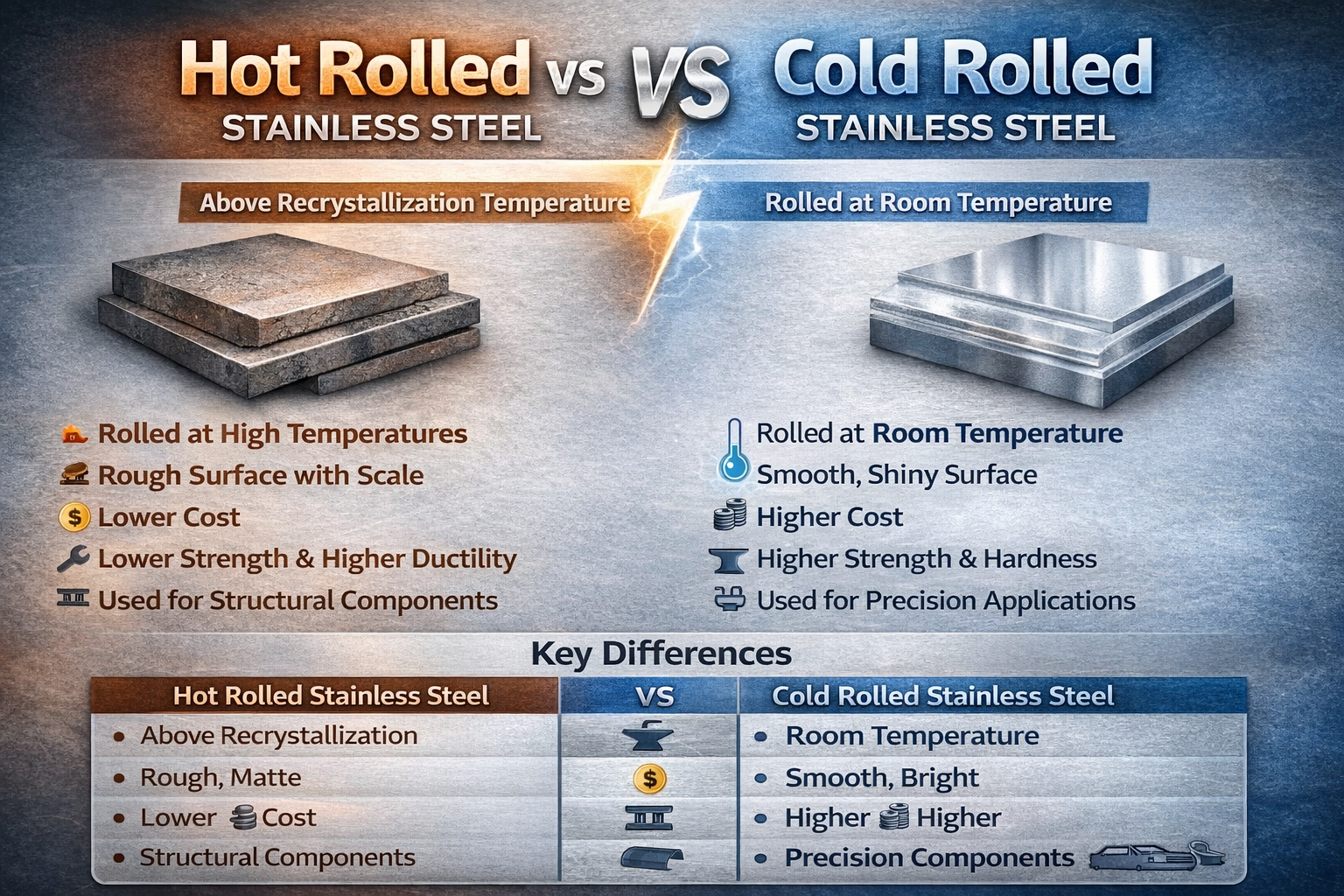
Hot Rolled vs Cold Rolled: Key Differences
| Feature | Hot Rolled Stainless Steel | Cold Rolled Stainless Steel |
|---|---|---|
| Rolling Temperature | Above recrystallization temperature (hot) | Below recrystallization temperature (cold) |
| Surface Finish | Rough, matte, often with scale | Smooth, bright, consistent |
| Dimensional Tolerance | Wider tolerance | Tighter tolerance |
| Strength | Lower strength, higher ductility | Higher strength, more hardness |
| Cost | Lower cost | Higher cost |
| Common Applications | Structural, industrial components, frames | Appliances, automotive parts, architectural panels |
Which One Should You Choose?
The choice between hot rolled and cold rolled stainless steel depends on the application requirements. Here are some typical scenarios:
Choose Hot Rolled Stainless Steel When:
- You need a cost-effective material for large structural components.
- Surface finish is not critical, or it will be coated/painted later.
- You need good formability and weldability.
- The application involves heavy-duty industrial use.
Choose Cold Rolled Stainless Steel When:
- You need a smooth, high-quality surface finish.
- Tight dimensional tolerance is required.
- You need higher strength and hardness.
- The material will be used in visible or decorative applications.
Common Applications of Hot Rolled Stainless Steel
- Structural beams and columns
- Industrial frames and supports
- Construction components
- Heavy machinery parts
- Welded assemblies and fabrication
Common Applications of Cold Rolled Stainless Steel
- Kitchen appliances and sinks
- Automotive body panels and trim
- Architectural panels and cladding
- Medical equipment
- Precision parts and electronics enclosures
Surface Finishes and Grades
Both hot rolled and cold rolled stainless steel can be produced in a variety of grades, including 304, 316, 430, and others. The surface finish can also vary:
- 2B finish: A common cold rolled finish with a smooth, matte surface.
- BA finish: Bright annealed, highly reflective surface.
- No.4 finish: Brushed finish often used for appliances and architectural panels.
- Mill finish: Typical hot rolled surface with a rough texture.
Conclusion
Hot rolled and cold rolled stainless steel are both essential materials in modern manufacturing and construction. Understanding their differences in production, mechanical properties, surface finish, and cost can help you select the right material for your project. If your project requires structural strength and cost efficiency, hot rolled stainless steel may be the best option. If you need a smooth, high-quality finish and tight tolerance, cold rolled stainless steel is the preferred choice.
To ensure the best performance, always confirm the specific grade (304, 316, etc.), thickness, surface finish, and tolerance requirements with your supplier before placing an order.
FAQ: Hot Rolled vs Cold Rolled Stainless Steel
1. What is the main difference between hot rolled and cold rolled stainless steel?
The main difference is the manufacturing temperature. Hot rolled stainless steel is rolled at high temperatures above the recrystallization point, while cold rolled stainless steel is rolled at room temperature. This leads to differences in surface finish, dimensional accuracy, strength, and cost.
2. Which one is stronger: hot rolled or cold rolled stainless steel?
Cold rolled stainless steel is generally stronger and harder due to strain hardening during cold rolling. Hot rolled steel is more ductile and easier to form but has lower strength compared to cold rolled.
3. Is hot rolled stainless steel more corrosion resistant than cold rolled?
Corrosion resistance mainly depends on the stainless steel grade (e.g., 304 vs 316) and surface treatment. Cold rolled stainless steel may have slightly better corrosion resistance if it has a clean, smooth surface and proper passivation. However, the difference is not due to rolling alone but surface finish and post-processing.
4. Which is better for structural applications?
Hot rolled stainless steel is often preferred for structural applications because it is cost-effective, easier to weld, and suitable for large components where surface finish is not critical.
5. Which is better for decorative or architectural use?
Cold rolled stainless steel is typically better for decorative or architectural use because it offers a smooth, shiny surface, tighter tolerances, and a more consistent appearance.
