
304, 304L and 316L for Dairy Equipment:
Review the Cleaning Duty Before Ordering
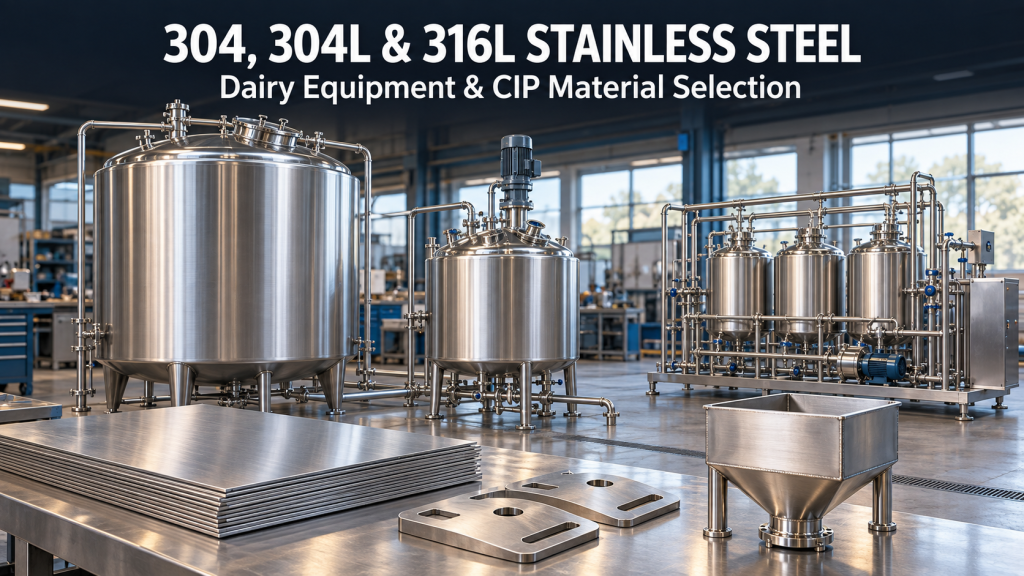
A material procurement guide for equipment projects
in Yekaterinburg, Russia.
A dairy tank can handle its product successfully yet face a
different corrosion exposure during cleaning. When a plant
changes a recipe, rinse-water source or cleaning programme,
the previous material list needs a fresh review.
For manufacturers of milk tanks, beverage mixers, ingredient
hoppers, conveyor contact plates and cleaning units, the useful
question is:
which surfaces will encounter which fluids, at what conditions,
throughout the operating cycle?
This guide turns that review into requirements for 304, 304L
and 316L sheet, plate and fabricated blanks.
304, 304L or 316L: What Changes the Decision?
- 304 — UNS S30400:
a candidate for compatible food-contact panels, formed
hoppers and general equipment components. It can be welded
with an appropriate procedure; welding alone does not
automatically exclude it. - 304L — UNS S30403:
the lower-carbon option often considered for welded vessel
shells, mixing containers and internals. Lower carbon reduces
susceptibility to weld-related sensitization and associated
intergranular corrosion. It does not provide a major upgrade
in chloride-pitting resistance over the 304 family. - 316L — UNS S31603:
a low-carbon, molybdenum-bearing grade to evaluate when the
process or cleaning exposure needs greater localized-corrosion
resistance. It is not automatically suitable for every brine,
chlorinated sanitizer or concentrated cleaning chemical.
Outokumpu’s
Core grade information
and
Supra grade information
explain these alloy-family differences. Final selection must
use the actual exposure and the equipment specification.
These grade names do not establish a guaranteed service life,
a permitted cleaning temperature or an acceptable concentration
of any particular chemical.
From Food Equipment to the Raw-Material Order
The following are candidate applications, subject to design
approval. They show where a cleaning or product change can
affect the material purchase.
| Product manufactured | Raw-material purchase | Material-selection checkpoint |
|---|---|---|
| Milk storage and balance tanks | Shell sheet, bottom or head blanks, lids and internal plates | Evaluate 304/304L for compatible service. Reassess the complete cleaning cycle before retaining that selection on a modified line. |
| Beverage and dairy blending vessels | Rolled-shell blanks, baffles, covers and other flat internals | Review 304L or 316L using the finished formulation and local exposure during concentrate addition. |
| Powder and ingredient hoppers | Folded panels, cone blanks, lids and discharge chutes | 304 or 304L may suit the approved duty. Include wet cleaning and drying conditions even when normal product handling is dry. |
| Conveyor and product-transfer assemblies | Contact plates, guide panels and removable transfer chutes | Assess residues and washdown on both exposed and sheltered surfaces. Review corrosion, wear and support requirements separately. |
| CIP skids and parts-washing units | Reservoir sheet, tank blanks, wash-chamber panels and trays | Assess each chemical and return-fluid duty individually. Consider 316L where justified; concentrated or aggressive service may require another material. |
Open hoppers and conveyor plates may use washdown or cleaning
after disassembly rather than clean-in-place. Do not assume
that the enclosed tank’s CIP assessment covers those components.
Review
JUDE’s stainless steel sheet options
for the flat-material scope. Tubing, fittings, agitator shafts
and completed machines require their own specifications and
supply confirmation.
Record the Cleaning Cycle Before Choosing an Upgrade
Clean-in-place, or CIP, cleans suitable equipment without
dismantling the process circuit. Its effectiveness and material
compatibility depend on more than the detergent name. The
worldstainless food and beverage guide
discusses the interaction of cleaning chemistry, flow,
temperature, time and surface condition.
Ask the plant or equipment designer for a process summary covering:
- Each fluid:
product, concentrate, detergent, sanitizer, rinse water
and recovered return liquid. - Operating conditions:
normal and credible maximum concentrations, temperatures
and contact times. - Water chemistry:
relevant chloride content and other parameters identified
by the corrosion assessment. - Dosing locations:
any temporary exposure to stronger chemicals before full dilution. - Shutdown conditions:
retained liquid, incomplete rinsing, deposits and drying
between production runs. - Change history:
what has changed since the existing material was approved,
including any documented corrosion.
Review oxidizing or chlorine-containing cleaners with the
chemical supplier and equipment designer. A simple chloride
number or pH reading cannot establish a universal safe
operating limit for 304, 304L or 316L.
Three Changes That Should Trigger a Material Review
A New Recipe or Concentrated Ingredient
Record the exposure at the addition hopper, inlet, mixing
baffle and vessel wall as well as the final diluted product.
Ask whether the existing grade remains approved at each
location. A 316L option can be quoted for evaluation where
additional corrosion resistance is useful, without assuming
the whole line needs the same upgrade.
A Different Cleaner, Sanitizer or Cleaning Schedule
Compare the previous and proposed operating conditions before
releasing replacement sheet. Include CIP supply and return
tanks, wash chambers and components that can retain cleaning
liquid. A change in concentration, temperature or dwell time
deserves review even when the cleaner’s trade name is unchanged.
Corrosion Found During Maintenance
Provide photographs, affected locations, operating records and
available material documentation. Have the cause investigated
before repeating the order or changing grade. Surface
contamination, fabrication condition, trapped solution and
unsuitable exposure can require different corrective actions.
For the basic vessel component breakdown, see JUDE’s
food and detergent tank material guide.
This review adds the operating changes that may alter an
existing material selection.
Turn the Approved Selection into a Purchasable Specification
For sheet, plate and strip, identify the grade and the required
edition of
ASTM A240/A240M,
with applicable
ASTM A480/A480M general requirements.
State the measurement system and tolerances. Where a Russian
drawing specifies a GOST or TU requirement, retain the exact
reference and obtain approval for any proposed alternative.
Sanitary tube is a separate product. ASTM A270/A270M addresses
sanitary stainless steel tubing when that is the project’s
required basis; a flat-sheet certificate cannot certify a
supplied tube or finished assembly.
Use design-approved starting thicknesses and blank dimensions.
Identify the product-contact face, supplied finish, required
surface acceptance and the stage at which it applies. A finish
label such as 2B or No. 4 does not by itself specify every
hygienic requirement.
Request confirmation of
cutting requirements
and
polishing scope
for the actual part. Allocate cut-edge treatment, weld
finishing, heat-tint removal and any specified passivation.
ASTM A380/A380M
addresses fabrication-related cleaning and surface treatment;
it does not supply the plant’s validated operating CIP recipe.
For orders containing several grades, keep the part number,
grade, heat identity and material certificate linked through
cutting and packing. Record approved substitutions in the
drawing or purchase documentation before processing.
Frequently Asked Questions
Can a 316L component be welded into a 304L assembly?
Such joints can be feasible, but the responsible engineer must
approve the materials, filler selection, welding procedure and
finishing. Adding a 316L part does not upgrade the remaining
304L surfaces. The complete wetted assembly still needs review
for the intended service.
Can 316L sheet be thinner because it offers better corrosion resistance?
Do not reduce thickness on that basis alone. Pressure, vacuum,
mixer loads, stiffness, forming and the applicable design rules
determine the required section. A grade change and a thickness
change require separate engineering decisions.
Can a pitted panel be polished and returned to service?
Polishing removes material; it does not restore lost wall
thickness. Assess remaining thickness, defect depth,
cleanability and the underlying cause before approving reuse.
Pressure-retaining parts also require the applicable repair
and inspection review.
Should cleaning concentration be reduced to keep an existing grade?
Do not change a validated cleaning programme solely to
accommodate the steel. The plant’s hygiene team, chemical
supplier and equipment designer should review cleaning
effectiveness and material compatibility together before
approving a change.
Request a 304, 304L or 316L Material Quotation
Preparing a new dairy line or replacing food-equipment
components in Yekaterinburg? Send JUDE Steel the approved
material list together with a short summary of the product
and cleaning duty. Use a separate line for each component
and grade.
Subject: Yekaterinburg Dairy Equipment Material RFQ Equipment and component: Drawing number and revision: New build, process change or replacement: Approved grade and product standard / edition: Product form, delivery condition and dimensions: Quantity by part number: Product and cleaning-duty summary: Contact-face finish and acceptance requirements: Requested cutting, edge work or polishing: Certificate, inspection and identification requirements: Destination, required date and delivery terms: Approved alternatives, if any:
Ask the quotation to identify material availability,
processing scope, documentation, minimum order quantity,
lead time and any deviations. Compare alternatives using
the same drawing, quantity and acceptance requirements.
Send Your Material List and Process Summary
Email:
support@jiscojude.com
