
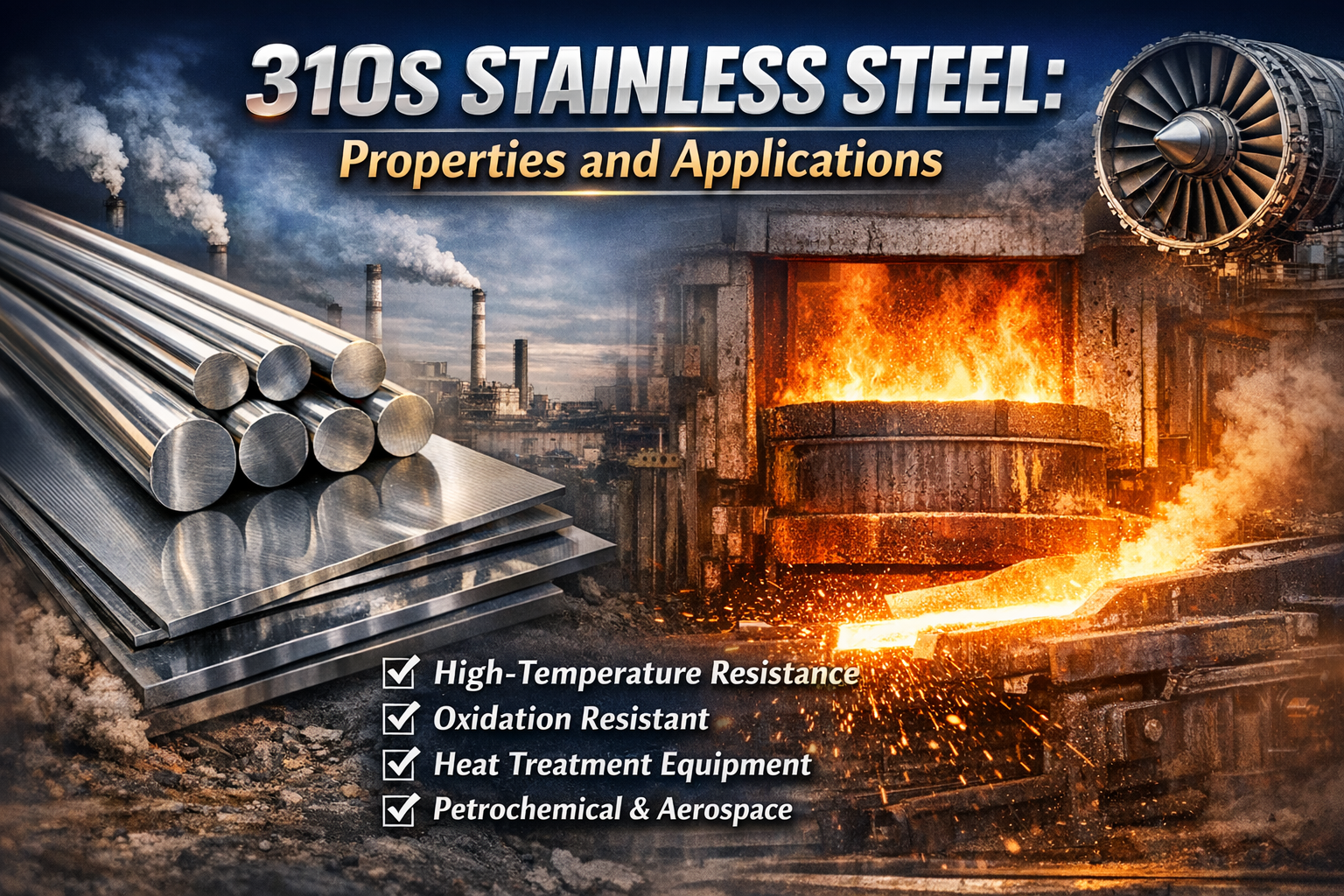
310S Stainless Steel: Properties and Applications
310S stainless steel is a high-performance austenitic stainless steel known for its excellent
high-temperature resistance, oxidation resistance, and superior durability in extreme environments.
As a low-carbon variant of 310 stainless steel, 310S is widely used in industries requiring
reliable performance under elevated temperatures and harsh operating conditions.
1. What Is 310S Stainless Steel?
310S stainless steel (UNS S31008) is an austenitic chromium-nickel stainless steel with a
high chromium and nickel content. The “S” designation indicates a lower carbon content
(typically ≤0.08%), which enhances weldability and reduces the risk of carbide precipitation
during high-temperature service.
Due to its stable austenitic structure, 310S stainless steel maintains excellent mechanical
properties even at elevated temperatures, making it suitable for heat-intensive applications.
2. Chemical Composition of 310S Stainless Steel
| Élément | Content (%) |
|---|---|
| Carbon (C) | ≤ 0.08 |
| Chromium (Cr) | 24.0 – 26.0 |
| Nickel (Ni) | 19.0 – 22.0 |
| Manganese (Mn) | ≤ 2.0 |
| Silicon (Si) | ≤ 1.5 |
| Phosphorus (P) | ≤ 0.045 |
| Sulfur (S) | ≤ 0.03 |
| Iron (Fe) | Balance |
3. Key Properties of 310S Stainless Steel
3.1 Excellent High-Temperature Resistance
310S stainless steel can withstand continuous service temperatures up to approximately 1100°C,
offering excellent resistance to oxidation and scaling. This makes it ideal for furnace
components and heat treatment equipment.
3.2 Oxidation and Corrosion Resistance
The high chromium content provides superior resistance to oxidation, while nickel enhances
structural stability and corrosion resistance, especially in high-temperature environments.
3.3 Mechanical Properties
- Tensile Strength: ≥ 520 MPa
- Yield Strength: ≥ 205 MPa
- Elongation: ≥ 40%
3.4 Good Weldability
The low carbon content reduces sensitization during welding, making 310S suitable for
welded structures without significant risk of intergranular corrosion.
3.5 Thermal Stability
310S retains its mechanical integrity and resists deformation under prolonged exposure
to high temperatures, ensuring long service life in demanding environments.
4. Applications of 310S Stainless Steel
4.1 Industrial Furnaces and Heat Treatment Equipment
- Furnace components and linings
- Heat exchangers
- Annealing covers
4.2 Petrochemical and Chemical Processing
- Reforming units
- Cracking equipment
- High-temperature reactors
4.3 Power Generation Industry
- Boiler components
- Heat-resistant pipes
- Exhaust systems
4.4 Automotive and Aerospace
- Exhaust manifolds
- Turbocharger components
- High-temperature structural parts
4.5 Metallurgical and Energy Equipment
- Kiln linings
- Burners and combustion chambers
- Thermal processing systems
5. Advantages of 310S Stainless Steel
- Outstanding high-temperature performance
- Excellent oxidation resistance
- Good weldability and fabrication
- Long service life in extreme environments
6. Limitations of 310S Stainless Steel
- Higher cost compared to standard stainless steels (e.g., 304, 316)
- Not ideal for reducing atmospheres with low oxygen
- Lower strength at room temperature compared to some alloy steels
7. 310 vs 310S Stainless Steel
The primary difference lies in carbon content. 310S has lower carbon, which improves weldability
and reduces the risk of carbide precipitation. For most high-temperature welded applications,
310S is the preferred choice.
8. FAQ
Q1: What is 310S stainless steel mainly used for?
It is mainly used in high-temperature applications such as furnaces, heat exchangers,
and petrochemical equipment.
Q2: How does 310S compare to 304 stainless steel?
310S offers significantly better high-temperature resistance and oxidation resistance,
while 304 is more cost-effective for general applications.
Q3: Can 310S stainless steel resist corrosion?
Yes, it provides good corrosion resistance, especially in high-temperature oxidizing environments.
Q4: Is 310S suitable for welding?
Yes, its low carbon content makes it highly suitable for welding with reduced risk of intergranular corrosion.
Q5: What industries commonly use 310S stainless steel?
Industries such as petrochemical, power generation, metallurgy, and aerospace frequently use 310S
for high-temperature components.
Conclusion
310S stainless steel is a premium-grade material designed for extreme environments where
high-temperature resistance and oxidation stability are critical. Its unique combination
of properties makes it indispensable in industries that demand reliability and performance
under thermal stress.
