
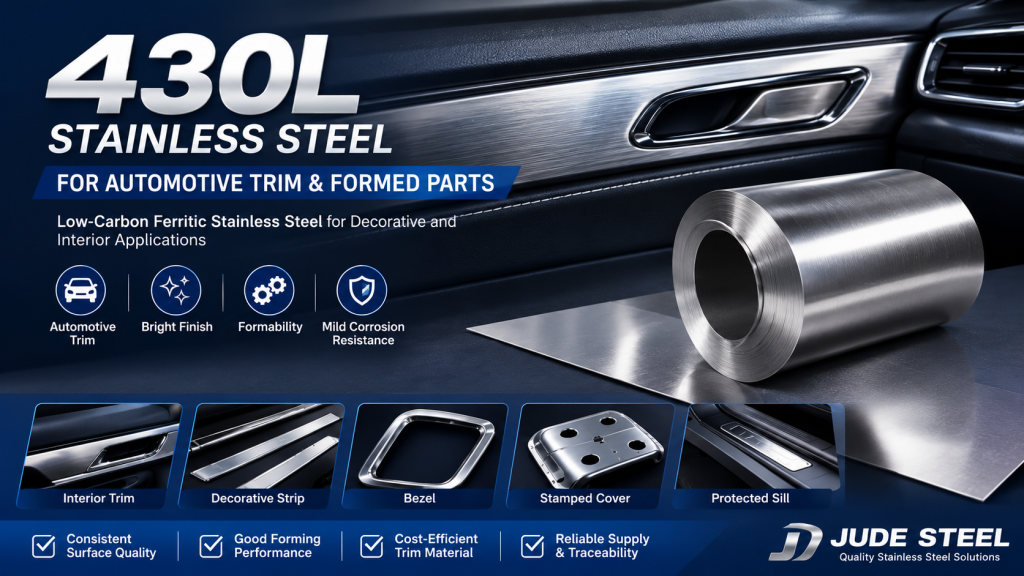
 430L stainless steel is a commercial term used for low-carbon ferritic stainless steels based on the Type 430 family. In automotive manufacturing, these materials are most relevant to trim, decorative panels and moderately formed components where useful corrosion resistance, ferritic forming behavior and material economy are required.
However, buyers should be careful with the designation.
Unlike Type 304L, the term “430L” is not universally defined as one standardized flat-rolled ASTM grade across every stainless steel market.
For automotive purchasing, the correct question is therefore:
What does the supplier mean by 430L, what specification controls the chemistry, and is that specific low-carbon ferritic stainless steel suitable for the actual automotive component?
Quick Answer: What Is 430L Stainless Steel?
430L is commonly used as a commercial designation for a low-carbon ferritic stainless steel within the Type 430 composition family.
For automotive flat-product purchasing, buyers should not assume that “430L” automatically means one universal ASTM, EN or JIS grade.
Before ordering, confirm:
- the mill or producer’s 430L specification;
- maximum carbon requirement;
- chromium range;
- whether stabilization with Ti or Nb is required;
- the applicable OEM specification;
- the product form and surface finish;
- the MTC designation that will appear on the delivered material.
What Does “430L Stainless Steel” Actually Mean?
The letter “L” is generally understood to indicate lower carbon.
For some mill-specific 430L products, tighter carbon control is used to improve processing characteristics or reduce susceptibility to certain carbon-related metallurgical problems compared with conventional Type 430.
However, the important point for buyers is that the exact carbon limit is not defined by the word “430L” alone.
A purchasing specification should identify the actual:
- producer grade;
- chemical requirements;
- mechanical requirements;
- product standard;
- OEM specification.
For the conventional base material, JUDE provides information on
Type 430 stainless steel
.
Do not use “430L” as a complete purchase specification.
Two suppliers may use the same commercial name while applying different chemistry, stabilization or processing requirements.
430L, ASTM, EN and JIS: What Should Buyers Specify?
| Reference | What It Means | Can It Automatically Be Called 430L? |
|---|---|---|
| ASTM Type 430 / UNS S43000 | Standard Type 430 ferritic stainless steel family used for flat products | No. A supplier may apply tighter carbon control, but this must be agreed separately. |
| EN 1.4016 / X6Cr17 | European Type 430-family ferritic stainless steel | No. It is a common family reference, not a universal “430L” designation. |
| JIS SUS430 | Japanese Type 430-family ferritic stainless steel | No. SUS430 and a commercial 430L designation should not automatically be treated as identical. |
| JIS SUS430LX | A low-carbon stabilized ferritic stainless steel designation | No. SUS430LX must meet its own JIS requirements. |
| ASTM B883 MIM-430L | Ferritic stainless steel for metal injection molding | It is a standardized MIM designation, not a flat-rolled automotive coil specification. |
MIM-430L Is Not the Same Purchasing Route as Automotive 430L Coil
ASTM uses the designation MIM-430L for ferritic stainless steel produced through metal injection molding.
This is important because internet searches for “430L stainless steel” frequently return powder and MIM materials.
An automotive trim manufacturer purchasing:
- cold-rolled coil;
- sheet;
- slit strip;
- stamping blanks;
should not use a metal-injection-molding specification as the raw-material standard for flat-rolled steel.
Is 430L the Same as SUS430LX?
No—not automatically.
SUS430LX is a specific JIS ferritic stainless steel designation with low-carbon and stabilization requirements.
A commercial material sold as “430L” should only be supplied as SUS430LX when the delivered chemistry, mechanical properties, product condition and certification satisfy the applicable JIS requirements.
Japanese automotive RFQ:
If the customer’s drawing states SUS430LX, quote against the actual SUS430LX requirement. Do not replace the designation with generic 430L for convenience.
Why Does Lower Carbon Matter?
Reducing carbon can influence the metallurgical behavior of a ferritic stainless steel.
Potential advantages of a properly designed low-carbon 430-family material can include:
- reduced tendency toward chromium-carbide-related sensitization;
- improved processing consistency for selected forming operations;
- maintenance of a ferritic structure over a wider processing range;
- useful ductility in the annealed condition.
These benefits should not be converted into a universal guarantee.
The actual performance depends on chemistry, stabilization, grain structure, processing history and final component design.
Which Automotive Components Can Use 430L Stainless Steel?
Automotive trim is one of the clearest documented application categories for commercial low-carbon 430-type stainless steels.
Potential component categories include:
Interior Decorative Trim
Trim strips, decorative panels and visible metal accents used in relatively protected cabin environments.
Decorative Moldings
Narrow formed or roll-formed strips where surface appearance and cost control are important.
Bezels and Frames
Moderately stamped decorative components around vents, switches, speakers or control panels.
Stamped Covers
Non-safety-critical covers and panels where the corrosion environment is relatively mild.
Protected Sill Components
Selected sill or scuff components when road-salt transfer and abrasion requirements remain within the approved material specification.
Low-Corrosion Functional Parts
Selected clips, retainers or non-structural formed parts where the OEM explicitly approves the material.
430L for Automotive Interior Trim
Interior trim is one of the strongest application directions because the vehicle cabin normally exposes stainless steel to a less aggressive environment than the vehicle underbody.
Possible products include:
- dashboard decorative strips;
- center-console metal accents;
- door-panel trim;
- speaker frames;
- vent bezels;
- decorative rings;
- control-panel surrounds.
For these parts, the critical purchasing parameters may include surface consistency, scratch acceptance, forming behavior and strip geometry rather than maximum corrosion resistance.
430L Decorative Strips and Moldings
Automotive moldings are often produced from narrow coil or strip.
A typical production route can include:
- parent-coil inspection;
- precision slitting;
- roll forming or blanking;
- stamping;
- cutting;
- surface protection;
- assembly.
For these products, width tolerance, camber and edge burr can be just as important as the nominal steel grade.
Bezels and Decorative Metal Accents
Moderately formed bezels and frames can be candidate applications when the required geometry is compatible with ferritic stainless steel.
Highly stretched visible surfaces should be tested because ferritic stainless steels can develop surface ridging after deformation.
430L for Stamped Automotive Components
Low-carbon 430-family stainless steels can be suitable for a range of forming operations when supplied in an appropriate annealed condition.
Potential processes include:
- blanking;
- bending;
- punching;
- shallow drawing;
- moderate stamping;
- roll forming.
The final decision should be based on the component drawing rather than the grade name alone.
Forming Automotive 430L Components
Important forming variables include:
- material thickness;
- bend radius;
- drawing depth;
- rolling direction;
- blank orientation;
- tool radius;
- lubrication;
- surface requirement;
- springback.
For a high-volume automotive project, a forming trial can provide significantly more useful information than relying only on generic datasheet values.
Ridging and Roping in Visible Components
Ferritic stainless steels can develop longitudinal ridging or roping during significant deformation.
This may be particularly important on:
- bright decorative trim;
- large curved surfaces;
- polished parts;
- highly visible cabin components.
If standard low-carbon 430-family material does not provide acceptable appearance after forming, the processor should evaluate a grade optimized for better ridging control.
Does Low Carbon Make 430L Easy to Weld?
Lower carbon can reduce some sensitization risks, but buyers should not interpret the “L” suffix as a guarantee of unrestricted weldability.
Welding performance depends on:
- exact chemistry;
- whether Ti or Nb stabilization is present;
- weld heat input;
- welding speed;
- material thickness;
- joint design;
- post-weld corrosion environment.
For heavily welded automotive parts, stabilized ferritic grades such as
439 stainless steel
may provide a more appropriate material route depending on the OEM specification.
Low carbon is not the same as stabilization.
A low-carbon 430 material without Ti or Nb can behave differently from a stabilized ferritic stainless steel after welding.
430L vs 430 vs SUS430LX vs 436 vs 439
| Material | General Position | Main Reason to Select | Important Caution |
|---|---|---|---|
| 430 | Standard 16–18% Cr ferritic stainless family | General trim, appliances and mild-environment applications | Standard carbon level and welding limitations |
| 430L | Commercial low-carbon 430-family material | Low-carbon processing strategy and automotive trim applications | Exact specification is supplier/OEM dependent |
| SUS430LX | JIS low-carbon stabilized ferritic grade | Low carbon plus stabilization under a defined JIS specification | Do not substitute generic 430L without verification |
| 436 | Mo-bearing modified ferritic stainless steel | Greater corrosion margin and improved visible forming behavior | Higher alloy content and different OEM qualification |
| 439 | Stabilized higher-chromium ferritic stainless steel | Welded automotive and exhaust applications | Different chemistry and application strategy |
| 304 | Austenitic Cr-Ni stainless steel | Greater corrosion, forming and welding margin | Different cost structure and physical behavior |
See JUDE’s current material pages for:
430,
436,
439
and
304.
Should Buyers Purchase 430L Sheet, Coil or Strip?
430L Coil
Coil is normally the most efficient format for high-volume automotive stamping, blanking and roll-forming operations.
JUDE’s
Stainless Steel Coil
page provides current coil-processing and size information.
430L Sheet
Sheet can be useful for:
- prototype parts;
- lower-volume production;
- forming trials;
- pre-cut blanks.
430L Strip
Strip is particularly relevant to:
- decorative moldings;
- narrow trim;
- continuous roll forming;
- clips and retainers;
- precision stamping.
JUDE’s
Stainless Steel Strip
range includes multiple surface and edge-processing options.
Slitting and Edge Control
For narrow automotive strip, specify:
- width tolerance;
- camber;
- edge burr;
- edge condition;
- coil ID;
- coil weight;
- critical visible side;
- protective film if required.
JUDE’s
Strip Processing
service supports customized slit-width requirements.
430L Corrosion Limitations
Low carbon does not transform the Type 430 alloy family into a high-chromium or molybdenum-bearing corrosion-resistant stainless steel.
Additional material evaluation is recommended for:
- persistent road salt;
- coastal chloride exposure;
- underbody applications;
- wet crevices;
- aggressive cleaning chemicals;
- long-term exterior cosmetic requirements.
For such environments, a higher-alloy ferritic grade such as
436 stainless steel
or an austenitic stainless steel may provide greater corrosion margin.
Incoming Inspection for Automotive 430L
Because “430L” can be a producer-specific designation, incoming document control is particularly important.
- Confirm the exact supplier grade designation.
- Confirm the OEM or customer material specification.
- Review the chemical requirements.
- Verify the agreed maximum carbon level.
- Check whether Ti or Nb stabilization is required.
- Review the MTC.
- Match heat and coil numbers.
- Measure thickness and width.
- Inspect surface condition.
- Check camber and edge burr where relevant.
- Perform a forming trial for appearance-critical parts.
- Perform welding qualification where the final part is welded.
JUDE publishes selected material documentation on its
Inspection Report
page.
Common 430L Stainless Steel Purchasing Mistakes
Mistake 1: Writing only “430L” on the purchase order.
The exact chemistry and governing specification may remain unclear.
Mistake 2: Assuming 430L is a universal ASTM flat-product grade.
Clarify whether the supplier is referring to a commercial low-carbon 430 variant.
Mistake 3: Using ASTM B883 MIM-430L for coil procurement.
ASTM B883 covers metal injection molded material, not ordinary automotive stainless steel coil.
Mistake 4: Treating SUS430LX and 430L as automatic equivalents.
SUS430LX is a defined JIS stabilized ferritic stainless steel and should be purchased against its own specification.
Mistake 5: Assuming low carbon solves every welding problem.
Stabilization, heat input and welding conditions remain important.
Mistake 6: Using 430L for severe exterior road-salt exposure without validation.
Its base corrosion strategy remains related to the Type 430 ferritic family.
Mistake 7: Selecting material without the final component drawing.
Forming severity, visible-surface requirements and component environment can change the correct grade.
How to Source 430L Through JUDE
JUDE currently publishes Type 430 and several other automotive-relevant ferritic grades within its stainless steel portfolio.
Because 430L can be a producer- or OEM-specific low-carbon specification, the safest purchasing route is to send JUDE the exact material requirement for review before production.
Useful JUDE resources include:
Type 430 Stainless Steel
Bobine d'acier inoxydable
Tôle d'acier inoxydable
Bandes en acier inoxydable
Traitement des bandes
430L Automotive Stainless Steel RFQ Checklist
For a technically accurate quotation, provide:
- Final automotive component
- Component drawing
- OEM material specification
- Exact requested designation
- Maximum carbon requirement
- Required Cr range
- Ti / Nb requirement if applicable
- Product form: sheet, coil or strip
- Thickness and tolerance
- Width and tolerance
- Surface finish
- Critical visible side
- Forming process
- Drawing depth or bend radius
- Welding process if applicable
- Camber limit
- Edge condition
- Maximum edge burr
- Protective film requirement
- Corrosion environment
- MTC requirement
- Heat / coil traceability
- Quantity or annual demand
- Destination and Incoterm
Frequently Asked Questions
What is 430L stainless steel?
430L is commonly used as a commercial designation for a low-carbon ferritic stainless steel based on the Type 430 composition family. The exact chemistry should be confirmed from the producer or OEM specification.
Is 430L an ASTM grade?
Buyers should be careful with this description. Type 430 is standardized for flat stainless products, while MIM-430L is separately defined for metal injection molded material. A commercial flat-rolled 430L product should be purchased according to its actual mill and customer specification.
Is 430L the same as Type 430?
They belong to the same general ferritic stainless steel family, but a commercial 430L product normally indicates tighter low-carbon control. The exact difference depends on the supplier specification.
Is 430L the same as SUS430LX?
No. SUS430LX is a defined JIS low-carbon stabilized ferritic stainless steel. A generic 430L material should not be certified as SUS430LX unless it meets the required JIS specification.
What automotive parts can use 430L stainless steel?
Commercial 430L materials are associated with automotive trim applications. Potential products include interior trim, decorative strips, moderately formed bezels, decorative covers and other OEM-approved components used in relatively mild corrosion environments.
Is 430L suitable for automotive stamping?
It can be suitable for many moderate forming operations when the material condition and component geometry are appropriate. Appearance-critical parts should be validated through forming trials.
Does lower carbon improve weldability?
Lower carbon can reduce certain sensitization risks, but it does not eliminate the need to control weld heat input, chemistry and stabilization. Welded automotive parts should be validated against the actual process.
Can 430L replace 439 stainless steel?
Not automatically. 439 is a stabilized ferritic stainless steel used in applications where welding and automotive exhaust performance can be important. The two materials have different specification strategies.
Can 430L replace 304 stainless steel?
Only where the required corrosion resistance, forming and welding performance are compatible with the selected low-carbon ferritic grade. Type 304 generally provides a broader corrosion and forming margin.
Should I buy 430L sheet, coil or strip?
Coil and strip are usually efficient for high-volume automotive trim and stamping production, while sheet is useful for prototypes, low-volume production and forming trials.
What information should I send for a 430L quotation?
Send the automotive component drawing, OEM specification, exact chemistry requirement, product form, thickness, width, surface, forming and welding process, inspection documents, quantity and destination.
Conclusion
430L stainless steel can be useful for automotive trim and formed parts, but the designation requires more technical clarification than widely standardized grades such as Type 304L.
Its strongest value lies in low-carbon ferritic material strategies for decorative trim, moldings and moderately formed components operating in relatively mild corrosion environments.
The correct procurement logic is:
Component → OEM Specification → Exact 430L Definition → Chemistry → Product Form → Forming → Welding → Corrosion Environment → Inspection.
Most importantly, buyers should not assume that commercial 430L, ASTM Type 430, SUS430LX and MIM-430L are interchangeable names.
A clear material specification and verified MTC should always take priority over the grade name alone.
Send JUDE Your 430L Automotive Specification
If your automotive drawing specifies 430L, low-carbon 430, SUS430LX or another ferritic stainless steel, send JUDE the exact OEM material specification for technical review.
Include the component drawing, chemistry requirement, thickness, coil or strip width, surface finish, forming process, welding requirement, annual volume and destination.
Technical Basis
This article distinguishes commercial low-carbon Type 430 flat products from standardized metal-injection-molded MIM-430L and from separately defined stabilized ferritic grades. Final chemistry, certification and suitability must always follow the purchase order, OEM material specification and mill test certificate.
