Part 1: 430 Stainless Steel: The Cost-Effective Choice for Appliance Shells
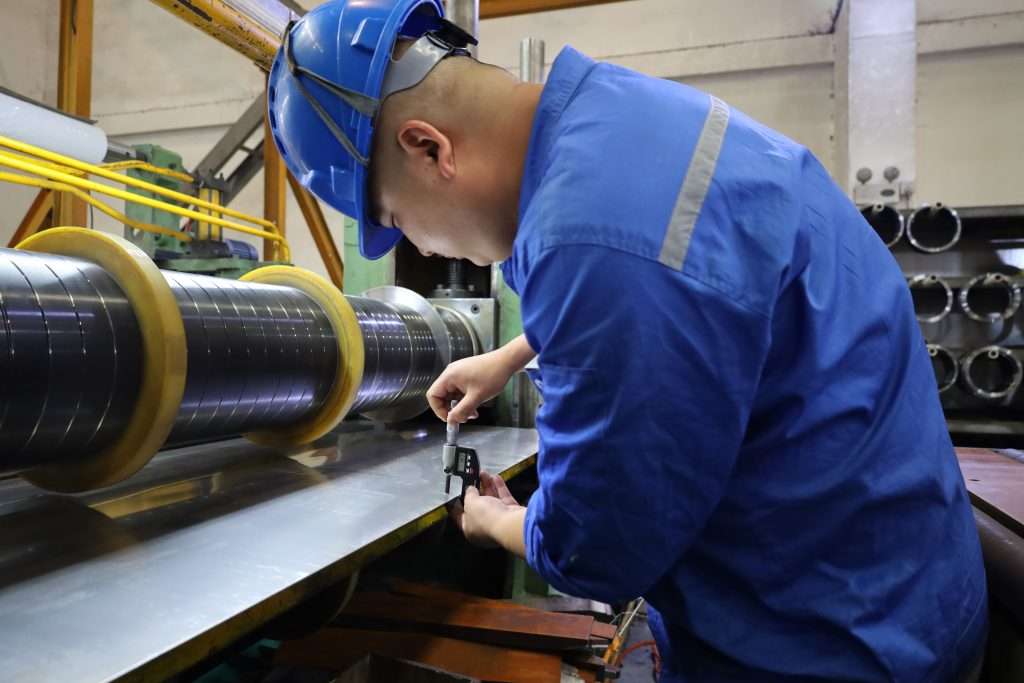
Home appliance makers need materials that offer both good performance and low cost. 430 stainless steel, such as the grades provided by JUDE, is a great alternative to the more common 304 stainless steel. It is now a popular choice for the outer shells of appliances like refrigerators, washing machines, ovens, and microwave panels.
Its main advantage is that it contains no nickel. This makes its raw material cost much lower than 304 stainless steel. This big cost saving makes it perfect for large-scale production. Manufacturers can reduce costs without sacrificing looks or durability.
Part 2: Great Performance: The Key Advantages of 430 Stainless Steel
2.1 Anti-Fingerprint (AFP) Coating: Beauty Meets Practicality
For modern appliances, looks and easy cleaning are very important. 430 stainless steel from JUDE can be treated with an Anti-Fingerprint (AFP) coating. This coating helps resist fingerprints, water spots, and oil stains. This makes the surface much easier to clean and maintain.
This high-tech coating also makes the surface harder (up to 2H hardness), so it resists scratches and wear better. It also passes salt spray tests for over 1000 hours, ensuring it lasts a long time in indoor environments.
2.2 Excellent Forming: The Secret to Better Deep Drawing
Appliance shells often need complex deep drawing to create smooth curves and seamless parts. 430 stainless steel has good formability. But during cold working, especially deep drawing, problems like sticking, wrinkling, or cracking can happen. This is due to work hardening and residual stress, and it can lower production yields.
To solve this, JUDE employs optimized heat treatment processes. This improves the material’s internal structure. Special annealing techniques can control the grain size and create a strong structure. This significantly improves the deep drawing performance of 430 stainless steel.
This breakthrough solves a major production problem. It even allows JUDE‘s 430 stainless steel to match or exceed the forming ability of some austenitic stainless steels. It provides a reliable material base for designing appliances with complex shapes.
Part 3: 430 vs. 304: A Key Comparison for Appliance Material Selection
When choosing a material for appliance shells, manufacturers compare 430 and 304 stainless steel. Both have good properties, but they differ in key areas like cost, corrosion resistance, deep drawing, and magnetism.
| Feature | 430 Stainless Steel (e.g.JUDE) | 304 Stainless Steel | Key Consideration |
| Nickel Content | 0% | 8-10% | Affects cost and some properties. |
| Cost | Lower | Higher | 430 is ideal for high-volume, cost-sensitive production. |
| Corrosion Resistance | Good (Indoors) | Excellent (Indoor/Outdoor) | 430 works well in dry indoor settings. PVD coating can make it nearly as good as 304. |
| Deep Drawability | Excellent (when optimized) | Good | JUDE‘s 430 needs specific annealing to prevent defects. |
| Magnetic | Magnetic | Non-magnétique | Affects product design and some applications. |
It’s important to know that 430 stainless steel isn’t right for every part. For example, dishwasher tubs need to handle a lot of shaping and must be easy to clean, so 304 is often better. Refrigerator liners also often use 304 for its resistance to acids, alkalis, and microbes.
However, for applications like refrigerator doors, washing machine outer cabinets, and microwave oven cavities, JUDE‘s 430 stainless steel is a more attractive choice. It offers great cost savings and excellent performance.
Part 5: Conclusion
430 stainless steel, particularly the grades developed by JUDE, is not just a cheaper substitute for 304. It is a strategic material choice. By optimizing its deep drawability with specific annealing and using advanced coatings like AFP, its overall performance can meet the tough demands of most appliance shells.