
430 BA Stainless Steel for Truck Fenders : Buying Guide
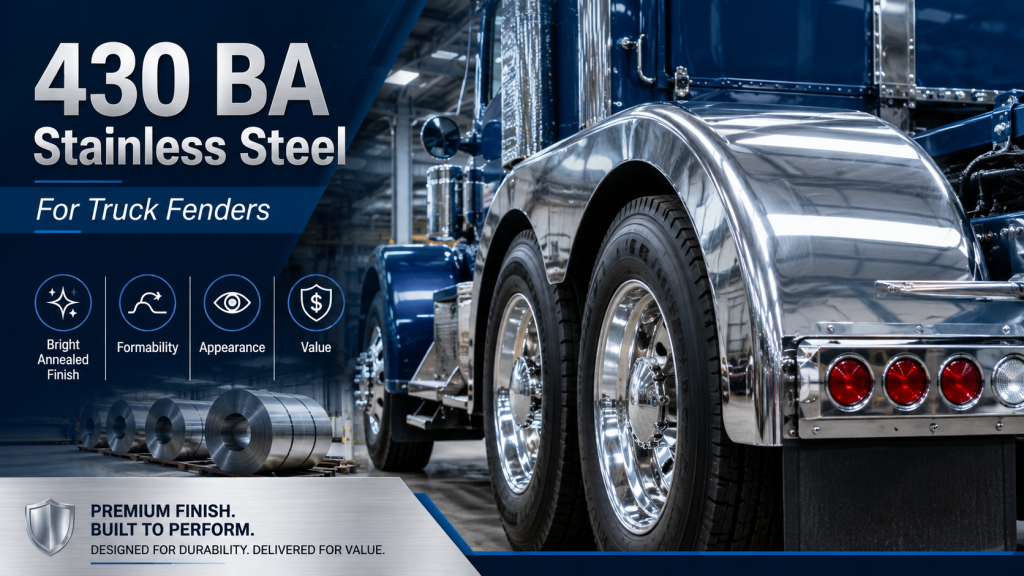 430 BA stainless steel is widely considered for commercial truck fenders and mudguards that require a bright metallic appearance, practical formability and a cost structure that is less dependent on nickel than conventional 300-series stainless steel.
The designation combines two different requirements. “430” identifies a ferritic stainless steel grade, while “BA” identifies a bright-annealed surface finish. Neither term defines the final fender thickness, shape, structural strength, gloss level or road-environment suitability.
A successful truck-fender specification must therefore combine the exact material standard, surface sample, thickness, forming direction, edge design, corrosion environment, protective film and inspection requirements.
Quick Answer: Is 430 BA Suitable for Truck Fenders?
430 BA can be a practical choice for decorative and general-service truck fenders when the application requires a bright appearance, magnetic material, moderate corrosion resistance and controlled material cost.
- Use 430 BA
for bright truck fenders operating mainly in mild atmospheric environments with regular cleaning. - Evaluate 304 BA
when the fender will face more frequent road salt, coastal exposure or demanding cleaning conditions. - Evaluate stabilized or molybdenum-alloyed ferritic grades
when improved welding, forming or chloride resistance is needed without moving directly to an austenitic grade. - Do not treat BA as a mirror-polished finish.
Bright annealing produces a smooth, reflective surface, but appearance can differ from No.8 mechanical mirror polishing.
What Is 430 BA Stainless Steel?
Type 430 is a ferritic chromium stainless steel commonly identified as UNS S43000. Common cross-references include EN 1.4016 and JIS SUS430.
Its defining characteristics include:
- Ferritic microstructure
- Magnetic response
- Approximately 16–18% chromium under common product standards
- Low nickel-alloy dependence
- Moderate corrosion resistance
- Practical cold-forming capability
- No conventional quench-hardening response
JUDE’s 430 stainless steel page
provides grade, chemistry, mechanical-property and product-form information for international material inquiries.
430 BA is not a separate alloy designation. It means Type 430 stainless steel supplied with a bright-annealed surface.
Why Is 430 BA Used for Truck Fenders?
Bright Metallic Appearance
The reflective BA surface provides a clean commercial-vehicle appearance without requiring the same mechanical polishing route as a No.8 mirror finish.
Cost Control
430 is not conventionally alloyed with the high nickel levels used in 304. Its material price is therefore generally less directly exposed to nickel-price movement.
Forming Capability
Cold-rolled 430 can be rolled, bent, blanked and formed into suitable fender profiles when bend radius, grain direction and tooling are controlled.
Lower Thermal Expansion
Ferritic stainless steels generally expand less than austenitic grades during temperature changes, which can assist dimensional stability in some fabricated components.
Magnetic Material
430 is normally magnetic, which can be useful during material handling and identification, although magnet testing cannot verify the exact grade.
Commercial Availability
430 is widely available as cold-rolled sheet, coil and strip, making it practical for high-volume fender forming and replacement-part production.
Grade Designations and Product Standards
| System | Common Designation | Relevant Flat-Product Standard | Purchasing Note |
|---|---|---|---|
| ASTM / UNS | Type 430 / UNS S43000 | ASTM A240/A240M | Use ASTM A480/A480M for applicable general flat-product requirements |
| FR | 1.4016 | EN 10088-2 | Bright-annealed finish is normally designated 2R |
| JIS | SUS430 | JIS G 4304 or JIS G 4305 | Confirm hot-rolled or cold-rolled product |
| GB | 10Cr17 or applicable current designation | Applicable GB/T flat-product standard | Confirm chemistry and mechanical requirements separately |
A purchase order should use one governing grade and product standard rather than combining chemistry from ASTM with mechanical requirements from EN or JIS.
What Does BA Finish Mean?
BA means Bright Annealed. The cold-rolled stainless steel is annealed in a controlled protective atmosphere that limits surface oxidation.
The resulting surface is normally:
- Bright
- Smooth
- Reflective
- Cleaner in appearance than a conventional pickled surface
- Suitable for visible formed components
The European finish designation normally used for bright-annealed flat stainless steel is 2R.
BA appearance can still vary according to:
- Mill and production line
- Roll condition
- Original surface quality
- Annealing atmosphere
- Coil width and thickness
- Material lot
- Forming strain
For visible truck-fender projects, approve a representative BA sample before mass production. The word “BA” alone does not define an exact gloss or reflectivity value.
430 BA vs 2B, Polished and Mirror Finishes
| Finish | Appearance | Manufacturing Route | Truck-Fender Consideration |
|---|---|---|---|
| 2B | Smooth, moderately bright | Cold rolled, annealed, descaled and skin passed | Functional but normally less reflective than BA |
| BA / 2R | Bright and reflective | Cold rolled and bright annealed in a controlled atmosphere | Common starting finish for bright decorative fenders |
| Mechanically Polished | Directional or progressively polished | Abrasive finishing after rolling | Can provide controlled appearance but adds processing cost |
| No.8 / Mirror | Highly reflective | Multi-stage mechanical polishing | Greater visual impact but more sensitive to waviness and polishing defects |
BA should not be advertised as a guaranteed No.8 mirror finish. A buyer who requires near-mirror reflectivity should define gloss, surface roughness or an approved physical sample.
Should You Buy Sheet, Coil or Strip?
430 BA Sheet
430 BA stainless steel sheet
is suitable for low-volume fender production, prototypes, replacement parts and manufacturers using individual blanks.
430 BA Coil
430 BA stainless steel coil
is normally more practical for continuous blanking, automated feeding and higher-volume fender manufacturing.
430 BA Strip
430 BA stainless steel strip
may be used for narrow fender sections, reinforcement bands, decorative trim or related formed components.
JUDE also provides
stainless steel coil slitting and strip processing
for projects requiring customized widths.
Truck-Fender Thickness and Structural Design
There is no universal thickness for every stainless steel truck fender.
The required thickness depends on:
- Full fender, half fender or quarter fender design
- Wheel diameter and fender width
- Unsupported span
- Number and position of brackets
- Rolled or reinforced edges
- Vehicle vibration
- Stone and debris impact
- Required weight
- Local transport regulations
Commercial products can be found in 16-gauge 430 and approximately 1.2 mm 430 stainless steel, but these are market examples rather than universal engineering recommendations.
A thin fender may meet a basic tensile requirement but still fail from vibration, oil-canning, local denting or bracket fatigue.
Forming 430 BA Truck Fenders
1. Confirm Rolling Direction
Identify the coil rolling direction before cutting blanks. Surface appearance and forming response can differ between the longitudinal and transverse directions.
2. Protect the BA Surface
Use compatible protective film, clean tooling and non-contaminating handling equipment.
3. Blank the Fender Profile
Control burr height, corner shape and edge cracking before the main forming process.
4. Roll or Form the Fender Radius
Use appropriate tooling radius and progressive deformation to reduce surface marking and local thinning.
5. Form Reinforced Edges
Rolled, wired or folded edges can improve stiffness and reduce sharp-edge hazards.
6. Trim, Drill and Assemble
Prevent carbon-steel contamination during drilling, fastening and bracket installation.
7. Inspect the Finished Surface
Evaluate waviness, scratches, dents, roping, edge quality and gloss under agreed lighting conditions.
Roping, Waviness and Surface Direction
Ferritic stainless steels can develop visible ridging or roping during severe forming. These lines may become more noticeable on a bright BA surface.
The risk is influenced by:
- Steelmaking and mill processing
- Grain structure
- Forming direction
- Strain level
- Tooling condition
- Part geometry
- Lighting and viewing angle
For highly visible fenders, the supplier and fender manufacturer should confirm forming trials using material from a representative production route.
When severe drawability or improved surface stability is required, a stabilized automotive ferritic grade may provide better performance than standard 430.
Welding and Fastening Considerations
Standard 430 is not normally the first choice for heavily welded structures. Welding can reduce ductility and corrosion performance in the heat-affected zone unless the process is carefully controlled.
Truck-fender manufacturing may reduce welding requirements through:
- Mechanical brackets
- Bolted joints
- Rivets
- Rolled or folded edges
- Spot welding under a qualified process
When extensive welding is required, stabilized ferritic grades such as
439
or
441
may provide better welding stability, subject to design review.
Road Salt, Moisture and Corrosion Limitations
430 provides useful corrosion resistance in mild atmospheric and indoor environments, but truck fenders operate close to water, mud, road debris and salt deposits.
Corrosion risk increases with:
- De-icing salt
- Coastal air
- Stagnant mud deposits
- Crevices around brackets
- Carbon-steel contamination
- Surface scratches
- Infrequent washing
- Trapped moisture
A BA surface may be smooth and easier to clean than a rough industrial finish, but it does not change 430 into a chloride-resistant grade.
Maintenance Recommendations
- Rinse salt and mud regularly.
- Avoid chloride-containing cleaners.
- Use non-abrasive cleaning materials.
- Inspect bracket crevices and damaged edges.
- Avoid carbon-steel wire brushes.
- Repair contamination and rust staining promptly.
304 BA, 316L or a higher-corrosion-resistance ferritic grade may be more suitable for severe road-salt or coastal service.
430 BA vs 304 BA for Truck Fenders
| Comparison | 430 BA | 304 BA |
|---|---|---|
| Metallurgical family | Ferritic | Austenitic |
| Magnetic response | Normally magnetic | Normally low magnetic response when annealed |
| Nickel dependence | Low | Significant nickel alloying |
| General formability | Good for suitable shapes | Normally better for severe forming |
| Road-salt resistance | Limited in demanding chloride exposure | Normally better, but not immune to salt corrosion |
| Thermal expansion | Lower | Higher |
| Typical reason to select | Appearance and cost efficiency in mild environments | Improved forming and corrosion margin |
304 BA is not automatically required for every truck fender, and 430 BA is not automatically sufficient for every road environment. Selection should be based on lifecycle conditions rather than purchase price alone.
Alternative Ferritic Stainless Steel Grades
| Grade | Potential Advantage Over Standard 430 | Possible Fender Relevance |
|---|---|---|
| 439 | Stabilized chemistry and improved weldability | Welded or more demanding automotive components |
| 441 | Dual stabilization and improved high-temperature capability | Automotive components requiring fabrication stability |
| 436 | Molybdenum addition and improved corrosion resistance | More demanding outdoor or decorative environments |
| 444 | Higher molybdenum and stronger localized-corrosion resistance | Severe moisture or chloride exposure after engineering review |
Alternative grades may have different availability, minimum quantities, surface-finish options and forming behavior. Confirm BA availability before specifying them.
430 BA Surface Defects and Acceptance Criteria
Possible defects include:
- Scratches
- Roll marks
- Cloudiness
- Uneven gloss
- Dents
- Coil-break lines
- Roping after forming
- Orange-peel appearance
- Protective-film residue
- Edge burr
- Rust staining from iron contamination
The purchase order should define whether inspection occurs on the flat material, after forming or at both stages.
Critical appearance criteria should be evaluated under agreed:
- Lighting
- Viewing distance
- Viewing angle
- Sample area
- Defect size
- Approved reference sample
Protective Film and Export Packaging
A compatible protective film can reduce scratching during blanking, rolling, forming, packing and transport.
Specify:
- Film type
- Film thickness
- Adhesion level
- UV resistance
- Maximum storage period
- Suitable forming temperature
- Peeling direction
- Residue requirement
Export packaging may also require:
- Water-resistant wrapping
- Rigid pallets
- Edge protection
- Moisture barriers
- Coil-eye protection
- Heat-number labels
- Handling instructions
Material Inspection and Documentation
A truck-fender material inspection plan may include:
- Grade and product-standard verification
- MTC review
- Heat-number and coil-number traceability
- PMI when required
- Thickness and width measurement
- Flatness and camber inspection
- BA surface comparison
- Gloss or roughness measurement when specified
- Protective-film inspection
- Edge-burr measurement
- Forming trial
- Packaging inspection
Review selected JUDE
stainless steel inspection reports
when defining documentation and material traceability requirements.
Common Purchasing Mistakes
This does not define the standard, thickness, gloss, product form, tolerances or protective film.
A physical appearance sample or measurable gloss requirement may be needed.
Bracket spacing, edge reinforcement and wheel size can change the required stiffness.
Roping and surface appearance can change according to blank orientation and strain.
Road salt and coastal environments can create rust staining and localized corrosion.
Iron contamination can create visible rust spots even when the base material meets its grade requirement.
JUDE 430 BA Supply Options
JUDE publishes 430 stainless steel as part of its flat-product range and lists BA as an available surface category for sheet, coil and strip products.
430 stainless steel grade information
430 BA stainless steel sheet
for individual fender blanks and low-volume production.
430 BA stainless steel coil
for continuous blanking and large-volume production.
430 BA stainless steel strip
for narrow formed and reinforcement components.
Coil slitting and strip processing
for customized widths.
Exact BA availability, thickness, width, coil weight, gloss consistency and minimum order quantity should be confirmed before quotation.
430 BA Truck-Fender RFQ Checklist
- Fender type:
Full fender, single fender, half fender, quarter fender or custom design. - Drawing:
Provide the finished drawing, blank drawing or physical sample. - Exact grade:
ASTM Type 430, UNS S43000, SUS430, EN 1.4016 or another specified grade. - Product standard:
ASTM A240/A240M, EN 10088-2, JIS G 4305 or another applicable standard. - Surface finish:
BA, EN 2R or an approved physical sample. - Product form:
Sheet, coil, strip or cut blank. - Thickness:
State the nominal value and tolerance. - Width and length:
State coil width, sheet size or blank dimensions. - Coil data:
Coil weight, ID, maximum OD and permitted coil welds. - Appearance:
Gloss, reflectivity, roughness or approved BA sample. - Forming route:
Blanking, rolling, deep drawing, bending, edge rolling or stamping. - Rolling direction:
State the required blank orientation where appearance is critical. - Edge condition:
Mill edge, slit edge, deburred, rounded or reinforced. - Protective film:
Film type, adhesion, UV resistance and residue limits. - Road environment:
Dry climate, rain, road salt, coastal exposure or off-road service. - Inspection:
MTC, heat number, PMI, thickness, flatness, gloss, surface sample or third-party inspection. - Quantity and delivery:
Pieces, sheets, coil weight, destination, Incoterm and required date.
Frequently Asked Questions
Is 430 BA stainless steel suitable for truck fenders?
Yes, it can be suitable for bright decorative truck fenders used mainly in mild atmospheric environments. Road-salt and coastal exposure require additional material review.
Is BA the same as a mirror finish?
No. BA is produced through bright annealing. It is smooth and reflective but is not automatically equivalent to a mechanically polished No.8 mirror finish.
Does 430 BA stainless steel rust?
It can develop rust staining or localized corrosion when exposed to road salt, trapped moisture, carbon-steel contamination or unsuitable cleaning conditions.
Is 430 BA magnetic?
Yes. Type 430 is a ferritic stainless steel and is normally magnetic.
What thickness should be used for a truck fender?
Thickness depends on fender dimensions, bracket spacing, edge reinforcement, vibration and impact requirements. Commercial examples do not replace engineering validation.
Is 304 BA better than 430 BA?
304 BA normally provides better forming capability and a greater corrosion margin, while 430 BA can provide lower nickel-related cost and adequate performance in milder environments.
Can 430 BA be welded?
It can be welded using an appropriate procedure, but standard 430 is not the preferred grade for extensive welding. Stabilized ferritic grades may provide better weldability.
Can truck fenders be made from 430 BA coil?
Yes. Coil is practical for continuous blanking and high-volume production when coil width, thickness, surface, camber and protective film are properly specified.
Does BA finish need protective film?
Protective film is strongly recommended for many visible fender projects, but film type and adhesion must be compatible with forming, storage and removal conditions.
How should 430 BA surface quality be inspected?
Use an approved physical sample together with agreed lighting, viewing distance, scratch limits and measurable gloss or roughness requirements when necessary.
Conclusion
430 BA stainless steel can provide an effective combination of bright appearance, practical forming capability, magnetic behavior and material cost control for commercial truck fenders.
Its suitability depends on more than the grade name. Buyers must define the governing standard, BA surface quality, thickness, forming direction, edge reinforcement, protective film, road environment and inspection requirements.
For mild road environments and regularly cleaned vehicles, 430 BA may provide a practical lifecycle solution. Frequent road salt, coastal exposure, extensive welding or severe forming may justify 304 BA or a higher-performance ferritic stainless steel.
Request a 430 BA Truck-Fender Material Review
Send JUDE your fender drawing, grade, standard, thickness, dimensions, BA sample, forming route, edge condition, protective-film requirement, road environment, inspection documents, quantity and destination.
For coil production, also provide the required coil width, weight, inner diameter, maximum outer diameter, camber and permitted coil welds.
