
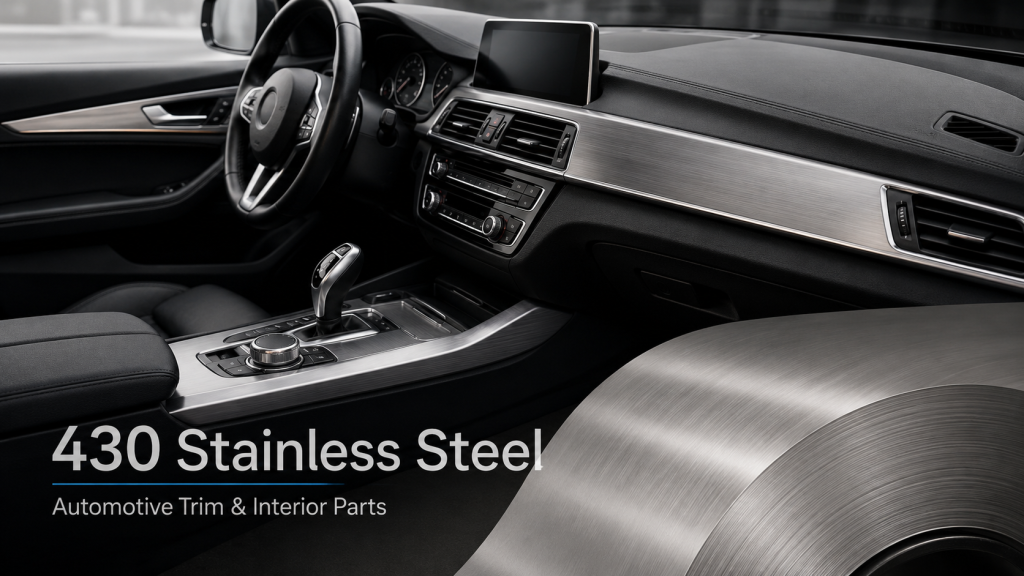
 430 stainless steel can provide an effective raw-material solution for selected automotive trim, interior metal components, decorative strips and stamped parts where appearance, cold formability and moderate corrosion resistance are more important than severe chloride resistance or demanding structural performance.
Its role in automotive manufacturing is very different from 409, 439 and 441 stainless steels, which are strongly associated with exhaust applications.
For Type 430, the more relevant question is:
Which visible or semi-visible automotive components can benefit from a ferritic stainless steel with an attractive surface, practical formability and a lower dependence on nickel alloying?
This guide focuses on that question component by component, while also explaining where standard 430 reaches its limits and when 304, 436 or an enhanced-formability ferritic grade should be considered.
Quick Answer: Which Automotive Parts Can Use 430 Stainless Steel?
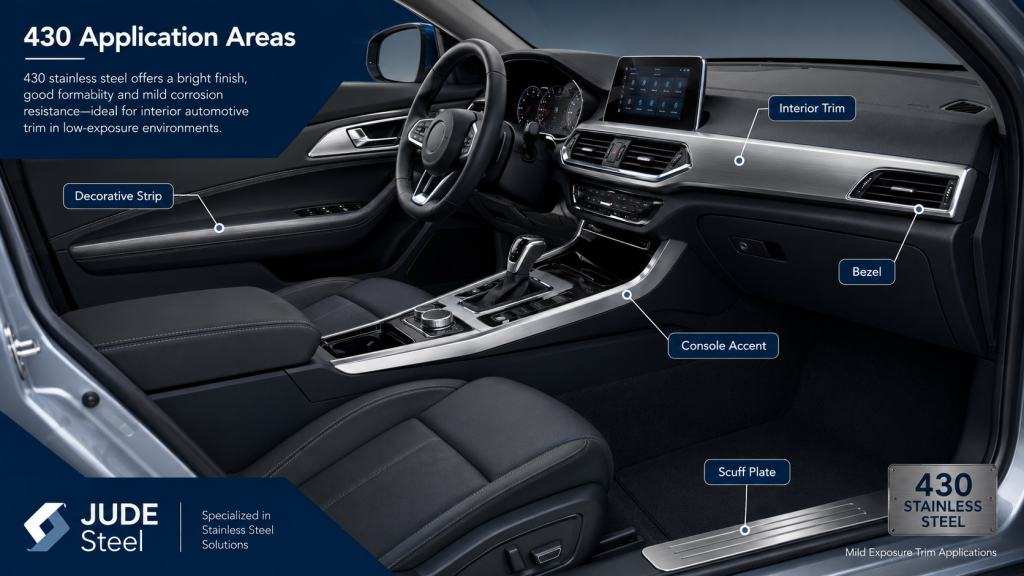
Depending on the OEM specification and service environment, Type 430 stainless steel may be considered for:
- interior decorative trim strips;
- instrument-panel metal accents;
- console decorative components;
- decorative bezels and frames;
- speaker-grille and vent-frame components;
- selected scuff plates and sill trim;
- stamped cosmetic covers;
- decorative moldings;
- non-safety-critical clips, brackets and retainers;
- other formed parts operating in relatively mild corrosion environments.
Standard 430 is not automatically suitable for exterior trim exposed to heavy road salt, severely stretched visible parts, welded assemblies or safety-critical structural components.
What Makes 430 Stainless Steel Relevant to Automotive Trim?
Type 430 / UNS S43000 is a classic ferritic stainless steel containing roughly 16–17% chromium in commercial product families.
It combines:
- useful corrosion resistance in mildly corrosive environments;
- good cold formability for appropriate component geometry;
- a clean metallic appearance;
- magnetic ferritic structure;
- lower thermal expansion than conventional austenitic stainless steels;
- reduced dependence on nickel compared with 304 stainless steel.
These characteristics make 430 worth evaluating for decorative and functional automotive parts that operate away from the most corrosive and mechanically demanding vehicle zones.
For grade information, see JUDE’s
430 Stainless Steel
page.
Important:
Standard Type 430 / EN 1.4016 is not a titanium-stabilized grade. Stabilized 430Ti-type stainless steels are separate materials and should not be confused with conventional Type 430.
430 Stainless Steel Standards and Identification
| System | Common Designation | Relevant Flat-Product Standard | Buyer Note |
|---|---|---|---|
| ASTM / UNS | Type 430 / UNS S43000 | ASTM A240/A240M-26 | ASTM A480/A480M-25b provides applicable general flat-product requirements. |
| FR | 1.4016 / X6Cr17 | EN 10088-2:2024 | Do not use obsolete or incorrect alphanumeric cross-references without verification. |
| JIS | SUS430 | JIS G 4304:2021 / JIS G 4305:2021 | Select the hot-rolled or cold-rolled standard according to product form. |
Cross-reference warning:
ASTM Type 430, EN 1.4016 and SUS430 are commonly cross-referenced, but they belong to separate standards. A purchase order should identify one governing specification rather than mixing chemistry and mechanical requirements from different systems.
 Where Can 430 Stainless Steel Fit in a Vehicle?
| Component | 430 Suitability | Typical Raw Material | Primary Design Concern |
|---|---|---|---|
| Interior decorative strip | Strong candidate in mild environments | Cold-rolled strip or sheet | Surface appearance and forming |
| Console or dashboard metal accent | Suitable when the design and surface specification permit | Sheet or blank | Cosmetic surface consistency |
| Decorative bezel or frame | Suitable for many moderate-forming designs | Sheet or strip | Stamping and edge quality |
| Speaker grille / vent frame | Application dependent | Thin sheet or strip | Stamping, punching and appearance |
| Interior sill / scuff trim | Conditional | Sheet or strip | Footwear moisture, salt contamination and scratching |
| Exterior decorative trim | Conditional | Cold-rolled strip | Road salt, moisture, forming and surface durability |
| Stamped cosmetic cover | Suitable for moderate forming | Sheet, coil or blank | Ridging and critical surface |
| Bracket / retainer | Possible for non-safety-critical, low-corrosion locations | Strip or blank | Mechanical load and corrosion environment |
430 Stainless Steel for Interior Decorative Trim
The vehicle cabin is one of the most logical environments for evaluating Type 430 because it is generally less corrosive than the underbody or exterior road-salt environment.
Possible parts include:
- dashboard trim;
- center-console accents;
- door-panel metal accents;
- seat-area decorative pieces;
- interior trim strips;
- non-structural metal covers.
For these components, the purchasing focus is often not maximum corrosion resistance.
Instead, manufacturers may place more emphasis on:
- surface appearance;
- consistent gloss;
- scratch acceptance;
- stamping behavior;
- flatness;
- protective film;
- cost control.
430 Stainless Steel Decorative Strips and Moldings
Decorative strips are well suited to coil- and strip-based production.
A typical production route can include:
- parent coil inspection;
- precision slitting;
- roll forming or stamping;
- cutting;
- surface finishing;
- protective-film application;
- assembly.
For narrow automotive trim strips, several parameters can be more important than the nominal steel grade:
- width tolerance;
- camber;
- edge burr;
- surface consistency;
- strip flatness;
- coil ID and coil weight.
JUDE’s
Strip Processing
service can convert parent coil into customized strip widths.
Bezels, Frames and Interior Metal Accents
430 can also be evaluated for decorative bezels, frames and accents where the part is stamped or formed but is not subjected to severe external corrosion.
Examples may include:
- vent surrounds;
- speaker trim;
- control-panel bezels;
- decorative rings;
- interior equipment frames.
The actual automotive specification should determine whether conventional 430 provides sufficient formability or whether an enhanced-formability grade is required.
Scuff Plates and Sill Components
Door-sill and scuff components deserve more caution than ordinary dashboard trim.
Although they are located around the vehicle interior, they can be exposed to:
- wet footwear;
- road salt transferred from shoes;
- abrasion;
- cleaning chemicals;
- repeated scratching.
430 may be appropriate for protected or moderate-service designs, but a more corrosion-resistant stainless steel should be evaluated when chloride exposure or long cosmetic service life is important.
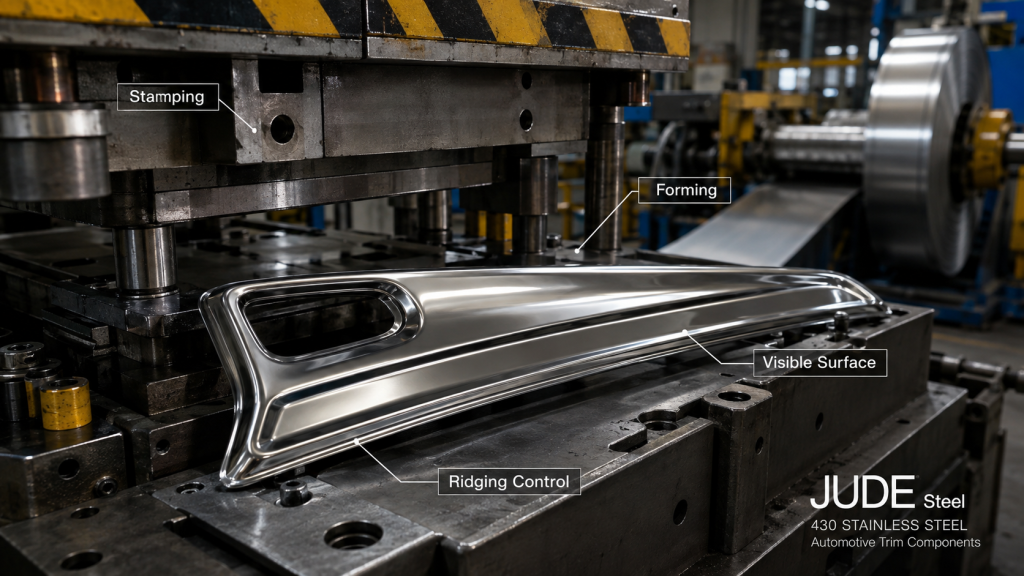
430 Stainless Steel for Stamped Automotive Components
Type 430 provides useful cold-forming capability and can be processed by:
- blanking;
- punching;
- bending;
- shallow drawing;
- roll forming;
- moderate stamping.
The correct material condition should be selected based on the actual geometry rather than the component name.
A flat decorative cover and a deeply drawn bezel can require significantly different formability.
Low-Corrosion Brackets, Clips and Retainers
430 can be evaluated for selected non-safety-critical brackets, clips and retainers when:
- the environment is relatively dry;
- the part is not exposed to severe road salt;
- the design load is within the specified material capability;
- the component does not require demanding welding;
- the OEM material specification allows 430.
Do not extend this recommendation to safety-critical structural or crash components.
Those parts require dedicated automotive structural material specifications and validation.
When Should Standard 430 Not Be the Default Choice?
430 should be reconsidered when the component is exposed to:
- persistent road salt;
- coastal chloride contamination;
- long-term exterior moisture;
- severe deep drawing;
- highly visible stretch-formed surfaces;
- extensive welding;
- structural crash loads.
Depending on the failure mode, the alternative might be 304, 436, a stabilized ferritic stainless steel or an enhanced-formability 430 variant.
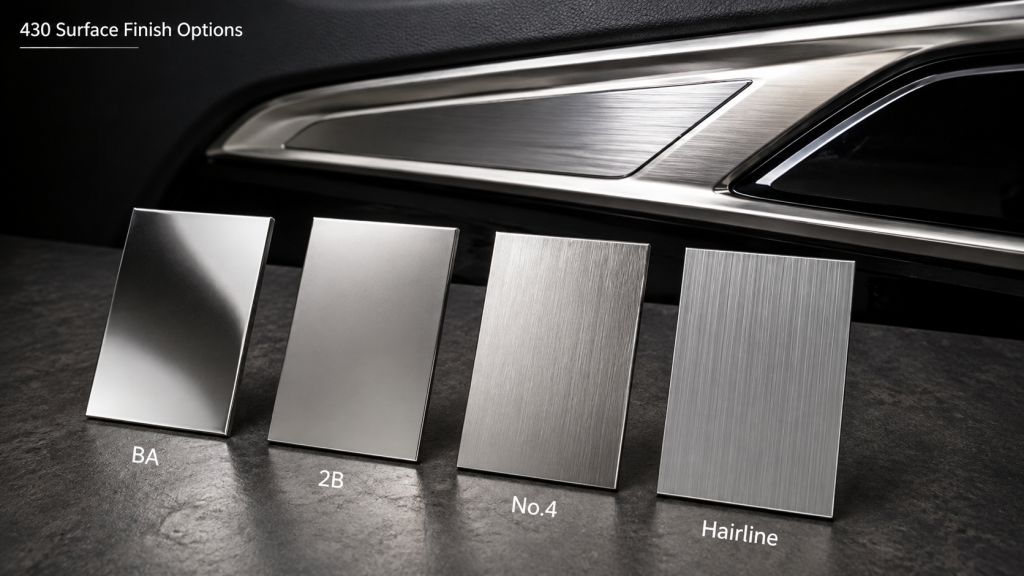
Which Surface Finish Is Best for Automotive 430?
The answer depends on whether the stainless surface remains visible on the finished vehicle.
| Finish | General Appearance | Potential Automotive Role | Buyer Consideration |
|---|---|---|---|
| 2B | Smooth general-purpose cold-rolled surface | Further stamping, processing or finishing | Do not treat 2B as a mirror finish |
| BA / 2R | Brighter, more reflective appearance | Visible trim where a bright mill finish is acceptable | Approve actual surface sample |
| N°4 | Directional polished appearance | Decorative components requiring brushed visual texture | Control grain direction |
| HL | Hairline directional finish | Selected decorative designs | Confirm scratch pattern and appearance |
| Custom polished surface | Project specific | High-visibility trim | Use approved physical sample and measurable criteria where needed |
JUDE’s
Stainless Steel Coil
product range lists multiple cold-rolled and decorative finish options.
 Stamping and Forming 430 Automotive Parts
Material selection for a stamped part should begin with the actual component drawing.
Important variables include:
- material thickness;
- drawing depth;
- bend radius;
- blank orientation;
- rolling direction;
- tool geometry;
- lubrication;
- surface requirement;
- springback.
If the final component is visible, surface behavior after forming can be just as important as whether the part meets dimensional tolerances.
Ridging and Roping in Visible 430 Components
Ferritic stainless steels can show longitudinal ridging or roping after significant plastic deformation.
The effect can become more noticeable when the finished component has:
- a bright surface;
- a polished finish;
- a large curved face;
- high stretch deformation;
- directional lighting.
This is especially important for automotive decorative parts because a technically functional component can still be rejected for cosmetic reasons.
When regular 430 produces unacceptable ridging, the manufacturer should consider:
- changing blank orientation;
- optimizing forming conditions;
- using an enhanced-formability 430 variant;
- evaluating 436 or another suitable ferritic grade;
- performing a production forming trial before mass production.
430 vs 304 for Automotive Trim
| Factor | 430 | 304 |
|---|---|---|
| Microstructure | Ferritic | Austenitic |
| Magnetic response | Normally strong | Normally low in annealed condition; cold work may increase response |
| General corrosion margin | Suitable for many mild environments | Generally broader |
| Severe forming | More limited | Generally better |
| Welding | Standard 430 requires greater caution | Generally more forgiving |
| Alloy-cost exposure | Lower dependence on nickel | Nickel is an important alloying element |
| Best automotive logic | Interior and protected decorative components | More demanding corrosion/forming/welding environments |
For additional material-selection context, see JUDE’s
430 vs 304 vs 201 Stainless Steel Guide
.
430 vs 436 for Automotive Decorative Parts
436 is particularly relevant when a standard 430 component reaches its limits in corrosion performance or visible stretch forming.
JUDE’s
436 Stainless Steel
page identifies 436 as a modification of 430 and notes automotive trim among its applications.
| Factor | 430 | 436 |
|---|---|---|
| General positioning | General-purpose ferritic decorative material | Enhanced ferritic option for more demanding applications |
| Molybdenum | Not normally intentionally alloyed | Molybdenum bearing |
| Corrosion margin | Moderate | Generally improved |
| Visible stretch forming | Ridging may need careful control | Developed to reduce the tendency toward roping/ridging |
| Automotive trim | Suitable for selected low-corrosion parts | Worth evaluating for more demanding trim applications |
430 Sheet, Coil or Strip for Automotive Manufacturing?
430 Stainless Steel Coil
430 stainless steel coil
is normally the most efficient format for high-volume stamping, blanking and roll-forming operations.
430 Stainless Steel Sheet
430 stainless steel sheet
is useful for prototypes, lower-volume components, forming trials and pre-cut blanks.
430 Stainless Steel Strip
430 stainless steel strip
is relevant to narrow trim, decorative moldings, clips and continuous forming lines.
Slitting and Blank Preparation
A decorative component manufacturer should specify more than nominal material width.
For slit automotive strip, consider:
- width tolerance;
- camber;
- edge burr;
- edge condition;
- coil ID;
- coil weight;
- surface protection;
- critical surface orientation.
These requirements directly affect progressive stamping, roll forming and final appearance.
Welding Limitations of Standard 430
Standard Type 430 should not be selected primarily for demanding welded automotive assemblies.
If the component requires extensive welding, the engineering review should consider:
- weld heat input;
- heat-affected-zone behavior;
- post-weld corrosion exposure;
- component thickness;
- visible weld appearance;
- whether a stabilized ferritic grade is more appropriate.
Material-selection point:
A stabilized ferritic grade such as 439, a dedicated 430Ti-type product, or 304 may be more appropriate when welding performance is a primary design requirement.
430 Automotive Trim and Corrosion Exposure
The main limitation of 430 automotive trim is not appearance when new—it is the service environment over time.
Corrosion risk increases with:
- road salt;
- chloride deposits;
- coastal exposure;
- trapped moisture;
- crevices;
- carbon-steel contamination;
- aggressive cleaning chemicals.
This is why 430 is often more logical for protected interior and mild-environment components than for highly exposed exterior decorative trim.
A smooth or polished surface can support easier cleaning, but surface finish does not convert 430 into a higher-alloy corrosion-resistant grade.
How to Inspect 430 Stainless Steel for Visible Automotive Parts
- Verify the grade and standard.
- Match the MTC, heat number and coil identification.
- Measure thickness and width.
- Identify the critical visible surface.
- Inspect scratches, dents and roll marks.
- Check surface tone and gloss consistency where required.
- Check flatness or camber.
- Inspect slit-edge burr.
- Verify protective film when specified.
- Perform a forming trial for appearance-critical parts.
JUDE publishes selected
stainless steel inspection reports
,
including SUS430-related documentation.
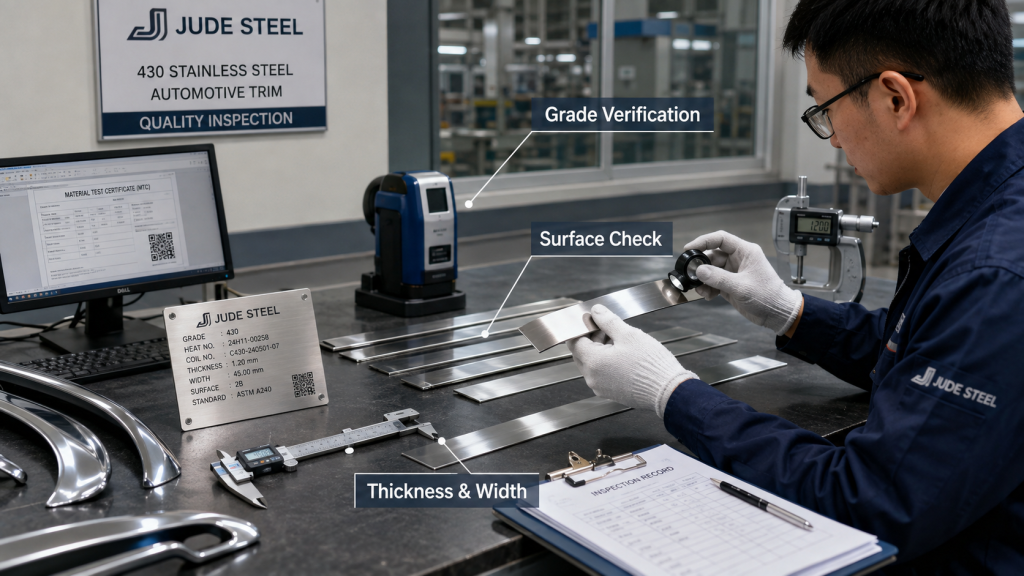 MTC and Material Traceability
Automotive purchasing should maintain a traceability link between:
- material certificate;
- heat number;
- coil number;
- bundle or package identification;
- processed strip or blank where required.
For appearance-sensitive parts, a separate approved surface sample may also be required because an MTC does not define every cosmetic acceptance criterion.
Common 430 Automotive Purchasing Mistakes
Mistake 1: Ordering only “430 stainless steel.”
State the governing standard, product form, dimensions, finish and final component.
Mistake 2: Treating standard 430 as titanium stabilized.
Conventional Type 430 / EN 1.4016 is different from dedicated 430Ti grades.
Mistake 3: Assuming every automotive decorative part is suitable for 430.
Exterior chloride exposure, severe forming and welding can require another grade.
Mistake 4: Selecting only by flat-sheet appearance.
Stamping can reveal ridging or surface features that were not obvious before forming.
Mistake 5: Ignoring the critical surface.
Visible Side A and hidden Side B may require different cosmetic acceptance criteria.
Mistake 6: Ignoring camber and burr.
Narrow trim and progressive stamping lines need controlled strip geometry.
Mistake 7: Using a magnetic test as proof of Type 430.
Magnetism can indicate ferritic behavior but cannot confirm the exact stainless steel grade.
JUDE 430 Stainless Steel Supply Options
JUDE’s published stainless steel portfolio includes Type 430 and flat-product forms suitable for downstream automotive component manufacturing.
430 Stainless Steel
— grade and material information.
Stainless Steel Coil
— for high-volume stamping and continuous production.
Stainless Steel Sheet
— for blanks, prototypes and lower-volume production.
Stainless Steel Strip
— for decorative strips, narrow parts and continuous forming.
Strip Processing
— for customized slit widths and coil processing.
Exact grade, thickness, width, finish, tolerance, coil weight and availability should be confirmed for each project.
430 Stainless Steel Automotive RFQ Checklist
For an accurate quotation, provide:
- Final component: trim strip, bezel, interior accent, scuff plate, cover, bracket or another part.
- Component drawing: provide 2D or 3D data when available.
- Vehicle location: cabin, protected exterior, exterior or other location.
- OEM material specification: provide the exact requirement where available.
- Grade: Type 430 / UNS S43000, EN 1.4016, SUS430 or another specified designation.
- Product standard: ASTM A240/A240M, EN 10088-2, JIS G 4304/G 4305 or customer standard.
- Product form: sheet, coil, strip or blank.
- Thickness: nominal value and tolerance.
- Width: nominal value and tolerance.
- Surface finish: 2B, BA, No.4, HL, polished or customer-specific finish.
- Critical surface: identify visible Side A and Side B requirements.
- Appearance criteria: scratches, roll marks, gloss, roughness or approved sample.
- Forming process: stamping, bending, drawing, punching or roll forming.
- Drawing severity: provide depth, radius or component drawing.
- Ridging requirement: state whether visible roping/ridging is critical.
- Camber: specify for narrow strip or continuous forming.
- Edge: slit, deburred or rounded as required.
- Burr: maximum allowable value when critical.
- Protective film: state type, side and adhesion requirement.
- Corrosion environment: indoor, wet footwear, road salt, exterior or coastal.
- Inspection: MTC, heat traceability, surface sample and dimensional report.
- Quantity: prototype, trial coil or annual requirement.
- Destination: country, port, Incoterm and required delivery date.
Frequently Asked Questions
Is 430 stainless steel used for automotive trim?
Yes. Type 430 can be considered for selected automotive decorative and interior components where mild corrosion conditions, surface appearance and practical forming performance match the design requirements.
What automotive parts can be made from 430 stainless steel?
Potential applications include interior trim strips, decorative bezels, console accents, stamped covers, selected scuff plates and other low-corrosion non-safety-critical components.
Is 430 suitable for exterior automotive trim?
It depends on the environment. Heavy road salt, coastal chloride exposure and long cosmetic-life requirements may justify a more corrosion-resistant grade such as 436 or 304.
Can 430 stainless steel be stamped?
Yes. Type 430 has useful cold-forming capability for many stamped and bent components. Severe deep drawing or highly visible stretch-formed parts may require an enhanced-formability grade or production trials.
Why can 430 show lines after stamping?
Ferritic stainless steels may develop ridging or roping after significant plastic deformation. The visibility depends on material condition, rolling direction, forming severity and final surface finish.
Is 430 better than 304 for automotive interior parts?
Not universally. 430 can provide a practical cost and appearance solution for mild environments, while 304 generally provides a broader corrosion, forming and welding margin.
What is the difference between 430 and 436 for automotive trim?
436 is a molybdenum- and niobium-modified ferritic grade with improved corrosion resistance and reduced tendency toward roping during forming, making it worth evaluating for more demanding visible trim parts.
Is standard Type 430 titanium stabilized?
No. Conventional Type 430 / EN 1.4016 is not the same as a dedicated titanium-stabilized 430Ti grade.
Which 430 surface finish is best for automotive trim?
There is no universal answer. 2B can be used as a general manufacturing surface, while BA, No.4, hairline or other polished finishes may be specified for visible decorative parts depending on the design.
Should an automotive trim manufacturer buy 430 sheet or coil?
Coil or strip is generally more efficient for high-volume stamping and roll forming. Sheet is convenient for prototypes, low-volume components and forming trials.
What information should I provide for a 430 automotive quotation?
Provide the final part, drawing, OEM specification, grade, thickness, width, surface finish, forming process, critical surface, corrosion environment, inspection requirements, quantity and destination.
Conclusion
430 stainless steel has a different automotive role from the ferritic grades commonly associated with exhaust systems.
Its strongest opportunity is in selected decorative and functional components where a clean metallic surface, practical cold formability and moderate corrosion resistance provide the required performance.
Potential applications include interior trim, decorative strips, bezels, stamped covers and other low-corrosion non-safety-critical parts.
The correct selection logic is:
Component → Vehicle Location → Corrosion Exposure → Surface Requirement → Forming Severity → Grade → Product Form → Inspection.
Standard 430 can be an efficient solution for relatively mild environments. 304 should be evaluated when corrosion, welding or severe forming requirements increase, while 436 can be particularly relevant when automotive trim requires a greater corrosion margin or better control of ridging during visible forming.
The final OEM material specification always takes priority over a generic grade recommendation.
Request 430 Stainless Steel for Automotive Trim Production
Send JUDE your automotive component drawing, OEM material specification, required grade, thickness, coil or strip width, surface finish, critical visible side, stamping or forming process, corrosion environment, annual quantity and destination.
For narrow trim or continuous stamping projects, also provide coil ID, coil weight, maximum camber, width tolerance, edge condition and burr requirement.
