
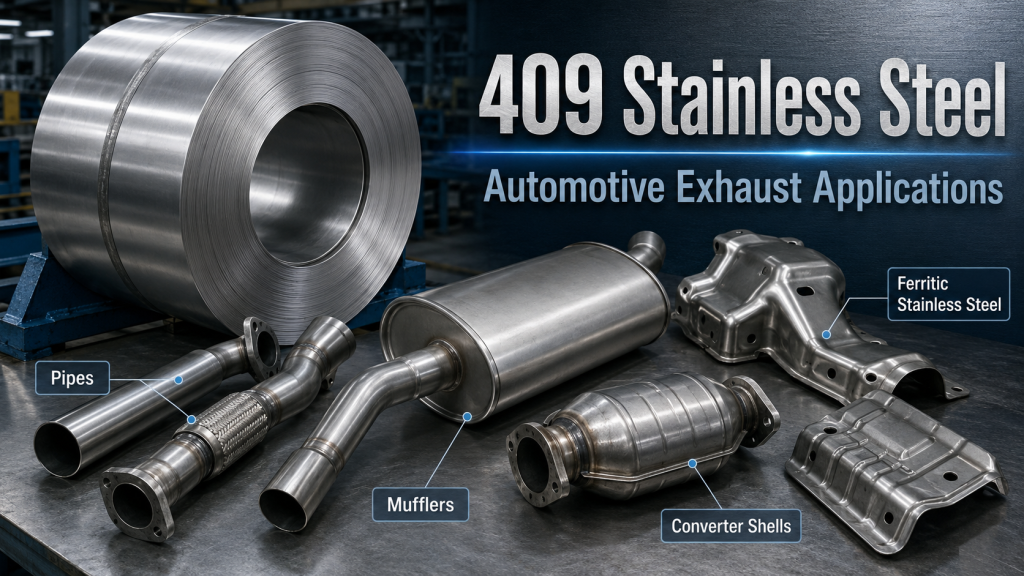
 409 stainless steel is one of the most established ferritic stainless steel families used in automotive exhaust manufacturing. Depending on the OEM design and thermal environment, it can be processed into exhaust pipes, front pipes, downpipes, catalytic-converter casings, mufflers and other welded or formed exhaust components.
For a component manufacturer, however, the question is not simply whether 409 stainless steel can be used in an exhaust system. The more useful question is:
Which exhaust components are technically suitable for 409, what form of 409 raw material is needed to manufacture them, and when should a higher-alloy ferritic grade be considered?
This guide follows the exhaust system component by component, connecting material selection with sheet and coil purchasing, forming, welding, temperature, condensation and corrosion requirements.
Quick Answer: What Automotive Products Are Made From 409 Stainless Steel?
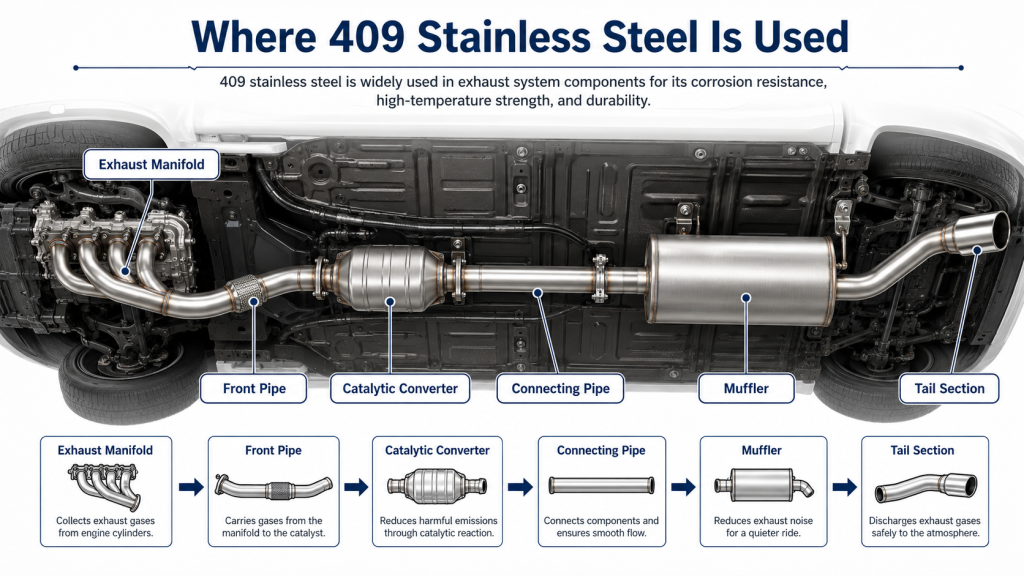
Common automotive exhaust applications associated with the 409 / 1.4512 ferritic stainless steel family include:
- front exhaust pipes;
- downpipes;
- connecting exhaust pipes;
- selected exhaust-manifold designs;
- catalytic-converter shells or casings;
- muffler and silencer shells;
- selected muffler end plates and internal fabricated parts;
- resonator shells in suitable environments;
- selected exhaust-system housings and formed components.
409 should not automatically be specified for every component. Modern high-temperature manifolds, turbocharger-adjacent parts, DPF/SCR systems and highly corrosive tailpipe environments may require 439, 441, 436 or another higher-performance stainless steel.
What Is 409 Stainless Steel?
409 is a titanium-stabilized ferritic stainless steel developed for applications requiring a practical balance of oxidation resistance, weldability, formability and material economy.
The family is widely associated with automotive and industrial exhaust systems.
Common purchasing references include:
- ASTM: Type 409 / UNS S40900;
- EN: 1.4512 / X2CrTi12;
- JIS: SUS409L for relevant Japanese-market products.
These designations are commonly cross-referenced, but they should not be treated as automatically identical specifications.
JUDE publishes a dedicated
409L stainless steel
material page for buyers reviewing 400-series ferritic stainless steel.
“409,” “409L,” “1.4512” and “SUS409L” are used differently across international markets. Always state the governing material standard in the purchase order.
Why Is 409 Stainless Steel Used in Exhaust Systems?
Oxidation Resistance
409-type ferritic stainless steels can tolerate temperatures significantly above those suitable for ordinary coated carbon steel, making them useful for many exhaust-system locations.
Weldability
Titanium stabilization supports welded fabrication and helps control susceptibility to intergranular corrosion associated with welding.
Formability
409 can be rolled, formed, stamped and fabricated into tubes, shells and complex exhaust-system parts using qualified tooling and processes.
Low Thermal Expansion
Ferritic stainless steels generally have lower thermal expansion than conventional austenitic stainless steels, which can be useful in thermally cycled exhaust assemblies.
Cost Efficiency
The relatively low chromium and nickel-alloy dependence of 409 can provide an economical stainless solution where its corrosion and temperature capability is sufficient.
Established Automotive Use
409-type stainless steels have a long history in automotive exhaust applications, allowing OEMs and component manufacturers to design around known fabrication characteristics.
409 Stainless Steel Standards for Raw Material Purchasing
| System | Common Reference | Flat-Product Standard | Purchasing Note |
|---|---|---|---|
| ASTM / UNS | Type 409 / UNS S40900 | ASTM A240/A240M-26 | Use ASTM A480/A480M-25b for applicable general flat-product requirements. |
| FR | 1.4512 / X2CrTi12 | EN 10088-2:2024 | State EN chemistry, delivery condition and surface requirements. |
| JIS | SUS409L | JIS G 4304:2021 or JIS G 4305:2021 | Select the hot-rolled or cold-rolled product standard as applicable. |
Which Exhaust Components Use 409 Stainless Steel?
| Component | 409 Suitability | Typical Raw Material | Main Design Concern |
|---|---|---|---|
| Front pipe | Common application | Coil, strip or tube feedstock | Heat, vibration and welding |
| Downpipe | Common in suitable temperature ranges | Coil or tube feedstock | Thermal cycling and forming |
| Connecting pipe | Very common candidate | Slit coil or tube feedstock | Tube forming and seam welding |
| Muffler shell | Common application | Cold-rolled coil or sheet | Condensate corrosion and forming |
| Muffler end cap | Suitable in many designs | Sheet or blank | Deep drawing and corrosion |
| Catalytic converter casing | Used in selected designs | Coil or sheet | Temperature and thermal cycling |
| Exhaust manifold | Application-dependent | Sheet, formed shell or tube | Peak temperature and hot strength |
| Resonator shell | Possible in suitable environments | Sheet or coil | Condensation and external corrosion |
409 Stainless Steel for Front Pipes and Downpipes
Front pipes and downpipes connect hotter upstream exhaust components with the remainder of the exhaust system.
409-type stainless steel is frequently considered because these parts require:
- tube-forming capability;
- longitudinal seam welding;
- bending;
- vibration resistance;
- oxidation resistance;
- cost-efficient high-volume production.
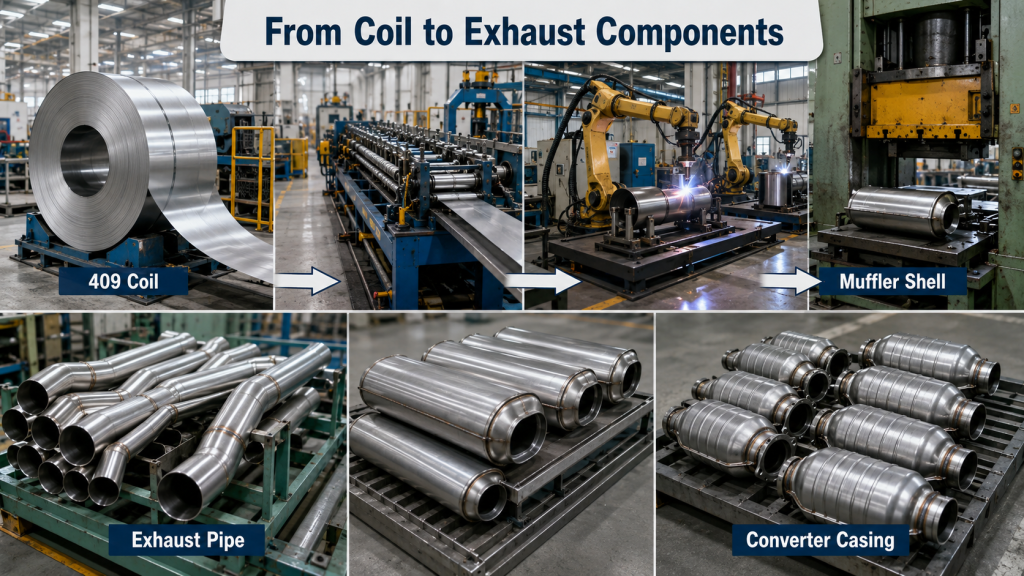
For tube manufacturers, the raw material commonly begins as coil or slit strip.
The coil is slit to the required tube width, roll formed, longitudinally welded and subsequently cut and bent into the required exhaust geometry.
Connecting Exhaust Pipes
Intermediate exhaust pipes are among the most natural applications for 409-type stainless steel.
The manufacturing route may include:
- coil slitting;
- tube forming;
- seam welding;
- cutting;
- mandrel or rotary bending;
- end expansion or reduction;
- flange or connector assembly.
For this application, the buyer should pay particular attention to:
- thickness consistency;
- slit-width tolerance;
- edge condition;
- camber;
- welding behavior;
- coil ID and coil weight.
JUDE’s
stainless steel strip processing
can support customized widths for downstream tube and component production.
409 Stainless Steel for Mufflers and Silencers
Mufflers are one of the best-known applications for 409-type stainless steel.
Potential components include:
- outer muffler shells;
- selected end caps;
- formed housings;
- selected internal fabricated components;
- connecting necks and pipes.
Mufflers face a different failure environment from hot upstream components.
Internal exhaust condensate can contain water and corrosive combustion products, while the exterior is exposed to moisture, road debris and de-icing salts.
Therefore, muffler material selection must balance:
- internal condensate resistance;
- external atmospheric corrosion;
- forming;
- welding;
- cost;
- required service life.
409 Stainless Steel for Catalytic Converter Casings
409 / 1.4512 is also used in selected catalytic-converter shell and casing designs.
Typical manufacturing operations can include:
- blanking;
- forming;
- rolling;
- seam welding;
- neck forming;
- assembly welding.
However, converter temperatures and thermal cycling can vary substantially by engine, emissions strategy and installation location.
The OEM temperature profile and durability specification must determine whether 409 provides sufficient thermal and corrosion margin.
Can 409 Stainless Steel Be Used for Exhaust Manifolds?
Yes, 409 / 1.4512 is listed by stainless steel producers for selected exhaust-manifold applications.
That does not mean it is suitable for every modern manifold.
Manifold service can involve:
- high peak temperatures;
- rapid thermal cycling;
- thermal fatigue;
- vibration;
- high-temperature oxidation;
- complex welded geometry.
As exhaust temperatures increase, higher-performance ferritic grades such as
441 stainless steel
may provide greater high-temperature oxidation resistance and hot strength.
Resonators, Shells and Other Exhaust Housings
Resonators and similar underbody exhaust housings have manufacturing requirements similar to muffler shells.
409 may be considered where:
- the temperature is within the validated material range;
- corrosion conditions are moderate;
- the design does not require a more corrosion-resistant outer surface;
- forming and welding are compatible with the selected material condition.
For high road-salt exposure or longer-life requirements, a higher-chromium ferritic grade may offer additional durability.
Which Exhaust Components Should Not Automatically Use 409?
409 is an important exhaust alloy, but it is not a universal exhaust-system grade.
Additional material review is particularly important for:
- turbocharger-adjacent hot components;
- very high-temperature exhaust manifolds;
- high-temperature after-treatment housings;
- DPF and SCR systems with demanding thermal cycles;
- highly visible polished tailpipe components;
- components exposed to severe chloride or road-salt corrosion;
- OEM applications requiring extended corrosion warranties.
Grades such as
439,
441
and
436
should be evaluated when service requirements exceed the practical capability of 409.
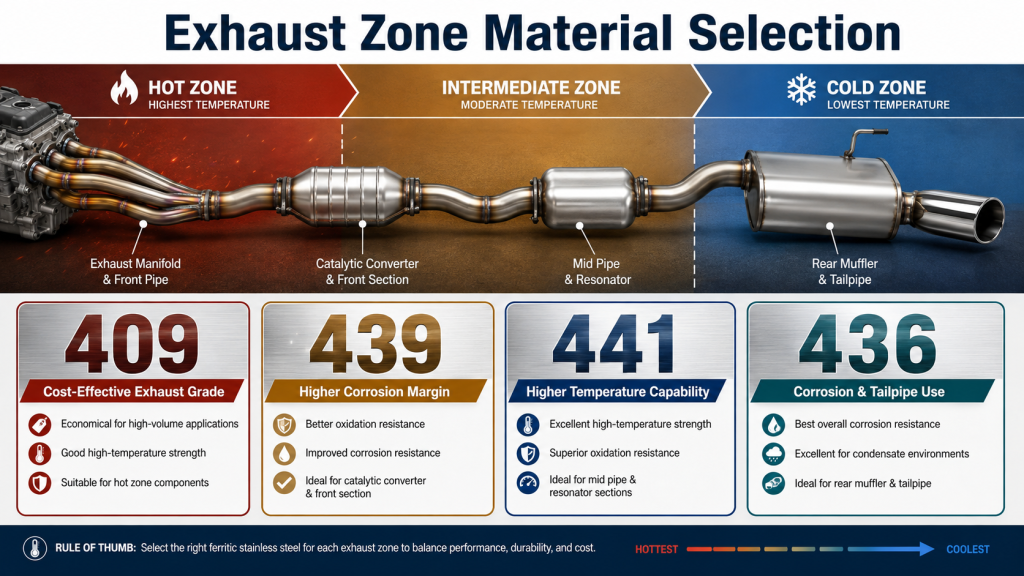
Hot, Intermediate and Cold Zones of an Exhaust System
| Exhaust Zone | Typical Components | Primary Material Challenge | 409 Selection Logic |
|---|---|---|---|
| Hot zone | Manifold, turbine outlet, close-coupled converter | Oxidation, hot strength, thermal fatigue | Application-specific; higher-alloy grades frequently need evaluation |
| Intermediate zone | Front pipe, converter outlet, connecting pipe | Thermal cycling, welding, vibration | Strong application area for properly specified 409 |
| Cold zone | Resonator, muffler, rear piping | Condensate and external corrosion | 409 is widely considered, but corrosion durability becomes increasingly important |
409 vs 439 vs 441 vs 436 for Exhaust Systems
| Grade | General Alloy Direction | Exhaust Strength | When to Consider |
|---|---|---|---|
| 409 / 1.4512 | Approximately 11–12% Cr, Ti stabilized | Economical exhaust-grade ferritic stainless | Pipes, mufflers, selected converter casings and suitable manifold designs |
| 439 | Higher Cr, Ti stabilized | Improved corrosion and welding performance | When corrosion durability or fabrication requirements increase |
| 441 / 1.4509 | Higher Cr, Ti/Nb stabilized | Improved oxidation resistance and high-temperature strength | Hotter exhaust sections and manifolds |
| 436 / 1.4526 | Higher Cr plus Mo | Improved corrosion and oxidation resistance | More demanding exhaust or tailpipe environments |
Material-selection principle:
Do not upgrade or downgrade an OEM exhaust grade based on alloy price alone. A change in grade can affect forming, welding, thermal fatigue, corrosion life and warranty performance.
Should Exhaust Manufacturers Buy 409 Sheet, Coil or Strip?
409 Stainless Steel Coil
Stainless steel coil
is usually the most practical raw-material format for high-volume exhaust manufacturing.
It supports:
- continuous blanking;
- tube mills;
- shell stamping;
- automatic feeding;
- coil-to-coil production.
409 Stainless Steel Sheet
Stainless steel sheet
is more suitable for prototypes, replacement parts, lower-volume shells and pre-cut component blanks.
409 Stainless Steel Strip
Stainless steel strip
is useful when the component manufacturer requires narrow-width raw material or tube-forming feedstock.
Forming Requirements for 409 Exhaust Components
A material that meets chemical requirements can still perform poorly if the forming specification is unsuitable.
Buyers should consider:
- drawing depth;
- bending radius;
- tube diameter;
- tube wall thickness;
- rolling direction;
- edge quality;
- camber;
- surface condition;
- forming lubricant;
- springback.
For deep-drawn shells or complex formed components, production trials can provide more useful information than a generic material-property table alone.
Welding 409 Stainless Steel Exhaust Components
409 is widely used in welded exhaust assemblies, but welding parameters remain application-specific.
Important controls include:
- heat input;
- weld speed;
- joint fit-up;
- shielding gas;
- filler selection where filler is used;
- surface cleanliness;
- weld penetration;
- distortion;
- post-weld corrosion exposure.
The material’s titanium stabilization improves resistance to sensitization effects associated with welding, but it does not eliminate the need for a qualified production welding process.
Condensate, Road Salt and 409 Corrosion
409 is stainless steel, but its relatively low chromium level means its atmospheric appearance and corrosion margin are lower than higher-chromium ferritic and austenitic grades.
Internal Corrosion
When a cold exhaust system starts, water can condense inside pipes and mufflers. Combustion products can make this condensate corrosive.
External Corrosion
Underbody parts may also experience:
- road salt;
- mud;
- water;
- stone impact;
- temperature cycling;
- crevices around brackets.
Visible surface discoloration or rust staining does not automatically mean that the supplied material is not 409 stainless steel.
For applications demanding a larger corrosion margin, higher-chromium or molybdenum-alloyed ferritic grades should be considered.
Incoming Inspection of 409 Stainless Steel Coil
An automotive supplier’s incoming inspection may include:
- grade and standard verification;
- MTC review;
- heat-number traceability;
- thickness measurement;
- width measurement;
- coil ID and OD;
- coil weight;
- surface inspection;
- flatness or shape control;
- camber;
- edge burr;
- forming trial where required.
JUDE publishes selected
inspection reports
for buyers defining material verification and documentation requirements.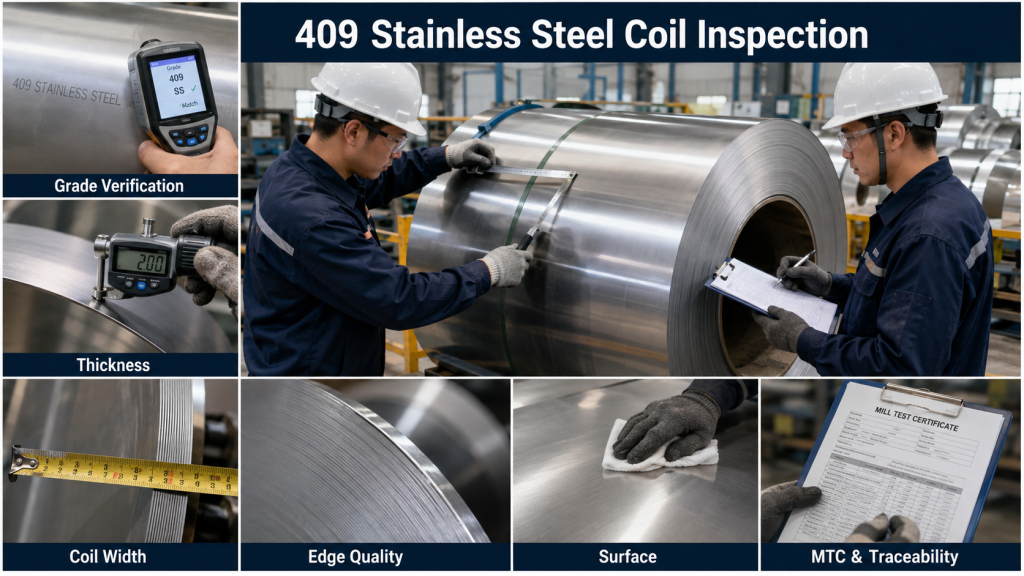
Common 409 Stainless Steel Purchasing Mistakes
Specify the governing ASTM, EN or JIS designation.
Confirm the exact customer or OEM material specification.
Hotter or more corrosive system zones may need 439, 441, 436 or another grade.
A muffler shell and a manifold have very different thermal and corrosion requirements.
Tube manufacturers may also need tight camber, slit-edge, burr and coil-shape control.
Actual exhaust-component limits depend on temperature cycles, stress, atmosphere and design.
JUDE 409 Stainless Steel Raw Material Options
JUDE’s published stainless steel portfolio includes
409L stainless steel
and flat-product forms suitable for further exhaust-component processing.
Stainless Steel Sheet
— for blanks, shells, end plates and prototype components.
Stainless Steel Coil
— for tube mills, continuous blanking and high-volume exhaust-component production.
Stainless Steel Strip
— for narrow-width feedstock and customized processing.
Strip Processing
— for customized widths and coil-processing requirements.
Exact grade, standard, thickness, width, coil weight, surface, tolerances and availability should be confirmed for each automotive project.
409 Stainless Steel Automotive RFQ Checklist
- Final component: front pipe, downpipe, muffler, converter shell, manifold, resonator or another part.
- Vehicle application: passenger car, commercial vehicle, truck, motorcycle or off-road equipment.
- Exact grade: ASTM 409, UNS S40900, EN 1.4512, SUS409L or the required OEM designation.
- Product standard: ASTM A240/A240M-26, EN 10088-2:2024, JIS G 4304/G 4305 or customer specification.
- Product form: coil, sheet, strip or cut blank.
- Thickness: nominal thickness and tolerance.
- Width: coil, strip or sheet width and tolerance.
- Coil information: coil weight, ID and maximum OD.
- Surface condition: hot rolled, cold rolled, 2D, 2B or another specified condition.
- Edge: mill edge, slit edge or deburred edge.
- Camber: maximum permissible value for strip and tube-feed applications.
- Forming process: roll forming, tube forming, stamping, drawing, bending or expanding.
- Welding process: state the intended process where relevant.
- Operating temperature: provide normal and peak thermal conditions when known.
- Corrosion environment: condensate, road salt, humidity and expected service life.
- OEM specification: provide the actual automotive material specification where applicable.
- Inspection: MTC, heat-number traceability, dimensional report or third-party inspection.
- Quantity: coil weight, number of sheets or annual demand.
- Destination: country, port, Incoterm and required delivery date.
Frequently Asked Questions
Why is 409 stainless steel used for exhaust systems?
It provides a useful combination of oxidation resistance, weldability, formability and material economy for many automotive exhaust components.
What exhaust parts are commonly made from 409 stainless steel?
Typical applications include front pipes, downpipes, connecting pipes, mufflers, catalytic-converter casings and selected manifold designs.
Is 409 stainless steel suitable for a muffler?
Yes. Mufflers are one of the established applications for 409-type ferritic stainless steels. Final selection should consider condensate, road salt and the required service life.
Can 409 stainless steel be used for an exhaust manifold?
Yes, in selected designs. However, high exhaust temperatures and severe thermal cycling may require higher-performance grades such as 441.
Can 409 stainless steel rust?
Yes. It can develop surface staining or localized corrosion, particularly in chloride-rich or wet environments. Its corrosion resistance is lower than that of higher-chromium stainless steels.
What is the difference between 409 and 441 stainless steel for exhaust systems?
441 contains substantially more chromium and is stabilized with titanium and niobium. It generally provides greater high-temperature oxidation resistance and hot strength for demanding exhaust applications.
Should an exhaust manufacturer buy 409 sheet or coil?
Coil is generally better suited to high-volume tube, stamping and shell production. Sheet is convenient for prototypes, cut blanks and lower-volume production.
Is 409 the same as SUS409L or EN 1.4512?
They are commonly cross-referenced within the same application family, but buyers should not assume they are automatically identical. Use the exact governing material standard required by the customer or OEM.
Is 409 suitable for DPF or SCR housings?
Not automatically. Modern after-treatment systems can experience demanding temperature and corrosion conditions, so higher-alloy ferritic stainless steels may be required.
What information should I send when requesting 409 exhaust steel?
Provide the component, grade, standard, thickness, width, surface, coil dimensions, forming and welding process, operating environment, inspection requirements, quantity and destination.
Conclusion
409 stainless steel is not simply an “exhaust pipe material.” It is a ferritic stainless steel raw material that can be converted into several different automotive exhaust components.
Its established applications include pipes, mufflers, converter casings and selected manifold designs. The suitability of 409 changes across the exhaust system because each component experiences a different combination of temperature, vibration, condensate and external corrosion.
For automotive manufacturers, the correct purchasing strategy is therefore:
Component → Service Zone → Grade → Product Form → Thickness → Forming → Welding → Inspection.
When higher thermal or corrosion performance is required, 439, 441, 436 or another specialized exhaust stainless steel should be evaluated instead of forcing 409 into an unsuitable component.
Request 409 Stainless Steel for Automotive Exhaust Production
Send JUDE your exhaust-component drawing, required grade, OEM specification, thickness, coil width, surface, slit-edge requirement, forming process, welding method, temperature range, annual quantity and destination.
For tube and high-volume coil projects, also provide coil ID, maximum OD, coil weight, camber and burr requirements.
Technical References
ASTM A240/A240M-26 — Stainless Steel Plate, Sheet and Strip
ASTM A480/A480M-25b — General Requirements for Flat-Rolled Stainless Steel
BS EN 10088-2:2024 — Stainless Steel Sheet, Plate and Strip
Aperam K09X / 1.4512 — Automotive Exhaust Stainless Steel
Outokumpu Moda 409/4512 — Ferritic Stainless Steel
worldstainless — Ferritic Stainless Steel Applications
