
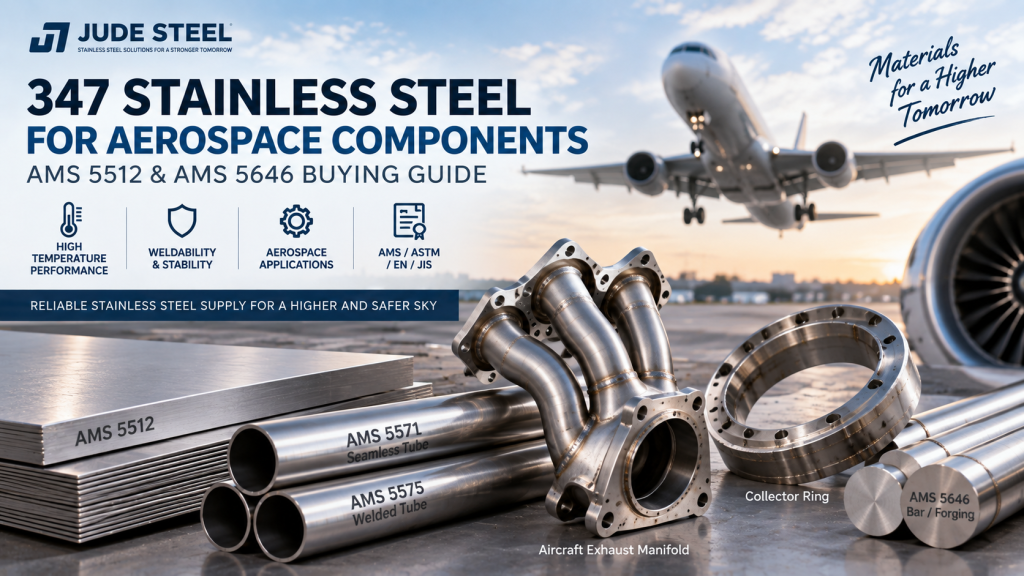
Type 347 stainless steel has a long history in aerospace applications where
welded stainless components experience elevated-temperature exposure.
However, an aircraft exhaust manifold, a collector ring and a machined
aerospace fitting do not necessarily use the same raw-material specification.
For aerospace buyers, writing only
“347 stainless steel”
is therefore incomplete.
The purchase order may need to identify:
- AMS 5512 sheet, strip or plate;
- AMS 5646 bar, forging or mechanical tubing;
- AMS 5571 seamless tubing;
- AMS 5575 welded tubing;
- the exact specification revision;
- dimensions and condition;
- full heat and lot traceability.
This guide connects:
aerospace component → raw material form → AMS specification →
fabrication → inspection → RFQ.
Quick Answer: Where Does 347 Fit in Aerospace?
Type 347 / UNS S34700 may be specified for selected aerospace components such as:
- aircraft exhaust stacks;
- exhaust manifolds;
- collector rings;
- collector assemblies;
- heavy welded hot assemblies;
- high-temperature formed components;
- selected rocket-engine parts;
- seamless aerospace tubing;
- welded aerospace tubing;
- machined rings and fittings where the applicable AMS standard requires 347.
Industry aerospace material references identify aircraft exhaust stacks,
manifolds and ring collectors as established Type 347 applications.
Outokumpu also lists rocket-engine parts among applications for
niobium-stabilized 347.
This application history should not be interpreted as permission to use 347
for every aircraft or propulsion-system component.
Why Does Niobium Stabilization Matter?
Type 347 is a chromium-nickel austenitic stainless steel stabilized with
niobium, historically also called columbium and abbreviated Cb in many
aerospace material specifications.
During certain combinations of temperature and exposure time, conventional
austenitic stainless steels can become sensitized when chromium-rich carbides
form at grain boundaries.
This can create chromium-depleted regions adjacent to the grain boundaries
and increase susceptibility to intergranular corrosion when a suitable
corrosive environment is encountered later.
Niobium preferentially combines with carbon and helps reduce this
sensitization mechanism.
This can be useful for aerospace components that combine:
- welded fabrication;
- repeated heating and cooling;
- thermal cycling;
- high-temperature exposure;
- oxidizing service environments.
Niobium stabilization does not make Type 347 immune to oxidation,
fatigue, creep, thermal distortion or every corrosion mechanism.
347 Aerospace Grade Designations and Specifications
| System / Product | Designation | Buyer Note |
|---|---|---|
| Common grade | Type 347 | Niobium-stabilized austenitic stainless steel |
| UNS | S34700 | Principal UNS designation |
| FR | 1.4550 / X6CrNiNb18-10 | Common European reference; use with the applicable EN product standard |
| JIS | SUS347 | Use with the applicable JIS material specification |
| Aerospace flat products | SAE AMS 5512 | Sheet, strip and plate; solution heat treated |
| Aerospace bars / forgings / mechanical tubing | SAE AMS 5646 | Bars, wire, forgings, mechanical tubing, rings and forging stock |
| Aerospace seamless tubing | SAE AMS 5571 | Solution-heat-treated seamless 347 tubing |
| Aerospace welded tubing | SAE AMS 5575 | Solution-heat-treated welded 347 tubing |
| General flat product | ASTM A240/A240M S34700 | Not automatically interchangeable with AMS 5512 |
As of the current SAE publication record:
- AMS 5512N was revised in 2024;
- AMS 5646R was revised in 2021;
- AMS 5571K was revised in 2023;
- AMS 5575 has its own current revision history for welded tubing.
An aerospace purchase order should identify the revision required by the
customer or OEM rather than assuming that any historical AMS version is
acceptable.
ASTM A240 Type 347 / UNS S34700 Chemical Composition
The following values are specification limits commonly associated with
ASTM A240 Type 347 flat products.
They are not producer-specific typical chemistry and should not be used
as a substitute for AMS 5512 acceptance requirements.
| Élément | ASTM A240 S34700, wt.% |
|---|---|
| Carbon (C) | 0.080 max. |
| Manganese (Mn) | 2.00 max. |
| Silicon (Si) | 0.75 max. |
| Phosphorus (P) | 0.045 max. |
| Sulfur (S) | 0.030 max. |
| Chromium (Cr) | 17.0–19.0 |
| Nickel (Ni) | 9.0–13.0 |
| Niobium / Columbium (Nb / Cb) | 10 × C minimum; 1.00 maximum |
Actual supplied material should be accepted against the exact governing
AMS, ASTM, EN, JIS or customer specification and the certified heat analysis.
Which Aerospace Components Use 347 Stainless Steel?
1. Aircraft Exhaust Stacks
Aircraft exhaust stacks experience combinations of:
- hot exhaust gas;
- thermal cycling;
- vibration;
- thin-wall fabrication;
- welded joints.
Type 347 is an established material for selected exhaust-stack applications
where the approved aerospace design requires the alloy.
For procurement, the component manufacturer may require AMS sheet,
welded tube, seamless tube or a combination of material forms.
2. Exhaust Manifolds
Type 347 has long been used for selected aircraft exhaust manifolds.
A manifold can include:
- formed tube;
- welded collector sections;
- flanges;
- formed sheet;
- ring components;
- local reinforcement.
Each raw-material line should follow the product specification identified
on the approved drawing.
An AMS 5512 sheet certificate does not certify a separate tube or forged
component to its required AMS specification.
3. Collector Rings
Collector rings are a particularly relevant Type 347 aerospace application.
These assemblies can be exposed to repeated heating, cooling and vibration
while also containing multiple welded joints.
Possible starting materials include:
- AMS 5512 sheet or strip;
- AMS 5575 welded tubing;
- AMS 5571 seamless tubing;
- AMS 5646 ring or forging stock where the drawing requires it.
The correct product route must come from the aerospace material schedule.
4. Heavy Welded Hot Assemblies
347 is also used in selected welded structures that cannot conveniently
receive a full solution heat treatment after fabrication and that will
experience elevated-temperature exposure.
Possible examples include:
- hot ducts;
- formed housings;
- collector assemblies;
- thermal expansion components;
- specialized welded aerospace hardware.
The material grade does not remove the requirement for a qualified weld
procedure, dimensional inspection or finished-component validation.
5. Rocket-Engine and High-Temperature Components
Producer application data for Type 347 includes selected rocket-engine
components.
This does not mean 347 should be used throughout a rocket engine.
Depending on the location, propulsion components can require:
- nickel-base superalloys;
- cobalt alloys;
- refractory metals;
- specialized precipitation-hardening alloys;
- other high-temperature materials.
Type 347 should only be used where the drawing and approved material
specification require it.
6. Tubing and Mechanical Components
AMS 5571 and AMS 5575 provide separate purchasing routes for seamless and
welded 347 tubing.
AMS 5646 additionally covers mechanical tubing, rings, bars and forgings.
This is why an RFQ containing only:
AMS 347 tube
is incomplete.
The buyer should identify whether the drawing requires seamless tubing,
welded tubing or mechanical tubing under another material specification.
Component-to-Raw-Material Procurement Matrix
| Aerospace Component | Possible Starting Material | Specification Direction | Main Procurement Check |
|---|---|---|---|
| Exhaust stack | Sheet + tubing | AMS 5512 + approved tubing AMS | Gauge, OD, wall, forming and welding |
| Exhaust manifold | Tube + formed sheet | AMS 5571 / 5575 + AMS 5512 where required | Seamless/welded route, bends and collector geometry |
| Collector ring | Tube / formed sheet / ring stock | AMS 5512 / 5571 / 5575 / 5646 | Drawing-controlled product form and traceability |
| Hot welded housing | Sheet / plate | AMS 5512 | Thickness, forming, welding and final inspection |
| Rocket-engine component | Drawing-specific flat or long product | OEM-approved AMS specification | Do not infer product route from the grade name |
| Machined ring or fitting | Bar / forging / ring stock | AMS 5646 | Condition, machining allowance and inspection |
AMS 5512 vs ASTM A240: Why the Difference Matters
ASTM A240 and AMS 5512 can both involve Type 347 flat material.
They are not the same purchase specification.
ASTM A240/A240M is a broad flat-product standard for stainless plate,
sheet and strip used in pressure-vessel and general applications.
AMS 5512 is an aerospace material specification specifically covering
solution-heat-treated 347 sheet, strip and plate.
Therefore, a drawing requiring:
AMS 5512 Type 347
should not be changed to:
ASTM A240 Type 347
because the alloy designation looks equivalent.
The AMS specification, revision, material condition, inspection and
documentation requirements must all be reviewed.
Official reference:
SAE AMS 5512N
.
AMS 5646 for Bars, Forgings and Rings
AMS 5646 covers Type 347 in several long-product and forged-product forms,
including:
- bars;
- wire;
- forgings;
- mechanical tubing;
- flash-welded rings;
- forging stock;
- ring stock.
This makes it relevant when an aerospace component is machined from bar,
produced from a forging or manufactured from an approved ring blank.
The current SAE revision identified by SAE is AMS 5646R.
Official reference:
SAE AMS 5646R
.
AMS 5571 vs AMS 5575: Seamless and Welded Tubing
Aerospace tubing should not be ordered only by alloy grade.
AMS 5571
AMS 5571 covers solution-heat-treated Type 347
seamless tubing.
The current SAE revision is AMS 5571K.
AMS 5575
AMS 5575 covers solution-heat-treated Type 347
welded tubing.
The distinction matters because the manufacturing route is part of the
material requirement.
A purchase order requiring AMS 5571 should not automatically be fulfilled
with AMS 5575 tubing, or vice versa.
Tube RFQs should include:
- AMS specification and revision;
- seamless or welded construction;
- outside diameter;
- wall thickness;
- length;
- solution-heat-treated condition;
- surface requirements;
- NDE or inspection requirements;
- lot traceability.
347 vs 321 in Aerospace
Type 321 and Type 347 are both stabilized austenitic stainless steels.
- 321: titanium stabilized;
- 347: niobium stabilized.
Both have long histories in high-temperature and welded aerospace
applications.
They should not be ranked as:
347 is always better than 321.
The correct choice depends on:
- OEM drawing;
- AMS specification;
- product form;
- welding procedure;
- temperature history;
- component qualification;
- availability and approved source.
For example, an aircraft exhaust program using AMS 5512 Type 347 should not
be converted to an AMS 5510 Type 321 material solely because both grades are
stabilized austenitic stainless steels.
Likewise, a Type 321 design should not be changed to 347 without the required
engineering approval.
Why 347 Is Not a Universal Turbine Hot-Section Alloy
Type 347 provides useful elevated-temperature performance, but it should not
be presented as a universal material for the hottest turbine or combustor
components.
Critical hot-section components can experience:
- extreme gas temperatures;
- creep;
- thermal-mechanical fatigue;
- oxidation;
- high centrifugal stress;
- combustion products;
- severe cyclic loading.
Nickel-base superalloys and other specialized materials may be required.
Published producer temperature ranges for Type 347 are material guidance,
not universal aircraft-design limits.
Forming and Welding 347 Aerospace Material
347 flat material may be formed into:
- exhaust shells;
- collector sections;
- ducts;
- rings;
- formed hot-section hardware.
Like other austenitic stainless steels, 347 work-hardens during cold forming.
The fabrication route should consider:
- starting material condition;
- sheet thickness;
- bend radius;
- forming strain;
- springback;
- tool condition;
- surface contamination.
Welding also requires an approved procedure.
Depending on the program, the WPS may control:
- filler material;
- joint geometry;
- purging;
- heat input;
- interpass temperature;
- weld profile;
- surface oxidation;
- final inspection.
A qualified Type 347 raw-material certificate does not establish the
airworthiness or fatigue life of the completed welded assembly.
Traceability and Incoming Inspection
Aerospace procurement normally requires strong material traceability.
The exact requirements depend on the customer and program.
Incoming material review may include:
- Type 347 / UNS S34700 identification;
- AMS specification;
- AMS revision;
- heat or lot number;
- chemical composition;
- mechanical properties;
- solution-heat-treated condition;
- sheet thickness;
- tube OD and wall thickness;
- surface condition;
- required NDE;
- full traceability to the original mill lot.
When material is cut into smaller blanks, the traceability method should be
defined before the original identification is removed.
PMI can be useful for confirming niobium-bearing Type 347 alloy identity,
but PMI alone does not prove compliance with every AMS requirement.
What Should a 347 Aerospace RFQ Include?
- Final component:
exhaust stack, manifold, collector ring, hot duct, ring or another component. - Material:
Type 347 / UNS S34700. - AMS specification:
AMS 5512, 5646, 5571, 5575 or another approved material specification. - Specification revision:
state the revision required by the OEM or customer. - Product form:
sheet, strip, plate, bar, forging, ring stock, seamless tube or welded tube. - Dimensions:
thickness, width, length, OD, wall or bar diameter as applicable. - Condition:
solution heat treated or another drawing-specified condition. - Fabrication:
forming, bending, welding, machining or drawing-based blanking. - Surface:
customer-specified surface and cleanliness requirements. - Inspection:
dimensional inspection, NDE or customer requirements. - Traceability:
heat / lot identification and traceability requirements. - Documentation:
required material certification package. - Quantity:
prototype, qualification or production quantity. - Drawing:
latest approved drawing or material schedule. - Destination:
customer location and required delivery date.
Example Aerospace Exhaust Material RFQ
Application:
Aircraft Exhaust Manifold and Collector Assembly
Material:
Type 347 / UNS S34700
Sheet Specification:
SAE AMS 5512, required revision stated in purchase order
Welded Tube Specification:
SAE AMS 5575, required revision stated in purchase order
Seamless Tube:
AMS 5571 only where identified on approved drawing
Sheet Thickness:
Per attached material schedule
Tube OD / Wall:
Per approved drawing
Condition:
Solution heat treated in accordance with the governing material specification
Fabrication:
Final forming and welding by approved component manufacturer
Traceability:
Full heat and lot traceability required
Inspection:
Material-standard requirements plus customer inspection plan
Documentation:
Material certification and required inspection records
Quantity:
Prototype and production quantities listed in BOM
Destination:
Buyer facility identified in RFQ
Substitution:
No substitution of ASTM A240 for AMS 5512, or 321 for 347,
without written engineering approval
This is an illustrative RFQ format.
It does not represent an actual JUDE aerospace program, qualified source,
stock commitment or regulatory approval.
How JUDE Steel Supports Aerospace Material Inquiries
JUDE Steel publishes general information for:
stainless steel sheet and plate
stainless steel processing services
laser cutting
stainless steel supply overview
JUDE’s current public supply overview clearly lists 347H among special
stainless steels but does not establish that every standard Type 347,
AMS 5512, AMS 5646, AMS 5571 or AMS 5575 size is routinely stocked.
For aerospace-controlled material, buyers should provide the exact AMS
specification, revision, product form, dimensions and certificate requirements
before supply availability is confirmed.
General cutting or processing capability should not be interpreted as
qualification to manufacture a finished flight-critical aerospace component.
Frequently Asked Questions
Is AMS 5512 the same as ASTM A240 Type 347?
No.
Both specifications can involve Type 347 flat material, but AMS 5512 is an
aerospace material specification and ASTM A240 is a general stainless flat-product
standard.
Do not substitute one for the other without approval.
What aerospace components use Type 347 stainless steel?
Established applications include selected aircraft exhaust stacks,
exhaust manifolds and collector rings.
Producer data also identifies selected rocket-engine parts and other
high-temperature components.
The approved drawing determines the actual alloy.
What is the difference between AMS 5571 and AMS 5575?
AMS 5571 covers seamless Type 347 tubing.
AMS 5575 covers welded Type 347 tubing.
They are different manufacturing routes and should not be interchanged
without engineering approval.
Can Type 347 replace Type 321 in an aircraft exhaust system?
Not automatically.
321 is titanium stabilized and 347 is niobium stabilized.
The OEM material specification and component qualification determine whether
a substitution is permitted.
Is 347H better than 347 for aerospace applications?
Not automatically.
347H is a separately controlled high-carbon variant intended for applications
where high-temperature mechanical performance is important.
Use it only when the approved drawing or material specification calls for it.
Is Type 347 suitable for turbine blades?
It should not be assumed.
Many turbine blades and severe hot-section components require nickel-base
superalloys or other specialized materials.
The component design controls the material.
Does an AMS 5512 certificate mean the finished component is FAA approved?
No.
AMS 5512 establishes material requirements.
Finished aerospace components have separate design, manufacturing,
inspection and regulatory requirements.
Can JUDE Steel guarantee permanent AMS 5512 stock?
Do not assume permanent stock from JUDE’s general product pages.
Submit the exact AMS revision, dimensions, quantity and documentation
requirements so availability can be reviewed for the order.
What should I send JUDE Steel for a Type 347 aerospace quotation?
Send the component drawing or material schedule, Type 347 / S34700,
required AMS specification and revision, product form, dimensions,
condition, inspection requirements, certification, quantity and destination.
Request 347 Stainless Steel for Aerospace Components
Buying Type 347 raw material for aircraft exhaust manifolds,
collector rings, hot assemblies or other aerospace components?
Send JUDE Steel your:
Drawing + Type 347 / S34700 + AMS Standard + Revision +
Product Form + Dimensions + Quantity + Destination
For controlled aerospace projects, also include:
Material Condition + Traceability + Inspection / NDE +
Certification Package + Approved Substitution Rules
Technical note:
This article supports preliminary raw-material selection and procurement.
Final aerospace component material, temperature capability, forming route,
welding procedure, fatigue requirement, inspection and regulatory approval
must follow the approved OEM or engineering specification.
A Type 347 material certificate does not certify the completed aircraft,
engine or propulsion component.
