
316 vs 317 Stainless Steel: Differences, Properties & Applications
316 and 317 stainless steel are two widely used austenitic stainless steel grades known for their excellent corrosion resistance and strong performance in aggressive industrial environments. Both materials contain molybdenum, which improves resistance to pitting and chloride corrosion compared with standard 304 stainless steel.
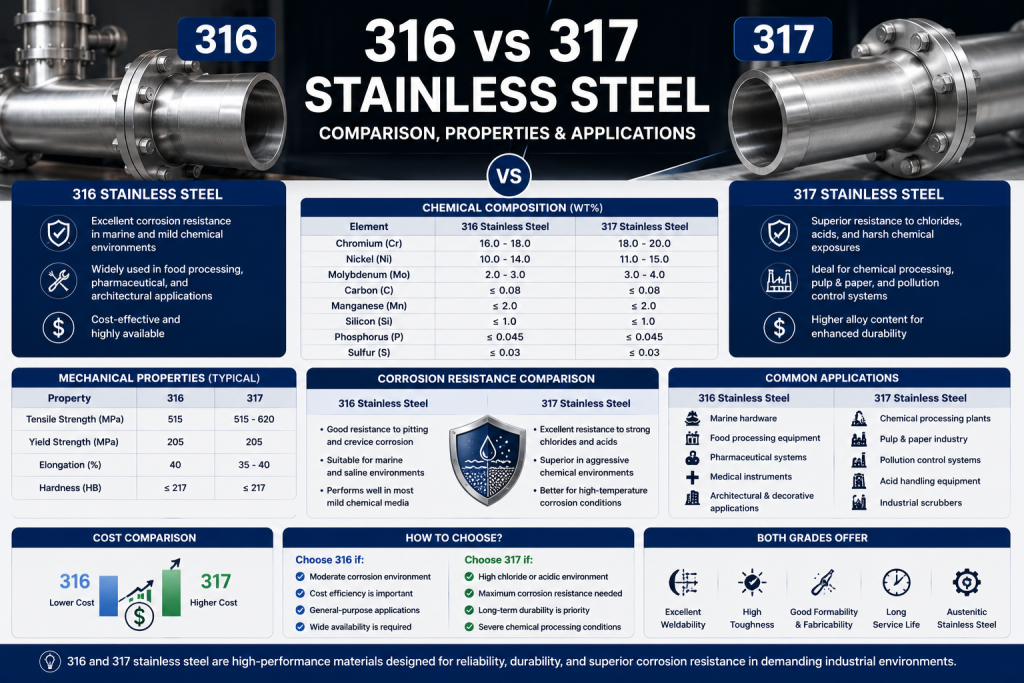
Although these grades share many similarities, 317 stainless steel offers higher molybdenum content and improved chemical corrosion resistance, making it more suitable for highly corrosive applications. Understanding the differences between 316 and 317 stainless steel is essential for engineers, project managers, fabricators, and industrial buyers selecting materials for marine engineering, chemical processing, food production, and industrial manufacturing.
This article provides a complete technical comparison of 316 vs 317 stainless steel, including chemical composition, corrosion resistance, mechanical properties, weldability, applications, advantages, and long-term industrial value.
1. What Is 316 Stainless Steel?
316 stainless steel is a molybdenum-bearing austenitic stainless steel widely recognized for its:
- Excellent corrosion resistance
- Good weldability
- High toughness
- Strong formability
- Reliable performance in marine environments
316 stainless steel is commonly used in:
- Marine equipment
- Food processing
- Chemical tanks
- Medical devices
- Architectural structures
Because of its excellent balance of performance and cost, 316 remains one of the most popular stainless steel grades worldwide.
2. What Is 317 Stainless Steel?
317 stainless steel is an upgraded version of molybdenum-alloyed austenitic stainless steel designed for even greater corrosion resistance.
Compared with 316 stainless steel, 317 contains:
- Higher molybdenum content
- Higher nickel content
These additions significantly improve resistance against:
- Pitting corrosion
- Crevice corrosion
- Chemical attack
- Chloride exposure
317 stainless steel is commonly used in:
- Chemical processing plants
- Pulp and paper industries
- Flue gas desulfurization systems
- Marine chemical environments
3. Chemical Composition Comparison
| Élément | 316 Stainless Steel | 317 Stainless Steel |
|---|---|---|
| Chromium (Cr) | 16–18% | 18–20% |
| Nickel (Ni) | 10–14% | 11–15% |
| Molybdenum (Mo) | 2–3% | 3–4% |
| Carbon (C) | ≤ 0.08% | ≤ 0.08% |
| Manganese (Mn) | ≤ 2% | ≤ 2% |
The higher molybdenum content in 317 stainless steel provides superior corrosion resistance in highly aggressive environments.
4. Corrosion Resistance Comparison
316 Stainless Steel
316 stainless steel performs extremely well in:
- Saltwater environments
- Food-grade applications
- Industrial moisture exposure
- Mild chemical processing
Its molybdenum content improves resistance to chloride corrosion compared with 304 stainless steel.
317 Stainless Steel
317 stainless steel provides even greater protection against:
- Strong chlorides
- Acidic chemicals
- Industrial chemical exposure
- Severe corrosion conditions
For highly corrosive industrial systems, 317 generally outperforms 316.
5. Mechanical Properties Comparison
| Property | 316 Stainless Steel | 317 Stainless Steel |
|---|---|---|
| Résistance à la traction | 515 MPa | 515–620 MPa |
| Yield Strength | 205 MPa | 205 MPa |
| Elongation | 40% | 35–40% |
| Dureté | Moderate | Moderate |
Both grades offer:
- Excellent toughness
- Good ductility
- Strong structural reliability
6. Weldability and Fabrication
Both 316 and 317 stainless steel provide excellent weldability using:
- MIG welding
- TIG welding
- Stick welding
316 Stainless Steel
- Easier to fabricate
- Widely available
- Lower processing cost
317 Stainless Steel
- Requires more precise fabrication control
- Higher alloy content may increase machining difficulty
Both materials maintain good mechanical integrity after welding when proper procedures are followed.
7. Heat Resistance Comparison
Both stainless steel grades offer excellent high-temperature performance.
316 Stainless Steel
- Good oxidation resistance
- Suitable for moderate heat exposure
317 Stainless Steel
- Improved resistance in aggressive high-temperature chemical environments
- Better performance under combined heat and corrosion conditions
8. Common Applications of 316 Stainless Steel
- Marine hardware
- Food processing equipment
- Pharmaceutical systems
- Medical instruments
- Kitchen equipment
- Architectural applications
9. Common Applications of 317 Stainless Steel
- Chemical processing equipment
- Pulp and paper plants
- Pollution control systems
- Acid handling equipment
- Industrial scrubbers
- Marine chemical facilities
10. Cost Comparison
317 stainless steel is generally more expensive because of:
- Higher nickel content
- Higher molybdenum content
- More advanced alloy formulation
316 stainless steel offers:
- Better global availability
- Lower material cost
- Excellent value for most industrial environments
For highly corrosive chemical applications, the higher cost of 317 may be justified by its longer service life.
11. Which Stainless Steel Grade Should You Choose?
Choose 316 Stainless Steel If:
- You need excellent general corrosion resistance
- Cost efficiency is important
- The environment is moderately corrosive
- You require wide material availability
Choose 317 Stainless Steel If:
- The environment contains strong chlorides or acids
- Maximum corrosion resistance is required
- The application involves aggressive industrial chemicals
- Long-term durability is critical in harsh conditions
Frequently Asked Questions (FAQ)
Is 317 stainless steel better than 316?
317 stainless steel offers superior corrosion resistance in highly aggressive chemical environments because of its higher molybdenum content.
Can 316 stainless steel rust?
Although highly corrosion resistant, 316 stainless steel can still corrode under extremely harsh chloride or chemical exposure.
Why is 317 stainless steel more expensive?
Its higher nickel and molybdenum content increases raw material and production costs.
Which stainless steel grade is better for marine applications?
316 stainless steel is widely used in marine environments, while 317 may perform better in highly aggressive marine chemical conditions.
Are both 316 and 317 stainless steel weldable?
Yes. Both grades provide excellent weldability using common industrial welding processes.
Conclusion: Both 316 and 317 stainless steel are high-performance austenitic stainless steel grades designed for demanding industrial applications. While 316 stainless steel offers an excellent balance of corrosion resistance, cost efficiency, and versatility, 317 stainless steel provides enhanced protection in severe chemical and chloride-rich environments. Selecting the correct grade depends on operating conditions, corrosion exposure, budget requirements, and long-term service expectations.
