
⚖️310S vs 309 Stainless Steel for High Temperature Use
Stainless steel grades 310S and 309 are widely used high-temperature austenitic stainless steels. Both alloys are designed to maintain strength and oxidation resistance under elevated temperatures, making them suitable for furnaces, heat treatment equipment, and thermal processing industries. However, differences in chemical composition lead to distinct performance characteristics and application preferences.
🔍Chemical Composition Comparison
The key difference between 310S and 309 stainless steel lies in their chromium and nickel content. Higher alloying levels generally translate into better oxidation resistance and high-temperature stability.
| Grade | Carbon (C) | Chromium (Cr) | Nickel (Ni) |
|---|---|---|---|
| 309 | ≤ 0.20% | 22.0–24.0% | 12.0–15.0% |
| 310S | ≤ 0.08% | 24.0–26.0% | 19.0–22.0% |
The significantly higher nickel content in 310S improves its resistance to thermal fatigue and structural degradation at extreme temperatures, while the lower carbon level enhances weldability and corrosion resistance.
🧲High Temperature Resistance
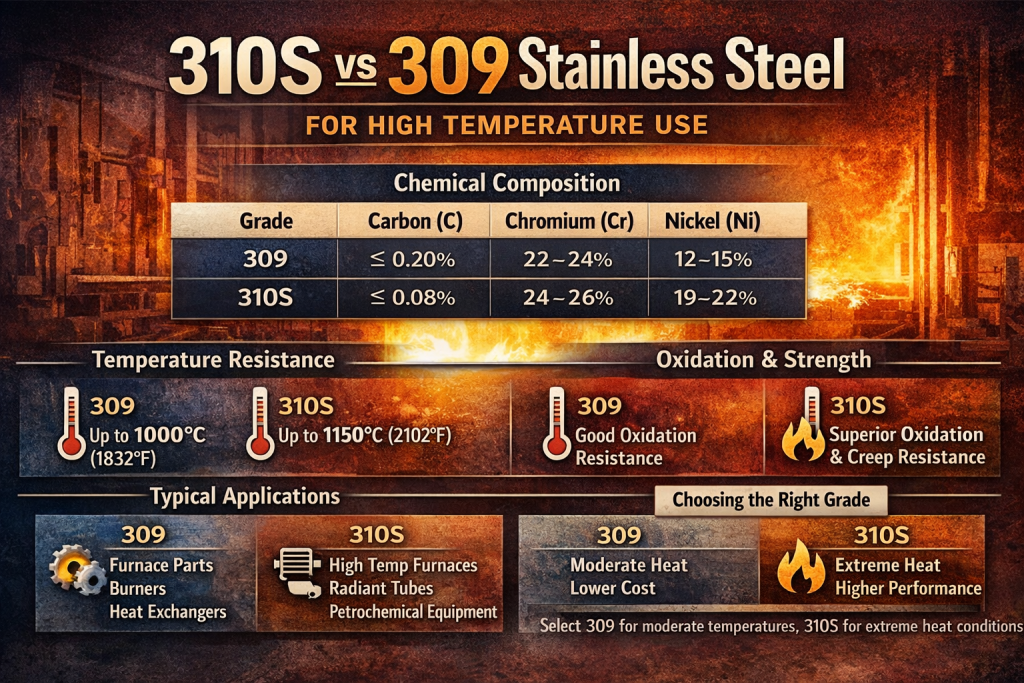
Both grades are designed for high-temperature service, but their maximum continuous operating temperatures differ.
- 309 Stainless Steel: Suitable for continuous service up to approximately 1000°C (1832°F) in oxidizing environments.
- 310S Stainless Steel: Can withstand continuous service temperatures up to 1100–1150°C (2012–2102°F), offering superior performance in severe thermal conditions.
⚙️Oxidation and Scaling Resistance
Oxidation resistance is critical in high-temperature applications. The higher chromium and nickel content of 310S provides enhanced protection against oxidation and scaling.
309 stainless steel performs well in moderately high temperatures, but prolonged exposure above its design limits may result in accelerated scaling compared to 310S.
🔧Mechanical Properties at Elevated Temperatures
At room temperature, both 309 and 310S exhibit similar mechanical properties. However, under elevated temperatures, 310S retains strength and creep resistance more effectively.
- 309: Adequate high-temperature strength for intermittent heating and moderate furnace components.
- 310S: Superior creep resistance and structural stability for long-term exposure to extreme heat.
🛡️Welding and Fabrication
Both grades are readily weldable using standard austenitic stainless steel welding techniques. Preheating is generally not required.
Due to its lower carbon content, 310S offers better resistance to carbide precipitation, making it more suitable for heavy welded structures operating at high temperatures.
⚠️Typical Applications
Applications of 309 Stainless Steel
- Furnace parts and heat shields
- Heat exchangers
- Burners and combustion chambers
- Welding consumables for dissimilar metals
Applications of 310S Stainless Steel
- High-temperature furnace linings
- Radiant tubes and retorts
- Petrochemical processing equipment
- Thermal oxidizers and incinerators
📍Cost Considerations
Due to its higher nickel and chromium content, 310S stainless steel is generally more expensive than 309. When selecting a material, engineers must balance performance requirements with budget constraints.
For applications with moderate temperature exposure, 309 stainless steel may provide a more cost-effective solution. In contrast, 310S is justified where extreme temperatures and long service life are critical.
🔬Which Grade Is Better for High Temperature Use?
The choice between 310S and 309 stainless steel ultimately depends on operating temperature, exposure duration, and environmental conditions.
- Choose 309 for moderately high temperatures and intermittent heating applications.
- Choose 310S for continuous operation at very high temperatures and severe thermal environments.
🧠Conclusion
Both 310S and 309 stainless steels are excellent high-temperature materials. While 309 offers reliable performance and lower cost for many furnace-related applications, 310S stands out for extreme heat resistance, oxidation stability, and long-term durability.
Understanding their compositional and performance differences ensures the right material choice, improving safety, efficiency, and service life in high-temperature industrial systems
❓FAQ: 310S vs 309 Stainless Steel for High Temperature Applications
1. What is the main difference between 310S and 309 stainless steel?
The primary difference lies in their chemical composition. 310S stainless steel contains higher chromium and significantly higher nickel than 309, which gives it superior oxidation resistance, thermal stability, and performance at extreme temperatures.
2. Which stainless steel is better for very high temperatures, 309 or 310S?
310S stainless steel is better for very high-temperature applications. It can withstand continuous service temperatures up to 1100–1150°C, while 309 stainless steel is typically limited to around 1000°C in oxidizing environments.
3. Can 309 stainless steel be used in furnace applications?
Yes, 309 stainless steel is widely used in furnace components such as heat shields, burners, and heat exchangers, especially in applications involving moderate temperatures or intermittent heating cycles.
4. Why does 310S perform better at high temperatures than 309?
310S performs better because of its higher nickel content, which improves resistance to thermal fatigue, creep, and structural degradation. Its lower carbon content also reduces carbide precipitation during prolonged high-temperature exposure.
5. Is 310S stainless steel more resistant to oxidation than 309?
Yes. Due to its higher chromium and nickel levels, 310S offers superior oxidation and scaling resistance, particularly in continuous high-temperature environments where 309 may experience accelerated surface scaling.
