
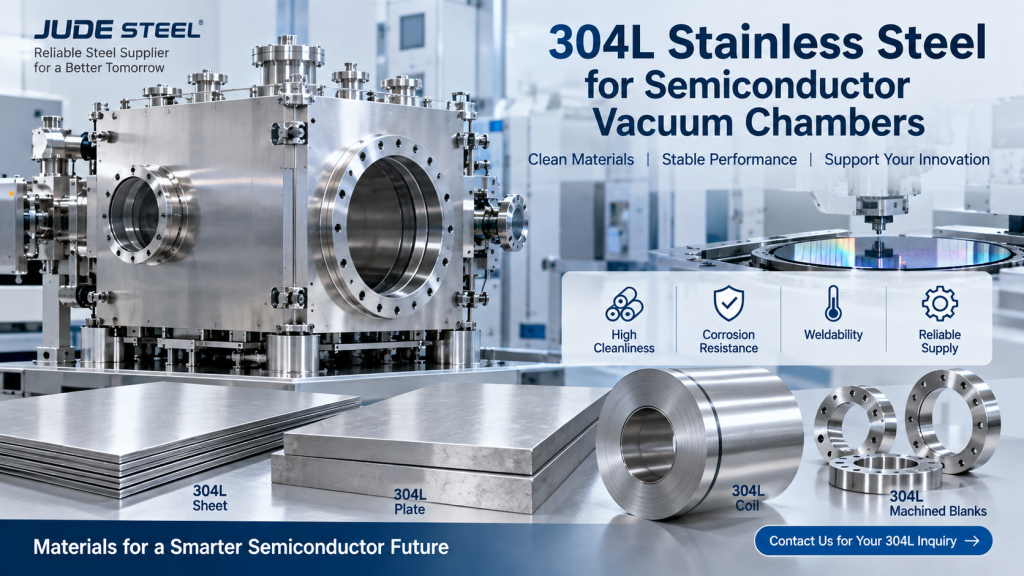
304L stainless steel is an established material option for vacuum chambers,
including selected chambers used in semiconductor research and thin-film
processing equipment. For a manufacturer buying sheet, plate or blanks,
however, the material grade is only the beginning of the specification.
A welded chamber body, a machined cover and an ultra-high-purity gas-delivery
component can belong to the same machine while requiring different materials,
finishes and acceptance tests. This guide focuses on 304L raw material
for vacuum chamber fabrication, not a universal steel specification
for every semiconductor process.
Vacuum equipment manufacturer Kurt J. Lesker identifies 304L among its
custom vacuum chamber material options.
That establishes an application reference, not approval of every commercial
304L heat for every semiconductor tool.
Which Semiconductor Equipment Components Can Use 304L?
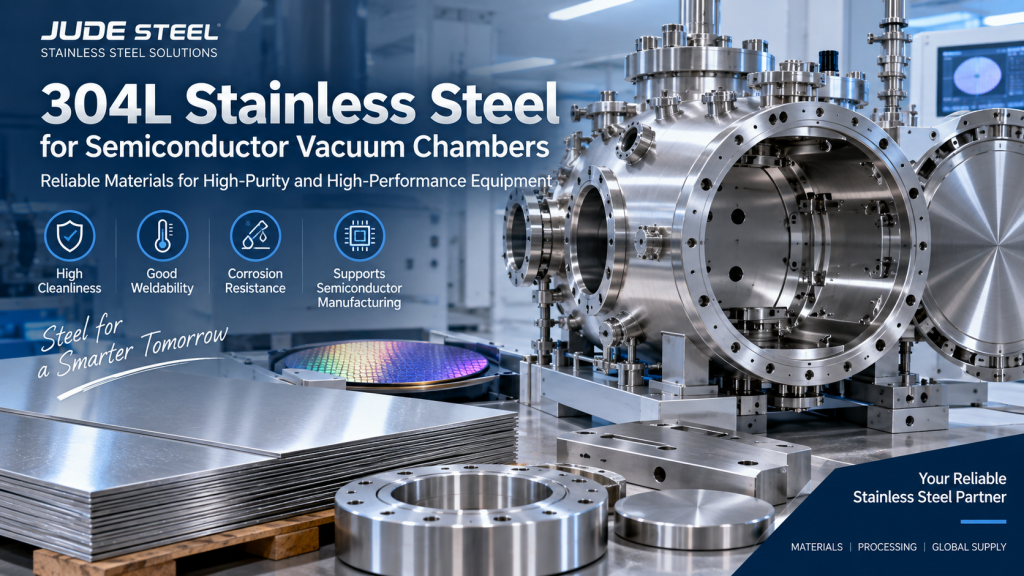 When the equipment drawing specifies 304L and the process environment is
compatible, the following components are practical starting points for a
material inquiry. The table is a sourcing guide, not a mandatory material list.
| Component | Possible starting material | What the buyer should define |
|---|---|---|
| Welded chamber body | 304L sheet or plate | Wall sections, forming, weld preparation and machining allowance |
| Load-lock or transfer chamber body | Sheet, plate or machined stock | Geometry, interface locations and the approved manufacturing route |
| Chamber lid, baseplate or access cover | Plate or another approved blank | Finished thickness, seal geometry, flatness and machining allowance |
| Vacuum port or flange blank | Plate, bar, tube or forging as designed | Product standard, seal type, dimensions and finished inspection |
| Selected internal bracket or removable shield | Sheet, strip or cut blank | Process exposure, particle control and cleaning or replacement procedure |
Welded chamber bodies
A chamber fabricator may form sheet into a cylindrical shell or machine and
join plate sections for another geometry. Flat-sided chambers and their
covers must withstand the relevant pressure differential. Material thickness
cannot be selected from the alloy name or copied from a generic application
example.
Lesker’s vacuum chamber technical notes
discuss chamber geometries, stainless steel construction, endplates and
liners. The equipment designer remains responsible for structural calculations,
reinforcement, seals and operating conditions.
Load locks and transfer chambers
A load lock allows substrates or samples to enter and leave a system without
venting the main process chamber for every transfer. It is a separate,
isolatable volume with its own evacuation and venting sequence, as explained
in this
load-lock operating overview.
For an approved 304L design, buyers should provide the chamber-body drawing
and interface requirements. Do not assume that its doors, seals, transfer
mechanism and internal hardware must all use 304L merely because the body does.
Covers, flange blanks and internal parts
Separate raw-stock tolerances from finished-component tolerances. A supplied
plate blank is not a finished sealing surface. Identify the machining stock
needed around seal faces, ports and datum features before cutting begins.
For parts inside the process volume, request explicit material approval.
A removable shield exposed to deposition, cleaning or plasma is not the same
selection problem as a protected chamber wall.
What the Low Carbon in 304L Does—and Does Not—Provide
Type 304L, UNS S30403, is a low-carbon chromium-nickel austenitic stainless
steel. For ASTM A240 S30403 flat products, the carbon limit is
0.030% maximum by mass. This is a specification limit,
not the actual carbon content of every supplied heat.
Lower carbon reduces the risk of chromium-carbide precipitation and associated
sensitization during relevant welding or thermal exposure.
Outokumpu’s 304L grade guidance
explains this welding-related benefit. It does not make the material immune
to corrosion or remove the need for an approved welding procedure.
For vacuum procurement, low carbon does not mean low hydrogen,
low outgassing or a guaranteed achievable pressure. Those are
separate material and system-performance questions.
Research comparing stainless steel chambers with different thermal histories
shows that outgassing performance depends on more than the nominal grade.
The published
comparison of chamber materials and heat treatments
is useful evidence of that distinction, not a performance guarantee for an
untested JUDE material batch.
Which Material Designations and Standards Belong on the Order?
Use Type 304L / UNS S30403 when that is the specified alloy.
EN 1.4307, X2CrNi18-9, and JIS SUS304L are common international references,
but acceptance must follow the selected product standard. EN 1.4306 is a
separate low-carbon grade and should not be silently substituted for 1.4307.
For chamber sheet and plate, identify
ASTM A240/A240M
where required, together with the applicable general requirements of
ASTM A480/A480M.
State the contract edition, delivery condition, dimensions and any additional
customer requirements.
Bar stock, tube and forgings require their own applicable product
specifications. A finished flange is not automatically an A240 product simply
because it is flat. The approved drawing should determine whether its starting
material is plate, bar or a forging.
JUDE Steel’s
304L material page
is a commercial starting point. The purchase specification and heat-traceable
mill certificate, rather than a general website table, govern the delivered
material.
Vacuum Chambers Are Not the Same as Ultra-High-Purity Gas Lines
High vacuum and ultra-high vacuum describe low-pressure conditions.
High-purity and ultra-high-purity chemical delivery concern contamination in
a delivered gas or liquid. The requirements can overlap, but they are not
interchangeable labels.
SEMI F20 explicitly addresses 316L stainless steel.
Its scope includes composition and metallurgical cleanliness for material
used in semiconductor chemical-distribution components. It is not a general
304L vacuum-chamber material specification.
Read the official SEMI F20 scope.
Related
SEMI F19 surface requirements
address wetted surfaces of stainless components for chemical-distribution
systems within their specified scope.
If a drawing requires F20-qualified 316L, ordinary A240 304L is not an
acceptable substitution. Conversely, do not add a 316L gas-system standard
to a 304L chamber RFQ without first resolving the contradiction.
Specify the Starting Finish Separately from Vacuum Cleanliness
A mill finish such as 2B describes the supplied surface condition. It does
not establish the cleanliness of a machined, welded and assembled chamber.
Likewise, a reflective polished surface is not evidence that oil, particles
or processing residues meet the equipment specification.
Ask the fabricator to define which surfaces are vacuum-facing, which are
sealing faces and which are external. Specify roughness only with the
applicable surface, measurement requirements and acceptance criteria.
Do not impose one unexplained Ra value on every surface of the equipment.
Agree responsibility for removing machining fluids, polishing residues,
protective films and handling contamination. Electropolishing, special
thermal treatment and clean packaging should be included when the approved
process calls for them, not assumed from the phrase “semiconductor grade.”
If the project requires a particular melt route, inclusion-cleanliness
assessment or hydrogen-related qualification, state that requirement and the
evidence needed. It is not established by a generic 304L designation.
Welding, Trapped Volumes and Final Vacuum Testing
Require the chamber manufacturer to review weld access, penetration,
post-weld machining and features that could trap gas. A small enclosed
volume around a joint or fastener can release gas into the chamber and
complicate diagnosis even without a direct atmospheric leak.
Pfeiffer’s
vacuum-system leak-detection guidance
discusses leaks, virtual leaks and test preparation. Helium testing is a
finished-assembly inspection activity; it is not replaced by the raw steel’s
mill certificate.
Write the required leak-test method, units, acceptance limit and test
configuration into the equipment specification. Treat pump-down, residual-gas
analysis and particle requirements separately where the project needs them.
Passing one test does not automatically satisfy the others.
| Evidence | Question it addresses | Do not infer from it |
|---|---|---|
| Mill test certificate | Does the delivered heat meet the ordered material requirements? | Final chamber leak rate or cleanliness |
| Dimensional inspection | Does the inspected part meet its drawing? | Compliance with every material and vacuum requirement |
| Surface inspection and cleaning records | Were the specified surface and cleaning requirements addressed? | A guaranteed base pressure |
| Helium leak-test report | Did the tested assembly meet the defined leak criterion? | Acceptable outgassing under all operating conditions |
| Specified pump-down, gas or particle testing | Did the system meet the stated test conditions and limits? | Suitability for a different process or operating sequence |
When Should the Designer Consider a Different Material?
Do not extrapolate from an approved 304L vacuum chamber to every plasma-facing
part, wet-chemical vessel or reactive-gas component. Identify the chemicals,
moisture, temperature, cleaning process and consequences of metal or particle
contamination before approving the wetted or exposed material.
Depending on the tool, the designer may specify 316L, aluminum, another alloy,
a coating or a replaceable liner. These are application-specific choices,
not an automatic ranking in which a higher grade number is always better.
A process change should trigger a compatibility review rather than silent
reuse of an earlier chamber’s material list.
What Should a 304L Vacuum-Component Material RFQ Include?
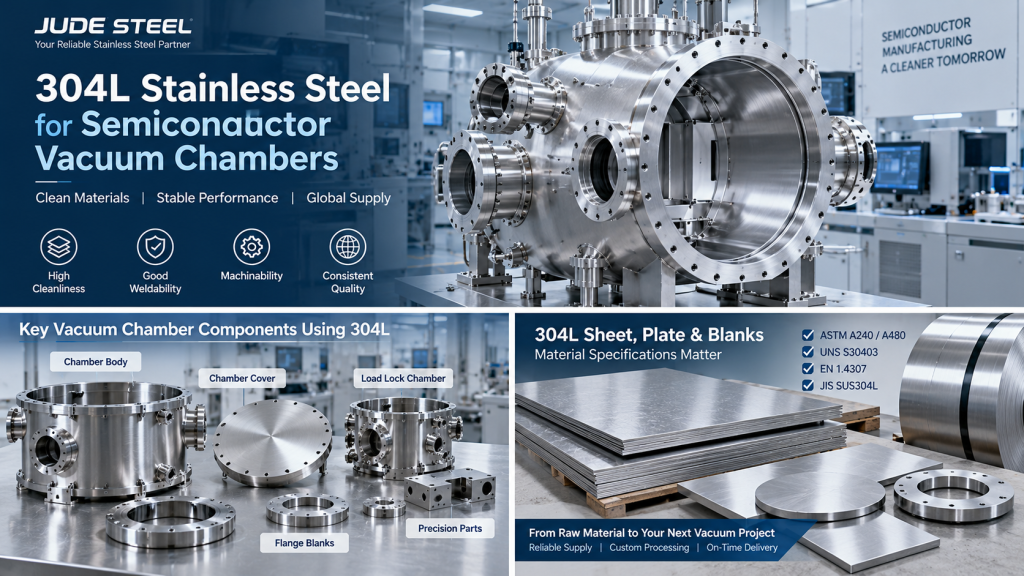 Start with the information needed to quote the raw material. Detailed system
qualification can remain in the equipment manufacturer’s specification unless
it changes the material-supply requirement.
- Material and scope: grade, product standard, edition,
delivery condition, sheet or plate form, and whether the order is for stock
or processed blanks. - Dimensions: thickness, width, length, tolerances,
drawing revision and machining allowance. - Surface and handling: starting finish, defect limits,
protective-film restrictions and packaging requirements. - Quality evidence: heat traceability, certificate type
and any additional inspection or material testing. - Commercial details: quantity, destination, required
delivery date and repeat-order expectations.
Add vacuum-facing surface requirements, special cleanliness or melt-route
requirements only where they affect supply. Clearly separate what JUDE is
being asked to deliver from the fabrication and testing to be completed later.
Illustrative RFQ: 304L Stock for a Load-Lock Chamber
Application:
Semiconductor load-lock chamber fabrication
Supply scope:
Raw plate and cut blanks only; no completed chamber
Material:
Type 304L / UNS S30403
Product specification:
ASTM A240/A240M; edition and applicable A480 requirements stated in the
purchase order
Dimensions and quantity:
Approved blank schedule supplied with the RFQ
Delivery condition and finish:
As specified for each line item
Machining allowance:
Identified separately from final component dimensions
Cutting:
Proposed method subject to buyer approval
Documentation:
Mill certificate and traceability from parent plate to each blank
Additional material tests:
Only those identified in the attached purchase specification
Downstream work:
Chamber welding, final machining, cleaning and vacuum testing by the
equipment fabricator
Packing and destination:
Buyer requirements included in the inquiry
This is a hypothetical inquiry format, not a completed JUDE project or a
claim of qualified semiconductor stock. No example plate thickness is given
because the chamber design must establish it.
Frequently Asked Questions
Can dual-certified 304/304L replace material ordered as 304L?
Only when the documentation demonstrates compliance with the required 304L
product specification and the purchaser permits the material. Verify the
actual chemistry, mechanical requirements and delivery condition rather
than accepting a slash designation on a quotation as proof.
Can handheld XRF confirm that a plate is 304L rather than 304?
Conventional handheld XRF cannot measure carbon, so it cannot establish the
low-carbon requirement on its own.
Thermo Fisher explains this limitation.
Use traceable material documentation and, when verification is required,
an agreed carbon-capable analytical method.
Must every 304L vacuum chamber be electropolished?
Do not assume so. Follow the approved surface and cleaning specification.
A requirement for electropolishing should identify the surfaces, process
acceptance and verification; a requirement for a polished appearance alone
is not a vacuum qualification.
Can a laser-cut blank be installed directly as a vacuum component?
Treat it as an intermediate product unless the drawing explicitly permits
that condition. Agree allowances for subsequent machining, edge treatment
and cleaning. Seal faces and other critical features must meet their finished
requirements, regardless of how the starting blank was cut.
Does the 304L name guarantee non-magnetic performance?
Do not accept a critical magnetic requirement by grade name alone. Specify
the permitted magnetic response, measurement method and condition of the
finished component when the equipment is sensitive to magnetic fields.
Request 304L Sheet and Plate for Vacuum Chamber Fabrication
JUDE Steel lists 304L in its
stainless steel sheet and plate,
coil
and
strip
product categories. Its published
processing services
include flat-product preparation, with
laser cutting
available for review against the required blank geometry.
Confirm grade, dimensions, mill source, delivery condition, tolerances and
inspection scope for each order. A general supply listing does not establish
SEMI qualification, special cleanliness, low-outgassing performance or a
finished chamber’s leak-test capability.
Buying 304L raw material for chamber bodies, load locks or machined covers?
Send your drawing revision, grade, product standard, sheet or plate dimensions,
starting finish, machining allowance, quantity and destination. Identify
special material qualification and documentation requirements before quotation.
Technical note:
This guide supports preliminary raw-material selection and purchasing.
The equipment designer and fabricator must approve process compatibility,
structural design, fabrication, cleanliness and vacuum performance.
Ordinary ASTM A240 S30403 material is not a substitute for project-specified
SEMI F20 316L or a qualified finished semiconductor component.
