
304/304L Stainless Steel for Food and Cosmetic Production Lines
in Saint Petersburg
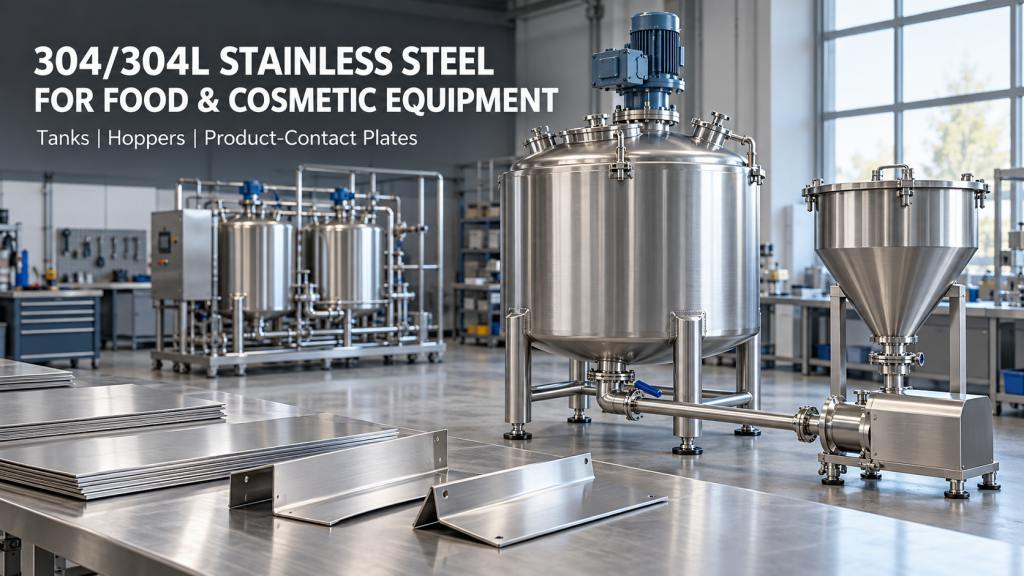 304 and 304L stainless steel sheet and plate can be used for
compatible-service dairy tanks, beverage mixing vessels,
selected cosmetic premix equipment, ingredient hoppers,
product-contact transfer plates and cleaning-unit components.
The material decision belongs to each component and its exposure,
rather than to the production line as a whole.
For equipment builders preparing a project in Saint Petersburg,
the useful purchasing document is a material schedule that follows
the process: ingredient intake, blending, transfer, filling and
cleaning. It should distinguish product-contact parts from
cleaning-fluid contact parts and external panels before quantities
are combined.
Which Equipment Creates Demand for 304/304L Flat Products?
The examples below are candidate applications, subject to the
equipment designer’s approval. They do not mean every listed
machine should use the same grade, thickness or finish.
| Equipment manufactured | Potential sheet or plate components | What determines suitability? |
|---|---|---|
| Dairy balance and ingredient tanks | Vessel walls, bottoms, lids and internal baffles | Milk or ingredient exposure, holding conditions, welds and the complete cleaning cycle |
| Beverage syrup and blending vessels | Rolled shells, mixing-container panels, covers and flat internal parts | Acids, concentrates, temperature and exposure near ingredient addition points |
| Cosmetic ingredient and premix equipment | Compatible-service mixing containers, addition hoppers and removable contact panels | Full formulation, salts, active ingredients and cleaning chemistry; retain another alloy where the approved design requires it |
| Powder intake and dosing hoppers | Folded or rolled hopper sections, cones, lids and chutes | Ingredient behavior, joining details, access for cleaning and wet-cleaning exposure where applicable |
| Product-transfer and conveyor assemblies | Transfer plates, guide plates, discharge chutes and removable contact panels | Direct product contact, edge condition, support geometry, wear and cleaning access |
| Parts washers and clean-in-place units | Wash chambers, liquid reservoirs, removable trays and approved internal panels | Actual cleaning-agent concentration, temperature, contact time, return-fluid composition and rinse water |
This guide focuses on flat-product procurement across a production
line. For a vessel-only breakdown, see JUDE’s
material guide for food and detergent tanks in Russia.
Separate Three Types of Material Exposure
Use the following practical grouping when building the purchase
list. It is a procurement aid, not a substitute for the project’s
hygienic-design classification.
- Product-contact parts:
record the actual ingredients, product temperature, holding
time and cleaning exposure. Include temporary contact during
dosing and product transfer. - Cleaning-fluid contact parts:
assess clean-in-place (CIP) tanks, wash chambers and return-liquid
components using the cleaning solution they actually encounter.
A tank holding concentrated cleaner has a different exposure
from a final-rinse reservoir. - External panels and guards:
specify their environment separately. A decorative cover does
not automatically need the same finish as a mixing-vessel
interior, but washdown and contamination risks still require
review.
Do not treat 304 or 304L as a default for bleach, chloride-rich
mixtures or aggressive acidic formulations. Review chemistry
together with temperature and contact time. The
worldstainless hygiene publication
discusses stainless applications and cautions about
chloride-containing cleaners.
Where 304 and 304L Differ in the Purchase Decision
- 304:
UNS S30400; EN 1.4301 is a commonly corresponding European
designation. It is a candidate for formed contact panels,
hoppers and compatible-service equipment components. - 304L:
UNS S30403; EN 1.4307 is a commonly corresponding European
designation. Its lower carbon content reduces susceptibility
to weld-related sensitization and associated intergranular
corrosion.
Outokumpu’s Core range information
provides grade-identification and application references.
These designations do not make all ASTM and EN product
requirements interchangeable.
Both grades can be welded with suitable procedures. The low-carbon
designation does not eliminate the need for sound welds and surface
restoration, and it does not establish resistance to every
cleaning agent. If the designer has specified another alloy for
a cosmetic formulation or cleaning circuit, obtain approval before
proposing 304/304L.
For material enquiries, use JUDE’s
304 stainless steel
and
304L stainless steel
pages as starting points, then attach the component requirements.
Specify the Flat Product and the Measurement System
ASTM A240/A240M
covers stainless steel plate, sheet and strip.
ASTM A480/A480M
provides applicable general requirements for these flat products.
State the grade, standard edition, delivery condition, dimensions
and required inspection documentation.
For a metric drawing, explicitly agree the metric specification
basis and its applicable tolerances. Do not mix inch-pound
tolerances with converted metric dimensions or leave the unit
system implicit.
Review
JUDE’s stainless steel sheet options,
then identify whether the order requires full sheets, rectangular
blanks or profiled parts. Use design-approved thicknesses,
including the required allowances for forming. Pressure, vacuum
and mixer loads require equipment-design review. Tube, fittings,
shafts and complete machines need separate specifications; a sheet
certificate does not certify the assembled equipment.
If the drawing names a GOST grade, product standard or TU technical
specification, include the exact reference. Have the responsible
designer approve any proposed substitute against the full
requirements.
Make Contact Faces, Edges and Openings Inspectable
For a hopper or transfer plate, identify the product-facing side
on the drawing. Define the required edge condition, bend geometry,
hole pattern, flatness and inspection stage. A raw cut blank and
a finished contact component are different deliverables.
Perforated trays and slotted plates need attention on both faces
and around openings. State how burrs, sharp edges and fabrication
residues will be assessed. For sliding transfer surfaces, let the
equipment designer establish wear, friction and support
requirements; stainless sheet grade alone does not define
operating performance.
Submit approved drawings for
laser-cutting enquiries
and identify which finishing operations follow cutting. Confirm
the achievable dimensions and surface condition for the
particular job.
For open, wet-cleaned food equipment,
EHEDG’s open-processing guidance
addresses hygienic design and construction. It should inform the
equipment review where applicable; specifying 304L does not
replace that review.
Allocate Finishing Work Before Comparing Prices
A label such as 2B, No. 4 or mirror finish is not a complete
acceptance specification for the assembled line. Identify the
contact face, required roughness value and unit where applicable,
measurement conditions and permitted surface defects. For example,
state Ra in micrometres when that is the agreed measurement basis.
Do not assume a grit number guarantees a particular roughness value.
Ask for separate pricing for supplied sheet finish, cut-edge
treatment and any further
polishing work.
This lets the fabricator compare which surfaces need treatment
before forming and which require restoration after welding.
ASTM A380/A380M
provides guidance for cleaning and related surface treatments of
stainless steel parts and equipment. It is not an operating CIP
recipe. Agree fabrication cleaning, heat-tint removal and any
specified passivation separately from the plant’s validated
production-cleaning procedure.
Acceptance should follow the work:
inspect supplied sheets or blanks against the material order,
then inspect completed contact parts after the relevant forming,
welding and finishing operations. Preserve the link between each
part, its material identification and the required inspection
records.
Prepare an RFQ for a Saint Petersburg Production Line
Group the enquiry by equipment tag and contact function. Keep
drawing identifiers consistent between Russian and English
documents so a hopper panel cannot be confused with a visually
similar external cover.
Use this material schedule format for each line item:
Component and contact function:
Product or cleaning-fluid exposure:
Approved grade and product standard, including edition:
Product form and delivery condition:
Dimensions, tolerances and measurement units:
Quantity by part number:
Contact face, supplied finish and acceptance requirements:
Cutting, edge treatment and other requested processing:
Inspection documents and traceability:
Packing, destination and required delivery date:
For the commercial offer, identify the buyer, consignee and named
delivery location in Saint Petersburg. Ask JUDE to confirm
available material, processing scope, exceptions, minimum order
quantity, lead time and delivery terms for the actual order.
Send the material schedule and drawings to
support@jiscojude.com.
Request separate prices for base material, processing, inspection
and packing so the offers can be compared on the same basis.
Frequently Asked Questions
Does magnetic attraction at a bent hopper edge prove that the
grade is wrong?
No. Cold working can increase the magnetic response of austenitic
stainless steel.
ASSDA explains this effect.
Verify material identity through traceability and appropriate
testing rather than accepting or rejecting a part on a magnet
test alone.
Should protective film remain in place through welding and
final cleaning?
Agree the removal stage with the fabricator and film supplier.
Remove film where it would interfere with welding, finishing or
cleaning, and check that accepted product-contact surfaces are
free of adhesive residue. Film requirements should be part of
the processing instructions.
Can one sheet contain nested blanks for several machines?
Yes, if every part’s specification permits the same material,
thickness and supplied surface. Maintain part identification
after cutting and agree how remnants are handled. Combining the
cutting layout must not erase the distinction between different
contact faces or finishing requirements.
Can the order be delivered in installation stages?
Request release quantities and delivery dates by equipment tag.
Confirm whether staged delivery, storage and separate packing
are available, and agree any associated charges. Do not assume
one quoted production lead time covers every later release.
