
302 vs 304 Stainless Steel: Composition, Strength, Corrosion Resistance & Applications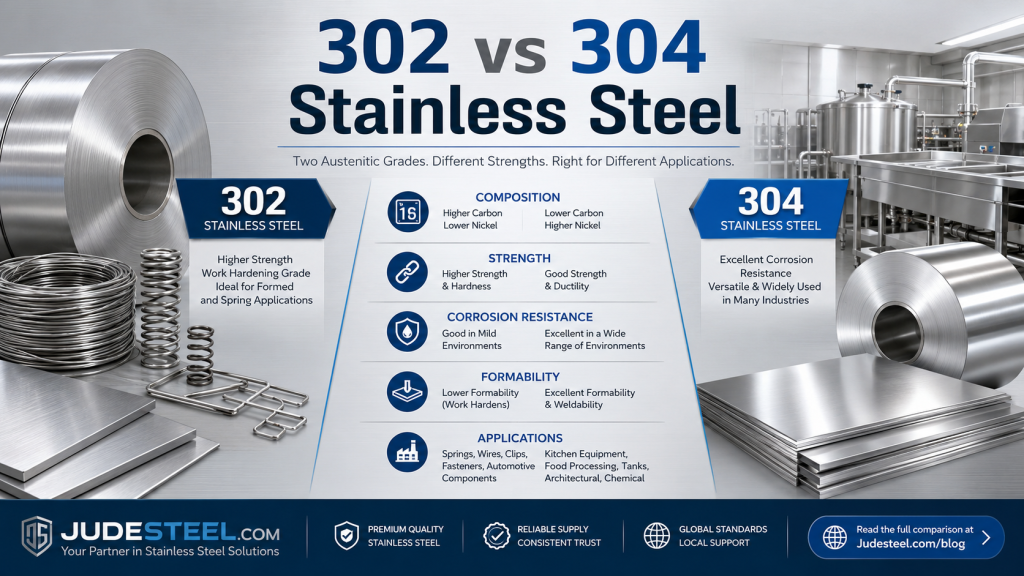
When comparing 302 vs 304 stainless steel, the two grades may look very similar at first. Both belong to the 300 series austenitic stainless steel family, both are chromium-nickel stainless steels, and both are widely used where corrosion resistance, toughness and formability are required.
However, 302 and 304 are not exactly the same. 302 stainless steel usually contains slightly higher carbon than 304, which can make it useful for spring wire, washers, screens, pressure components and formed parts. 304 stainless steel is the more widely used general-purpose grade, preferred for food equipment, kitchenware, tanks, architectural panels, tubing, sheet, coil and industrial fabrication.
This guide explains the difference between 302 and 304 stainless steel in chemical composition, carbon content, corrosion resistance, strength, spring performance, formability, weldability, cost and application selection. For related material information, visit 304 Stainless Steel, 304L Stainless Steel, Stainless Steel Sheet, Stainless Steel Coil and the Jude Steel Stainless Steel Grade Center.
Fast Comparison: 302 vs 304 Stainless Steel
| Feature | 302 Stainless Steel | 304 Stainless Steel |
|---|---|---|
| Stainless Steel Family | Austenitic stainless steel | Austenitic stainless steel |
| Common Description | 18-8 chromium-nickel stainless steel with slightly higher carbon | General-purpose 18-8 chromium-nickel stainless steel |
| Typical Chromium Content | About 17%–19% | About 18%–20% |
| Typical Nickel Content | About 8%–10% | About 8%–10.5% |
| Carbon Content | Higher than 304 | Lower than 302 |
| Corrosion Resistance | Good | Excellent for general applications |
| Strength / Spring Performance | Often preferred for springs, wire and strip applications | Good general strength and excellent fabrication balance |
| Formability | Good | Excellent |
| Weldability | Good, but carbon content should be considered | Excellent for general welding and fabrication |
| Typical Applications | Springs, washers, screens, wire, pressure components, formed parts | Kitchen equipment, food processing, tanks, sinks, panels, pipes, coils, sheets |
1. What Is 302 Stainless Steel?
302 stainless steel is an austenitic chromium-nickel stainless steel in the 300 series. It is one of the classic 18-8 stainless steels and is known for toughness, ductility, good corrosion resistance and strong performance in wire and strip forms.
Compared with 304, 302 generally has slightly higher carbon content. This can improve strength in certain conditions, especially for products such as springs, washers, screens and formed metal parts. Because of this, 302 is often selected for applications where spring properties, resilience and mechanical performance are important.
Main Characteristics of 302 Stainless Steel
- Austenitic chromium-nickel stainless steel
- Part of the 18-8 stainless steel family
- Slightly higher carbon content than 304
- Good corrosion resistance in many urban and rural environments
- Good toughness and ductility
- Commonly used in strip and wire forms
- Suitable for springs, washers, screens and pressure-related parts
- Usually non-magnetic in annealed condition
- Not hardenable by heat treatment
Typical 302 Stainless Steel Applications
- Stainless steel springs
- Spring wire
- Washers
- Screens and mesh
- Pressure vessels and pressure components
- Sanitary and cryogenic components
- Formed strip products
- Small industrial parts requiring toughness and ductility
2. What Is 304 Stainless Steel?
304 stainless steel is the most widely used austenitic stainless steel grade. It is also part of the 18-8 stainless steel family, but it is generally selected for its broad balance of corrosion resistance, formability, weldability, cleanability and availability.
304 is commonly used in kitchen equipment, food processing, dairy equipment, brewery equipment, sinks, architectural panels, tanks, tubing, sheet, coil and general industrial fabrication. It is a practical choice when buyers need a reliable stainless steel grade for many different environments.
Main Characteristics of 304 Stainless Steel
- Most widely used general-purpose stainless steel grade
- Austenitic chromium-nickel stainless steel
- Excellent corrosion resistance in many normal environments
- Excellent formability and deep drawing performance
- Excellent weldability
- Good cleanability and hygiene performance
- Available in sheet, coil, plate, strip, pipe, tube and bar forms
- Usually non-magnetic in annealed condition
- Cannot be hardened by heat treatment
Typical 304 Stainless Steel Applications
- Food processing equipment
- Kitchen equipment and sinks
- Brewery, dairy and pharmaceutical equipment
- Architectural panels
- Stainless steel tanks and vessels
- Heat exchangers and tubing
- Industrial fabrication
- Stainless steel sheet, coil and strip products
3. Chemical Composition Comparison
The chemical difference between 302 and 304 stainless steel is relatively small, but it can affect performance. Both grades contain chromium and nickel, but 302 typically has a higher maximum carbon content. 304 usually has lower carbon content and slightly broader chromium and nickel ranges depending on specification.
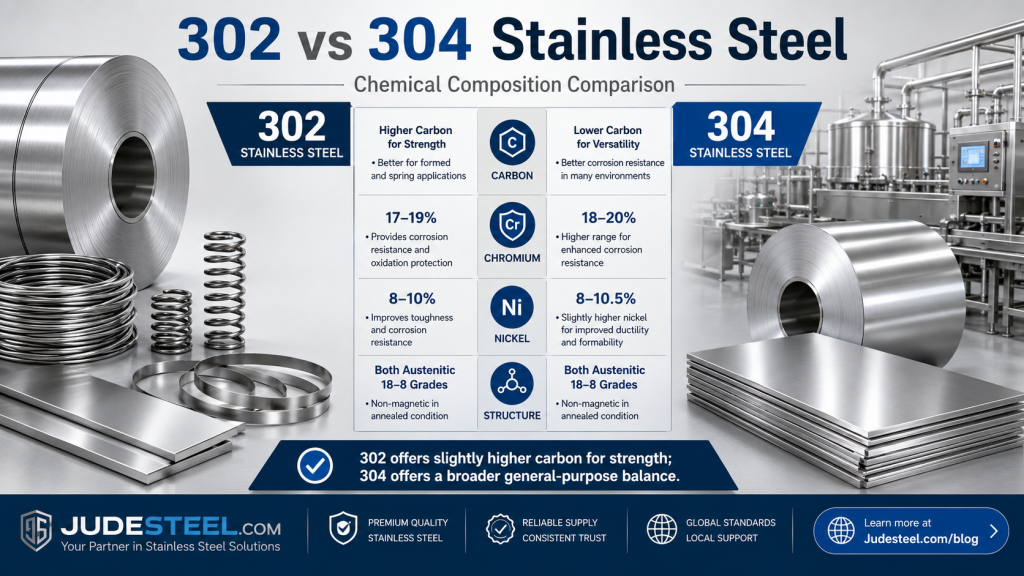
| Element / Feature | 302 Stainless Steel | 304 Stainless Steel |
|---|---|---|
| Chromium | About 17%–19% | About 18%–20% |
| Nickel | About 8%–10% | About 8%–10.5% |
| Carbon | Higher maximum carbon content | Lower carbon content than 302 |
| Manganese | Usually up to about 2% | Usually up to about 2% |
| Silicon | Usually up to about 1% | Usually up to about 1% |
| Structure | Austenitic | Austenitic |
| Primary Design Focus | Spring properties, toughness and formed strip/wire applications | General corrosion resistance, fabrication, hygiene and availability |
Why Carbon Content Matters
Carbon can influence strength, hardness, sensitization risk and weld performance. Because 302 usually has higher carbon than 304, it may provide useful strength in certain strip and wire products. However, 304 is often preferred for welded, food-contact and general corrosion-resistant applications because of its lower carbon content and better overall balance.
4. Strength, Spring Performance and Formability
302 stainless steel is often associated with spring wire and strip applications because it can provide good strength, toughness and ductility. It is commonly used where the material must bend, flex or return to shape under repeated mechanical loading.
304 stainless steel also has good mechanical properties and excellent formability. It is widely used in deep drawing, bending, forming and fabrication applications where surface quality, corrosion resistance and processing stability are required.
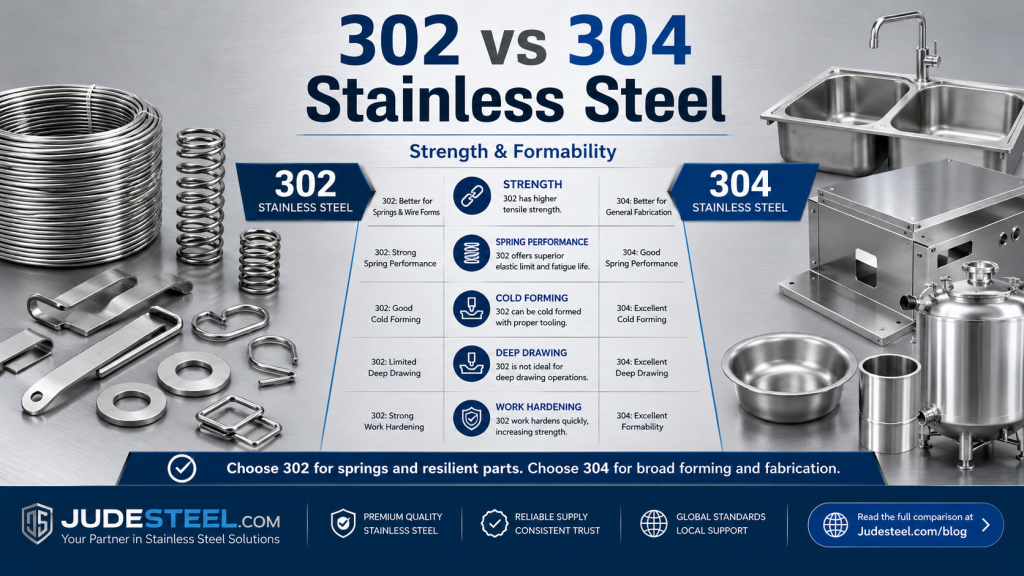
| Mechanical Factor | 302 Stainless Steel | 304 Stainless Steel |
|---|---|---|
| Strength | Good, especially in wire and strip forms | Good general-purpose strength |
| Spring Performance | Often preferred for spring wire and resilient parts | Can be used in some spring-related parts, but 302 is common for spring applications |
| Ductility | Good | Excellent |
| Deep Drawing | Good in suitable conditions | Excellent and widely used |
| Cold Forming | Good | Excellent |
| Work Hardening | Strong | Strong |
| Best Mechanical Use | Springs, washers, wire, screens and formed strip products | Panels, tanks, sinks, kitchenware, equipment and general fabrication |
5. Corrosion Resistance Comparison
Both 302 and 304 stainless steel provide good corrosion resistance in many normal environments. However, 304 is generally the more common choice for broad corrosion-resistant applications because it offers excellent general performance and is easier to specify for food, kitchen, sanitary and industrial environments.
302 can resist many urban, rural and mild organic acid environments, but the higher carbon content should be considered when welding or when the material may be exposed to conditions that increase sensitization or intergranular corrosion risk.
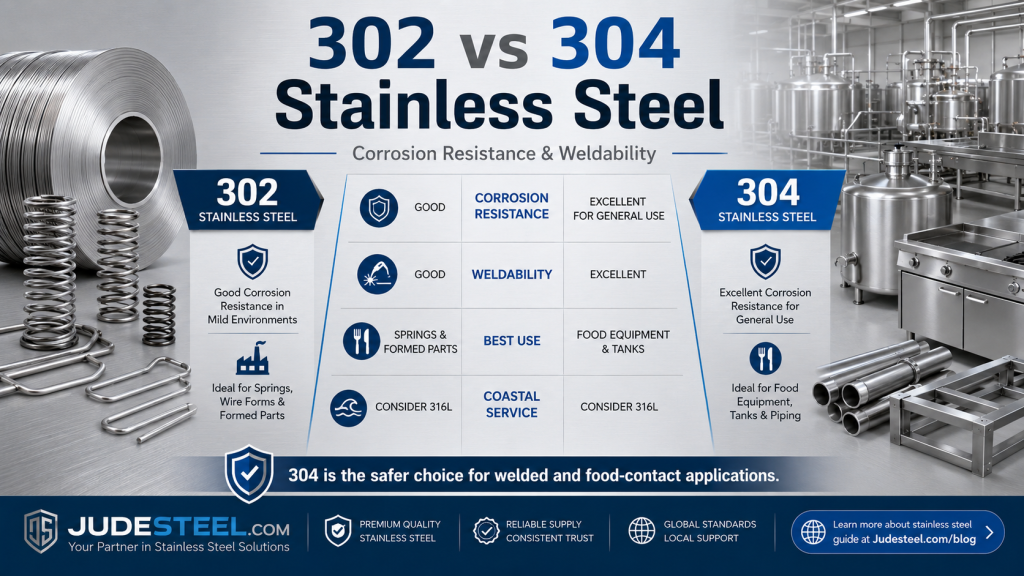
| Environment | Better Choice | Reason |
|---|---|---|
| Springs and wire parts | 302 Stainless Steel | Good strength and spring performance |
| Food processing equipment | 304 Stainless Steel | Excellent corrosion resistance, hygiene and cleanability |
| Urban and rural atmosphere | 302 or 304 Stainless Steel | Both perform well in many mild environments |
| Kitchen equipment | 304 Stainless Steel | Better general-purpose food equipment choice |
| Welded tanks and vessels | 304 or 304L Stainless Steel | Lower carbon options improve weld performance |
| Sanitary equipment | 304 Stainless Steel | More widely specified for hygiene applications |
| Coastal or chloride-rich environment | 316L or higher grade | 302 and 304 may be limited under strong chloride exposure |
6. Weldability and Fabrication
304 stainless steel is widely recognized for excellent weldability. It is commonly used in welded tanks, piping, kitchen equipment, food processing machinery and general fabrication. 304L may be preferred for heavier welded sections because of its lower carbon content.
302 stainless steel is weldable, but its higher carbon content should be considered. If the application involves heavy welding, corrosive service or post-weld corrosion risk, 304 or 304L is often a more practical choice.
| Fabrication Factor | 302 Stainless Steel | 304 Stainless Steel |
|---|---|---|
| Weldability | Good, but carbon content should be considered | Excellent |
| Heavy Section Welding | Not usually the first choice | 304L is often preferred |
| Cold Working | Good, with strong work hardening | Excellent, with strong work hardening |
| Forming | Good | Excellent |
| Machining | Moderate | Moderate |
| Polishing / Brushing | Possible | Excellent and widely used |
| Best Fabrication Use | Wire, springs, washers, strip parts and screens | Sheet, coil, tanks, panels, food equipment and welded structures |
For custom stainless steel processing, Jude Steel provides services such as laser cutting, bending, brushing and polishing.
7. Surface Finish and Appearance
Both 302 and 304 stainless steel can provide a clean metallic appearance. However, 304 is more widely available in decorative sheet, coil and strip forms, making it the more common option for visible products and architectural applications.
304 stainless steel can be supplied in finishes such as 2B, BA, No.4, hairline, brushed and mirror finish depending on product form and processing requirements. This makes it suitable for elevators, kitchen panels, equipment surfaces and decorative structures.
| Surface Factor | 302 Stainless Steel | 304 Stainless Steel |
|---|---|---|
| Decorative Appearance | Good | Excellent and widely available |
| Polissage | Possible | Excellent |
| Brossage | Possible | Very common |
| Mirror Finish | Possible but less common | Common in decorative applications |
| Product Availability | More common in wire and strip applications | Broad availability in sheet, coil, plate, pipe and bar |
| Best Appearance Use | Small parts, wire and formed components | Architectural panels, kitchen surfaces, tanks and visible equipment |
8. Cost and Availability
The cost difference between 302 and 304 stainless steel is usually not as dramatic as the difference between 304 and high-alloy grades such as 316L or duplex stainless steel. However, availability can be a major factor.
304 stainless steel is produced in very large quantities and is widely available in sheet, coil, strip, plate, pipe, tube and bar forms. 302 is more commonly selected in wire, spring and strip-related applications. For large-volume sheet or coil purchasing, 304 is often easier to source.
| Cost / Supply Factor | 302 Stainless Steel | 304 Stainless Steel |
|---|---|---|
| Raw Material Cost | Similar to 304 depending on form and market | Usually very competitive due to high production volume |
| Availability | Good in wire, strip and special forms | Excellent in sheet, coil, plate, strip, pipe, tube and bar |
| Best Buying Scenario | Spring wire, washers, screens and strip parts | General-purpose stainless steel procurement |
| Processing Cost | Depends on temper, wire/strip condition and forming requirement | Highly mature processing and supply chain |
| Lifecycle Value | Good when mechanical spring performance is required | Excellent for broad corrosion-resistant fabrication |
9. Application Comparison
| Application | Better Choice | Reason |
|---|---|---|
| Spring wire | 302 Stainless Steel | Commonly used for spring performance and resilience |
| Washers | 302 Stainless Steel | Good strength, toughness and formed part performance |
| Screens and mesh | 302 Stainless Steel | Useful in wire and screen applications |
| Kitchen sinks | 304 Stainless Steel | Excellent deep drawing, corrosion resistance and appearance |
| Food processing equipment | 304 Stainless Steel | Better hygiene, cleanability and industry acceptance |
| Architectural panels | 304 Stainless Steel | Better surface availability and decorative finish options |
| Welded tanks | 304 or 304L Stainless Steel | Better weldability and corrosion performance |
| Pressure components | 302 or 304 depending on design | Final choice depends on strength, weldability and corrosion environment |
10. 302 vs 304 Stainless Steel: Selection Guide
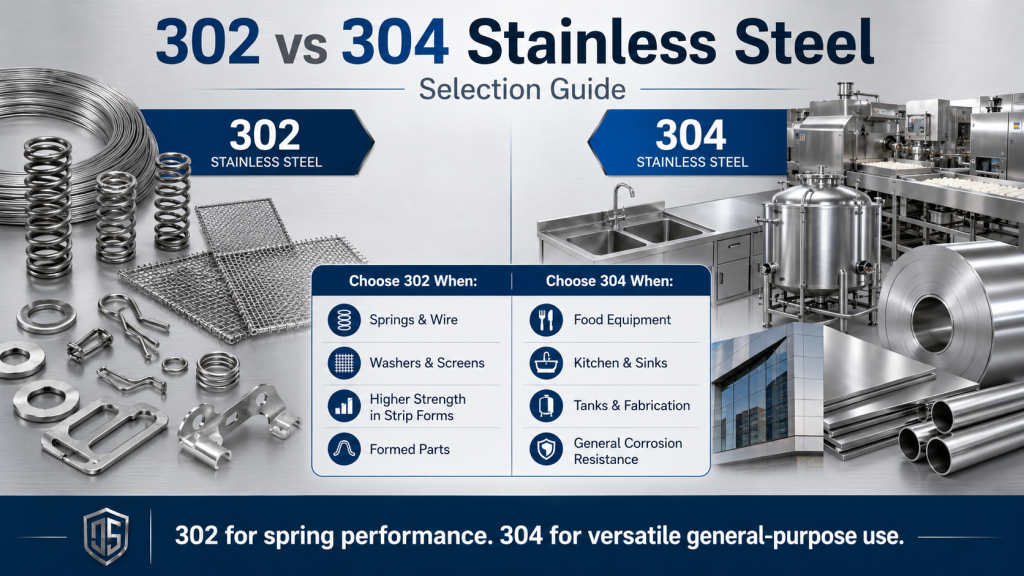
Choose 302 Stainless Steel If:
- The product is a spring, spring wire or resilient component
- The application uses stainless steel strip or wire
- Washers, screens or small formed parts are required
- Higher carbon content is acceptable
- The application is not heavily welded
- The environment is mild to moderately corrosive
- Mechanical resilience is more important than broad availability
Choose 304 Stainless Steel If:
- The product requires excellent general corrosion resistance
- The application involves food, kitchen, dairy or brewery equipment
- Welding and fabrication are important
- Deep drawing or forming is required
- The material must be widely available in sheet, coil, plate or pipe
- The surface must be polished, brushed or decorative
- You need a safe general-purpose stainless steel selection
Consider Other Grades If:
- 304L is needed for better weldability in heavy welded sections
- 316L is needed for stronger chloride or coastal corrosion resistance
- 301 is needed for higher work-hardening and spring applications
- 321 is needed for stabilized high-temperature service
- 430 is needed for lower-cost magnetic decorative applications
- 2205 duplex is needed for higher strength and chloride resistance
11. Common Buyer Mistakes to Avoid
- Assuming 302 and 304 are identical because both are 18-8 stainless steels
- Using 302 in welded applications without considering carbon content
- Choosing 304 for spring wire when 302 or 301 may be more suitable
- Using either grade in strong chloride environments without evaluating 316L or duplex stainless steel
- Comparing only price and ignoring product form availability
- Ignoring temper, hardness and spring properties in wire or strip products
- Not confirming material certificates, surface finish and delivery condition
- Choosing a grade without considering forming, welding, cleaning and final service environment
Frequently Asked Questions
What is the main difference between 302 and 304 stainless steel?
302 stainless steel is a chromium-nickel austenitic stainless steel with slightly higher carbon content than 304. 304 stainless steel has lower carbon content and is more widely used for general corrosion resistance, food equipment, kitchenware, tanks, architectural panels and fabrication.
Is 302 stainless steel stronger than 304?
302 can offer good strength and spring performance, especially in wire and strip forms. 304 provides excellent general strength, formability and corrosion resistance, but it is not always the first choice for spring wire.
Is 304 stainless steel more corrosion resistant than 302?
Both grades offer good corrosion resistance, but 304 is generally preferred for broad corrosion-resistant applications because of its lower carbon content, availability and excellent general-purpose performance.
Can 302 replace 304 stainless steel?
302 can replace 304 in selected applications such as springs, wire, washers, screens and formed strip components. It should not automatically replace 304 in welded, food-contact, decorative or high-corrosion applications without technical evaluation.
Which grade is better for springs, 302 or 304?
302 is commonly used for springs and spring wire because it provides good toughness, ductility and mechanical resilience. However, final selection should consider temper, wire size, load, fatigue and service environment.
Which grade is better for food equipment?
304 stainless steel is usually better for food equipment because it offers excellent corrosion resistance, cleanability, weldability and broad industry acceptance in kitchen, dairy, brewery and food processing applications.
Are 302 and 304 stainless steel magnetic?
Both 302 and 304 are usually non-magnetic in the annealed condition because they are austenitic stainless steels. They may become slightly magnetic after cold working.
Conclusion
302 and 304 stainless steel are closely related 18-8 austenitic stainless steels, but they are not identical. 302 typically has slightly higher carbon content and is often selected for springs, wire, washers, screens and formed strip components where mechanical resilience and toughness are important.
304 stainless steel is the more widely used general-purpose stainless steel grade. It is preferred for food equipment, kitchenware, tanks, architectural panels, welded structures, stainless steel sheet, coil, pipe and broad industrial fabrication because of its excellent corrosion resistance, formability, weldability and availability.
Choose 302 stainless steel for spring, wire and strip performance. Choose 304 stainless steel for corrosion resistance, food equipment, decorative panels, tanks and general fabrication. Jude Steel supplies stainless steel sheets, coils, strips and customized processing services for global buyers. Explore more at Judesteel.com, or visit our product pages for stainless steel sheet, stainless steel coil and stainless steel strip.
