
301 vs 304 Stainless Steel: Strength, Corrosion Resistance, Work Hardening & Applications
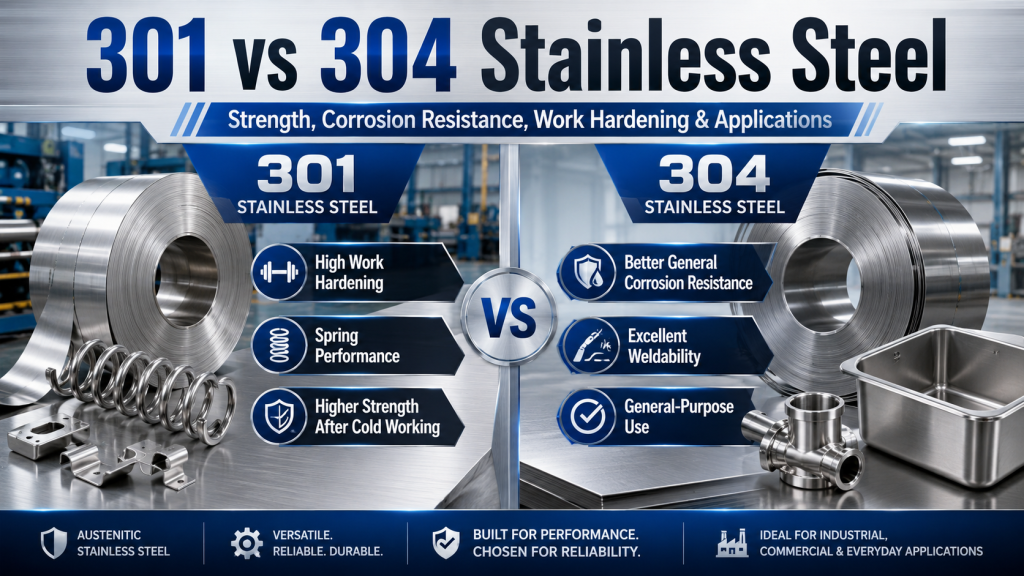
When comparing 301 vs 304 stainless steel, many buyers notice that both grades belong to the 300 series austenitic stainless steel family. They both contain chromium and nickel, both offer good formability, and both can be supplied as sheet, coil, strip and precision components.
However, they are optimized for different engineering priorities. 301 stainless steel is known for its high work-hardening rate, strong spring performance and excellent strength after cold working. 304 stainless steel is known for its excellent general corrosion resistance, weldability, food equipment performance, clean appearance and wide availability.
This guide compares 301 and 304 stainless steel in chemical composition, work hardening, mechanical strength, corrosion resistance, spring performance, formability, weldability, surface finish, cost and application selection. For related material information, visit 301 Stainless Steel, 304 Stainless Steel, Stainless Steel Sheet, Stainless Steel Coil and Stainless Steel Strip
Fast Comparison: 301 vs 304 Stainless Steel
| Feature | 301 Stainless Steel | 304 Stainless Steel |
|---|---|---|
| Stainless Steel Family | Austenitic stainless steel | Austenitic stainless steel |
| Main Advantage | High work hardening, high strength and spring performance | Excellent corrosion resistance, weldability and general-purpose versatility |
| Typical Chromium Content | About 16%–18% | About 18%–20% |
| Typical Nickel Content | About 6%–8% | About 8%–10.5% |
| Carbon Content | Higher maximum carbon than 304 | Lower carbon than 301 |
| Cold Work Hardening | Very high | Moderate to high |
| Strength After Cold Working | Very high | Good, but usually lower than hardened 301 |
| Spring Performance | Excellent | Good, but not usually the first choice for spring temper applications |
| Corrosion Resistance | Very good in mild environments | Excellent for general applications |
| Weldability | Good, but application-dependent | Excellent for general fabrication |
| Typical Applications | Springs, clips, clamps, battery contacts, rail vehicle parts, lightweight structures | Kitchen equipment, food processing, tanks, pipes, decorative panels, general fabrication |
1. What Is 301 Stainless Steel?
301 stainless steel is an austenitic chromium-nickel stainless steel with lower nickel content than 304. Its most important feature is its strong ability to work harden during cold rolling, bending, stamping, forming and stretching.
After cold working, 301 stainless steel can achieve high tensile strength and good elastic recovery. This makes it highly suitable for springs, clips, clamps, fasteners, battery contacts, rail vehicle parts, aircraft components and lightweight structural parts.
Main Characteristics of 301 Stainless Steel
- Austenitic stainless steel structure
- Lower nickel content than 304
- Excellent cold work hardening ability
- High strength after cold rolling or forming
- Excellent spring performance and elastic recovery
- Good corrosion resistance in mild environments
- Often supplied in annealed, 1/4 hard, 1/2 hard, 3/4 hard and full hard conditions
- Usually non-magnetic when annealed, but can become magnetic after cold working
Typical 301 Stainless Steel Applications
- Stainless steel springs
- Spring clips and retaining clips
- Hose clamps
- Battery spring contacts
- Fasteners and washers
- Railway and subway vehicle components
- Automotive trim and structural parts
- Conveyor belts
- Lightweight stamped components
- Aerospace and transport structural parts
2. What Is 304 Stainless Steel?
304 stainless steel is one of the most widely used stainless steel grades in the world. It is also an austenitic chromium-nickel stainless steel, but it contains more nickel than 301 and is designed for a broader balance of corrosion resistance, formability, weldability, hygiene and appearance.
304 is commonly used in kitchen equipment, food processing machinery, tanks, vessels, decorative panels, industrial piping, architectural products, stainless steel sheet, coil and general fabrication.
Main Characteristics of 304 Stainless Steel
- General-purpose austenitic stainless steel
- Higher chromium and nickel content than 301
- Excellent corrosion resistance in many environments
- Excellent weldability and fabrication performance
- Good formability and deep drawing capability
- Good cleanability and hygiene performance
- Widely available in sheet, coil, strip, plate, pipe, tube and bar forms
- Usually non-magnetic in annealed condition
Typical 304 Stainless Steel Applications
- Food processing equipment
- Kitchen equipment and sinks
- Stainless steel tanks and vessels
- Decorative panels
- Architectural products
- Industrial piping
- Heat exchangers
- Appliance parts
- General stainless steel sheet and coil fabrication
3. Chemical Composition Comparison
301 and 304 stainless steel are chemically similar, but the differences are important. 301 usually has lower nickel and slightly lower chromium than 304. This supports stronger work hardening and higher strength after forming, but it also means 301 generally has slightly lower corrosion resistance than 304.
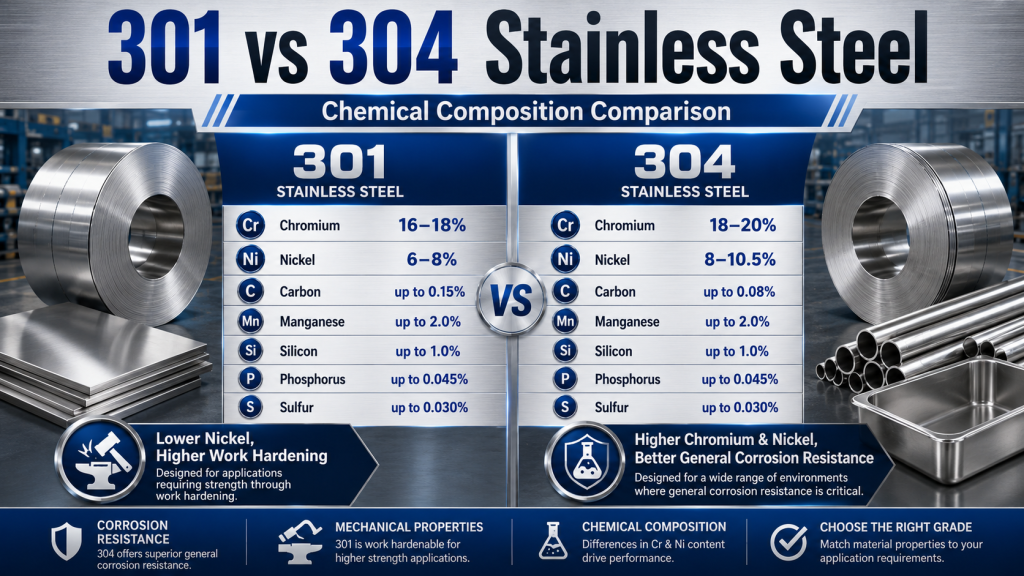
| Element / Feature | 301 Stainless Steel | 304 Stainless Steel |
|---|---|---|
| Chromium | About 16%–18% | About 18%–20% |
| Nickel | About 6%–8% | About 8%–10.5% |
| Carbon | Up to about 0.15% | Up to about 0.08% |
| Manganese | Usually up to about 2% | Usually up to about 2% |
| Silicon | Usually up to about 1% | Usually up to about 1% |
| Structure | Austenitic | Austenitic |
| Primary Design Focus | Work hardening, strength and spring performance | Corrosion resistance, weldability and general-purpose fabrication |
Why Nickel Content Matters
Nickel helps stabilize the austenitic structure and improves corrosion resistance, toughness and formability. Since 301 contains less nickel than 304, it can reach higher strength after cold working, but 304 usually provides better corrosion resistance and broader application flexibility.
4. Strength and Work Hardening Comparison
The biggest advantage of 301 stainless steel is its strong work-hardening behavior. When 301 is cold rolled, bent, stamped or formed, its strength and hardness increase significantly. This allows manufacturers to produce thinner, lighter and stronger parts without heat treatment.
304 stainless steel also work hardens, but not as aggressively as 301. Its main value is not maximum spring strength, but its excellent balance of corrosion resistance, fabrication, weldability and availability.
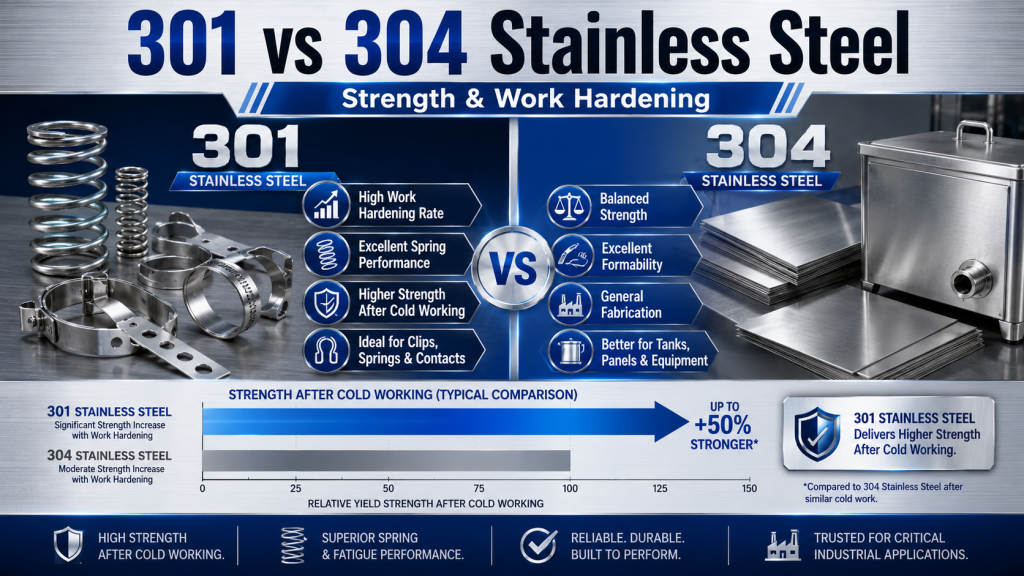
| Mechanical Factor | 301 Stainless Steel | 304 Stainless Steel |
|---|---|---|
| Work Hardening Rate | Very high | Moderate to high |
| Strength After Cold Working | Very high | Good |
| Spring Recovery | Excellent | Good |
| Fatigue Resistance | Excellent in spring and clip applications | Good for general use |
| Elastic Performance | Excellent | Moderate to good |
| Deep Drawing | Good, depending on temper | Excellent |
| Best Mechanical Use | Springs, clips, clamps, contacts and lightweight structural parts | Tanks, panels, kitchen equipment, pipes and general fabrication |
Common 301 Temper Conditions
- Annealed
- 1/4 Hard
- 1/2 Hard
- 3/4 Hard
- Full Hard
These temper conditions allow designers to select different combinations of strength, ductility, spring performance and forming behavior.
5. Corrosion Resistance Comparison
Both 301 and 304 stainless steel offer good corrosion resistance in normal environments. However, 304 generally performs better because it contains more chromium and nickel and is optimized for broad general-purpose corrosion resistance.
301 is suitable for indoor environments, mild atmospheric exposure and industrial components where strength is more important than maximum corrosion resistance. 304 is usually preferred for humid environments, food processing, kitchen equipment, tanks, outdoor exposure and long-term general corrosion resistance.
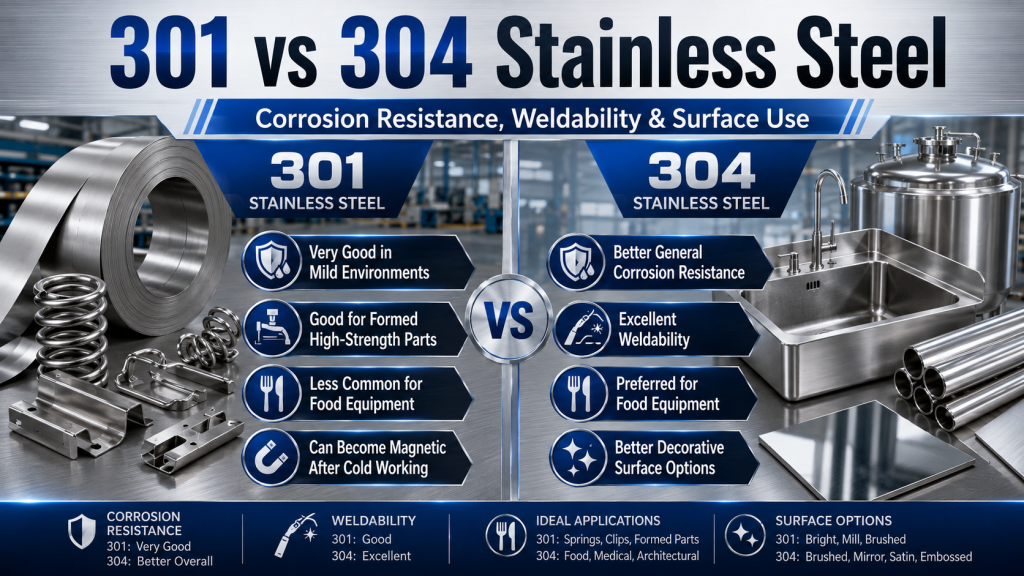
| Environment | Better Choice | Reason |
|---|---|---|
| Dry indoor environment | 301 or 304 | Both grades perform well under mild conditions |
| Spring clips and clamps | 301 Stainless Steel | Higher work hardening and elastic recovery |
| Kitchen equipment | 304 Stainless Steel | Better corrosion resistance, cleanability and hygiene performance |
| Food processing equipment | 304 Stainless Steel | More widely accepted and safer for food-related applications |
| Humid environment | 304 Stainless Steel | Better resistance to moisture-related staining and corrosion |
| Decorative panels | 304 Stainless Steel | Better surface finish options and appearance retention |
| Repeated flexing parts | 301 Stainless Steel | Better spring performance and fatigue resistance |
| Coastal or chloride-rich environment | 316L or higher grade | Neither 301 nor 304 is ideal for strong chloride exposure |
6. Formability and Fabrication
Both 301 and 304 stainless steel have good formability, but they behave differently during fabrication. 301 becomes stronger more quickly during forming, which is useful for springs and high-strength parts. However, this also means forming and tooling must be controlled carefully.
304 is easier to use as a general fabrication material because it offers a more forgiving combination of ductility, formability, weldability and surface finish. It is widely used in bending, deep drawing, welding, polishing and sheet metal fabrication.
| Fabrication Factor | 301 Stainless Steel | 304 Stainless Steel |
|---|---|---|
| Cold Forming | Excellent, but work hardens quickly | Excellent and more forgiving |
| Stamping | Excellent for high-strength stamped parts | Excellent for general stamped parts |
| Deep Drawing | Good depending on temper | Excellent |
| Pliage | Good, but temper must be considered | Excellent for general sheet fabrication |
| Welding | Good, but not always the first choice for extensive welding | Excellent |
| Polishing / Brushing | Possible, but less common for decorative use | Excellent and widely used |
| Best Fabrication Use | Springs, clips, clamps, contacts, conveyor belts and resilient parts | Kitchen equipment, tanks, panels, pipes and general fabrication |
For processing support, Jude Steel offers laser cutting, bending, brushing, polishing and stainless steel strip processing services.
7. Weldability Comparison
304 stainless steel has better overall weldability and is commonly used in welded tanks, piping, food equipment, kitchen equipment and general industrial structures. For heavy welded sections or corrosion-critical welded structures, 304L may be preferred because of its lower carbon content.
301 stainless steel can be welded, but because it is often used in cold-worked temper conditions, welding may reduce local strength or affect spring performance. For spring components and high-strength formed parts, welding must be carefully reviewed.
| Welding Factor | 301 Stainless Steel | 304 Stainless Steel |
|---|---|---|
| General Weldability | Good | Excellent |
| Extensive Welding | Not usually the first choice | Preferred |
| Post-Weld Strength | May lose cold-worked strength near weld zones | More stable for general welded fabrication |
| Food Equipment Welding | Usually not preferred | Commonly used |
| Best Welded Use | Limited welded components where strength design is reviewed | Tanks, vessels, piping, frames, food equipment and sheet fabrication |
8. Surface Finish and Appearance
304 stainless steel is more commonly used for visible and decorative applications because it is widely available in 2B, BA, No.4, hairline, brushed and mirror finishes. It is commonly used for elevator panels, kitchen equipment, wall panels, sinks and architectural decoration.
301 can also be supplied in 2B, BA and hard-rolled finishes, but it is more commonly selected for industrial strip, spring and high-strength applications rather than premium decorative surfaces.
| Surface Factor | 301 Stainless Steel | 304 Stainless Steel |
|---|---|---|
| Common Surface Forms | 2B, BA, hard rolled, spring temper strip | 2B, BA, No.4, hairline, brushed, mirror |
| Decorative Appearance | Good, but less common | Excellent and widely available |
| Industrial Use | Very common in spring and strip products | Very common in general sheet and coil products |
| Polissage | Possible | Excellent |
| Brossage | Possible | Excellent |
| Best Surface Use | Spring strip, clips, clamps, formed parts | Kitchen, decoration, equipment panels and visible products |
9. Magnetism and Cold Working
Both 301 and 304 are generally non-magnetic in the annealed condition because they are austenitic stainless steels. However, both can become magnetic after cold working. This effect is usually stronger in 301 because it work hardens more aggressively and can transform more noticeably during forming.
| Condition | 301 Stainless Steel | 304 Stainless Steel |
|---|---|---|
| Annealed Condition | Usually non-magnetic | Usually non-magnetic |
| After Cold Rolling | Can become noticeably magnetic | May become slightly magnetic |
| After Stamping / Forming | Magnetism can increase | Magnetism can increase slightly |
| Quality Meaning | Normal behavior | Normal behavior |
10. Cost and Availability
301 stainless steel may sometimes be slightly less expensive than 304 because it contains less nickel. However, actual cost depends on thickness, temper, hardness level, surface finish, product form, quantity and processing requirement.
304 is generally more widely available in sheet, coil, plate, pipe and general product forms. 301 is more commonly purchased in strip, spring temper and precision-formed applications.
| Cost / Supply Factor | 301 Stainless Steel | 304 Stainless Steel |
|---|---|---|
| Raw Material Cost | Often slightly lower, but temper can affect price | Very competitive due to wide production volume |
| Nickel Cost Exposure | Lower | Higher |
| Availability in Strip | Excellent, especially for spring temper | Good |
| Availability in Sheet / Coil | Good | Excellent |
| Availability in Pipe / Tube / Plate | More limited than 304 | Excellent |
| Best Cost Scenario | High-strength thin strip and spring applications | General fabrication and broad stainless steel procurement |
11. Real-World Application Comparison
| Application | Better Choice | Reason |
|---|---|---|
| Spring wire | 301 Stainless Steel | Excellent work hardening and elastic recovery |
| Hose clamps | 301 Stainless Steel | High strength and repeated flexing performance |
| Battery contacts | 301 Stainless Steel | Good spring performance and conductivity design support |
| Clips and fasteners | 301 Stainless Steel | High strength in thin sections |
| Railway and subway components | 301 Stainless Steel | Strength and lightweight structural performance |
| Kitchen equipment | 304 Stainless Steel | Better corrosion resistance, hygiene and cleanability |
| Food processing machinery | 304 Stainless Steel | More widely accepted for food-contact environments |
| Water tanks and vessels | 304 Stainless Steel | Better corrosion resistance and weldability |
| Decorative panels | 304 Stainless Steel | Better surface finish options and appearance |
| Industrial piping | 304 Stainless Steel | Better general-purpose welded fabrication performance |
12. 301 vs 304 Stainless Steel: Selection Guide
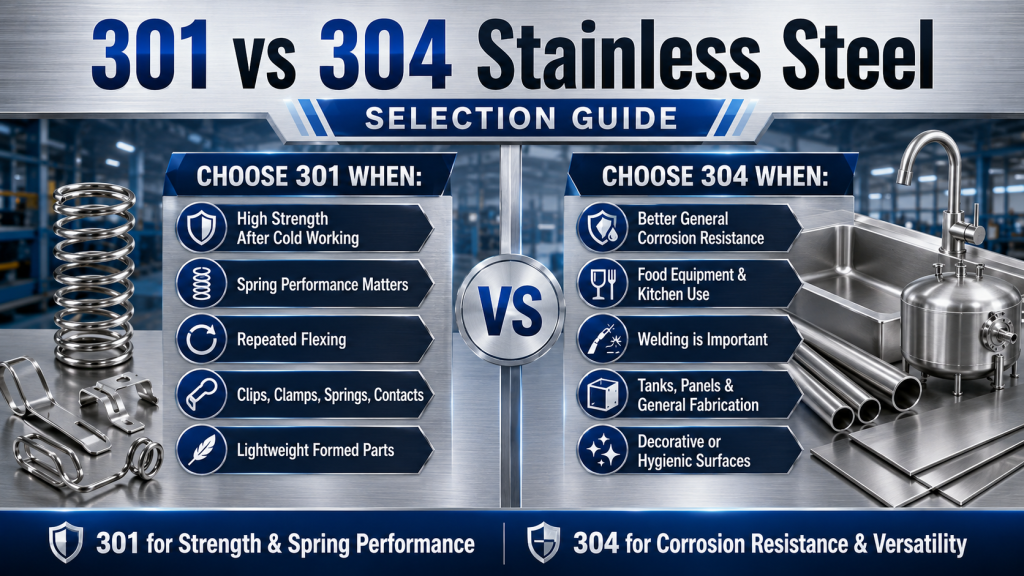
Choose 301 Stainless Steel If:
- High strength after cold working is required
- Spring performance or elastic recovery matters
- The component will experience repeated flexing
- Weight reduction is important
- The part is a clip, clamp, contact, spring or high-strength stamped component
- Thin material must provide high mechanical performance
- The environment is mild and not chloride-rich
Choose 304 Stainless Steel If:
- General corrosion resistance is the main requirement
- The product will contact food, water or cleaning chemicals
- Welding is important
- Deep drawing or general fabrication is required
- Surface appearance is important
- The material must be widely available in sheet, coil, pipe or plate
- The project involves tanks, kitchen equipment, decorative panels or industrial piping
Consider Other Grades If:
- 304L is needed for better weldability in heavy welded sections
- 316L is needed for chloride, coastal or marine atmosphere
- 302 is needed for selected spring and wire applications
- 430 is needed for cost-sensitive indoor decorative applications
- 2205 duplex is needed for higher strength and chloride resistance
- 17-4PH is needed for very high strength and corrosion resistance
13. Common Buyer Mistakes to Avoid
- Assuming 301 and 304 are the same because both are austenitic stainless steels
- Choosing 301 for food equipment when 304 is more suitable
- Choosing 304 for spring parts when 301 may perform better
- Ignoring temper condition when buying 301 stainless steel strip
- Using 301 in highly corrosive or chloride-rich environments without evaluation
- Using magnetic testing alone to judge grade quality
- Comparing only price without considering forming, welding and lifecycle performance
- Not confirming surface finish, hardness, tensile strength and material certificate
- Ignoring the effect of welding on cold-worked 301 parts
Frequently Asked Questions
What is the main difference between 301 and 304 stainless steel?
301 stainless steel is designed for high work hardening, high strength and spring performance. 304 stainless steel is designed for better general corrosion resistance, weldability, food equipment use and broad fabrication versatility.
Is 301 stainless steel stronger than 304?
Yes. After cold working, 301 stainless steel can achieve much higher strength than 304. This is why it is widely used for springs, clips, clamps, battery contacts and lightweight formed parts.
Which has better corrosion resistance, 301 or 304?
304 stainless steel generally has better corrosion resistance because it contains more chromium and nickel. 301 still performs well in mild environments but is not usually preferred for humid, food-grade or outdoor corrosion-critical applications.
Is 301 stainless steel good for springs?
Yes. 301 is one of the most common stainless steels for spring applications because it work hardens strongly and provides excellent elastic recovery after cold working.
Can 301 replace 304 stainless steel?
301 can replace 304 when strength, spring performance, repeated flexing or weight reduction are more important than maximum corrosion resistance. It should not automatically replace 304 in food equipment, humid environments, heavily welded structures or decorative applications.
Is 301 stainless steel magnetic?
Annealed 301 stainless steel is usually non-magnetic. After cold working, it can become noticeably magnetic. This is normal and does not mean the material is defective.
Which grade is better for kitchen equipment?
304 stainless steel is usually better for kitchen equipment because it provides better corrosion resistance, cleanability, welding performance and food-grade acceptance.
Conclusion
301 and 304 stainless steel are both valuable austenitic stainless steels, but they are designed for different priorities. 301 stainless steel focuses on high work hardening, high strength, spring recovery and lightweight formed part performance. It is ideal for springs, clips, clamps, battery contacts, conveyor belts, rail vehicle components and high-strength stamped parts.
304 stainless steel focuses on corrosion resistance, weldability, hygiene, surface appearance and general-purpose fabrication. It is the better choice for kitchen equipment, food processing machinery, tanks, pipes, vessels, decorative panels and broad stainless steel sheet and coil applications.
Choose 301 stainless steel when spring performance and high strength after cold working are the main requirements. Choose 304 stainless steel when corrosion resistance, food equipment performance, welding and long-term versatility are more important. Jude Steel supplies stainless steel sheets, coils, strips and customized processing services for global buyers. Explore more at Judesteel.com, or visit our product pages for stainless steel sheet, stainless steel coil and stainless steel strip.
