
201 vs 301 Stainless Steel: Which Grade Is Better for Your Application?
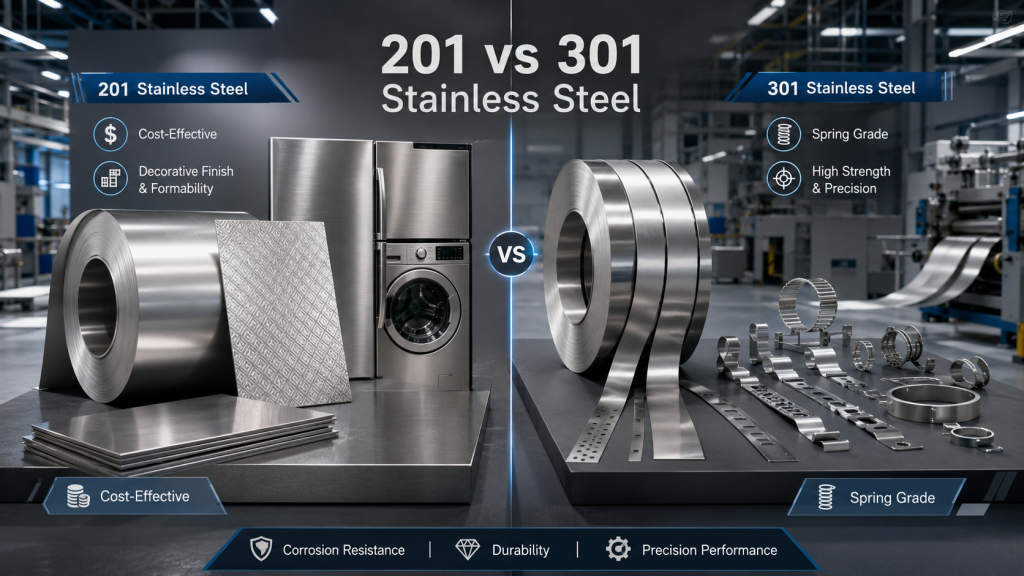
201 and 301 are work-hardening austenitic stainless steels, but they are optimized for different cost, forming and strength requirements.
201 and 301 stainless steel can look almost identical after cold rolling, brushing or polishing. Both grades are austenitic stainless steels containing chromium, nickel and manganese, and both can develop substantially higher strength through cold working.
Their engineering priorities are different. Type 201 reduces nickel content and uses more manganese and nitrogen to maintain the austenitic structure. This makes it an economical material for decorative sheet, appliance components, transportation panels, kitchen products and general formed parts.
Type 301 uses a more conventional chromium-nickel composition and is particularly valued for its transformation-assisted work hardening, high strength in cold-rolled tempers, elastic recovery and spring performance. It is widely used for clips, clamps, springs, precision stampings, conveyor components and parts exposed to repeated mechanical loading.
This guide compares 201 vs 301 stainless steel by chemical composition, annealed strength, cold-worked strength, corrosion resistance, formability, welding, magnetism, fatigue performance, surface finish, price and typical applications.
Quick Answer: Should You Choose 201 or 301?
Choose 201 stainless steel when material cost, decorative appearance, general forming and moderate service conditions are the main priorities.
Choose 301 stainless steel when the component requires high cold-worked strength, spring performance, elastic recovery, fatigue resistance or repeated flexing.
Do not assume that 301 is automatically stronger in every delivery condition. In the annealed condition, ASTM A240 minimum values give 201 a higher specified yield strength. The major strength advantage of 301 appears after controlled cold rolling or forming.
201 vs 301 Stainless Steel at a Glance
| Comparison Item | 201 Stainless Steel | 301 Stainless Steel |
|---|---|---|
| Stainless steel family | Chromium-nickel-manganese austenitic stainless steel | Chromium-nickel austenitic stainless steel |
| UNS designation | S20100 | S30100 |
| Common EN designation | 1.4372 | 1.4310 or 1.4319 depending on the referenced specification |
| Chromium under ASTM A240 | 16.0–18.0% | 16.0–18.0% |
| Nickel under ASTM A240 | 3.5–5.5% | 6.0–8.0% |
| Manganese under ASTM A240 | 5.5–7.5% | 2.0% maximum |
| Nitrogen under ASTM A240 | 0.25% maximum | 0.10% maximum |
| Annealed minimum yield strength | 260 MPa under ASTM A240 | 207 MPa under ASTM A240 |
| Annealed minimum tensile strength | 515 MPa under ASTM A240 | 517 MPa under ASTM A240 |
| Cold-worked strength potential | High | Very high and widely specified in spring tempers |
| Spring performance | Suitable for selected formed parts | Preferred for springs, clips and repeated-flexing components |
| Corrosion resistance | Suitable for many mild and indoor environments | Good atmospheric resistance and often preferred for demanding mechanical parts |
| Heat-treatment hardening | Not hardenable by conventional heat treatment | Not hardenable by conventional heat treatment |
| Magnetism | Usually low when annealed; increases after cold working | Usually low when annealed; often becomes strongly magnetic after cold working |
| Relative material cost | Generally lower | Generally higher because of higher nickel content |
| Typical selection priority | Economy, appearance and general fabrication | Strength, elasticity, fatigue resistance and spring performance |
What Is 201 Stainless Steel?
201 stainless steel
is a chromium-nickel-manganese austenitic stainless steel developed to reduce dependence on nickel. Part of the nickel normally used to stabilize austenite is replaced by manganese and nitrogen.
The reduced nickel content normally makes Type 201 less expensive than many 300-series austenitic grades. Nitrogen also contributes to strength, which is one reason 201 has a relatively high annealed yield-strength requirement.
Typical advantages of 201 include:
- Lower alloy cost than higher-nickel austenitic grades
- Good strength in the annealed condition
- Strong work-hardening response
- Good appearance after brushing or polishing
- Good fabrication performance when the process is properly controlled
- Availability in sheet, coil and strip
- Suitability for indoor decorative and general industrial products
Common applications include:
- Kitchen utensils and appliance components
- Decorative panels and architectural trim
- Elevator interior panels
- Restaurant and catering equipment
- Railway and trailer panels
- Automotive trim
- Watch cases and bands
- General stamped or formed components
Type 201 is best suited to mild atmospheric, indoor and regularly cleaned conditions. It should not be treated as a direct substitute for 304, 316L or another higher-alloy grade in aggressive chloride, chemical or continuously wet environments.
What Is 301 Stainless Steel?
301 stainless steel
is a chromium-nickel austenitic stainless steel known for excellent stretch formability in the annealed condition and very high strength after cold working.
Type 301 contains less nickel than conventional 304 stainless steel. Its composition allows the austenitic structure to transform more readily during cold deformation. This transformation is a major contributor to its rapid increase in strength and magnetic response.
Typical advantages of 301 include:
- Excellent cold-work hardening capability
- Very high strength in temper-rolled conditions
- Excellent spring and elastic recovery performance
- Good fatigue resistance when correctly designed
- Good stretch formability in the annealed condition
- Good atmospheric corrosion resistance
- Availability in multiple hardness and temper conditions
- Suitability for precision strip and high-volume stamping
Common applications include:
- Springs and spring clips
- Hose clamps
- Retaining rings
- Conveyor components
- Automotive trim and structural parts
- Railway and subway components
- Precision stampings
- Electronic shielding and connectors
- Head gaskets and flexible components
- Mixer blades and mechanically loaded parts
Chemical Composition Comparison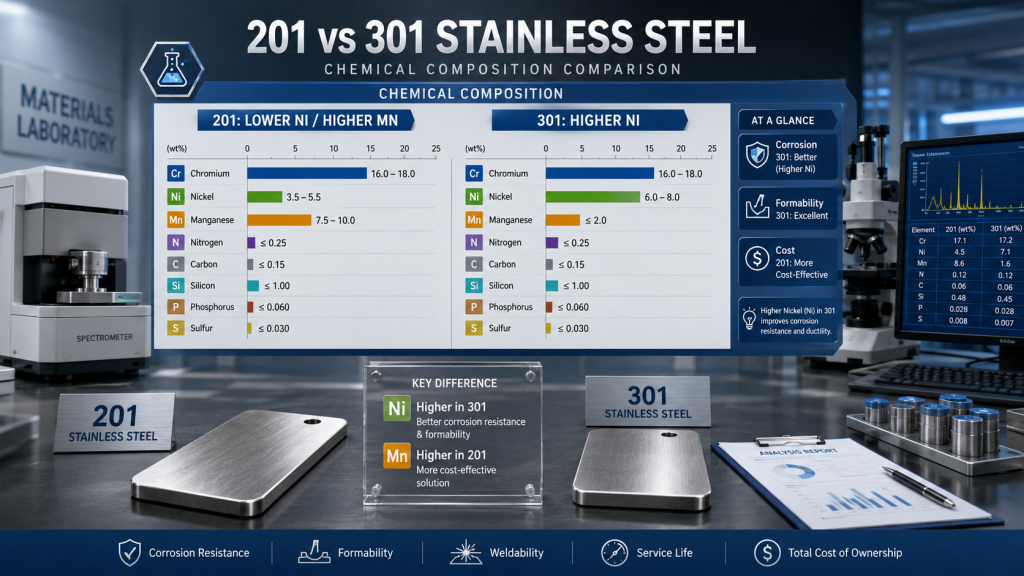
201 reduces nickel by using more manganese and nitrogen, while 301 contains more nickel and substantially less manganese.
| Élément | 201 ASTM A240 | 301 ASTM A240 | Practical Effect |
|---|---|---|---|
| Carbon | 0.15% maximum | 0.15% maximum | Carbon contributes to strength and work-hardening behavior but can affect welding and corrosion if thermal exposure is poorly controlled. |
| Chromium | 16.0–18.0% | 16.0–18.0% | Chromium forms the passive film responsible for stainless behavior. |
| Nickel | 3.5–5.5% | 6.0–8.0% | Nickel stabilizes austenite and affects formability, toughness, corrosion behavior and alloy cost. |
| Manganese | 5.5–7.5% | 2.0% maximum | Manganese helps maintain the austenitic structure in the lower-nickel 201 composition. |
| Nitrogen | 0.25% maximum | 0.10% maximum | Nitrogen stabilizes austenite and contributes to the relatively high strength of 201. |
| Silicon | 1.0% maximum | 1.0% maximum | Silicon is used primarily as a deoxidizer. |
| Phosphorus | 0.060% maximum | 0.045% maximum | Phosphorus is controlled because excessive content can reduce toughness and fabrication performance. |
| Sulfur | 0.030% maximum | 0.030% maximum | Sulfur is limited because inclusions can affect forming, surface quality and corrosion performance. |
Why Does 201 Contain More Manganese?
Nickel is an effective but relatively expensive austenite-stabilizing element. Type 201 reduces the nickel requirement by adding more manganese and nitrogen.
This alloy design can lower material cost while maintaining an austenitic structure and useful forming characteristics. However, the higher manganese content does not provide the same corrosion contribution as nickel.
Why Does 301 Contain More Nickel?
Type 301 uses a higher nickel range than 201, but less nickel than conventional 304. Its chemistry is carefully balanced so that the annealed material remains formable while transforming readily during cold deformation.
This balance gives 301 its characteristic combination of stretch formability, rapid work hardening and very high cold-worked strength.
Annealed Mechanical Properties
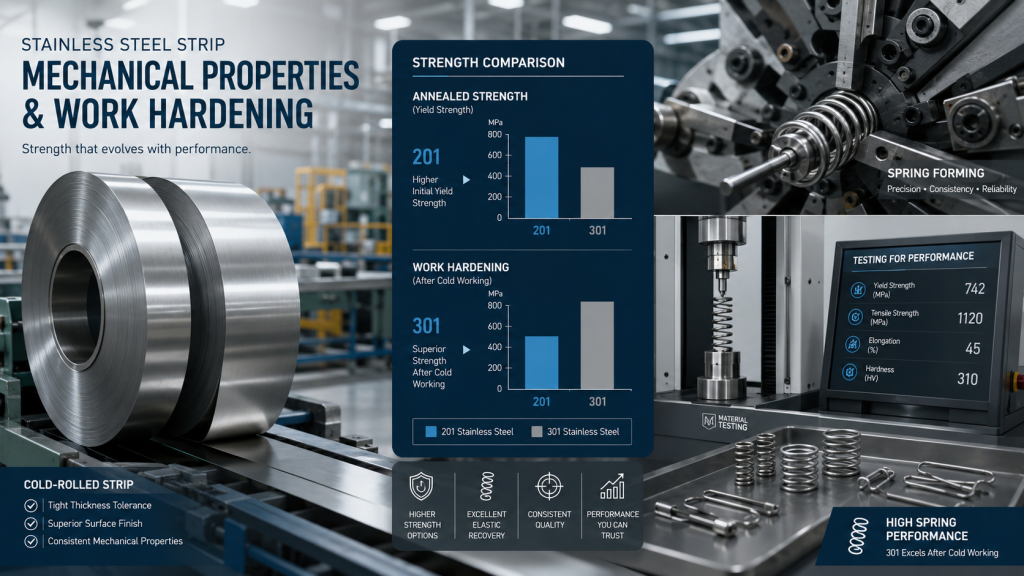 Annealed 201 has a higher ASTM minimum yield strength, while cold-worked 301 is preferred for very high strength and spring performance.
| Property | 201 ASTM A240 | 301 ASTM A240 |
|---|---|---|
| Minimum tensile strength | 515 MPa | 517 MPa |
| Minimum 0.2% yield strength | 260 MPa | 207 MPa |
| Minimum elongation | 40% | 40% |
| Maximum Rockwell hardness | 100 HRB | 95 HRB |
| Heat-treat hardenable | No | No |
| Main strengthening method | Cold working | Cold working and transformation-induced hardening |
Grade 301 is frequently purchased as 1/4 hard, 1/2 hard, 3/4 hard, full hard or another specified temper. Its strength can increase dramatically as cold reduction increases. Mechanical requirements must be agreed for the actual temper and product standard.
Is 301 Always Stronger Than 201?
No. In the annealed ASTM A240 condition, the specified minimum tensile strengths are almost identical, and 201 has a higher minimum yield strength.
The major advantage of 301 appears after cold rolling or forming. Type 301 is widely used in temper-rolled strip because it can reach very high tensile and yield strengths while retaining useful elasticity.
A valid comparison must therefore identify:
- The product standard
- The delivery condition
- The cold-reduction level
- The thickness
- The rolling direction
- The required tensile and yield strengths
- The required hardness
- The required elongation or bend performance
Work Hardening and Spring Performance
Both 201 and 301 become stronger and harder when they are cold rolled, drawn, stamped or formed. This behavior is called work hardening.
Type 201 has a high work-hardening coefficient and can develop substantial strength during forming. Type 301 is particularly valued because deformation can transform part of the austenitic structure into strain-induced martensite.
The transformation helps 301 achieve:
- Very high tensile strength
- High yield strength
- Strong elastic recovery
- Good spring properties
- High resistance to permanent deformation
- Useful fatigue performance in correctly designed components
Common 301 Temper Conditions
Precision 301 strip is commonly ordered in conditions such as:
- Annealed
- 1/4 hard
- 1/2 hard
- 3/4 hard
- Full hard
- Extra hard or specially rolled conditions
The commercial temper name is not sufficient by itself. The purchase order should define the required tensile strength, yield strength, hardness, elongation and permitted tolerance.
Which Grade Is Better for Springs?
301 is generally the preferred choice for springs, clips, retaining parts and repeated-flexing components because its cold-worked properties are widely standardized and used in spring design.
201 may be suitable for selected spring-like or formed components, but it should not replace 301 without validating the required elastic limit, fatigue life, bend performance and corrosion resistance.
Corrosion Resistance Comparison
Both grades contain 16–18% chromium under ASTM A240 and can form a protective chromium-rich passive film. Neither grade contains an intentional molybdenum addition.
In clean, mild atmospheric and indoor conditions, both materials can provide useful corrosion resistance. Their performance depends strongly on surface finish, fabrication quality, contamination, maintenance and exposure conditions.
201 Corrosion Performance
Type 201 is commonly used in dry indoor environments, decorative products, regularly cleaned kitchenware and general transportation applications.
Its lower nickel content and higher manganese composition make careful environmental evaluation important. Persistent moisture, salt deposits, acidic cleaning chemicals and coastal exposure can increase the risk of staining or localized corrosion.
301 Corrosion Performance
Type 301 has good atmospheric corrosion resistance and is widely used in automotive, transportation and industrial spring components.
Cold working can change microstructure, residual stress and magnetic response. Severe deformation, rough edges or poor cleaning can influence real corrosion performance.
Which Grade Has Better Corrosion Resistance?
301 is often preferred when a component requires a combination of mechanical performance and reliable atmospheric corrosion resistance. However, 201 and 301 have overlapping chromium ranges, and real results can vary with exact heat chemistry and product condition.
Neither material should automatically be selected for:
- Continuously wet chloride environments
- Seawater immersion
- Hot salt solutions
- Aggressive acids
- Bleach or hypochlorite exposure
- Critical food or pharmaceutical environments requiring a higher-alloy grade
When corrosion resistance is the primary design requirement, compare the actual environment with 304L, 316L, duplex or another more corrosion-resistant stainless steel instead of choosing only between 201 and 301.
Formability, Deep Drawing and Stamping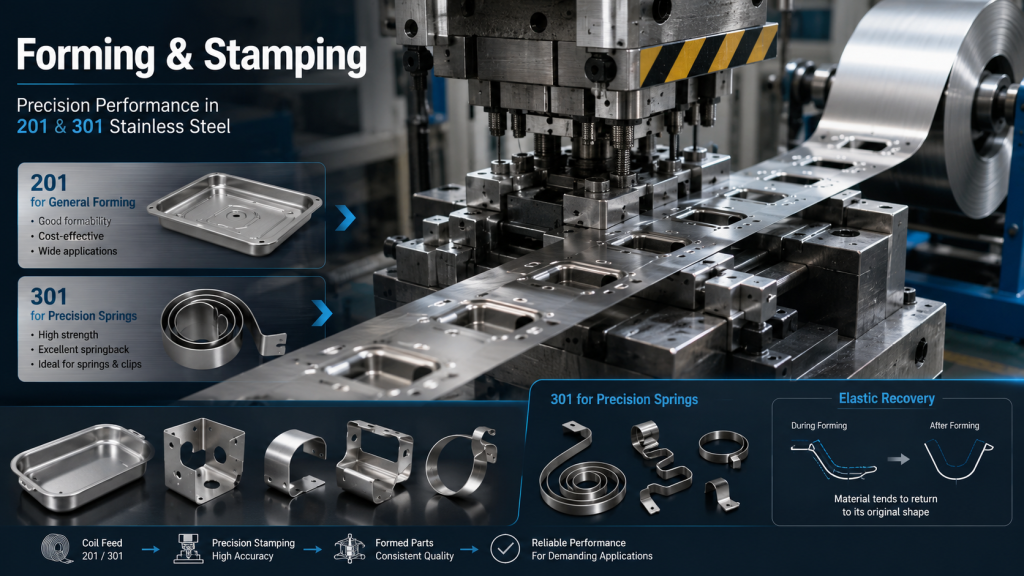
Tooling, lubrication, rolling direction and work-hardening rate must be considered when forming 201 or 301 stainless steel.
Forming 201 Stainless Steel
Type 201 can be bent, stamped, roll formed and drawn. Its relatively high strength and rapid work hardening mean that forming force, die clearance and lubrication may need adjustment compared with softer low-carbon steel.
Common forming considerations include:
- Higher forming loads
- Strong springback
- Potential galling
- Need for effective lubrication
- Work hardening during multiple forming stages
- Need for suitable intermediate annealing in severe processes
Forming 301 Stainless Steel
Annealed 301 offers excellent stretch formability. During deformation, it hardens rapidly and can develop very high strength.
This characteristic is useful when the forming operation is designed to create both the final shape and required strength. It can also create problems if tooling, forming sequence and strain distribution are not controlled.
Which Grade Is Better for Deep Drawing?
The answer depends on component geometry, strain path, tooling and delivered condition. Annealed 301 provides excellent stretch-forming capability, while 201 is widely used for economical formed products.
For severe deep drawing, production trials are recommended. The supplier should provide consistent chemistry, grain size, annealed condition and mechanical properties.
Which Grade Is Better for Precision Stamping?
301 precision strip is usually preferred for components that require tight hardness, strength, springback and fatigue-control requirements.
201 can be suitable for cost-sensitive stampings where extreme spring properties are not required.
Welding and Fabrication
Both 201 and 301 can be welded using common stainless steel welding processes when the procedure is matched to the product thickness, joint design and service environment.
Possible processes include:
- Gas tungsten arc welding
- Gas metal arc welding
- Resistance spot welding
- Laser welding
- Seam welding
Welding 201 Stainless Steel
The higher nitrogen and manganese content of 201 affects its metallurgical behavior. Heat input, shielding, filler metal and joint design should be controlled to reduce distortion and preserve corrosion performance.
Welding 301 Stainless Steel
Thin 301 strip is frequently resistance welded or laser welded. Heavily cold-worked material may lose part of its cold-worked strength in the heat-affected zone because welding locally anneals or softens the material.
A welded 301 spring component may not retain the same strength next to the weld as the unaffected cold-rolled base metal. Joint location and post-weld performance should be validated.
Post-Weld Cleaning
Welding oxide, heat tint and embedded iron can reduce corrosion resistance. Depending on the product and finish, post-weld treatment may include:
- Mechanical cleaning
- Controlled pickling
- Passivation
- Grinding and polishing
- Final surface inspection
Magnetic Properties
Annealed 201 and 301 are austenitic and are normally non-magnetic or only weakly magnetic. This does not remain true after heavy cold working.
Cold deformation can create strain-induced martensite. As a result:
- Cold-rolled 201 may become noticeably magnetic.
- Cold-rolled 301 often becomes strongly magnetic.
- Magnetic response may vary across a formed component.
- A highly worked edge may be more magnetic than the center.
Magnetic response depends on alloy chemistry, annealing condition, cold reduction and forming history. Use PMI, XRF, OES or certificate traceability for reliable verification.
Surface Finish and Appearance
Both grades can be supplied with a wide range of industrial and decorative finishes, including:
- 2D
- 2B
- BA
- N° 3
- N°4
- Hairline
- Mirror polish
- Embossed or patterned finishes
- Anti-fingerprint coating
- Protective film
A polished surface can make different grades look almost identical. Appearance should never be used as the sole method for distinguishing 201 from 301.
Surface quality can be affected by inclusions, rolling marks, scratches, grinding contamination, uneven polishing and protective-film residue.
JUDE supplies
stainless steel sheet
,
stainless steel coil
and
stainless steel strip
with customized finishes and dimensional requirements.
Application Comparison
| Application | Recommended Starting Choice | Selection Reason |
|---|---|---|
| Decorative indoor panel | 201 | Economical, attractive and suitable for mild indoor conditions |
| Kitchen utensil | 201 or another approved grade | Cost-effective for selected products; hygiene and corrosion requirements must be confirmed |
| Appliance trim | 201 | Good appearance and competitive material cost |
| Railway or trailer panel | 201 | Useful combination of strength, weight reduction and economy |
| Precision spring | 301 | High cold-worked strength, elastic recovery and established spring tempers |
| Hose clamp | 301 | Good spring force and resistance to permanent deformation |
| Retaining clip | 301 | High strength and repeated-flexing performance |
| Electronic connector or shield | 301 | Precision strip availability and controlled spring properties |
| Automotive decorative trim | 201 or 301 | Selection depends on strength, forming and environmental requirements |
| Automotive structural spring component | 301 | Better suited to high mechanical loading and elastic performance |
| Conveyor component | 301 | High strength and resistance to repeated mechanical loading |
| Coastal exterior component | Evaluate a higher-alloy grade | Neither 201 nor 301 is the default choice for aggressive salt exposure |
Cost, Availability and Lead Time
Type 201 generally has a lower alloy cost because it contains less nickel. This can create significant savings for high-volume sheet, coil, strip and stamped-component production.
Type 301 normally costs more because of its higher nickel content and because precision spring strip may require tightly controlled cold rolling, heat treatment, flatness, mechanical properties and edge processing.
The final quotation depends on:
- Nickel, chromium and manganese market prices
- Required grade and origin
- Annealed or temper-rolled condition
- Required tensile strength and hardness
- Thickness and width tolerance
- Coil weight and minimum order quantity
- Surface finish
- Slit-edge, deburred-edge or rounded-edge requirements
- Flatness and camber tolerances
- Testing and certification
- Packaging and destination port
The lowest price per kilogram does not always provide the lowest component cost. A stronger 301 temper may permit a thinner section or longer fatigue life, while 201 may be the more economical solution when spring performance is unnecessary.
Can 201 and 301 Replace Each Other?
Can 201 Replace 301?
201 may replace 301 in selected decorative, general formed or cost-sensitive products when the required strength, fatigue life and spring properties are modest.
It should not replace 301 automatically in:
- Precision springs
- Retaining clips
- Repeated-flexing components
- Safety-critical stampings
- Specified temper-rolled strip
- Components requiring tightly controlled elastic recovery
Can 301 Replace 201?
301 can often provide the required strength and appearance for a component originally designed in 201, but the substitution may increase material and processing cost.
Higher strength and stronger springback may also require changes to tooling, bend allowance, forming sequence and die clearance.
Compare chemistry, delivered temper, tensile strength, yield strength, hardness, elongation, bend performance, corrosion conditions, thickness and total component cost before approving a grade change.
Which Grade Should You Choose?
Choose 201 When:
- Material cost is a primary consideration.
- The product will be used indoors or in a mild environment.
- Decorative appearance is important.
- Moderate-to-high annealed strength is acceptable.
- Extreme spring performance is not required.
- The component is a panel, trim, utensil or general stamping.
- High-volume production makes alloy cost especially important.
Choose 301 When:
- Very high cold-worked strength is required.
- The component functions as a spring or clip.
- Elastic recovery must be controlled.
- Repeated bending or flexing is expected.
- Fatigue performance is an important design factor.
- A controlled 1/4 hard, 1/2 hard, 3/4 hard or full-hard temper is required.
- The project uses precision strip or high-performance stampings.
201 and 301 Stainless Steel Purchasing Checklist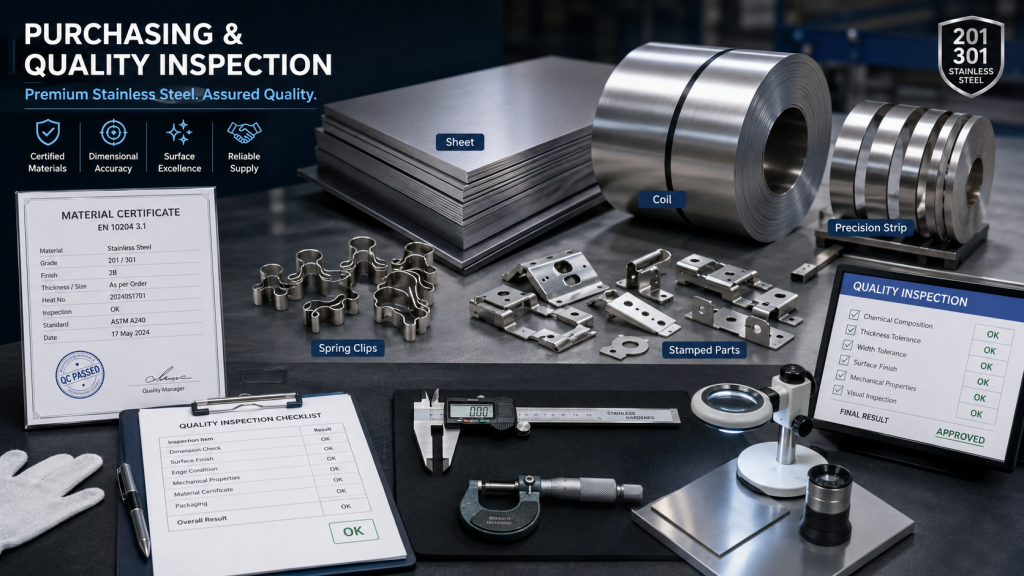
Grade, temper, dimensions, mechanical properties, surface finish and edge condition should all be stated in the purchase specification.
Before requesting a quotation, provide the following information:
- Grade:
Specify 201/S20100 or 301/S30100. - Product standard:
Identify ASTM A240, ASTM A666, EN 10088-2, JIS G4304, JIS G4305 or another applicable standard. - Product form:
Specify sheet, plate, coil, precision strip or fabricated component. - Delivery condition:
State annealed, 1/4 hard, 1/2 hard, 3/4 hard, full hard or custom temper. - Mechanical properties:
Define tensile strength, yield strength, hardness and elongation. - Dimensions:
Provide thickness, width, length, coil inner diameter and coil weight. - Dimensional tolerances:
State thickness tolerance, width tolerance, flatness and camber. - Surface finish:
Specify 2D, 2B, BA, No.4, hairline, mirror or another required finish. - Edge condition:
Select mill edge, slit edge, deburred edge or rounded edge. - Forming direction:
Identify whether bend or spring performance must be controlled relative to the rolling direction. - Inspection:
Define PMI, chemical analysis, tensile testing, hardness testing or bend testing. - Documentation:
Request the material certificate, heat number and inspection report. - End application:
Explain whether the material will be used for decoration, stamping, springs, clips or transportation equipment. - Quantity and destination:
Provide total weight, packaging, delivery schedule and destination port.
Available Product Forms and Processing Services
JUDE supplies 201 and 301 stainless steel products for decorative, appliance, transportation, spring and precision-stamping applications.
Stainless steel sheet and plate
Bobine d'acier inoxydable
Precision stainless steel strip
Customized stainless steel sheet-metal components- Cold rolling and temper rolling
- Precision slitting
- Cut-to-length processing
- Cisaillement sur mesure
- Laser and waterjet cutting
- Brushing and polishing
- Deburred and rounded-edge processing
- Protective-film application
- Material traceability and inspection
JUDE’s
stainless steel strip-processing service
includes uncoiling, precision slitting, leveling, rewinding and customized packaging.
Buyers can review available
inspection reports and certifications
before placing an order.
Final Conclusion
201 and 301 are both work-hardening austenitic stainless steels, but they should not be treated as interchangeable materials.
Type 201 uses lower nickel and higher manganese and nitrogen to provide an economical combination of strength, appearance and formability. It is commonly selected for indoor decorative products, kitchenware, appliance components, transportation panels and general stampings.
Type 301 is optimized for high cold-worked strength, elastic recovery and spring performance. It is the preferred choice for springs, clips, clamps, precision strip, conveyor components and parts exposed to repeated mechanical loading.
The correct comparison must consider more than the grade name. Buyers should compare the delivery temper, tensile strength, yield strength, hardness, elongation, forming direction, corrosion environment, surface finish and total component cost.
Frequently Asked Questions
Is 301 stainless steel stronger than 201?
Not in every condition. In the annealed ASTM A240 condition, 201 has a higher specified minimum yield strength, while their minimum tensile strengths are similar. Cold-worked 301 can achieve very high strength and is widely preferred for spring applications.
What is the main difference between 201 and 301 stainless steel?
Type 201 contains less nickel and more manganese and nitrogen. Type 301 contains more nickel and is particularly valued for high cold-worked strength, elastic recovery and spring performance.
Which grade is cheaper, 201 or 301?
201 is generally cheaper because it uses less nickel. Actual price depends on alloy markets, dimensions, temper, surface finish, quantity and processing requirements.
Which grade is better for springs?
301 is normally better for springs, clips and repeated-flexing parts because it is widely available in controlled cold-worked tempers with high strength and elastic recovery.
Which grade has better corrosion resistance?
301 is often preferred for components requiring both mechanical performance and dependable atmospheric corrosion resistance. However, their chromium ranges overlap, and neither grade is intended for severe chloride or chemical environments.
Can 201 replace 301 stainless steel?
201 may replace 301 in selected decorative or general formed products. It should not replace 301 in spring, fatigue-sensitive or high-strength applications without engineering validation.
Can 301 replace 201 stainless steel?
301 may provide sufficient or higher mechanical performance, but it usually costs more and may create greater springback during forming. Tooling and processing may need to be adjusted.
Are 201 and 301 stainless steel magnetic?
Both are normally non-magnetic or weakly magnetic in the annealed condition. Cold working can make both grades magnetic, and heavily cold-worked 301 often becomes strongly magnetic.
Can 201 and 301 be hardened by heat treatment?
No. These austenitic grades cannot be hardened by conventional quenching and tempering. Their strength and hardness increase through cold working.
Which grade is better for deep drawing?
Both can be formed, but performance depends on annealed condition, component geometry, tooling, lubrication and strain path. Annealed 301 offers excellent stretch formability, while 201 is widely used for economical formed products.
Which grade is better for precision stamping?
301 is generally preferred when the stamped component requires tightly controlled strength, hardness, springback or fatigue performance. 201 is suitable for many cost-sensitive general stampings.
Can 201 and 301 stainless steel be welded?
Yes. Both can be welded using suitable procedures. In cold-worked 301, the heat-affected zone may lose part of its cold-worked strength because welding locally softens the material.
How can you identify 201 and 301 stainless steel?
Use material certificates, heat-number traceability and PMI. XRF can normally distinguish their different nickel and manganese ranges. A magnet test alone cannot reliably identify the grade.
Is 201 stainless steel suitable for outdoor use?
201 can be used in selected mild outdoor conditions, but persistent moisture, salt, pollution and coastal exposure can increase staining and corrosion risk. A more corrosion-resistant grade may be preferable.
What information should I provide when requesting a quotation?
Provide the grade, standard, temper, tensile strength, hardness, dimensions, tolerances, surface finish, edge condition, quantity, inspection requirements, end application and destination port.
Request a 201 or 301 Stainless Steel Quotation
Send JUDE your required grade, product standard, temper, dimensions, mechanical properties, surface finish, edge condition, quantity, inspection requirements and destination port.
For spring or precision-stamping applications, include the required tensile strength, yield strength, hardness, rolling direction, bend requirements and component drawing.
