
18/10 vs 18/8 Stainless Steel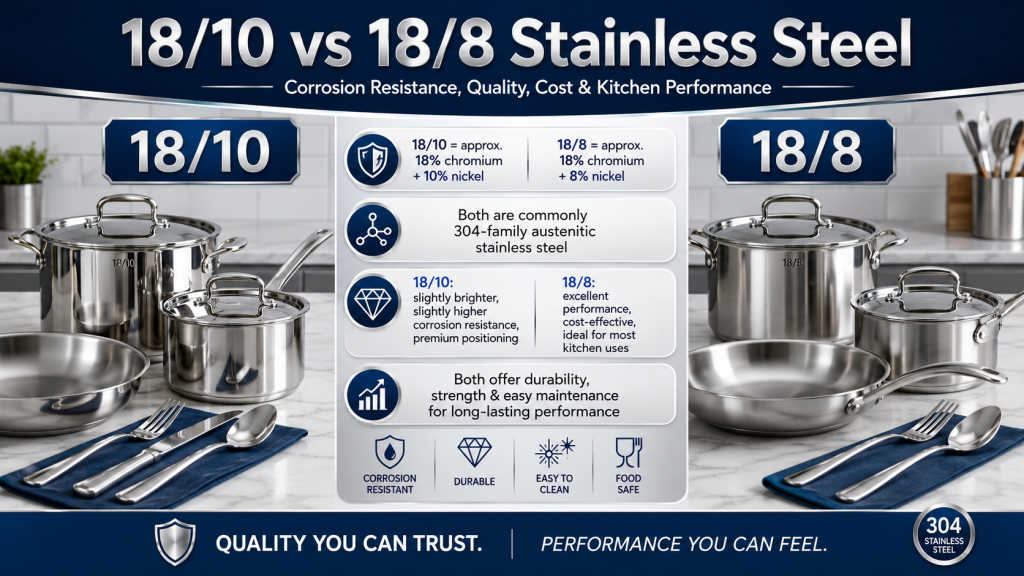
When comparing 18/10 vs 18/8 stainless steel, many buyers assume that one material is dramatically better than the other. In reality, both are high-quality stainless steels commonly used in cookware, cutlery, food equipment, kitchenware and consumer products.
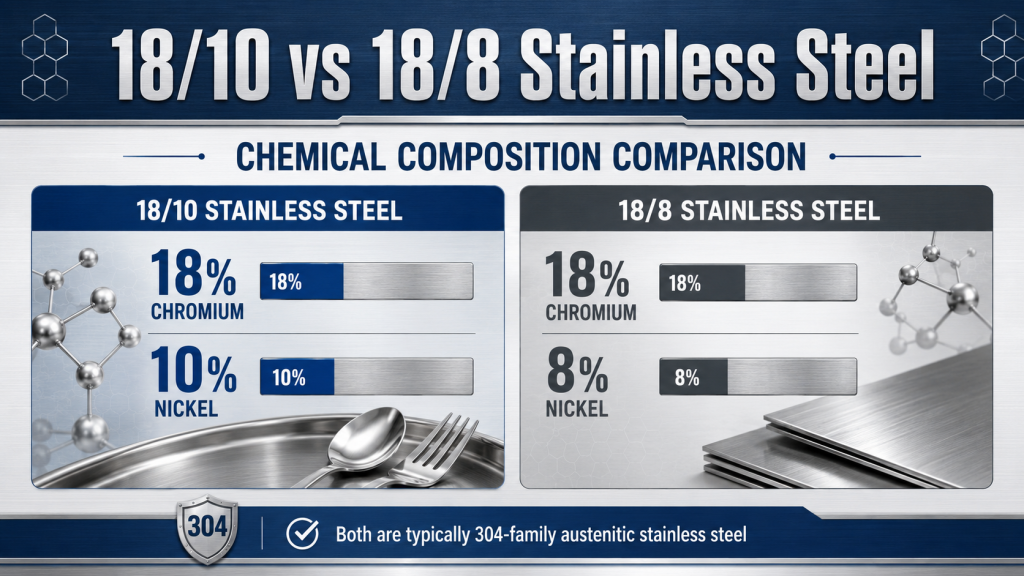
The main difference is nickel content. 18/10 stainless steel typically contains about 18% chromium and 10% nickel, while 18/8 stainless steel typically contains about 18% chromium and 8% nickel. This small difference can affect corrosion resistance, surface brightness, polish retention, price and product positioning.
This guide explains the real difference between 18/10 and 18/8 stainless steel, including chemical composition, corrosion resistance, food safety, appearance, cookware performance, cost and application selection. For related material information, visit 304 Stainless Steel, 316L Stainless Steel and the Jude Steel Stainless Steel Grade Center.
Fast Comparison: 18/10 vs 18/8 Stainless Steel
| Feature | 18/10 Stainless Steel | 18/8 Stainless Steel |
|---|---|---|
| Meaning | About 18% chromium and 10% nickel | About 18% chromium and 8% nickel |
| Typical Stainless Steel Family | 304-family austenitic stainless steel | 304-family austenitic stainless steel |
| Chromium Content | Approximately 18% | Approximately 18% |
| Nickel Content | Approximately 10% | Approximately 8% |
| Corrosion Resistance | Excellent | Excellent |
| Rust Resistance | Slightly better in demanding kitchen conditions | Very good for most normal applications |
| Appearance | Slightly brighter and more premium | Bright, clean and attractive |
| Magnetism | Usually non-magnetic in annealed condition | Usually non-magnetic in annealed condition |
| Cost | Slightly higher | Slightly lower |
| Best Use | Premium cookware, luxury cutlery, hotel kitchenware | General cookware, restaurant equipment, food processing, household kitchenware |
1. What Does 18/10 Stainless Steel Mean?
18/10 stainless steel refers to stainless steel with approximately 18% chromium and 10% nickel. It is commonly associated with premium 304-family stainless steel used in high-end cookware, luxury cutlery, hotel kitchen equipment and food-contact products.
Chromium helps form the passive protective layer that gives stainless steel its corrosion resistance. Nickel improves austenitic stability, toughness, surface brightness, corrosion resistance and polish retention.
Main Characteristics of 18/10 Stainless Steel
- Excellent corrosion resistance in kitchen and food environments
- Slightly better resistance to acidic foods and moisture
- Premium surface brightness and polish retention
- Good toughness and ductility
- Widely used in luxury cookware and high-end tableware
- Usually non-magnetic in annealed condition
- Slightly higher cost due to higher nickel content
Typical Applications of 18/10 Stainless Steel
- Premium cookware sets
- Luxury cutlery and flatware
- Hotel buffet equipment
- Restaurant kitchenware
- Food preparation surfaces
- High-end kitchen utensils
- Decorative food-service products
- Long-service kitchen equipment
2. What Does 18/8 Stainless Steel Mean?
18/8 stainless steel refers to stainless steel with approximately 18% chromium and 8% nickel. Like 18/10, it is usually associated with 304-family austenitic stainless steel and is widely used in kitchenware, restaurant equipment and food processing applications.
Although 18/8 contains slightly less nickel than 18/10, it still provides excellent corrosion resistance, food safety and long-term durability for most normal kitchen and industrial food environments.
Main Characteristics of 18/8 Stainless Steel
- Excellent general corrosion resistance
- Strong food-contact performance
- Good surface appearance and cleanability
- More cost-effective than 18/10
- Excellent balance of quality and price
- Suitable for cookware, containers, trays and food equipment
- Usually non-magnetic in annealed condition
Typical Applications of 18/8 Stainless Steel
- General cookware
- Restaurant equipment
- Food processing machinery
- Kitchen sinks and containers
- Mixing bowls and trays
- Food storage vessels
- Household kitchen utensils
- Industrial food-contact components
3. Chemical Composition Comparison
The chemical difference between 18/10 and 18/8 is small but important. Both contain similar chromium levels, but 18/10 contains slightly more nickel. This extra nickel can improve surface brightness, corrosion resistance and long-term appearance, especially in premium products.
| Element / Feature | 18/10 Stainless Steel | 18/8 Stainless Steel |
|---|---|---|
| Chromium | Approximately 18% | Approximately 18% |
| Nickel | Approximately 10% | Approximately 8% |
| Carbon | Low, depending on specification | Low, depending on specification |
| Typical Structure | Austenitic | Austenitic |
| Typical Base Grade | 304-family stainless steel | 304-family stainless steel |
| Primary Design Goal | Premium corrosion resistance and appearance | Excellent performance with better cost efficiency |
Why Nickel Matters
Nickel helps stainless steel maintain an austenitic structure and improves toughness, formability, corrosion resistance and surface stability. Higher nickel content can slightly improve performance in humid, acidic or frequently cleaned kitchen environments.
4. Corrosion Resistance Comparison
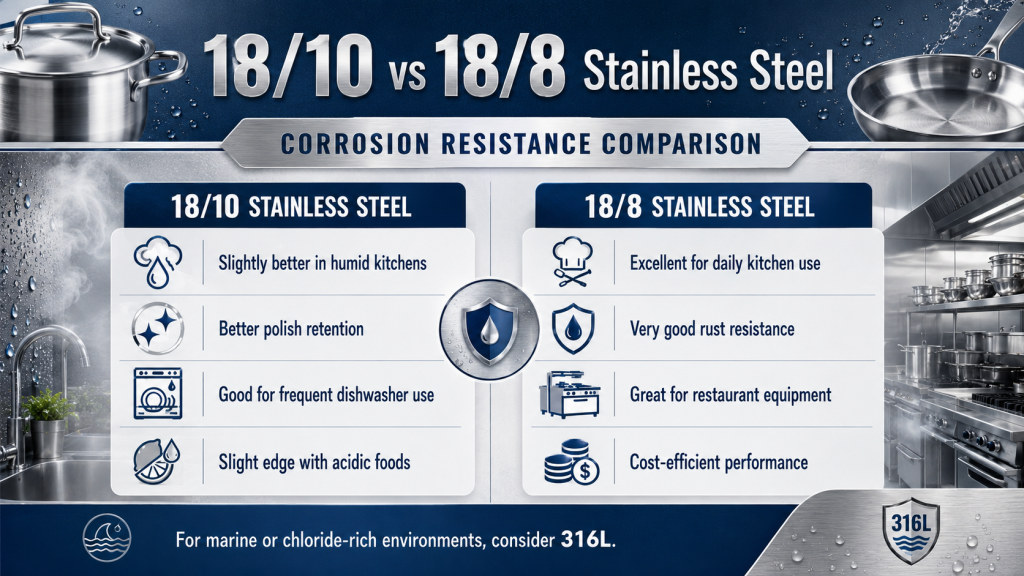
Both 18/10 and 18/8 stainless steel provide excellent corrosion resistance for kitchen, restaurant and food-contact applications. In normal daily use, most users will not notice a major difference.
However, 18/10 may perform slightly better in demanding conditions such as high humidity, repeated dishwasher exposure, acidic food contact or premium kitchen environments where surface appearance must remain bright for a long time.
| Environment | Better Choice | Reason |
|---|---|---|
| Home kitchen | Both | Both provide excellent corrosion resistance for normal use |
| Restaurant equipment | Both | Both are suitable for food-service environments |
| Luxury cookware | 18/10 Stainless Steel | Slightly better surface brightness and premium positioning |
| Budget-conscious cookware | 18/8 Stainless Steel | Excellent performance at lower cost |
| High humidity kitchen | 18/10 Stainless Steel | Slightly better corrosion and stain resistance |
| Dishwasher-heavy use | 18/10 Stainless Steel | Better long-term appearance retention in demanding cleaning cycles |
| Food processing equipment | 18/8 or 18/10 Stainless Steel | Final choice depends on environment, cleaning chemicals and budget |
| Marine or chloride exposure | 316L or higher-grade stainless steel | 18/10 and 18/8 may not be enough for strong chloride environments |
5. Food Safety and Kitchen Performance
Both 18/10 and 18/8 stainless steel are widely used in food-contact products. They are valued because they are durable, cleanable, non-reactive in normal kitchen use and resistant to many common food environments.
18/10 is often marketed as a premium choice for high-end cookware and luxury flatware. 18/8 is widely used because it offers nearly the same practical performance with better cost control.
Kitchen Performance Comparison
| Kitchen Factor | 18/10 Stainless Steel | 18/8 Stainless Steel |
|---|---|---|
| Food Safety | Excellent | Excellent |
| Cleanability | Excellent | Excellent |
| Acidic Food Resistance | Slightly better | Very good |
| Dishwasher Durability | Slightly better | Very good |
| Surface Brightness | Slightly brighter | Bright and attractive |
| Long-Term Appearance | Slightly better | Very good |
| Practical Difference | Small but useful for premium products | Small difference in most daily use |
6. Appearance and Surface Finish
Appearance is one of the reasons 18/10 stainless steel is often used in premium tableware and cookware. The slightly higher nickel content can improve polish retention and create a brighter, more refined visual impression.
18/8 stainless steel also provides an attractive surface and is widely used in restaurants, kitchens and food equipment. For most users, the visual difference between 18/10 and 18/8 is not obvious unless the product is positioned as premium or luxury.
| Surface Factor | 18/10 Stainless Steel | 18/8 Stainless Steel |
|---|---|---|
| Initial Brightness | Slightly brighter | Bright |
| Polish Retention | Slightly better | Very good |
| Luxury Appearance | More commonly used | Suitable for standard premium products |
| Stain Resistance | Slightly better | Very good |
| Common Finish Options | Mirror, polished, satin, brushed | Mirror, polished, satin, brushed |
Jude Steel supplies stainless steel products with multiple surface options through stainless steel sheet, stainless steel coil and stainless steel strip. Surface options can include 2B, BA, No.4, HL and mirror finishes depending on product specification.
7. Strength, Formability and Fabrication
Because 18/10 and 18/8 stainless steel are both typically linked to 304-family austenitic stainless steel, their mechanical behavior is very similar. Both offer good ductility, formability, toughness and weldability.
For most manufacturing projects, the choice between 18/10 and 18/8 is less about strength and more about corrosion resistance, appearance, product positioning and cost.
| Fabrication Factor | 18/10 Stainless Steel | 18/8 Stainless Steel |
|---|---|---|
| Formability | Excellent | Excellent |
| Weldability | Excellent | Excellent |
| Deep Drawing | Good depending on grade and temper | Good depending on grade and temper |
| Polissage | Excellent | Excellent |
| Brossage | Excellent | Excellent |
| Découpe au laser | Good with proper process control | Good with proper process control |
| Practical Difference | Very small | Very small |
For custom stainless steel processing, Jude Steel offers services such as laser cutting, bending, brushing and polishing.
8. Cost Comparison
Cost is one of the clearest differences between 18/10 and 18/8 stainless steel. Nickel is an important cost factor in stainless steel. Since 18/10 contains slightly more nickel, it is usually slightly more expensive.
For premium cookware and luxury tableware, the higher cost of 18/10 may be justified by product positioning and appearance. For large-volume kitchenware, restaurant equipment and general food applications, 18/8 can provide excellent value.
| Cost Factor | 18/10 Stainless Steel | 18/8 Stainless Steel |
|---|---|---|
| Raw Material Cost | Slightly higher | Slightly lower |
| Nickel Cost Exposure | Higher | Lower |
| Premium Product Value | Strong | Good |
| Large-Volume Production | Higher total cost | Better cost efficiency |
| Lifecycle Value | Best for premium and high-humidity use | Best for balanced performance and price |
9. Typical Applications
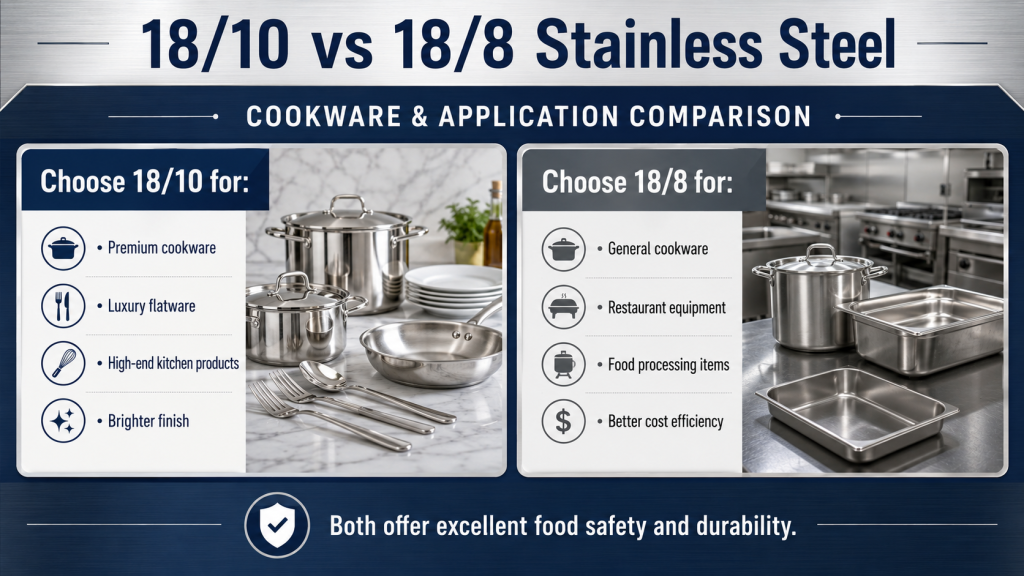
Best Applications for 18/10 Stainless Steel
- Premium cookware
- Luxury flatware and cutlery
- High-end restaurant equipment
- Hotel buffet systems
- Premium kitchen utensils
- Products requiring a brighter finish
- Humid kitchen environments
- Long-life consumer products
Best Applications for 18/8 Stainless Steel
- General cookware
- Restaurant kitchen equipment
- Food processing machinery
- Mixing bowls and trays
- Food storage containers
- Household kitchenware
- Cost-sensitive food-contact products
- Large-volume stainless steel production
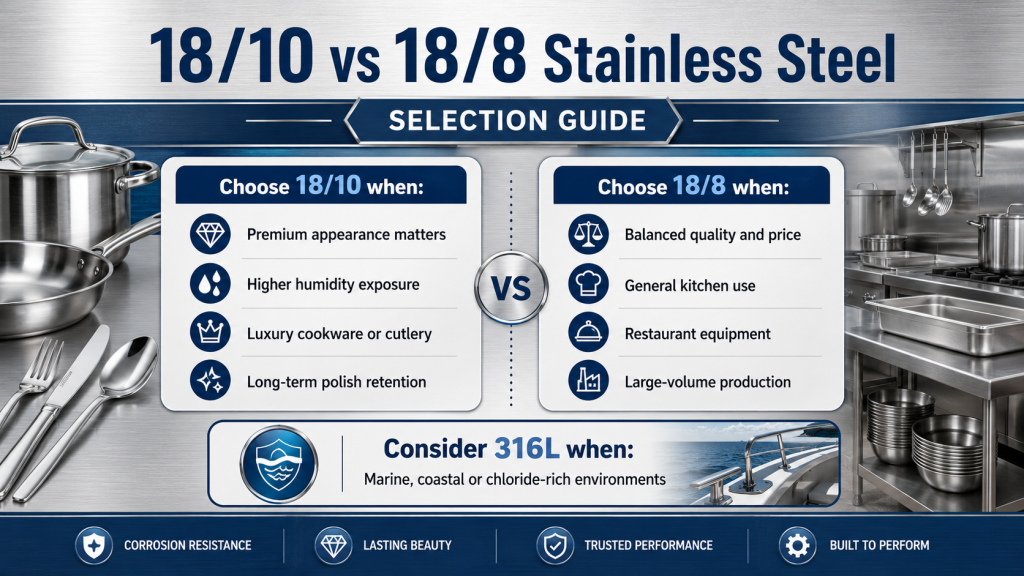
10. 18/10 vs 18/8 Stainless Steel: Selection Guide
| Project Requirement | Recommended Material | Reason |
|---|---|---|
| Luxury cookware | 18/10 Stainless Steel | Premium positioning, brightness and slightly better corrosion resistance |
| General cookware | 18/8 Stainless Steel | Excellent performance with better cost efficiency |
| High-end cutlery | 18/10 Stainless Steel | Better polish retention and premium market perception |
| Restaurant equipment | 18/8 or 18/10 Stainless Steel | Both work well; final choice depends on budget and appearance |
| Food processing equipment | 18/8 or 18/10 Stainless Steel | Both are suitable in many food-contact environments |
| Cost-sensitive kitchenware | 18/8 Stainless Steel | Lower nickel cost while maintaining excellent performance |
| Humid or dishwasher-heavy use | 18/10 Stainless Steel | Slightly better long-term appearance and stain resistance |
| Marine or chloride-rich environment | 316L Stainless Steel | Better chloride resistance than 18/10 or 18/8 |
Choose 18/10 Stainless Steel If:
- You want premium product positioning
- Appearance and polish retention matter
- The product will be used in high-humidity kitchens
- The product is luxury cookware or high-end cutlery
- You want slightly better corrosion resistance
- The higher cost is acceptable
- Brand perception is important
Choose 18/8 Stainless Steel If:
- You want excellent performance at a lower cost
- The product is used in normal kitchen or restaurant conditions
- Large-volume production cost matters
- The performance difference of 18/10 is not necessary
- The product is general cookware, food tray, bowl or kitchen equipment
- You need a strong balance of quality and price
- Appearance requirements are good but not luxury-grade
Consider Other Grades If:
- 316L is needed for marine, coastal or high-chloride environments
- 430 is needed for lower-cost magnetic kitchen or appliance applications
- 201 or 202 is considered for low-cost indoor decorative applications
- 2205 duplex is required for higher strength and chloride resistance
- 304L is needed for improved weldability in selected fabrication projects
11. Common Buyer Mistakes to Avoid
- Assuming 18/10 is always much better than 18/8
- Choosing only by marketing label without confirming actual grade
- Using 18/10 or 18/8 in marine environments where 316L is more suitable
- Comparing only nickel content and ignoring surface finish
- Ignoring cleaning environment, dishwasher exposure and acidic food contact
- Paying more for 18/10 when 18/8 is sufficient
- Using magnetic test results alone to judge stainless steel quality
- Not checking material certificates, thickness and surface finish before purchase
The correct choice should consider nickel content, corrosion environment, cleaning method, surface finish, product positioning, budget and expected service life.
Frequently Asked Questions
What is the main difference between 18/10 and 18/8 stainless steel?
18/10 stainless steel typically contains about 18% chromium and 10% nickel, while 18/8 stainless steel typically contains about 18% chromium and 8% nickel. The extra nickel in 18/10 can slightly improve corrosion resistance, brightness and long-term appearance.
Is 18/10 stainless steel better than 18/8?
18/10 is slightly better in corrosion resistance, polish retention and premium appearance. However, 18/8 already provides excellent performance for most cookware, restaurant equipment and food-contact applications.
Are 18/10 and 18/8 stainless steel food safe?
Yes. Both 18/10 and 18/8 stainless steel are widely used in cookware, cutlery, kitchenware and food equipment when properly manufactured and maintained.
Does 18/8 stainless steel rust?
18/8 stainless steel has very good rust resistance, but it can still corrode under extreme conditions such as salt exposure, acidic residues, poor cleaning or chloride-rich environments.
Which is better for cookware, 18/10 or 18/8?
18/10 is often preferred for premium cookware and high-end cutlery. 18/8 is excellent for general cookware and restaurant equipment where cost efficiency matters.
Is 18/10 stainless steel magnetic?
18/10 stainless steel is usually non-magnetic in annealed condition because it is typically austenitic stainless steel. It may become slightly magnetic after cold working or forming.
Which is more expensive, 18/10 or 18/8 stainless steel?
18/10 stainless steel is usually slightly more expensive because it contains more nickel. 18/8 stainless steel is often more cost-effective while still offering excellent performance.
Conclusion
18/10 and 18/8 stainless steel are both high-quality stainless materials commonly used in cookware, cutlery, kitchen equipment and food-contact products. Their main difference is nickel content. 18/10 contains slightly more nickel, which can provide slightly better corrosion resistance, brightness and polish retention.
18/8 stainless steel remains an excellent choice for most applications. It provides strong corrosion resistance, food safety, clean appearance and better cost efficiency. For many buyers, the practical difference between 18/10 and 18/8 is small.
Choose 18/10 stainless steel for premium cookware, luxury cutlery and high-end kitchen products. Choose 18/8 stainless steel for general cookware, restaurant equipment and cost-effective food-contact applications. Jude Steel supplies stainless steel sheets, coils, strips and customized processing services for global buyers. Explore more at Judesteel.com, or visit our product pages for stainless steel sheet, stainless steel coil and stainless steel strip.
