
18-10 vs 18-0 Stainless Steel: Corrosion Resistance, Food Safety, Magnetism & Cost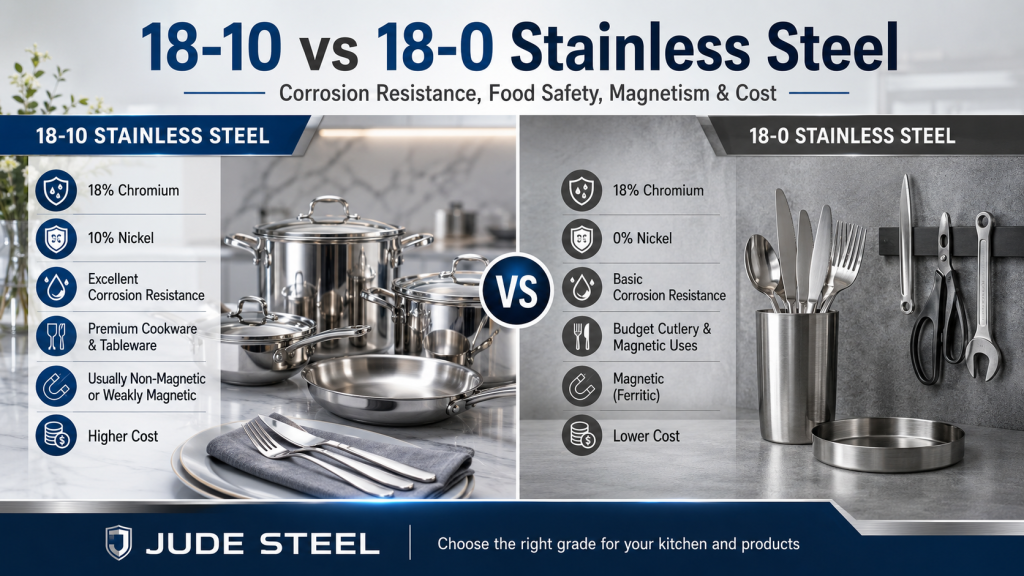
When comparing 18-10 vs 18-0 stainless steel, the key difference is nickel content. Both materials contain chromium, but 18-10 stainless steel contains nickel while 18-0 stainless steel contains little to no nickel. This creates major differences in corrosion resistance, food-contact performance, appearance, magnetism, cost and long-term durability.
18-10 stainless steel is commonly associated with premium cookware, high-end cutlery, hotel kitchenware and food processing equipment. 18-0 stainless steel is widely used in budget cutlery, magnetic kitchenware, appliance panels, induction-compatible cookware bases and cost-sensitive consumer products.
This guide explains the real differences between 18-10 and 18-0 stainless steel, including chemical composition, corrosion resistance, magnetism, surface finish, food safety, fabrication, cost and application selection. For related material information, visit 304 Stainless Steel, 430 Stainless Steel and the Jude Steel Stainless Steel Grade Center.
Fast Comparison: 18-10 vs 18-0 Stainless Steel
| Feature | 18-10 Stainless Steel | 18-0 Stainless Steel |
|---|---|---|
| Meaning | About 18% chromium and 10% nickel | About 18% chromium and little to no nickel |
| Typical Stainless Steel Family | 300-series austenitic stainless steel, commonly 304-family | 400-series ferritic stainless steel, commonly similar to 430-family |
| Nickel Content | High | Very low or none |
| Corrosion Resistance | Excellent for kitchen, food and humid environments | Moderate; best for dry or lower-corrosion environments |
| Rust Resistance | Strong | Lower than 18-10 |
| Magnetism | Usually non-magnetic or weakly magnetic after forming | Magnetic |
| Surface Appearance | Brighter, smoother and more premium | More economical, slightly duller appearance |
| Cost | Higher because of nickel content | Lower because nickel is reduced or removed |
| Typical Applications | Premium cookware, tableware, food equipment, hotel kitchenware | Budget cutlery, induction bases, appliance panels, magnetic kitchen accessories |
1. What Does 18-10 Stainless Steel Mean?
18-10 stainless steel means the material contains approximately 18% chromium and 10% nickel. In most cookware and tableware markets, 18-10 is commonly linked to premium 304-family austenitic stainless steel.
Chromium helps create a protective passive layer on the surface. Nickel improves corrosion resistance, toughness, ductility, polish retention and long-term appearance. This is why 18-10 stainless steel is often selected for premium kitchen products and food-contact applications.
Main Characteristics of 18-10 Stainless Steel
- Excellent corrosion resistance in kitchen and food environments
- Better resistance to moisture, acidic foods and cleaning chemicals
- Premium surface brightness and polish retention
- Good toughness and ductility
- Suitable for high-end cookware, cutlery and hotel kitchenware
- Usually non-magnetic in annealed condition
- Higher cost due to nickel content
Typical 18-10 Stainless Steel Applications
- Premium cookware sets
- High-end forks, spoons and knives
- Hotel buffet equipment
- Restaurant kitchenware
- Food preparation surfaces
- Food processing equipment
- Medical and laboratory items where cleanability matters
- Decorative kitchen and dining products
2. What Does 18-0 Stainless Steel Mean?
18-0 stainless steel means the material contains approximately 18% chromium and little to no nickel. It is commonly associated with ferritic stainless steel, often similar to 430 stainless steel in market applications.
Because nickel is expensive, removing nickel can significantly reduce material cost. However, lower nickel content also means that 18-0 stainless steel generally has lower corrosion resistance, lower long-term polish retention and higher sensitivity to moisture or acidic environments compared with 18-10 stainless steel.
Main Characteristics of 18-0 Stainless Steel
- Lower cost than 18-10 stainless steel
- Magnetic due to ferritic structure
- Good basic corrosion resistance in dry environments
- Useful for induction cookware base layers
- Suitable for budget cutlery and consumer products
- More sensitive to moisture, salt and acidic foods than 18-10
- May develop surface rust if used in unsuitable environments
Typical 18-0 Stainless Steel Applications
- Budget cutlery
- Economy kitchen utensils
- Magnetic kitchen accessories
- Induction cookware base layers
- Appliance panels
- Interior decorative panels
- Food trays for lower-corrosion use
- Cost-sensitive household products
3. Chemical Composition Comparison
The performance difference between 18-10 and 18-0 stainless steel starts with chemical composition. Both materials rely on chromium for basic stainless behavior, but 18-10 contains nickel while 18-0 removes nickel for cost control and magnetism.
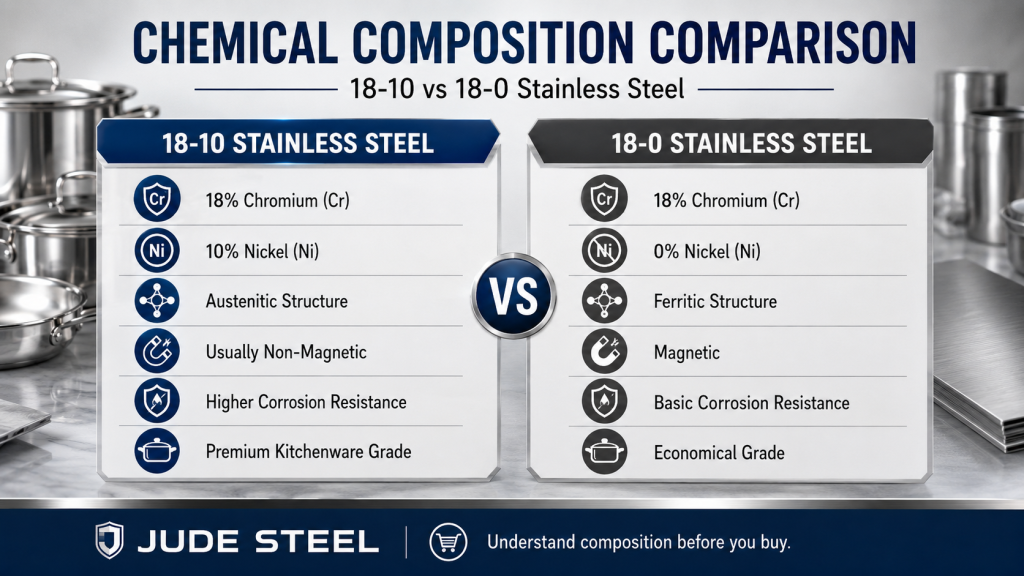
| Element / Feature | 18-10 Stainless Steel | 18-0 Stainless Steel |
|---|---|---|
| Chromium | Approximately 18% | Approximately 18% |
| Nickel | Approximately 10% | Little to no nickel |
| Typical Structure | Austenitic | Ferritic |
| Magnetism | Usually non-magnetic or weakly magnetic after forming | Magnetic |
| Cost Driver | Higher nickel content increases cost | Nickel-free design reduces cost |
| Primary Design Goal | Premium corrosion resistance, appearance and durability | Economy, magnetism and basic stainless performance |
Why Nickel Matters
Nickel improves corrosion resistance, ductility, toughness and surface stability. This is why 18-10 stainless steel usually performs better in humid kitchens, dishwasher use, acidic food contact and long-term food-service applications.
4. Corrosion Resistance Comparison
Corrosion resistance is the most important difference between 18-10 and 18-0 stainless steel. 18-10 stainless steel performs better in humid kitchens, food-contact environments, dishwashing conditions and long-term water exposure.
18-0 stainless steel can perform well in dry and lower-corrosion environments, but it is more likely to show rust spots, staining or discoloration when exposed to moisture, salt, acidic foods or aggressive cleaning conditions.
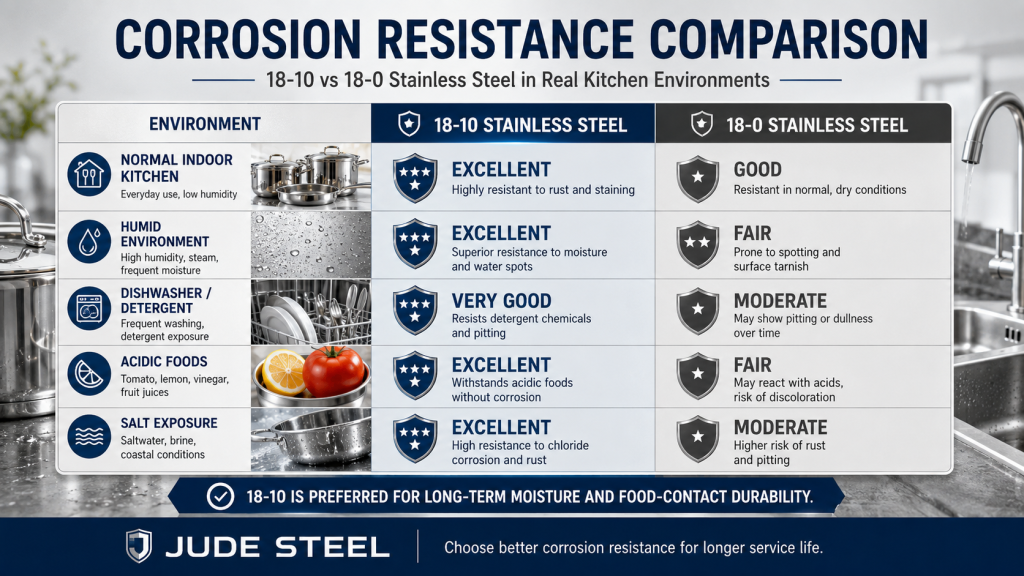
| Environment | Better Choice | Reason |
|---|---|---|
| Premium cookware | 18-10 Stainless Steel | Better corrosion resistance, polish retention and long-term durability |
| Restaurant kitchen | 18-10 Stainless Steel | Handles moisture, cleaning and food contact more reliably |
| Budget cutlery | 18-0 Stainless Steel | Lower cost and acceptable performance for basic use |
| Humid kitchen environment | 18-10 Stainless Steel | Lower risk of rust spots and staining |
| Dishwasher exposure | 18-10 Stainless Steel | Better resistance to water, detergent and repeated washing |
| Dry indoor use | 18-0 Stainless Steel | Cost-effective when corrosion exposure is low |
| Acidic food contact | 18-10 Stainless Steel | Nickel-containing austenitic stainless steel is generally more stable |
5. Magnetism Difference
Magnetism is a major buying factor in cookware, kitchen tools and appliance systems. 18-10 stainless steel is usually non-magnetic or only weakly magnetic after forming. 18-0 stainless steel is magnetic because it is typically ferritic.
This difference matters for induction cooktops, magnetic holders, magnetic knife racks and kitchen accessories. A magnetic stainless steel layer is often used in cookware bases to improve induction compatibility.
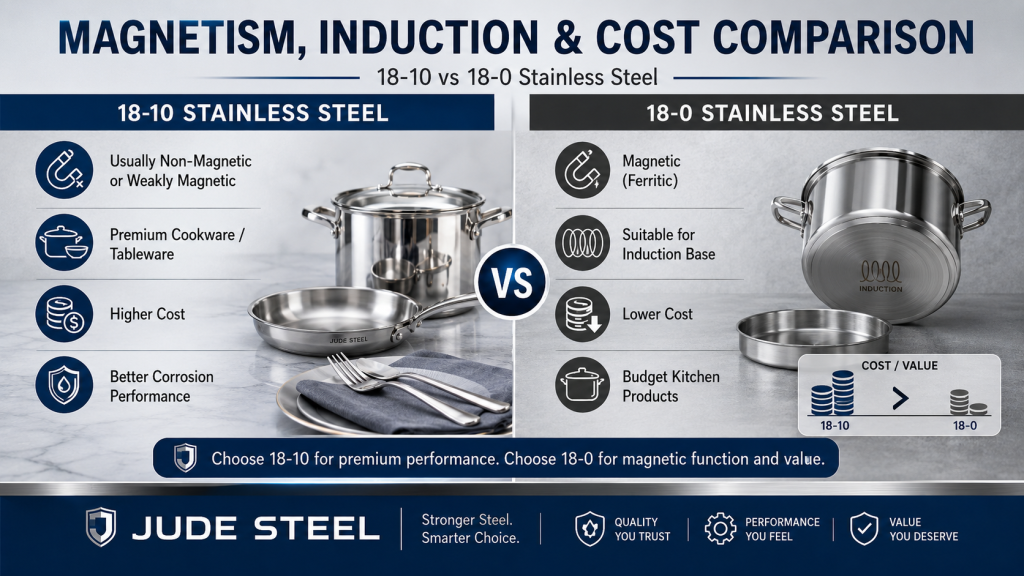
| Magnetic Feature | 18-10 Stainless Steel | 18-0 Stainless Steel |
|---|---|---|
| Magnetic Response | Usually non-magnetic or weakly magnetic | Magnetic |
| Induction Compatibility | Usually needs a magnetic base layer | Works well as a magnetic layer |
| Kitchen Magnetic Holders | Not ideal | Suitable |
| Structure | Austenitic | Ferritic |
| Practical Advantage | Premium corrosion and appearance performance | Magnetic function and cost control |
Practical Insight
- Premium cookware often uses 18-10 stainless steel for the food-contact surface.
- Induction cookware may use 18-0 or another magnetic stainless layer at the base.
- Magnetism does not mean the material is fake; it often indicates ferritic stainless steel.
- Material choice should be based on function, not only magnet testing.
6. Appearance and Surface Finish
18-10 stainless steel usually offers a brighter and more premium appearance. It holds polish better and is widely used in high-end tableware, hotel dining equipment and decorative kitchen products.
18-0 stainless steel can also be polished or brushed, but it may appear slightly duller over time and can be more sensitive to scratches, water marks and staining in demanding kitchen environments.
| Surface Factor | 18-10 Stainless Steel | 18-0 Stainless Steel |
|---|---|---|
| Initial Appearance | Bright, premium and smooth | Good but often less premium |
| Polish Retention | Better | Moderate |
| Stain Resistance | Better | Lower in humid or acidic environments |
| Fingerprint Visibility | Depends on finish | Depends on finish |
| Common Finish Options | Polished, brushed, mirror, satin | Brushed, polished, 2B, BA depending on product |
Jude Steel supplies stainless steel products with multiple surface options through stainless steel sheet, stainless steel coil and stainless steel strip. Available surface options can include 2B, BA, No.4, HL and mirror-type finishes depending on product specification.
7. Food Safety and Kitchen Use
Both 18-10 and 18-0 stainless steel can be used in kitchen products when properly manufactured and applied in suitable environments. However, 18-10 is usually preferred for higher-end food-contact applications because it provides better resistance to corrosion, staining and repeated cleaning.
18-0 is widely used for budget cutlery, magnetic bases and basic kitchen products. It can be appropriate when the environment is dry, the product life expectation is moderate and cost control is important.
| Kitchen Application | Recommended Material | Reason |
|---|---|---|
| Premium cookware inner surface | 18-10 Stainless Steel | Better food-contact corrosion resistance and durability |
| Hotel buffet equipment | 18-10 Stainless Steel | Better appearance retention and cleaning durability |
| Economy cutlery | 18-0 Stainless Steel | Lower cost and acceptable basic performance |
| Induction cookware bottom layer | 18-0 Stainless Steel | Magnetic response supports induction heating |
| Dishwasher-heavy use | 18-10 Stainless Steel | Better resistance to moisture and detergent cycles |
| Magnetic kitchen accessories | 18-0 Stainless Steel | Ferritic structure provides magnetic functionality |
8. Strength, Durability and Service Life
18-10 stainless steel generally provides better toughness, ductility and corrosion durability. This makes it suitable for long-term use in premium cookware, tableware and food-service products.
18-0 stainless steel offers useful strength and magnetic functionality, but its durability depends strongly on environment and maintenance. In dry and low-corrosion settings, it can perform well. In wet or acidic environments, the service life may be shorter than 18-10.
| Durability Factor | 18-10 Stainless Steel | 18-0 Stainless Steel |
|---|---|---|
| Long-Term Corrosion Durability | Excellent | Moderate |
| Toughness | Higher | Moderate |
| Ductility | Excellent | Moderate |
| Scratch Aging | Better surface stability | More visible aging in harsh use |
| Best Service Condition | Humid, food-contact and premium-use environments | Dry, cost-sensitive and magnetic-function applications |
9. Cost Comparison
Cost is one of the clearest differences between 18-10 and 18-0 stainless steel. Nickel is a major cost factor. Because 18-10 contains nickel, it is usually more expensive. Because 18-0 contains little to no nickel, it is usually more economical.
| Cost Factor | 18-10 Stainless Steel | 18-0 Stainless Steel |
|---|---|---|
| Raw Material Cost | Higher | Lower |
| Nickel Cost Exposure | High | Very low |
| Long-Term Maintenance Risk | Lower in humid kitchens | Higher if used in wet or acidic environments |
| Best Cost Scenario | Premium products requiring long service life | Budget products requiring magnetic function or low cost |
| Lifecycle Value | Better when corrosion resistance and appearance matter | Better when dry use and low cost are the priority |
10. 18-10 vs 18-0 Stainless Steel: Selection Guide
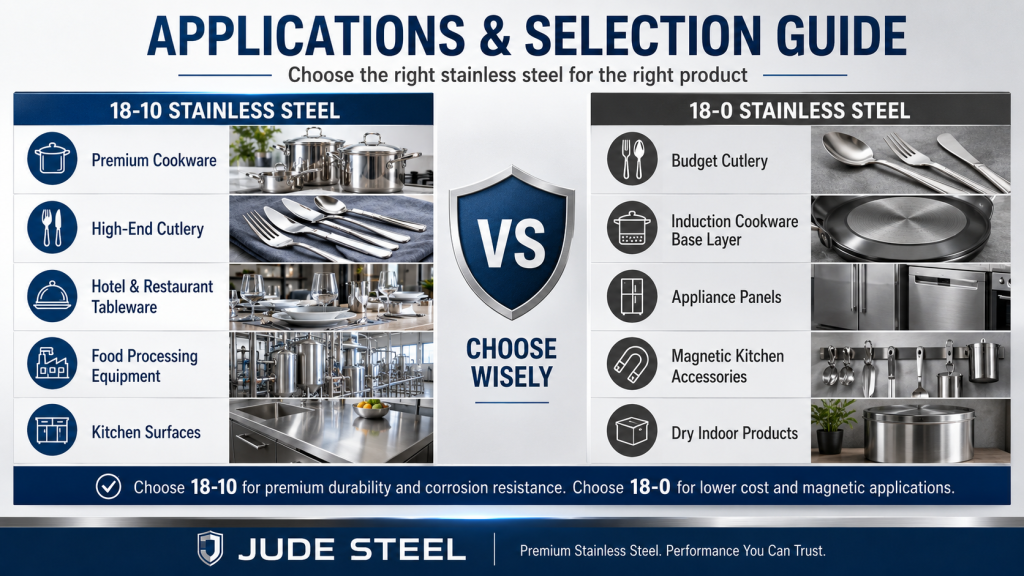
| Project Requirement | Recommended Material | Reason |
|---|---|---|
| Premium cookware | 18-10 Stainless Steel | Better corrosion resistance, polish retention and durability |
| Budget cutlery | 18-0 Stainless Steel | Lower cost and acceptable basic function |
| Food processing equipment | 18-10 Stainless Steel | Better hygiene and cleaning durability |
| Induction cookware base | 18-0 Stainless Steel | Magnetic structure supports induction heating |
| Humid kitchen environment | 18-10 Stainless Steel | Lower rust and staining risk |
| Dry indoor consumer products | 18-0 Stainless Steel | Cost-effective for lower-corrosion conditions |
| Luxury tableware | 18-10 Stainless Steel | Better appearance and long-term surface stability |
| Magnetic accessories | 18-0 Stainless Steel | Ferritic stainless steel provides magnetic response |
Choose 18-10 Stainless Steel If:
- You want premium product quality
- Corrosion resistance is important
- The product will contact food frequently
- The product will be washed often or used in humid kitchens
- Appearance and polish retention matter
- Long-term durability is required
- The product is cookware, tableware, hotel kitchenware or food equipment
Choose 18-0 Stainless Steel If:
- Budget is the main priority
- Magnetic properties are needed
- The environment is dry or low-corrosion
- The product is economy cutlery or basic kitchenware
- The product needs induction compatibility as a base layer
- Short-to-medium service life is acceptable
- Lower nickel cost is important
Consider Other Stainless Steel Grades If:
- 304 is needed for general food-grade and kitchen equipment applications
- 316L is required for stronger chloride or marine corrosion resistance
- 430 is suitable for lower-cost magnetic decorative or appliance applications
- 201 or 202 may be considered for cost-sensitive indoor decorative uses
- Duplex stainless steel is needed for higher strength and chloride resistance
11. Common Buyer Mistakes to Avoid
- Assuming 18-10 and 18-0 have the same corrosion resistance
- Choosing 18-0 only because it looks similar to 18-10 when new
- Using 18-0 in humid or acidic food-contact environments without evaluation
- Assuming magnetism means poor quality
- Ignoring nickel content when comparing long-term durability
- Choosing 18-10 for magnetic function without checking induction compatibility
- Comparing only price without considering replacement and maintenance cost
- Not confirming the actual grade, certificate and surface finish before purchase
Correct material selection should consider nickel content, corrosion environment, food-contact requirements, magnetism, surface finish, product positioning, expected service life and total cost.
Frequently Asked Questions
What is the main difference between 18-10 and 18-0 stainless steel?
18-10 stainless steel contains about 18% chromium and 10% nickel. 18-0 stainless steel contains about 18% chromium and little to no nickel. Nickel gives 18-10 better corrosion resistance, durability and premium appearance, while 18-0 is more economical and magnetic.
Is 18-10 better than 18-0 stainless steel?
18-10 is generally better for corrosion resistance, food-contact reliability, surface brightness and long-term durability. 18-0 is better when low cost and magnetic properties are more important.
Does 18-0 stainless steel rust?
18-0 stainless steel can develop surface rust more easily than 18-10, especially in humid, salty, acidic or poorly maintained environments. It performs best in dry and lower-corrosion applications.
Is 18-10 stainless steel food safe?
18-10 stainless steel is widely used in premium cookware, tableware and food equipment because it offers strong corrosion resistance, cleanability and long-term surface stability.
Why is 18-0 stainless steel magnetic?
18-0 stainless steel is usually ferritic stainless steel. Ferritic stainless steels have a magnetic structure, making 18-0 suitable for induction-compatible base layers and magnetic kitchen accessories.
Which stainless steel is better for induction cookware?
18-0 stainless steel works well as a magnetic base layer for induction cookware. Premium cookware may use 18-10 stainless steel on the food-contact surface and a magnetic stainless steel layer at the base.
Which is cheaper, 18-10 or 18-0 stainless steel?
18-0 stainless steel is usually cheaper because it contains little to no nickel. 18-10 stainless steel costs more because nickel improves corrosion resistance, ductility and long-term appearance.
Conclusion
18-10 and 18-0 stainless steel are both widely used in cookware, cutlery, kitchenware and consumer products, but they are designed for different priorities. 18-10 stainless steel focuses on premium corrosion resistance, food-contact reliability, surface appearance and long-term durability. It is the better choice for high-end cookware, hotel kitchenware, food equipment and products exposed to moisture or repeated cleaning.
18-0 stainless steel focuses on affordability and magnetic properties. It is useful for budget cutlery, induction cookware base layers, magnetic kitchen accessories, appliance panels and dry indoor applications where severe corrosion resistance is not required.
The best choice depends on application, environment and product positioning. Choose 18-10 for premium performance and long service life. Choose 18-0 for cost control and magnetic functionality. Jude Steel supplies stainless steel sheets, coils, strips and customized processing services for global buyers. Explore more at Judesteel.com, or visit our product pages for stainless steel sheet, stainless steel coil and stainless steel strip.
