
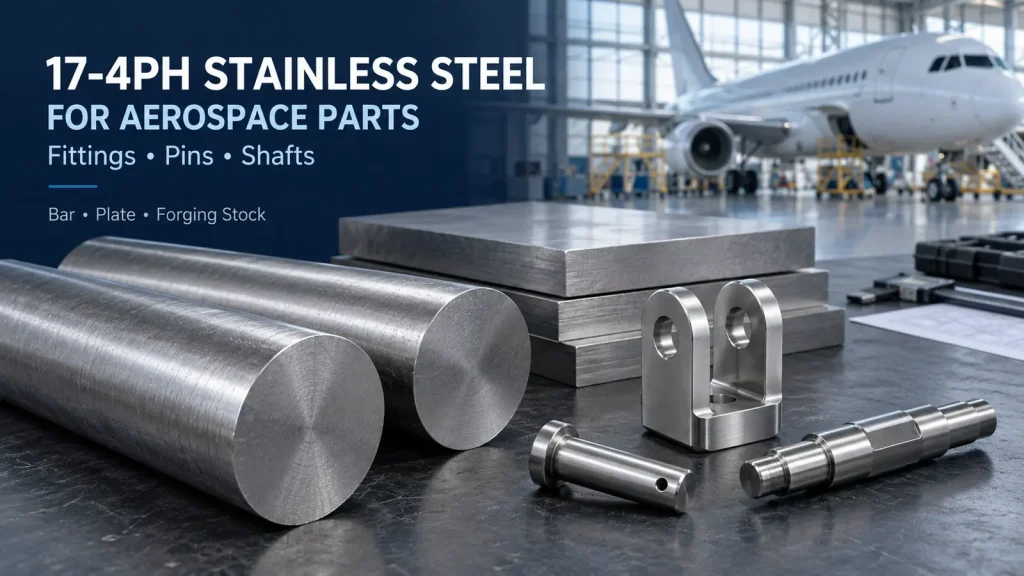
 17-4PH Stainless Steel for Aerospace Parts: Fittings, Pins and Shafts
The purchasing task is to connect a finished-part drawing with the correct material specification, starting form and delivery condition. A request for “aerospace-grade 17-4PH” leaves important acceptance requirements undefined.
Start with the drawing: these are application families to evaluate, not a list of parts that universally require 17-4PH. The aircraft or equipment designer determines the approved alloy, product form, heat treatment and qualification requirements.
Which Aerospace Parts Can Use 17-4PH Stainless Steel?
17-4PH is identified as UNS S17400, also known as Type 630. Carpenter Technology lists aircraft fittings among the applications for its Custom 630 material. The following component-to-stock mapping is a procurement guide for designs that specify S17400; it does not identify a particular aircraft program or claim JUDE supplies flight-approved finished parts.
| Component family | Possible starting stock | Important drawing or purchase detail |
|---|---|---|
| Clevises, lugs and attachment fittings | Bar, plate or specified forging | Stock route, grain orientation and final heat-treated condition |
| Pivot pins, hinge pins and locking hardware | Round bar or approved preform | Finished diameter, shear or bearing requirements and surface finish |
| Special bolts, studs and other fasteners | Bar, wire or heading stock, as specified | Fastener specification, forming route, thread processing and inspection |
| Actuator shafts and mechanical couplings | Round bar or specified forging | Torque, fatigue assessment, straightness and machining allowance |
| Valve stems and selected fluid-system hardware | Bar or approved forging | Fluid compatibility, pressure-cycle requirements and sealing surfaces |
| Assembly fixtures and ground-support locating parts | Bar or plate | Tooling duty, wear surfaces and separation from flight-part requirements |
Aircraft Fittings: Clevises, Lugs and Attachment Hardware
Fittings connect one assembly to another, often through holes, pins or threaded interfaces. When a fitting drawing specifies 17-4PH, buyers should identify whether the part is to be machined from bar, cut from plate or produced from a forging.
A plate blank and a forging with similar external dimensions are not automatically interchangeable. Ask whether the drawing controls grain direction, test orientation or the manufacturing route before comparing quotations. For a plate-cut lug, mark the required orientation on the nesting drawing and preserve it through cutting.
Pins and Locking Components
Round bar is a practical starting form for cylindrical pins and locking components when the specification permits it. The stock schedule should distinguish the purchased diameter from the final ground or machined diameter.
For a pin associated with a landing-gear or actuation assembly, identify the exact part and drawing revision. “Landing gear material” is too broad: requirements for a small pin cannot be extended to a main structural member. Include the specified condition, surface treatment and dimensional acceptance stage.
Special Fasteners
17-4PH can enter a fastener manufacturing route as approved bar, wire or heading stock. A machined stud and an upset-head bolt may begin with different stock and processing requirements even when both reference S17400.
Separate the raw-material specification from the finished-fastener specification. The latter may control head formation, thread rolling, heat treatment, surface processing and tests. A compliant bar certificate alone does not qualify a finished bolt for installation.
Actuator Shafts and Couplings
For designs using 17-4PH shafts or couplings, send the stock supplier the required starting size and the component manufacturer the complete functional drawing. Splines, cross-holes, shoulders and threads should be considered in the component’s engineering assessment.
Agree where finish machining or grinding sits in the manufacturing sequence. The purchase specification should state straightness and surface requirements for the supplied stock, while the component drawing defines the final fits. These are separate acceptance stages.
Valve Stems and Fluid-System Components
Selected stems, spindles and associated hardware may use 17-4PH where the design requires its strength and the service environment is suitable. A material choice for the stem does not establish the alloy for the valve body, seat or every wetted surface.
Identify the actual fluid, operating conditions, sealing interfaces and required verification. For an aerospace hydraulic or fuel-system purchase, provide the governing component specification rather than relying on a generic “corrosion-resistant stainless steel” description.
Tooling and Ground-Support Parts
Locating pins, fixture blocks and maintenance-tool components are a separate purchasing category. A shop may evaluate 17-4PH for these parts even when the tool never flies.
State whether the order is for flight hardware, production tooling, a test rig or ground-support equipment. That distinction helps the supplier identify the applicable documentation and approval requirements without assuming every aerospace-related order has the same scope.
Bar, Plate or Forging: Choose the Starting Form Before Comparing Price
Round bar is often convenient for turned parts. Request diameter tolerance, length, surface condition and any allowance needed for downstream machining. A finished shaft diameter should not be copied directly into a stock order without reviewing that allowance.
Plate or flat stock may suit approved machined fittings and fixture components. Specify thickness, flatness where required, blank dimensions and orientation. If cut blanks are requested, identify edge condition and clean-up allowance. JUDE’s water jet cutting service page provides a starting point for discussing a proposed cutting scope; drawing-specific capability must be confirmed.
Forgings and forging stock require a clear distinction. Material intended for later forging is not the same deliverable as an inspected finished forging. Identify the responsible forge shop, required route, test stage and material identification transferred to the next operation.
Compare quotations on the same basis: usable stock size, quantity, material condition, tests, processing and documentation. A lower price per kilogram may be offset by greater machining waste or additional qualification work. Any change of product form needs the buyer’s technical approval.
17-4PH Aerospace Specifications: AMS 5643, AMS 5604 and ASTM
S17400 identifies the alloy; it is not a complete purchase specification. Select the document appropriate to the product form and quote the revision required by the drawing or purchase order.
| Reference | Product scope | Purchasing distinction |
|---|---|---|
| SAE AMS 5643 | Bars, wire, forgings, mechanical tubing, flash-welded rings and specified manufacturing stock | The cited W revision covers solution-treated products within defined size limits; check the full scope. |
| SAE AMS 5604 | Sheet, strip and plate | The cited K revision covers nominal thicknesses up to 4.0 in (102 mm). This is not a JUDE stock range. |
| ASTM A564/A564M | Age-hardening stainless steel bars and shapes | Type 630 may be ordered solution-treated or age-hardened; define the actual delivery condition. |
| ASTM A693 | Precipitation-hardening plate, sheet and strip | For S17400, distinguish solution-treated delivery from tests on precipitation-hardened specimens. |
| ASTM A705/A705M | Age-hardening stainless steel forgings | A general forging specification does not, by itself, establish aircraft-program acceptance. |
An ASTM certificate is not automatically evidence of AMS compliance. If dual certification is required, ask for documented conformity to both specified documents. Likewise, an EN or JIS designation offered as a commercial equivalent needs a requirement-by-requirement review before substitution.
Specify Delivery Condition Separately from Final Part Condition
17-4PH is a martensitic precipitation-hardening stainless steel. Condition A is solution-treated material; it should not be described as soft stock ready for unrestricted service. H900, H1025 and H1150 are different aging conditions, not interchangeable quality grades.
ATI’s 17-4 technical datasheet explains the strength–toughness trade-off. Peak-strength treatment can also increase susceptibility to stress-corrosion cracking. Select the drawing-specified condition rather than the highest hardness.
Write two separate entries in the RFQ:
- Material at delivery: the actual condition of the shipped stock.
- Finished component: the required final condition, processing responsibility and acceptance tests.
An aged test specimen does not prove that the entire shipment was supplied aged. Check the certificate’s test condition against its delivery-condition statement. Producer datasheet values are reference information, not automatic acceptance minima for every product size and orientation.
Engineering Checks That a Grade Name Cannot Replace
- Fatigue and fracture: ask the responsible engineer to define applicable design data and component-level requirements. A raw-material tensile result is not a fatigue-life guarantee.
- Temperature and environment: 17-4PH is not a general-purpose hot-section turbine material. Assess actual metal temperature, exposure time and corrosion conditions. Its aging temperature is not its allowable operating temperature.
- Dimensions after processing: aging can cause dimensional change. Reserve the approved allowances and specify when final dimensions are inspected.
- Route and substitutions: bar, plate, forgings, castings and additively manufactured parts require their own applicable controls. Similar chemistry does not establish interchangeable performance.
If the drawing specifies another precipitation-hardening alloy, such as 15-5PH stainless steel, keep that requirement in the enquiry. A matching stock size is not grounds to substitute 17-4PH.
What to Include in a 17-4PH Aerospace Raw-Material RFQ
Send enough information to let the supplier identify a conforming supply route and flag any gap before the purchase order is placed:
- Part and scope: component family, drawing revision, and whether the purchase covers raw stock, cut blanks or another defined deliverable.
- Material: alloy, governing specification and revision, product form, and approved mill or melt-route requirements where applicable.
- Size: dimensions, units, tolerances, machining allowances and orientation requirements.
- Condition: actual delivery condition, required final condition and responsibility for each thermal-processing step.
- Acceptance: mandatory specification tests plus any customer-required additional tests, methods, acceptance criteria and reporting.
- Traceability: certificate requirements and the identification to remain on each bar, blank or package after cutting.
- Commercial details: quantity, release schedule, destination, requested delivery date and any buyer qualification conditions.
Example Enquiry: Bar for a Machined Aircraft Fitting
This illustrative template shows how to structure an enquiry. Complete the project-specific fields from the approved documents; it is not a production material recommendation or a JUDE customer case.
- Application: machined aircraft attachment fitting, drawing and revision attached.
- Supply scope: raw round bar, cut to the attached stock schedule.
- Alloy: 17-4PH / UNS S17400.
- Specification: AMS 5643, revision as required by the drawing.
- Delivery condition: solution-treated, subject to the ordered specification.
- Final component condition: per approved drawing; subsequent processing by the designated component manufacturer.
- Dimensions and quantity: per attached schedule, including machining allowance.
- Inspection: specification requirements and attached customer inspection plan.
- Documentation: traceable material certificate and required processing or test records.
- Supply restrictions: approved source, origin and melt route where required.
- Substitutions: submit any proposed deviation for written approval before supply.
Receiving Inspection: Keep the Certificate Connected to the Stock
Check the supplied material against the accepted quotation and purchase order. Match the heat or lot identification, grade, product form, dimensions and delivery condition to the supporting records. Review the specified results, including their test orientation and heat-treatment condition where applicable.
After stock is cut, retain the agreed identification on the resulting pieces or controlled packages. If additional heat treatment or processing is performed, link those records to the affected material. A missing traceability link should be resolved before the stock enters the next controlled operation.
Ask for evidence supporting any claimed aerospace quality-system or process approval, including its scope and validity. A supplier’s general grade listing does not establish approval for a particular aircraft program.
Frequently Asked Questions
Can an existing ASTM-only stock lot be offered for an AMS order?
It can be submitted for review, but acceptance needs evidence that the lot meets the complete ordered AMS requirements. Changing the wording on a certificate does not demonstrate compliance. Resolve any missing manufacturing or test evidence before committing the lot.
Does every aerospace 17-4PH order require vacuum remelting?
Do not infer the melt route from the alloy name or the word “aerospace.” Obtain the requirement from the governing specification and customer documents, then ask the supplier to confirm the offered material’s actual route and supporting records.
Can one mill certificate cover several cut blanks?
It may support multiple blanks from the identified parent material when the required traceability is maintained. Record how each blank or controlled package connects to that material, and verify any additional piece-level identification requirements.
Should nondestructive testing be requested simply as “UT passed”?
No. Where ultrasonic testing is required, state the applicable method, coverage, acceptance criteria and reporting requirements. Define the inspection stage and any customer approval requirement; a generic pass statement is insufficient.
What should I send if the drawing only says “17-4PH”?
Request clarification of the product specification, revision, starting form and required condition from the design authority. Send JUDE the available information for an initial supply discussion, clearly identifying what remains unresolved.
Request a 17-4PH Material Supply Review from JUDE Steel
Review JUDE Steel’s 17-4PH material page, then send the requirements for your fitting, pin, fastener, shaft or other specified component. Ask for a quotation that identifies the proposed product form, condition, documentation, delivery basis and any exceptions.
Availability of a particular AMS revision, approved source, melt route, size or inspection package must be confirmed for the enquiry. References to producer datasheets explain material behavior; they do not identify the mill supplying a JUDE order.
Send your drawing or stock schedule with:
Specification and revision + product form + delivery condition + dimensions + quantity + inspection requirements + destination.
Include approved-source and aerospace qualification requirements at the enquiry stage so they can be assessed before quotation.
Technical scope: this guide supports raw-material procurement. Final component suitability and release depend on the approved design, manufacturing route, inspections and applicable customer requirements.
