
17-4 PH vs 316 Stainless Steel: Strength, Corrosion Resistance & Industrial Applications
Stainless steel materials play a critical role in modern industrial manufacturing, aerospace engineering, marine systems, medical equipment, and precision machining. Among the many stainless steel grades available today, 17-4 PH stainless steel and 316 stainless steel are two highly respected materials widely used for demanding industrial applications.
Although both belong to the stainless steel family, they differ significantly in strength, heat treatment capability, corrosion resistance, machinability, and typical applications. Choosing the correct grade is essential for achieving long-term performance, reliability, and cost efficiency.
This guide provides a comprehensive comparison between 17-4 PH and 316 stainless steel to help engineers, fabricators, industrial buyers, and project managers make informed material selection decisions.
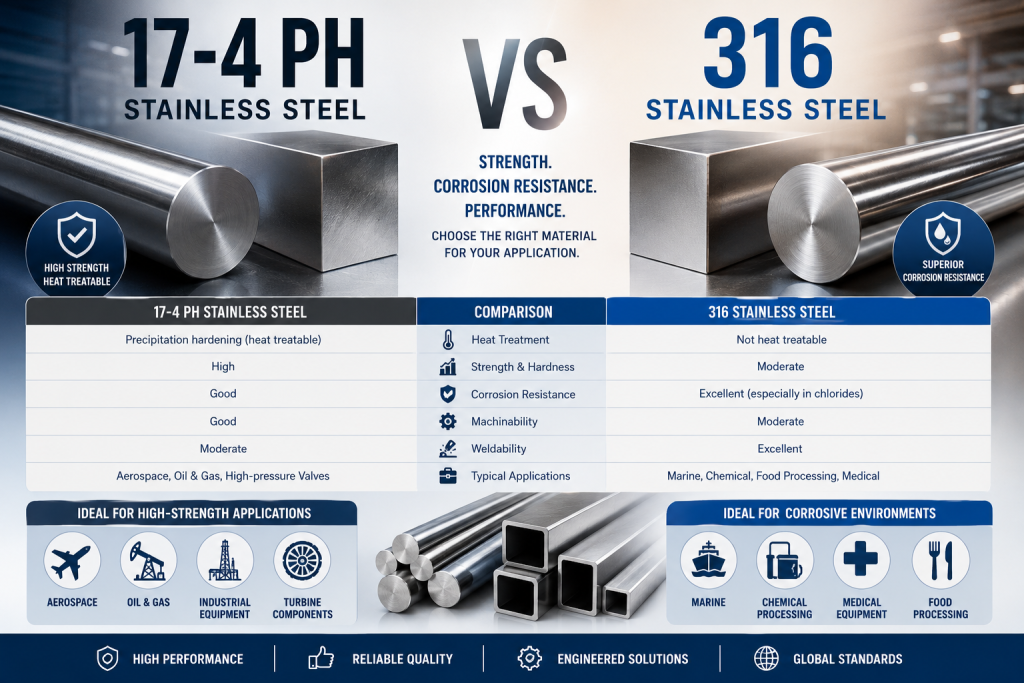
1. What Is 17-4 PH Stainless Steel?
17-4 PH stainless steel is a precipitation-hardening martensitic stainless steel containing chromium, nickel, and copper. The “PH” stands for precipitation hardening, a heat treatment process that significantly increases strength and hardness.
Typical composition:
- 15–17.5% Chromium
- 3–5% Nickel
- 3–5% Copper
- Niobium and tantalum additions
17-4 PH offers an excellent combination of:
- High strength
- Good corrosion resistance
- Excellent hardness
- Heat treatment capability
It is widely used in aerospace, energy, petrochemical, and high-performance mechanical applications.
2. What Is 316 Stainless Steel?
316 stainless steel is an austenitic stainless steel containing chromium, nickel, and molybdenum. It is one of the most commonly used corrosion-resistant stainless steel grades worldwide.
Typical composition:
- 16–18% Chromium
- 10–14% Nickel
- 2–3% Molybdenum
The addition of molybdenum significantly improves resistance to chlorides and corrosive chemicals.
316 stainless steel is known for:
- Outstanding corrosion resistance
- Excellent weldability
- Good formability
- Strong performance in marine environments
3. Strength Comparison
| Property | 17-4 PH Stainless Steel | 316 Stainless Steel |
|---|---|---|
| Résistance à la traction | Very High | Moderate |
| Yield Strength | Excellent | Lower |
| Dureté | High | Moderate |
| Heat Treatable | Yes | No |
17-4 PH stainless steel offers substantially higher strength and hardness than 316 stainless steel, especially after heat treatment.
For high-load structural or mechanical applications, 17-4 PH is often the preferred material.
4. Corrosion Resistance Comparison
316 stainless steel generally provides superior corrosion resistance compared with 17-4 PH, particularly in chloride-rich and marine environments.
316 Stainless Steel Advantages
- Excellent seawater resistance
- Superior chemical resistance
- Better pitting resistance
- Strong performance in humid environments
17-4 PH Stainless Steel Advantages
- Good atmospheric corrosion resistance
- Suitable for mild industrial environments
- Better corrosion resistance than many hardened steels
In highly corrosive environments such as offshore engineering or chemical processing systems, 316 stainless steel is generally considered more reliable.
5. Heat Treatment Capability
One of the biggest differences between these two materials is heat treatment capability.
17-4 PH Stainless Steel
17-4 PH can be precipitation hardened through controlled aging treatments such as:
- H900
- H1025
- H1150
These treatments allow engineers to optimize:
- Strength
- Dureté
- Toughness
316 Stainless Steel
316 stainless steel cannot be hardened by heat treatment. Its strength is mainly improved through cold working.
6. Weldability and Fabrication
| Feature | 17-4 PH | 316 |
|---|---|---|
| Weldability | Good | Excellent |
| Machinability | Good | Moderate |
| Formability | Lower | Excellent |
| Fabrication Ease | Moderate | Easy |
316 stainless steel is easier to fabricate, weld, and form into complex shapes, making it highly popular in architectural and food-grade industries.
17-4 PH machining is efficient in solution-treated condition but becomes harder after aging treatment.
7. Temperature Resistance
17-4 PH stainless steel performs well at moderate elevated temperatures and maintains excellent mechanical strength.
316 stainless steel offers:
- Good high-temperature oxidation resistance
- Excellent low-temperature toughness
- Stable thermal performance
The ideal choice depends on whether corrosion resistance or mechanical strength is more important at operating temperature.
8. Typical Industrial Applications
17-4 PH Stainless Steel Applications
- Aerospace components
- Turbine blades
- High-pressure valves
- Mechanical shafts
- Nuclear industry equipment
- Oil & gas systems
316 Stainless Steel Applications
- Marine equipment
- Food processing systems
- Medical devices
- Chemical storage tanks
- Architectural decoration
- Pharmaceutical equipment
9. Cost Comparison
Material cost varies depending on:
- Market nickel prices
- Heat treatment requirements
- Processing complexity
- Project specifications
Generally:
- 17-4 PH may have higher processing costs due to heat treatment
- 316 stainless steel may cost more in high-nickel market conditions
Lifecycle performance should always be considered instead of material price alone.
10. Which Material Should You Choose?
Choose 17-4 PH Stainless Steel If:
- High strength is critical
- Heat treatment capability is required
- The application involves heavy mechanical stress
- Aerospace-grade performance is needed
Choose 316 Stainless Steel If:
- Corrosion resistance is the top priority
- The environment contains chlorides or seawater
- Excellent weldability is required
- Food-grade or medical applications are involved
Frequently Asked Questions (FAQ)
Is 17-4 PH stronger than 316 stainless steel?
Yes. 17-4 PH stainless steel offers significantly higher strength and hardness than 316 stainless steel.
Which has better corrosion resistance, 17-4 PH or 316?
316 stainless steel generally provides superior corrosion resistance, especially in marine and chloride-rich environments.
Can 17-4 PH stainless steel rust?
17-4 PH has good corrosion resistance, but it is less resistant than 316 in aggressive environments.
Is 316 stainless steel heat treatable?
No. 316 stainless steel cannot be hardened through heat treatment.
Which material is better for marine applications?
316 stainless steel is typically preferred for marine applications due to its superior chloride resistance.
Conclusion: Both 17-4 PH and 316 stainless steel are exceptional engineering materials, but they serve different industrial purposes. 17-4 PH excels in high-strength, high-performance mechanical applications where heat treatment and structural reliability are critical. Meanwhile, 316 stainless steel remains the industry standard for corrosion resistance, marine environments, food processing, and hygienic applications. Understanding the differences between these two materials helps ensure optimal performance, long-term durability, and cost-effective engineering solutions.
