
Hastelloy vs Stainless Steel: Corrosion Resistance, Cost, Strength & Applications
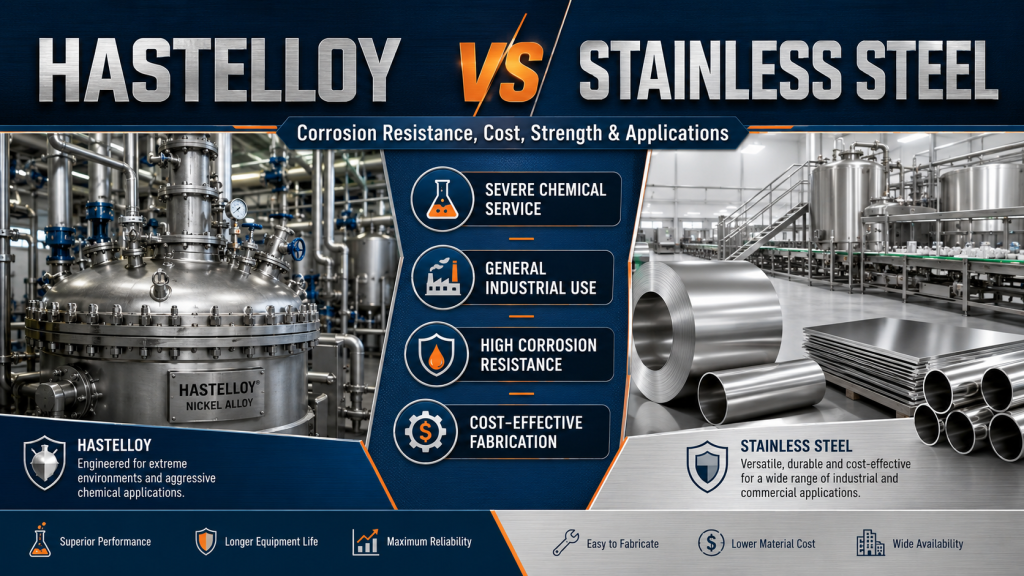
When comparing Hastelloy vs stainless steel, the correct choice depends on corrosion environment, chemical exposure, temperature, mechanical load, fabrication method, availability and total lifecycle cost. Both materials are corrosion-resistant alloys, but they are not designed for the same level of service.
Hastelloy is a nickel-based alloy family developed for severe chemical corrosion, strong acids, wet chlorine, oxidizing media, reducing media, pitting and crevice corrosion. Stainless steel is an iron-based chromium alloy family widely used for food equipment, architecture, tanks, piping, machinery, appliances and general industrial fabrication.
This guide explains the difference between Hastelloy and stainless steel in chemical composition, corrosion resistance, acid resistance, seawater and chloride behavior, strength, temperature performance, fabrication, cost and application selection. For related material information, visit Stainless Steel vs Nickel Alloy, Stainless Steel Sheet, 316L Stainless Steel and the Jude Steel Stainless Steel Grade Center.
Fast Comparison: Hastelloy vs Stainless Steel
| Feature | Hastelloy | Stainless Steel |
|---|---|---|
| Material Family | Nickel-based corrosion-resistant alloy | Iron-chromium alloy family |
| Main Strength | Severe chemical corrosion resistance | Versatile and cost-effective corrosion resistance |
| Key Alloying Elements | Nickel, molybdenum, chromium and sometimes tungsten | Iron, chromium, nickel, molybdenum, carbon and nitrogen depending on grade |
| Acid Resistance | Excellent in many aggressive acids and mixed chemical systems | Grade-dependent; 316L, 904L and duplex grades are stronger than 304 |
| Chloride Resistance | Excellent in many severe chloride environments | Grade-dependent; 316L, 2205, 2507 or 904L may be required |
| Pitting / Crevice Resistance | Very strong | Moderate to excellent depending on grade |
| Strength | Good to high depending on grade | Wide range; duplex and precipitation hardening grades can be very strong |
| Fabrication | More difficult and expensive | Usually easier, widely available and more flexible |
| Cost | Very high | Low to high depending on grade |
| Best Applications | Chemical reactors, scrubbers, acid pipelines, pharmaceutical systems, pollution control | Food equipment, tanks, architecture, machinery, pipes, appliances, general fabrication |
1. What Is Hastelloy?
Hastelloy is a family of nickel-based alloys designed for highly corrosive environments. Many Hastelloy grades contain high levels of molybdenum and chromium, which help improve resistance to acids, chlorides, localized corrosion and mixed chemical media.
Hastelloy is often used when common stainless steels, including 304 and 316L, cannot provide enough corrosion resistance. It is commonly selected for chemical processing, acid handling, scrubbers, reactors, pharmaceutical systems and pollution control equipment.
Common Hastelloy Grades
| Hastelloy Grade | Main Feature | Typical Applications |
|---|---|---|
| Hastelloy C-276 | Broad corrosion resistance in severe chemical environments | Chemical reactors, scrubbers, acid pipelines, pollution control equipment |
| Hastelloy C-22 | Excellent resistance to oxidizing and reducing media | Pharmaceutical systems, process vessels, waste treatment systems |
| Hastelloy B-2 | Strong resistance to hydrochloric acid in selected conditions | Hydrochloric acid systems, chemical process equipment |
| Hastelloy X | High-temperature strength and oxidation resistance | Furnace parts, gas turbine components and thermal equipment |
Main Characteristics of Hastelloy
- Excellent resistance to severe chemical corrosion
- Strong acid resistance in selected grades
- Superior resistance to pitting and crevice corrosion
- Strong performance in chloride-containing chemical systems
- Useful in wet chlorine, scrubber and process media environments
- Much higher cost than common stainless steel
- Requires experienced machining, welding and fabrication control
2. What Is Stainless Steel?
Stainless steel is an iron-based alloy containing chromium. Chromium forms a passive oxide film on the surface, helping stainless steel resist rust and corrosion. Different stainless steel grades use different amounts of chromium, nickel, molybdenum, carbon, nitrogen and other elements.
Compared with Hastelloy, stainless steel offers a much wider range of product forms, sizes, finishes and cost levels. It is available as sheet, coil, strip, plate, pipe, tube, bar and custom processed components.
Common Stainless Steel Grades
| Stainless Steel Grade | Main Feature | Typical Applications |
|---|---|---|
| 304 Stainless Steel | General-purpose corrosion resistance and excellent formability | Kitchen equipment, tanks, architecture, food equipment, machinery |
| 316L Stainless Steel | Better chloride resistance due to molybdenum | Food processing, coastal atmosphere, chemical equipment, medical equipment |
| 2205 Duplex Stainless Steel | Higher strength and stronger chloride stress corrosion resistance | Chemical tanks, pressure vessels, heat exchangers, offshore structures |
| 2507 Super Duplex Stainless Steel | Very strong chloride resistance and high strength | Seawater systems, desalination, offshore and severe chloride service |
| 904L Stainless Steel | High-alloy austenitic stainless steel for stronger corrosion resistance | Chemical equipment, acid systems and severe industrial environments |
Main Characteristics of Stainless Steel
- Good to excellent corrosion resistance depending on grade
- Lower cost than Hastelloy in most projects
- Wide product availability
- Excellent fabrication flexibility
- Suitable for cutting, welding, bending, polishing and brushing
- Available in many surface finishes such as 2B, BA, No.4, HL and mirror
- Strong choice for food, architecture, machinery, tanks and general industry
3. Chemical Composition Comparison
The biggest technical difference between Hastelloy and stainless steel is alloy system. Hastelloy is nickel-based and commonly contains high molybdenum and chromium. Stainless steel is iron-based and relies on chromium to form a corrosion-resistant passive film.
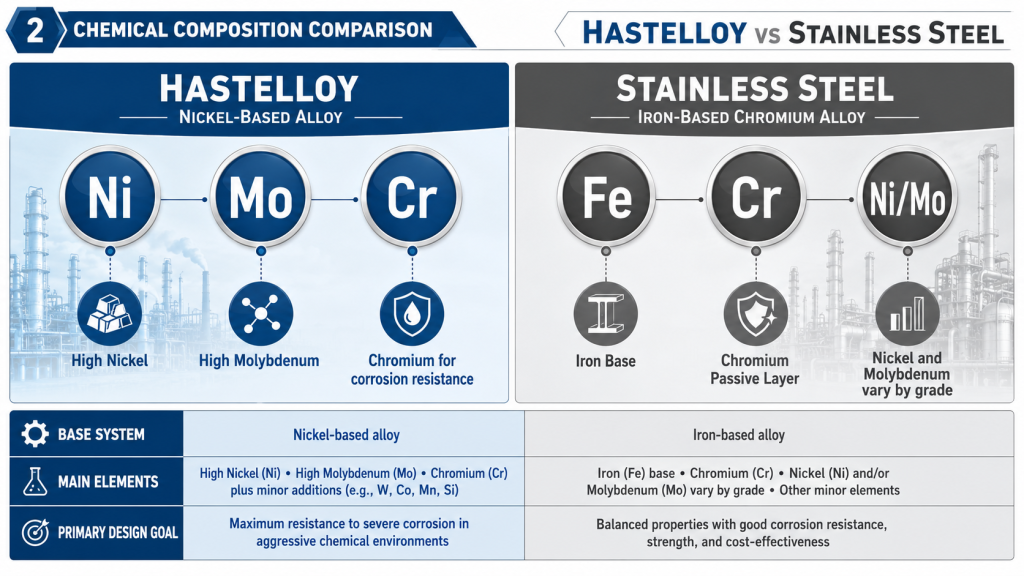
| Element / Feature | Hastelloy | Stainless Steel |
|---|---|---|
| Base Alloy System | Nickel-based alloy | Iron-based chromium alloy |
| Nickel | Very high | None to high depending on grade |
| Molybdenum | High in many corrosion-resistant grades | Important in 316L, 2205, 2507 and 904L |
| Chromium | Moderate to high depending on grade | Essential for passive corrosion resistance |
| Iron | Lower than stainless steel | Main base element |
| Primary Design Goal | Severe chemical and localized corrosion resistance | Broad corrosion resistance, strength, fabrication and cost efficiency |
Why Composition Matters
High nickel and molybdenum content gives Hastelloy excellent resistance to aggressive chemical corrosion. Iron-chromium chemistry gives stainless steel broad usability and lower cost. This is why Hastelloy is used for severe process environments, while stainless steel remains the first choice for most general industrial applications.
4. Corrosion Resistance Comparison
Corrosion resistance is the main reason engineers compare Hastelloy and stainless steel. Stainless steel performs well in many normal environments, especially when the correct grade is selected. However, in strong acids, wet chlorine, high-chloride chemical systems and severe pitting conditions, Hastelloy often provides much stronger protection.
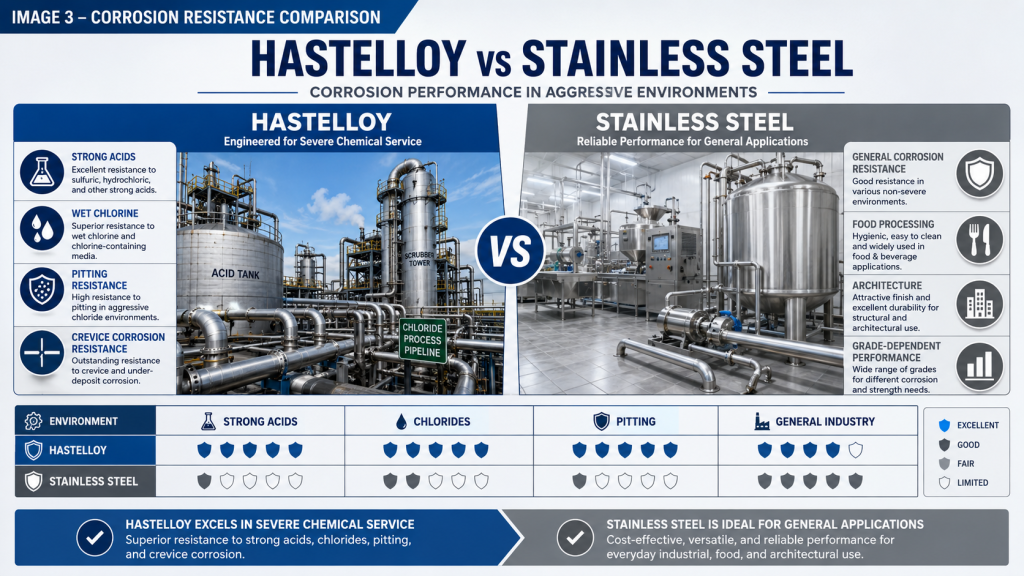
| Environment | Better Choice | Reason |
|---|---|---|
| Dry indoor environment | Stainless Steel | 304, 430 or other stainless grades are usually sufficient and economical |
| Food processing | Stainless Steel | 304 and 316L offer cleanability, corrosion resistance and cost efficiency |
| Coastal atmosphere | 316L, 2205 or higher stainless steel | Better cost-performance balance than Hastelloy in many atmospheric conditions |
| Seawater service | Duplex, super duplex, titanium or nickel alloy depending on condition | Final choice depends on chloride level, temperature, flow and crevice design |
| Strong acids | Hastelloy | Better resistance to aggressive chemical attack in suitable grades |
| Wet chlorine gas | Hastelloy | Selected Hastelloy grades may resist conditions where stainless steel fails |
| Scrubber systems | Hastelloy | Strong resistance to acidic, chloride-containing and mixed chemical environments |
| Pitting and crevice corrosion | Hastelloy or high-alloy stainless steel | Hastelloy usually offers stronger protection in severe chemical conditions |
5. Acid and Chemical Resistance
Hastelloy is usually selected when acid corrosion or mixed chemical corrosion is the main risk. Grades such as Hastelloy C-276 and C-22 are widely used in chemical plants because they resist many aggressive media that can attack common stainless steels.
Stainless steel may still work well in mild chemicals, food processing, freshwater, neutral environments and selected process conditions. However, when the environment contains strong acids, wet chlorine, reducing media, oxidizing media or severe chlorides, a high-alloy material may be required.
| Chemical Environment | Hastelloy | Stainless Steel |
|---|---|---|
| Hydrochloric acid | Excellent in selected grades and conditions | Usually limited; standard grades may fail quickly |
| Sulfuric acid | Good to excellent depending on grade, concentration and temperature | Grade-dependent; 904L or special stainless may be needed |
| Wet chlorine gas | Strong in selected grades | Often unsuitable for severe service |
| Mixed acids | Often preferred | May be limited depending on chemistry |
| Mild organic acids | Usually excellent but may be over-specified | 304 or 316L may be sufficient |
| Cleaning chemicals | Strong resistance in severe cases | 316L or higher stainless grades may be suitable |
6. Strength and Mechanical Performance
Both Hastelloy and stainless steel can provide useful strength, but stainless steel offers a wider grade range for mechanical design. Austenitic grades such as 304 and 316L provide good toughness and ductility. Duplex grades such as 2205 and 2507 offer higher yield strength. Precipitation hardening grades such as 17-4PH offer very high strength.
Hastelloy also provides good mechanical properties, but it is usually selected primarily for corrosion resistance rather than cost-effective strength.
| Mechanical Factor | Hastelloy | Stainless Steel |
|---|---|---|
| Room-Temperature Strength | Good to high depending on grade | Wide range depending on grade |
| Ductility | Good | Excellent in austenitic stainless steels |
| High-Strength Options | Grade-dependent | Duplex, super duplex and precipitation hardening grades |
| Fatigue Performance | Good depending on grade and environment | Wide range depending on grade and application |
| Best Mechanical Use | Corrosion-critical chemical components | Structures, pressure vessels, machinery, tanks, shafts and general fabrication |
7. Temperature Performance
Temperature performance depends strongly on grade. Some Hastelloy grades are designed for high-temperature oxidation and thermal stability, while others are optimized mainly for corrosion resistance in chemical media. Stainless steel also includes heat-resistant grades such as 309S, 310S, 321 and 347.
| Temperature Factor | Hastelloy | Stainless Steel |
|---|---|---|
| Moderate Temperature Service | Good depending on grade | Good depending on grade |
| High-Temperature Oxidation | Hastelloy X and selected grades perform well | 309S, 310S and heat-resistant grades may be suitable |
| Hot Acid or Chemical Media | Often stronger in suitable grades | May require high-alloy stainless or nickel alloy |
| Thermal Cycling | Grade- and environment-dependent | Grade-dependent; ferritic and heat-resistant stainless grades may be used |
| Extreme Heat | Evaluate specific Hastelloy or nickel alloy grade | Evaluate heat-resistant stainless steel or nickel alloy |
For high-temperature nickel alloy comparisons, review Hastelloy vs Inconel and Stainless Steel vs Nickel Alloy.
8. Fabrication, Welding and Machining
Stainless steel is generally easier to source, cut, weld, bend, polish, brush and fabricate than Hastelloy. Stainless steel also has a larger global processing network and more mature supply chain.
Hastelloy can be welded and fabricated, but it requires more careful procedure control. Machining is more difficult because nickel alloys can work harden, generate heat and cause tool wear. Welding also requires suitable filler metal, clean surfaces and skilled operators.
| Processing Factor | Hastelloy | Stainless Steel |
|---|---|---|
| Machining | Difficult | Moderate depending on grade |
| Welding | Possible but strict control is required | Generally good, especially 304 and 316L |
| Forming | Possible but more specialized | Excellent in many sheet and coil grades |
| Cutting | Requires controlled process | Widely supported by laser, plasma, waterjet and shear cutting |
| Polishing / Brushing | Possible but less common | Common and highly developed |
| Availability | Limited and expensive | Very broad availability |
Jude Steel provides stainless steel processing services, including laser cutting, bending, brushing and polishing.
9. Cost and Lifecycle Value
Cost is one of the biggest differences between Hastelloy and stainless steel. Hastelloy contains high nickel, molybdenum and other alloying elements, making it far more expensive than common stainless steels such as 304, 316L or 430.
However, purchase price alone is not the full story. In severe chemical environments, Hastelloy may reduce leakage risk, shutdown cost, maintenance cost and replacement frequency. In normal environments, stainless steel usually delivers better total value because it is cheaper, available and easier to fabricate.
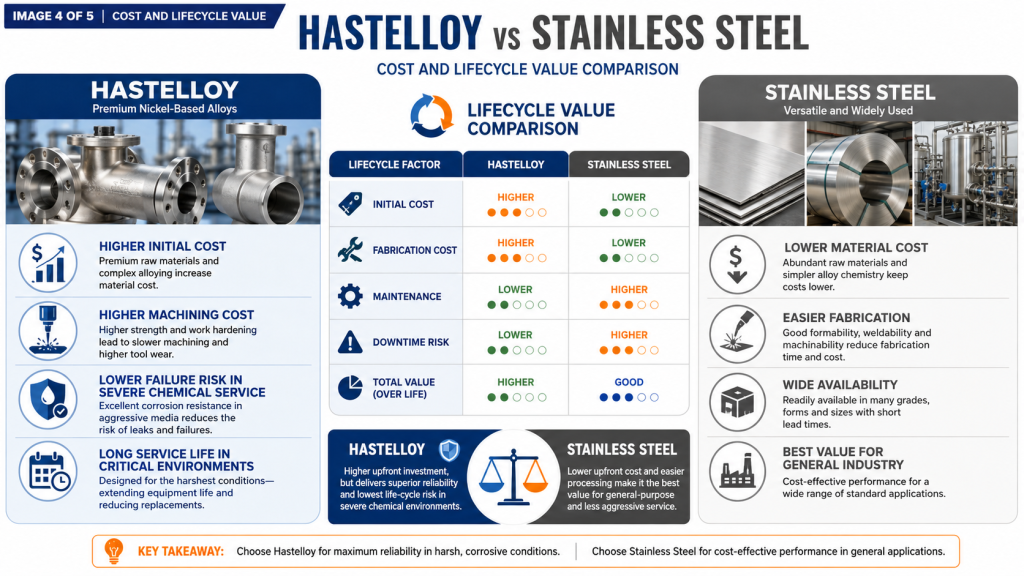
| Cost Factor | Hastelloy | Stainless Steel |
|---|---|---|
| Raw Material Cost | Very high | Low to high depending on grade |
| Machining Cost | High | Moderate in most common grades |
| Welding Cost | Higher due to specialized procedure | Lower and widely supported |
| Availability | Limited | Excellent |
| Maintenance Risk | Low in properly selected severe chemical service | Low to high depending on grade and environment |
| Best Value Scenario | Severe chemical, acid and corrosion-critical service | General industrial, food, architectural and fabrication applications |
10. Application Comparison
| Application | Better Choice | Reason |
|---|---|---|
| Food processing equipment | 304 or 316L Stainless Steel | Cleanability, corrosion resistance, cost efficiency and availability |
| Kitchen equipment | 304 Stainless Steel | Good corrosion resistance, surface finish and fabrication |
| Chemical reactors | Hastelloy | Better resistance to severe acids and mixed chemicals |
| Acid pipelines | Hastelloy or high-alloy stainless steel | Final selection depends on acid type, concentration and temperature |
| Scrubber systems | Hastelloy | Strong resistance to acidic and chloride-containing process media |
| Architectural panels | Stainless Steel | Better appearance options, lower cost and easier supply |
| Marine atmosphere | 316L, 2205 or 2507 Stainless Steel | Better cost-performance balance in many coastal applications |
| Severe chemical corrosion | Hastelloy | High nickel-molybdenum alloy system provides stronger protection |
11. Hastelloy vs Stainless Steel: Selection Guide
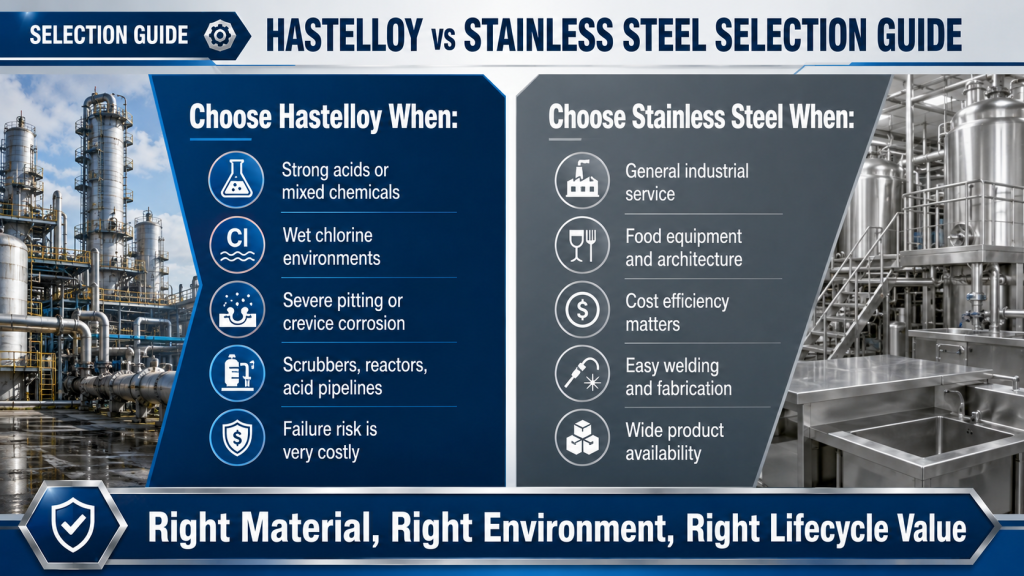
Choose Hastelloy If:
- The application involves strong acids or mixed chemicals
- Wet chlorine, oxidizing media or reducing media are present
- Pitting and crevice corrosion are major risks
- Stainless steel has failed in similar service conditions
- The system involves chemical reactors, scrubbers or acid pipelines
- Leakage, shutdown or corrosion failure would be very expensive
- The project requires long service life in severe process environments
Choose Stainless Steel If:
- The environment is mild or moderately corrosive
- Cost efficiency is important
- The application involves food equipment, architecture, tanks, pipes or machinery
- 304, 316L, 2205, 2507 or 904L can provide enough corrosion resistance
- You need broad product availability and fast delivery
- Cutting, welding, bending, polishing or brushing is required
- The project requires many thicknesses, finishes or product forms
Consider Higher Stainless Grades If:
- 304 is not corrosion resistant enough
- 316L is needed for chloride or marine atmosphere
- 2205 duplex is needed for higher strength and chloride resistance
- 2507 super duplex is required for severe seawater or offshore service
- 904L or 254SMO is needed for stronger chemical resistance
- Hastelloy is too expensive for the project budget
12. Common Buyer Mistakes to Avoid
- Choosing Hastelloy when stainless steel is already sufficient
- Using 304 stainless steel in severe acid or chloride service without evaluation
- Comparing only purchase price and ignoring corrosion failure cost
- Assuming all stainless steels perform the same way
- Assuming Hastelloy is always better in every environment
- Ignoring chemical concentration, temperature and flow velocity
- Ignoring crevice design, surface finish and cleaning method
- Underestimating Hastelloy machining and welding cost
- Not confirming material certificate, grade standard and service condition
Frequently Asked Questions
What is the main difference between Hastelloy and stainless steel?
Hastelloy is a nickel-based alloy family designed for severe chemical corrosion, acids, chlorides, pitting and crevice corrosion. Stainless steel is an iron-based chromium alloy family used for general corrosion resistance, fabrication flexibility and cost-effective industrial applications.
Is Hastelloy better than stainless steel?
Hastelloy is better in many aggressive chemical, acid and chloride environments. Stainless steel is better when cost, availability, weldability, product variety and general-purpose corrosion resistance are more important.
Which is more corrosion resistant, Hastelloy or stainless steel?
Hastelloy generally provides stronger resistance to severe chemical corrosion, acids, wet chlorine, pitting and crevice corrosion. Stainless steel corrosion resistance depends on grade, such as 304, 316L, 2205, 2507 or 904L.
Is Hastelloy more expensive than stainless steel?
Yes. Hastelloy is usually much more expensive than common stainless steels because it contains high nickel, molybdenum and other alloying elements and requires more specialized processing.
Can stainless steel replace Hastelloy?
Stainless steel can replace Hastelloy in mild or moderate environments when grades such as 316L, 2205, 2507 or 904L provide sufficient corrosion resistance. In severe acid, wet chlorine or aggressive chemical environments, Hastelloy may still be required.
Which stainless steel grade is closest to Hastelloy performance?
No stainless steel grade is exactly the same as Hastelloy. However, 904L, 254SMO, 2205 duplex and 2507 super duplex may be evaluated before selecting Hastelloy, depending on corrosion severity and budget.
Which material is easier to fabricate?
Stainless steel is generally easier to cut, weld, form, polish and source. Hastelloy requires more specialized machining, welding procedures and experienced fabrication control.
Conclusion
Hastelloy and stainless steel are both corrosion-resistant materials, but they serve different roles. Hastelloy is a premium nickel-based alloy family designed for severe chemical corrosion, strong acids, wet chlorine, pitting, crevice corrosion and harsh process media. It is widely used in chemical reactors, scrubbers, acid pipelines, pharmaceutical systems and pollution control equipment.
Stainless steel is the more versatile and cost-effective material for most industrial, food, architectural and fabrication applications. With the right grade selection, stainless steel can provide excellent performance at a much lower cost than Hastelloy.
Choose Hastelloy when severe chemical corrosion resistance is the main priority. Choose stainless steel when general corrosion resistance, availability, fabrication flexibility and cost efficiency are more important. Jude Steel supplies stainless steel sheets, coils, strips and customized processing services for global buyers. Explore more at Judesteel.com, or visit our product pages for stainless steel sheet, stainless steel coil and stainless steel strip.
