
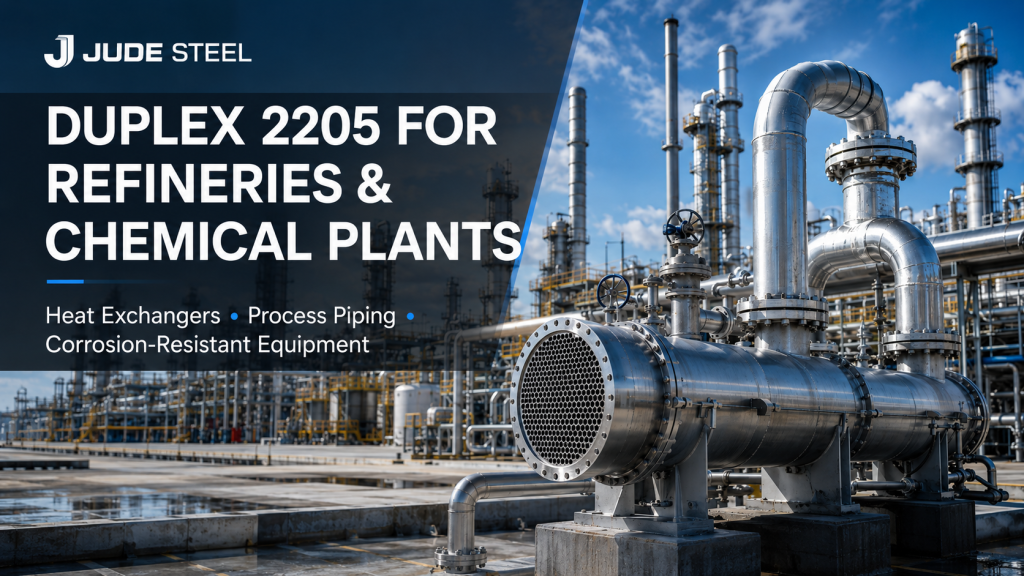
 Where Is Duplex 2205 Used in Refineries and Chemical Plants?
Duplex 2205 stainless steel is widely considered for refinery, petrochemical and chemical-processing equipment where a combination of high mechanical strength and resistance to chloride-related corrosion is required.
However, specifying “2205” alone is not enough for an industrial purchase. A heat exchanger manufacturer, pressure-vessel fabricator and piping contractor may all use Duplex 2205, but they normally require different product forms and different ASTM specifications.
This guide focuses on a practical procurement question: which refinery and chemical-processing products are commonly manufactured from Duplex 2205, and what 2205 raw material should be specified for each product?
For basic grade information, see the
JUDE Steel Duplex 2205 material page.
Quick Answer: What Equipment Is Commonly Made From Duplex 2205?
Depending on the process environment and engineering specification, Duplex 2205 may be selected for the following refinery and chemical-processing equipment:
- shell-and-tube heat exchangers
- heat-exchanger tubes and tubesheets
- condensers
- pressure vessels
- chemical process vessels
- reactor and separator components
- process piping
- flowlines
- storage and process tanks
- flanges
- valve bodies and forged valve components
- butt-weld pipe fittings
- pump shafts and valve stems
- machined corrosion-resistant components
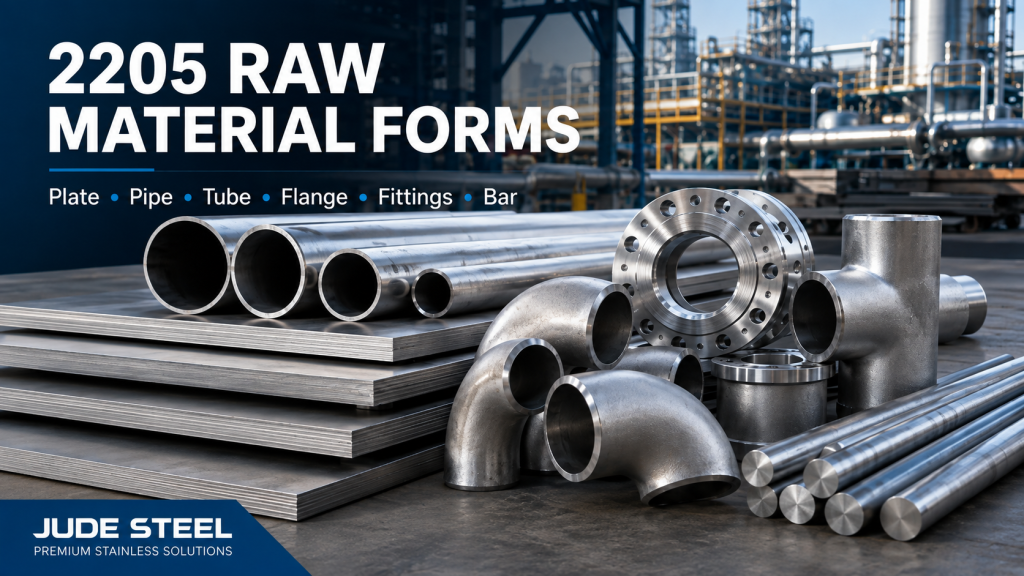
The important point for buyers is that these products do not all use the same raw-material specification. Plate, pipe, tubing, forgings and fittings should be ordered to the appropriate product standard.
Why Engineers Consider Duplex 2205 in Refining and Chemical Processing
Duplex 2205 combines an austenitic-ferritic microstructure with chromium, molybdenum and nitrogen alloying. This combination provides substantially higher yield strength than conventional 300-series austenitic stainless steels while also improving resistance to chloride-induced pitting, crevice corrosion and stress-corrosion cracking in many service environments.
These properties are particularly useful when process equipment is exposed to chloride-containing water, brackish cooling water, certain contaminated process streams or combinations of corrosion and mechanical loading.
A major Duplex 2205 producer, Alleima, lists applications including refineries, oil and gas production, chloride-contaminated process solutions and heat exchangers using chloride-bearing or brackish cooling water. See the
Alleima SAF 2205 technical datasheet.
This does not mean that 2205 is automatically suitable for every refinery or chemical stream. Actual material selection should be verified against process chemistry, temperature, pressure, fabrication condition, applicable design code and corrosion requirements.
2205 Grade Designations and Product Standards
“2205” is a commonly used commercial grade name rather than a complete purchasing specification.
| System | Common Designation | Procurement Note |
|---|---|---|
| UNS | S32205 | Common modern 2205 designation with tighter Cr, Mo and N minimums |
| UNS | S31803 | Older, broader duplex 2205 chemistry range; confirm project specification |
| EN | 1.4462 / X2CrNiMoN22-5-3 | Common European designation |
| JIS | SUS329J3L | Frequently cross-referenced, but should not be assumed to be automatically identical to an ASTM/UNS order |
Typical UNS S32205 Composition Range
| Element | Specified Range, wt.% |
|---|---|
| Carbon (C) | 0.030 max. |
| Silicon (Si) | 1.00 max. |
| Manganese (Mn) | 2.00 max. |
| Phosphorus (P) | 0.030 max. |
| Sulfur (S) | 0.020 max. |
| Chromium (Cr) | 22.0–23.0 |
| Nickel (Ni) | 4.5–6.5 |
| Molybdenum (Mo) | 3.0–3.5 |
| Nitrogen (N) | 0.14–0.20 |
Values such as approximately 22% chromium, 5–6% nickel, about 3% molybdenum or a PREN in the mid-30s are useful engineering descriptions, but they should be treated as typical or calculated values rather than a substitute for the chemical limits on the applicable material specification and mill test certificate.
Which ASTM Standard Applies to Which 2205 Product?
| Raw Material / Component | Common ASTM Specification | Typical Designation |
|---|---|---|
| Plate, sheet and strip | ASTM A240/A240M | UNS S32205 |
| Heat-exchanger and general-service tube | ASTM A789/A789M | UNS S32205 |
| Seamless or welded process pipe | ASTM A790/A790M | UNS S32205 |
| Forged flanges, forged fittings and valve components | ASTM A182/A182M | F60 / UNS S32205 |
| Wrought butt-weld fittings | ASTM A815/A815M | WPS32205 |
| Bars and machined components | ASTM A276 or ASTM A479/A479M | UNS S32205 |
ASTM A240 covers stainless steel plate, sheet and strip for pressure vessels and general applications. Buyers can review the current scope on the
ASTM International A240/A240M page.
Which Refinery and Chemical-Plant Products Use Duplex 2205?
1. Heat Exchangers and Condensers
Heat exchangers are one of the most important application areas for Duplex 2205.
The alloy may be considered when the cooling side contains chlorides or brackish water, or when the process side creates a corrosion condition that is too aggressive for conventional 304L or 316L.
Depending on the exchanger design, 2205 can be used for:
- heat-exchanger tubes
- tubesheets
- shells
- channel components
- nozzles
- other wetted pressure-retaining components
A tube supplier may quote ASTM A789 UNS S32205, while a tubesheet or shell fabricator may require ASTM A240 UNS S32205 plate. The complete exchanger material specification should therefore identify each component separately.
2. Pressure Vessels and Chemical Process Vessels
Duplex 2205 plate can be used to fabricate pressure-containing equipment handling chloride-bearing or otherwise corrosive process fluids when engineering calculations and corrosion assessment support the selection.
Potential products include:
- pressure-vessel shells
- heads
- chemical process vessels
- separator vessels
- selected reactor components
- nozzle and reinforcement components
For pressure-vessel fabrication, the buyer may specify ASTM A240 or the applicable ASME material specification together with the vessel design code.
If you are sourcing flat material, JUDE supplies
stainless steel sheet and plate
with cut-to-size processing options.
3. Process Piping and Flowlines
Duplex 2205 is also used in piping systems that combine corrosive process conditions with mechanical or pressure requirements.
Typical raw-material categories include:
- seamless process pipe
- straight-seam welded pipe
- instrument or process tubing
- spools
- branches and fabricated piping assemblies
ASTM A790 is commonly associated with seamless and welded ferritic/austenitic stainless steel pipe, while ASTM A789 applies to ferritic/austenitic stainless steel tubing.
Buyers comparing manufacturing routes can also review JUDE’s guide to
seamless vs welded stainless steel pipe.
4. Storage Tanks and Process Tanks
Duplex 2205 plate may be selected for storage or process tanks where corrosion resistance, mechanical strength or both justify its use.
Relevant applications can include tanks for chloride-containing process liquids and selected chemical solutions, but the compatibility of the actual stored medium must be confirmed.
High strength may also allow engineering designs with reduced wall thickness compared with lower-strength austenitic stainless steels, subject to code calculations, minimum fabrication thicknesses, corrosion allowance and structural requirements.
5. Flanges, Valves and Pipe Fittings
A 2205 piping system normally requires more than pipe.
Corrosion-resistant pressure systems may also require:
- weld-neck flanges
- blind flanges
- socket-weld or threaded forged fittings
- elbows
- tees
- reducers
- valve bodies
- bonnets
- other forged pressure-containing parts
For forged components, ASTM A182 F60 is commonly associated with UNS S32205. Wrought butt-weld fittings may be supplied under ASTM A815.
6. Pump Shafts, Valve Stems and Machined Components
The combination of mechanical strength and corrosion resistance also makes 2205 useful for selected machined components.
Examples include:
- pump shafts
- valve stems
- couplings
- rings
- machined discs
- other load-bearing corrosion-resistant parts
Bar or forged stock may be supplied under specifications such as ASTM A276, ASTM A479 or an applicable forging specification depending on the finished component.
Equipment-to-Raw-Material Procurement Matrix
| Finished Equipment | Possible 2205 Component | Raw Material Form | Common Specification |
|---|---|---|---|
| Heat exchanger | Tubes | Tube | ASTM A789 S32205 |
| Heat exchanger | Tubesheet | Plate | ASTM A240 S32205 |
| Heat exchanger | Shell | Plate | ASTM A240 S32205 |
| Pressure vessel | Shell / head | Plate | ASTM A240 S32205 |
| Process piping | Pipe | Seamless or welded pipe | ASTM A790 S32205 |
| Piping system | Elbow / tee / reducer | Wrought fitting | ASTM A815 WPS32205 |
| Piping system | Flange | Forging | ASTM A182 F60 |
| Valve | Forged pressure component | Forging | ASTM A182 F60 |
| Tank | Shell / bottom / roof component | Plate | ASTM A240 S32205 |
| Pump / valve | Shaft / stem | Bar | ASTM A276 or A479 S32205 |
Where Can 2205 Make Sense in a Refinery?
Chloride-Bearing Cooling Water
Heat exchangers using chloride-containing cooling water or brackish water are a well-established area in which duplex stainless steels may offer advantages over conventional austenitic stainless steels.
Chloride-Contaminated Process Streams
Refinery process streams can become contaminated with salts or chlorides. Where chloride pitting, crevice corrosion or chloride stress-corrosion cracking becomes an important design concern, 2205 may be evaluated as part of the material-selection study.
Corrosive Process Piping
Where both mechanical strength and corrosion resistance are important, 2205 pipe, fittings and flanges can form part of an integrated corrosion-resistant piping system.
Sour Refinery Environments
Wet hydrogen-sulfide service requires additional attention. The fact that a material is Duplex 2205 does not automatically establish its suitability for every sour environment.
Material condition, hardness, welding, H2S exposure and the applicable standard must be evaluated.
Sour Service: MR0103 Is Not the Same as MR0175
This distinction is particularly important for refinery procurement.
ANSI/NACE MR0103 / ISO 17945 addresses metallic materials resistant to sulfide stress cracking in corrosive petroleum-refining environments.
NACE MR0175 / ISO 15156 is primarily associated with H2S-containing environments in oil and gas production.
Therefore, a refinery buyer should not simply write “NACE compliant” without identifying the applicable standard and service condition.
More information on refinery sour-service material requirements is available from
AMPP’s ANSI/NACE MR0103 / ISO 17945 standard page.
When Duplex 2205 May Not Be the Correct Material
2205 is a high-performance engineering stainless steel, but it is not a universal corrosion solution.
A different alloy may be required when:
- the process contains highly aggressive acids at unfavorable concentrations or temperatures
- chloride conditions exceed the practical corrosion resistance of standard duplex 2205
- the equipment is exposed to unusually severe crevice conditions
- service temperature creates metallurgical limitations for duplex stainless steel
- the project specification requires a higher-alloy duplex, super duplex or nickel alloy
- fabrication requirements cannot maintain the required duplex microstructure and weld quality
For more severe chloride environments, engineers may evaluate
2507 super duplex stainless steel
or another corrosion-resistant alloy.
2205 vs 316L vs 2507 for Process Equipment
| Selection Factor | 316L | Duplex 2205 | Super Duplex 2507 |
|---|---|---|---|
| General fabrication | Easier | Requires tighter welding control | Requires tighter welding control |
| Yield strength | Lower | Significantly higher | Higher |
| Chloride pitting resistance | Moderate | Higher than 316L in many conditions | Higher than 2205 |
| Chloride SCC resistance | More susceptible | Improved resistance | Improved resistance |
| Typical cost level | Usually lower | Intermediate | Usually higher |
| Typical role | General chemical and industrial service | More demanding chloride and high-strength service | Severe chloride and higher-corrosion-duty service |
For a more detailed comparison, see
2205 vs 316 stainless steel.
The table above is a screening guide only. Final alloy selection should be based on actual service conditions rather than grade ranking alone.
How to Specify Duplex 2205 in an RFQ
An RFQ containing only “Duplex 2205, please quote” normally requires several rounds of clarification.
A professional raw-material inquiry should include as much of the following information as possible:
- Grade: Duplex 2205
- UNS designation: preferably S32205 when required by the project
- Standard: ASTM A240, A789, A790, A182, A815, EN 10088 or other applicable specification
- Product form: plate, sheet, coil, pipe, tube, bar or forging
- Dimensions: thickness, width, length, OD, wall thickness or schedule
- Quantity: pieces, meters or total weight
- Surface condition: where applicable
- Edge or machining requirement: mill edge, slit edge, cut plate or machined blank
- Process medium: if material-selection support is required
- Design or operating temperature: if relevant
- Design or operating pressure: if relevant
- Inspection documentation: EN 10204 3.1, 3.2 or project-specific documentation
- Testing: PMI, UT, PT, corrosion testing or additional project requirements
- Sour-service requirement: identify MR0103 / ISO 17945 or MR0175 / ISO 15156 where applicable
Example Duplex 2205 Plate RFQ
Material: Duplex Stainless Steel 2205 / UNS S32205
Specification: ASTM A240/A240M
Product: Hot-rolled plate
Thickness: 12 mm
Width: 2000 mm
Length: 6000 mm
Quantity: 20 plates
Certificate: EN 10204 3.1
Additional requirement: PMI and UT if available
Application: Chemical process vessel
Delivery destination: Houston, USA
Providing this information allows the supplier to check material availability, processing requirements, certification and logistics without repeatedly requesting basic technical details.
How JUDE Steel Supports Duplex 2205 Raw-Material Procurement
JUDE Steel supplies stainless steel flat products and provides processing services for industrial buyers and fabricators.
For a Duplex 2205 project, buyers can submit the required grade, specification, dimensions and quantity for availability confirmation.
Available processing capabilities can be reviewed on the
JUDE Steel Services & Capabilities page.
For project-specific availability of plate, sheet, coil or other product forms, confirm the exact requirement during the inquiry rather than assuming that every dimension or product form is continuously stocked.
Frequently Asked Questions
Is UNS S32205 the same as Duplex 2205?
UNS S32205 is one of the principal modern UNS designations used for Duplex 2205. UNS S31803 is also associated with 2205, but S32205 has tighter minimum requirements for key alloying elements such as chromium, molybdenum and nitrogen. The project specification should determine which designation is ordered.
Is ASTM A240 enough when ordering 2205?
Not by itself. ASTM A240 identifies the flat-product specification, but an RFQ should also identify UNS S32205 or the required grade, dimensions, quantity, surface condition, certificate requirements and any supplementary testing.
Which ASTM standard should I specify for 2205 pipe?
ASTM A790 is commonly used for seamless and welded ferritic/austenitic stainless steel pipe. For tubing, ASTM A789 is commonly specified. Always confirm the product definition and project code before ordering.
What specification is commonly used for 2205 flanges?
Forged Duplex 2205 flanges and similar forged pressure components are commonly ordered under ASTM A182 Grade F60 / UNS S32205, subject to the applicable dimensional and project standards.
Does NACE compliance automatically mean Duplex 2205 is safe for sour service?
No. Sour-service suitability depends on the applicable standard, material condition, hardness, welding condition and actual H2S-containing environment. Refining service commonly references MR0103 / ISO 17945, while upstream oil and gas production commonly references MR0175 / ISO 15156.
Should I choose 2205 or 2507 for a chloride service?
The answer depends on chloride concentration, temperature, oxygen level, pH, crevice conditions and other process factors. 2507 provides greater localized-corrosion resistance than 2205 but normally costs more and also requires controlled fabrication. A corrosion or materials engineer should confirm the final selection for critical service.
What information should I send JUDE Steel for a 2205 quotation?
Send the grade or UNS number, ASTM or EN standard, product form, dimensions, quantity, destination, certification requirements and any special testing. If you need assistance matching the raw material to a specific process application, also provide the process medium, temperature and pressure.
Request a Duplex 2205 Quote
Buying Duplex 2205 plate, sheet or other stainless steel raw material for a refinery, chemical plant or equipment-manufacturing project?
Send JUDE Steel your grade + standard + dimensions + quantity + destination. For application-related inquiries, include the process medium, temperature, pressure and required inspection documentation.
Engineering note: The information in this article is intended for material screening and procurement guidance. Final material selection, pressure design, corrosion allowance, fabrication procedure and code compliance should be confirmed by the responsible project engineer or materials specialist.
