
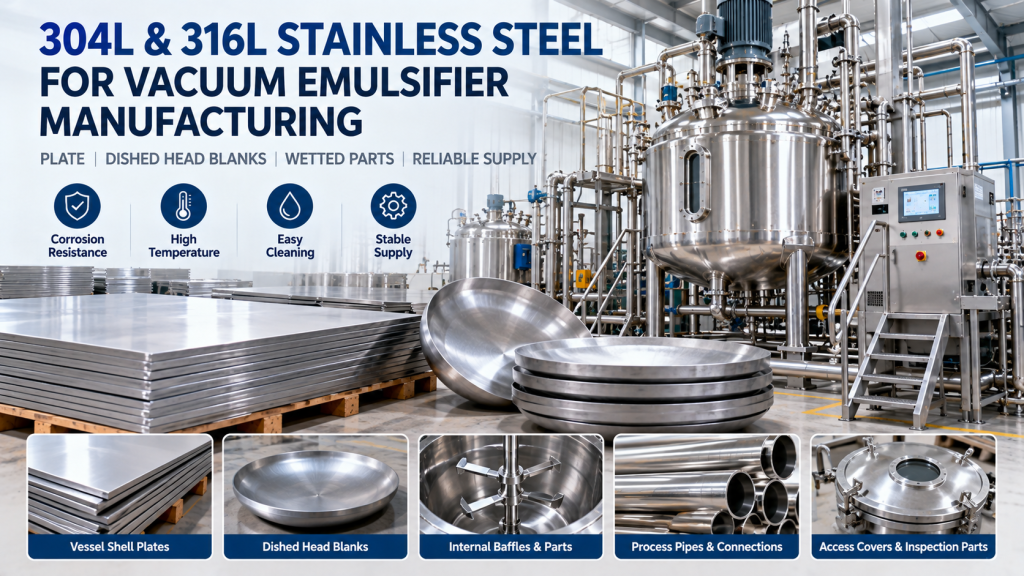
 Technical Application Guide | Stainless Steel for Cosmetic Equipment OEMs
A vacuum emulsifier manufacturer may purchase several
different stainless steel products for one machine:
plate for the main vessel shell, blanks for formed
heads, sheet for internal baffles, and separately
specified material for access covers and
process-contact connections.
These items should not be grouped under a single
description such as “food-grade 316 stainless steel.”
The material schedule must distinguish the
component, alloy designation, product form,
surface requirement and fabrication process.
304L and 316L are two austenitic stainless steel
grades that can be evaluated for vacuum emulsifying
equipment used in the production of creams, lotions,
emulsions and other personal care products.
Neither grade is suitable for every formulation
or cleaning procedure.
This guide focuses on stainless steel raw materials
for equipment manufacturers, rather than the
selection or sale of completed emulsifying machines.
1. Which Vacuum Emulsifier Components Require Stainless Steel?
Vacuum emulsifying systems can include a primary
mixing chamber, agitator assemblies, heating or
cooling jackets, ingredient inlets, vacuum
connections, access covers and supporting
structures.
The configuration depends on the equipment
manufacturer and the intended process.
Not every emulsifier uses the same component
materials or fabrication methods.
| Component | Potential raw material | Fabrication route | Purchase requirement |
|---|---|---|---|
| Main vessel shell | Approved 304L or 316L plate/sheet | Cutting, rolling and welding | Standard, thickness, developed size and vessel drawing |
| Top or bottom dished head | Stainless steel plate or circular blank | Pressing, spinning or another approved forming process | Starting thickness, blank diameter and finished-head requirements |
| Product-contact baffles | Stainless sheet or cut plate | Cutting, forming and welding | Grade, profile, edge details and surface acceptance |
| Internal mounting plates | Sheet or structural plate as designed | Cutting, drilling and welding | Load, material specification, dimensions and inspection |
| Process-contact connections | Separately specified pipe, tubing or fitting material | Cutting, machining and joining | Product standard, diameter, wall and internal finish |
| Maintenance and access covers | Plate or sheet | Cutting, drilling and edge finishing | Pressure duty, gasket interface, flatness and finish |
| Heating/cooling jacket | Approved metal product | Forming and welding | Utility medium, design pressure and temperature |
Some mixer shafts, mechanical seals, bearings,
rotor-stator components and other precision parts
require different product forms or materials.
A flat-product quotation should not be assumed
to include these finished assemblies.
For plate and sheet products, see
JUDE stainless steel sheet and plate
.
2. 304L vs 316L for Vacuum Emulsifying Equipment
304L and 316L are both low-carbon austenitic
stainless steels. The important difference
for many processing applications is that
316L contains molybdenum, which can improve
resistance to localized corrosion in
certain environments.
| Selection factor | 304L | 316L |
|---|---|---|
| UNS | S30403 | S31603 |
| Common EN designation | 1.4307 | 1.4404 |
| Common JIS designation | SUS304L | SUS316L |
| Alloy family | Low-carbon chromium-nickel austenitic stainless steel | Low-carbon chromium-nickel-molybdenum austenitic stainless steel |
| Main selection consideration | Welded equipment in compatible process and cleaning environments | Additional localized-corrosion resistance where justified by service conditions |
| Limitation | Not suitable for every chloride or aggressive chemical exposure | Not immune to corrosion or chloride stress-corrosion cracking |
Grade designations used by ASTM, EN and JIS
should be verified against the applicable
product specifications. Similar designations
are not automatically interchangeable
for every purchase order.
When 304L May Be Appropriate
304L may be evaluated for welded vessel
shells, internal plates and other product-contact
components when the formulation and cleaning
environment are compatible with the alloy.
Its low-carbon composition helps reduce
susceptibility to sensitization during
many welding operations. However, low
carbon does not provide a general solution
to pitting, crevice corrosion or all
forms of chemical attack.
A cosmetic formulation may contain
salts, surfactants, preservatives,
acids or alkaline ingredients.
The material decision should account
for the actual concentrations,
temperature and cleaning procedures.
View the
304L stainless steel grade page
for further product information.
When 316L May Be Preferred
316L contains molybdenum and can provide
improved resistance to pitting and crevice
corrosion in many relevant environments
compared with 304L.
This difference may matter where a
mixing system encounters chloride-containing
ingredients, retained residues, chemical
cleaners or difficult-to-clean crevices.
Nevertheless, 316L should not be selected
without checking the complete process
chemistry. Temperature, local concentration,
deposits, exposure duration and cleaning
practice can change the corrosion risk.
316L is not guaranteed to resist every
acid, disinfectant or high-chloride process.
Some applications may require a different
alloy or another material system.
View the
316L stainless steel grade page
for further product information.
3. Vacuum Conditions Require More Than a Corrosion-Resistant Grade
A vacuum emulsifier vessel can experience
external pressure when the internal
pressure falls below atmospheric pressure.
External-pressure design is different
from checking an internal-pressure
vessel for tensile stress alone.
Shell geometry, unsupported length,
stiffeners, head shape, fabrication
tolerances and material properties
can affect resistance to instability
or buckling.
The equipment designer must evaluate
the applicable pressure-equipment
requirements and all relevant
operating conditions.
Specifying 304L or 316L does not
establish that a shell can safely
withstand a particular vacuum level.
Neither grade name provides a
universal minimum plate thickness.
For material purchasing, request
the approved shell thickness,
developed dimensions, plate
specification and fabrication drawing.
Do not estimate required thickness
from vessel capacity alone.
4. Vessel Shell Plate: What OEM Buyers Must Confirm
A fabricated stainless steel shell
often begins as a flat plate that
is cut, rolled and joined.
The starting material must match
the approved manufacturing route.
Before sending a request for quotation,
confirm the following:
- Grade: Approved 304L, 316L or another specified material.
- Product standard: Applicable ASTM, EN, JIS or project specification.
- Thickness: Design-approved nominal thickness and required tolerance.
- Dimensions: Plate width, length and developed shell blank size.
- Surface: Supplied finish and any protection requirements.
- Weld preparation: Edge condition and drawing requirements.
- Traceability: Heat identification and specified certificate.
- Quantity: Pieces, total area or required mass.
Material purchasers should distinguish
mill-supplied plate tolerances from
precision-cut blank tolerances.
The latter may require a separately
defined processing and inspection scope.
For drawing-based blanks, review
JUDE stainless steel laser cutting
and
custom shearing services
.
Material size, cutting geometry,
edge quality and achievable tolerance
must be confirmed for each quotation.
5. Dished Head Blanks: Starting Thickness vs Finished Thickness
Vacuum emulsifier vessels may use
formed top or bottom heads.
Their geometry should be specified
by the equipment designer.
A head-forming blank cannot be
defined accurately by the finished
vessel diameter alone.
The approved blank dimensions
depend on the head profile,
forming method, trim allowance,
material properties and
fabrication requirements.
Local material thinning may occur
during pressing or spinning.
The starting plate thickness
therefore should not be represented
as the guaranteed minimum thickness
of the completed head.
When ordering plate for
head manufacturing, provide:
- Approved head drawing and revision
- Required material grade and standard
- Blank diameter or other approved flat-pattern dimensions
- Starting plate thickness
- Required finished thickness or approved forming criteria
- Quantity and edge requirements
- Inspection and traceability requirements
The head fabricator remains
responsible for confirming
the forming method and
finished component acceptance.
6. Product-Contact Parts and Surface Finish
The term “hygienic stainless steel”
should not be used as a substitute
for a defined surface specification.
A 2B stainless steel sheet
may be suitable as starting
material for certain fabricated
parts, but the supplied finish
does not automatically make a
completed vacuum emulsifier
hygienic or cleanable.
Manufacturing processes can
introduce weld discoloration,
surface scratches, embedded
contamination and crevices.
These issues must be addressed
by the fabricator’s approved
finishing and cleaning procedures.
Where the equipment specification
requires a defined surface
roughness, the drawing or
purchase order should identify:
- The required Ra or other surface parameter
- The applicable measurement method
- Which surfaces are product-contact surfaces
- Inspection locations and acceptance criteria
- Weld finishing and post-fabrication cleaning requirements
Neither 304L nor 316L
automatically establishes
compliance with cosmetic
production hygiene requirements.
For polishing information, see
JUDE stainless steel polishing
.
The requested finish and
inspection conditions must
be confirmed before ordering.
7. Heating Jackets and Process-Contact Connections
A vacuum emulsifier may have a
heating or cooling jacket,
a process-contact chamber
and various inlet or discharge
connections.
These parts can experience
different fluids, temperatures,
pressures and fabrication stresses.
Their material specifications
should be reviewed separately.
The fact that the process-contact
shell uses 316L does not
automatically mean that the jacket
must also use 316L.
Likewise, a jacket material
cannot be selected solely from
the cosmetic formulation.
For process-contact pipe and
tubing, the buyer must specify
the required product standard,
outside diameter, wall thickness,
surface condition and connection
details. Flat-product specifications
must not be substituted for
finished pipe or tubing standards.
Where hygienic tubing is required,
confirm whether the applicable
project specification calls for
ASTM A270/A270M or another
appropriate tubing standard.
Availability should be checked
separately from sheet and plate.
8. Standards and Material Certificates
Stainless steel plate, sheet
and strip may be specified
under ASTM A240/A240M for
applicable grades and applications.
ASTM A480/A480M provides
general requirements for
specified flat-rolled stainless
steel products used with
applicable product standards.
For European projects,
EN 10088-2 may be relevant
to stainless steel flat
products. JIS G 4304 and
JIS G 4305 are relevant
references for hot-rolled
and cold-rolled stainless
steel flat products,
respectively.
Select the exact standard,
edition, designation and
product form required by
the project.
A material certificate
may document required
chemical and mechanical
properties of the supplied
material, but it does
not certify the complete
emulsifier design.
Where specified, request
heat-number traceability,
material test certificates,
dimensional records and
supplementary test reports.
Official references:
ASTM A240/A240M
and
ASTM A480/A480M
.
9. Material Schedule for Vacuum Emulsifier Manufacturing
The following is an illustrative
raw-material schedule for
quotation preparation.
It does not represent a
finished equipment design
or a customer-specific BOM.
| Item | Component | Material inquiry | Required RFQ data |
|---|---|---|---|
| 01 | Main shell | 304L / 316L stainless steel plate | Approved grade, standard, thickness, width, length, quantity |
| 02 | Formed head blank | Approved stainless steel plate or circular blank | Drawing, starting thickness, blank diameter, quantity |
| 03 | Product-contact baffles | Cut stainless steel sheet | Grade, drawing, thickness, finish, quantity |
| 04 | Internal mounting parts | Approved sheet or plate blanks | Load specification, grade, geometry and surface |
| 05 | Maintenance cover | 304L / 316L or other approved sheet/plate | Pressure duty, size, flatness and sealing requirements |
| 06 | Process pipe section | Separately specified pipe or tubing | Grade, product standard, OD, wall, length, internal finish |
| 07 | Heating or cooling jacket | Design-approved metal material | Utility fluid, grade, pressure, temperature and dimensions |
For repeat equipment production,
a component-based schedule
helps buyers distinguish
mill-size sheet orders
from precision-cut blanks.
Where multiple grades are
used in one assembly,
keep the items separately
identified through material
receipt, cutting and
fabrication.
10. What to Include in an RFQ to JUDE Steel
A clear RFQ helps the supplier
review grade, dimensions,
processing requirements
and material documentation
without assuming missing
technical details.
- Equipment type and project reference
- Drawing number and revision
- Material grade and product standard
- Product form: plate, sheet, coil or cut blank
- Thickness, width, length and required tolerance
- Surface finish and protective packaging
- Cutting, bending or edge-preparation requirements
- Quantity and delivery schedule
- Required material certificate and additional inspection
- Destination, Incoterms and commercial requirements
Example Purchasing Inquiry
Subject: RFQ – 304L / 316L Stainless Steel
for Vacuum Emulsifier ManufacturingWe are sourcing stainless steel sheet,
plate and cut blanks for a vacuum
emulsifier manufacturing project.Please review the attached drawings
and material schedule, including
the required grade, product standard,
dimensions, surface finish,
quantity and inspection documents.Please confirm material availability,
processing feasibility, quotation
validity, lead time and delivery
terms to our specified destination.
For equipment manufacturers
serving Moscow and the wider
Moscow Region, include the
required Russian or Eurasian
project documentation where
applicable.
Any proposed material equivalence
requires technical approval.
International trade, payment
and delivery arrangements
must also comply with
applicable laws and restrictions.
Frequently Asked Questions
Does every vacuum emulsifier require 316L stainless steel?
No. 304L may be suitable for
compatible processing and
cleaning environments.
316L should be evaluated
where its additional
localized-corrosion resistance
provides a relevant benefit.
The final selection belongs
to the equipment designer.
Can 304L and 316L components be used in the same vessel?
Potentially, subject to
engineering approval.
The project must review
corrosion exposure,
welding procedures,
joint design and
material traceability.
Does vacuum operation determine which stainless steel grade to use?
Vacuum operation introduces
external-pressure and buckling
considerations. These must be
evaluated using the equipment
design and material properties.
The grade name alone does
not establish structural adequacy.
Can JUDE quote circular blanks for formed vessel heads?
Submit the approved drawing,
blank diameter, thickness,
grade, product standard
and required quantity.
JUDE can review the
requested material and
cutting scope for quotation.
Is a 2B finish sufficient for cosmetic-contact equipment?
Not necessarily. The final
equipment specification
may require additional
surface finishing,
weld treatment,
cleaning and inspection.
A 2B supply condition
does not independently
establish hygienic compliance.
Can handheld XRF confirm that a plate is 304L rather than 304?
Conventional handheld XRF
cannot directly measure
carbon content.
It therefore cannot
independently verify
the low-carbon requirement
that distinguishes 304L
from 304. Use the required
material certificate and
an appropriate analytical
method where additional
verification is specified.
Does ASTM A240 certification approve a completed vacuum vessel?
No. ASTM A240/A240M concerns
the specified flat material.
A completed vessel may require
additional design,
fabrication, examination
and certification under
the governing equipment code.
What drawings should an OEM send for laser-cut stainless steel parts?
Provide the approved flat
pattern or component drawing,
preferably with dimensions,
tolerances, material
designation, quantity
and edge requirements.
The supplier should confirm
which file formats and
processing tolerances
it can accept.
Request 304L and 316L Stainless Steel for Vacuum Emulsifier Production
JUDE Steel supplies stainless
steel products for industrial
manufacturers and offers
selected processing services
for drawing-based
flat-product requirements.
For vacuum emulsifier
manufacturing, submit your
approved BOM or material
schedule covering vessel
shell plate, formed-head
blanks, internal plates
and other specified
sheet-metal components.
Send your RFQ:
Contact JUDE Steel
Email drawings and material lists:
support@jiscojude.com
Please specify the grade,
material standard, dimensions,
quantity, surface condition,
processing request,
certificate requirements
and delivery destination.
JUDE’s formal quotation
should confirm available
materials, processing scope,
inspection documentation,
commercial terms and
delivery feasibility.
Supply of steel raw materials
does not imply that JUDE
manufactures the complete
vacuum emulsifier.
Technical note: This article is a
raw-material procurement guide.
It is not a pressure-equipment
design, material-compatibility
approval, hygiene certification
or guarantee of finished
equipment performance.
Final material selection,
structural design, welding,
surface acceptance and
regulatory compliance
must follow the approved
project specification.
