
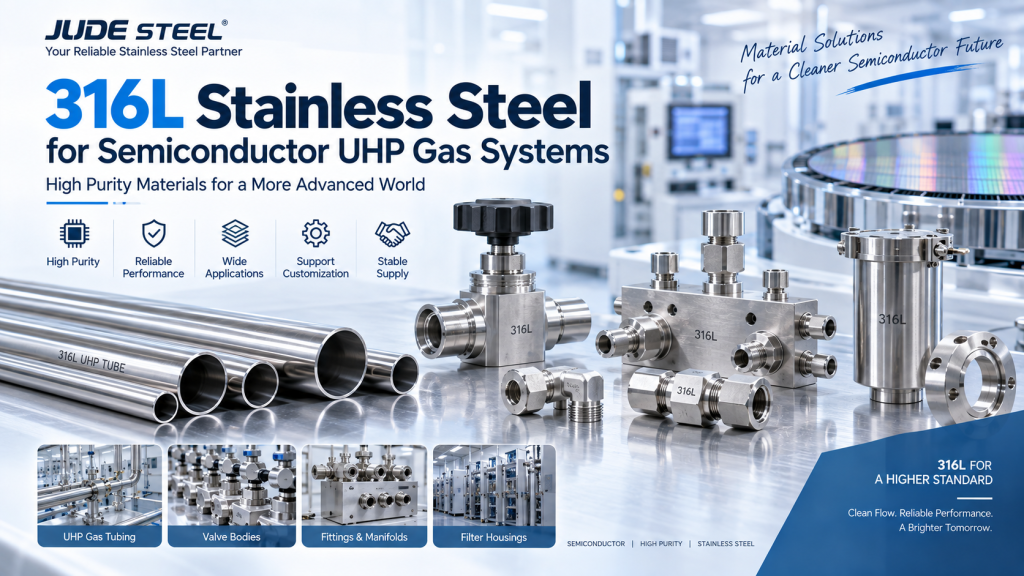
A semiconductor gas line and a stainless steel vacuum chamber may operate
inside the same fabrication facility, but they do not create the same
material specification.
For ultra-high-purity gas delivery, the stainless steel must be evaluated
not only for corrosion resistance and weldability, but also for material
cleanliness, wetted-surface condition, fabrication and contamination control.
Type 316L / UNS S31603 is widely used for semiconductor gas-delivery
components, including tubing, valves, fittings and manifolds.
However, writing only “316L semiconductor grade” is not
a complete purchasing specification.
This guide explains how to connect:
UHP gas component → raw-material form → ASTM product standard →
SEMI F20 → SEMI F19 → surface condition → inspection → RFQ.
Quick Answer: Which Semiconductor Gas Components Use 316L?
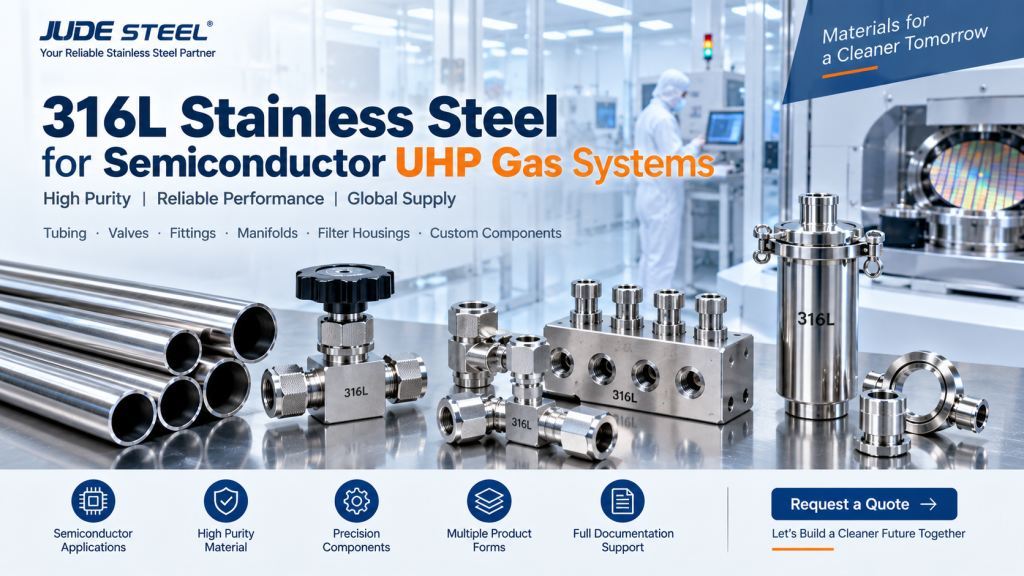 Subject to the equipment design, process gas and applicable facility
specification, Type 316L may be used to manufacture selected:
- ultra-high-purity gas tubing;
- gas valve bodies;
- face-seal fitting bodies and glands;
- gas manifold blocks;
- gas-stick components;
- filter housings;
- regulator and pressure-control bodies;
- purifier or distribution-system housings;
- chemical-distribution components;
- other wetted stainless steel parts in semiconductor gas or liquid delivery systems.
This does not mean that every visible stainless steel part in a gas cabinet
must be 316L.
Frames, panels, brackets and other non-wetted structures may follow different
material requirements.
The product-contact or gas-contact boundary should therefore be clearly
identified on the drawing or bill of materials.
Why Ordinary 316L Is Not the Same as SEMI F20 Material
SEMI F20 is specifically written for 316L stainless steel used to manufacture
components for general-purpose, high-purity and ultra-high-purity semiconductor
chemical-distribution systems.
The standard addresses more than the generic commercial alloy name.
It defines material-composition and metallurgical-cleanliness requirements
for relevant 316L product forms.
Therefore:
ASTM 316L material should not automatically be described as
SEMI F20-compliant material.
If the semiconductor project requires SEMI F20, the purchase order should
state the requirement explicitly and the supplier should confirm the required
documentation and material route.
Official reference:
SEMI F20 — 316L Stainless Steel for Semiconductor Chemical Distribution Components
.
316L Grade Designations and Product Standards
| Product / System | Grade / Standard | Purchasing Note |
|---|---|---|
| Common alloy | Type 316L / UNS S31603 | Low-carbon Cr-Ni-Mo austenitic stainless steel |
| European reference | EN 1.4404 / X2CrNiMo17-12-2 | Use with the applicable EN product specification |
| Japanese reference | JIS SUS316L | Use with the applicable JIS product specification |
| Plate stock | ASTM A240/A240M S31603 | Referenced by SEMI F20 for applicable plate stock |
| Bar | ASTM A276 S31603 where specified | Relevant to machined bodies and component blanks |
| Forging | ASTM A182/A182M where specified | Relevant to forged pressure or fitting components |
| General tubing | ASTM A269/A269M TP316L | One of the tubing specifications referenced by SEMI F20 |
| Small-diameter tubing | ASTM A632 TP316L where applicable | Relevant to smaller-diameter tubing covered by the specification |
| Semiconductor material requirement | SEMI F20 | Composition and metallurgical-cleanliness requirements |
| Wetted-surface requirement | SEMI F19 | Surface characterization and acceptance requirements |
The material grade, product standard and semiconductor-industry specification
perform different functions.
Writing only:
“316L EP tube”
does not identify all three.
For general grade information, see:
JUDE Steel 316L Stainless Steel
.
Which UHP Gas Delivery Components Use 316L?
1. UHP Gas Tubing
Tubing forms the primary flow path in many semiconductor gas-distribution
systems.
For a high-purity or ultra-high-purity installation, the tube specification
can need to control:
- exact alloy and material standard;
- outside diameter;
- wall thickness;
- seamless or welded construction where permitted;
- heat treatment;
- internal surface condition;
- electropolishing where specified;
- cleaning;
- packaging;
- material traceability;
- particle and surface requirements where applicable.
ASTM A269 is a general tubing specification.
Its presence on an MTC does not by itself establish SEMI F20 material
cleanliness or SEMI F19 finished-surface compliance.
2. Valve Bodies
Gas valves can use machined or forged 316L bodies depending on design.
Possible starting materials include:
- bar stock;
- forgings;
- precision-machined blanks;
- other design-approved product forms.
The buyer should identify whether SEMI F20 applies to the starting material
and which finished wetted-surface requirements apply after machining,
cleaning and passivation.
A valve body produced from compliant material is not automatically a
qualified semiconductor valve.
3. Face-Seal Fittings and Glands
High-purity gas systems often use metal face-seal connections and other
precision fittings.
For these components, procurement may need to control:
- starting material;
- material cleanliness;
- machining quality;
- sealing-face geometry;
- wetted-surface finish;
- cleaning;
- packaging;
- traceability.
The material certificate does not replace dimensional or leak-testing
requirements for the finished fitting.
4. Gas Manifold Blocks
A gas manifold can contain multiple machined flow passages and valve interfaces.
Depending on the design, a manifold body may begin from:
- 316L bar;
- forged stock;
- extruded stock;
- another approved starting form.
Internal passages are part of the wetted surface.
Their final condition should therefore be evaluated after machining,
cleaning and any specified surface treatment.
5. Filter Housings
High-purity gas filtration assemblies can use 316L stainless steel housings.
The housing material, filter medium, welding, cleaning and final testing
should be specified separately.
Do not assume that a 316L housing makes the complete filter assembly suitable
for every corrosive or ultra-high-purity gas.
6. Regulator and Pressure-Control Components
Selected regulator bodies and pressure-control components can also use 316L.
Material selection should consider:
- actual process gas;
- pressure;
- temperature;
- corrosion compatibility;
- particle requirements;
- surface specification;
- seat and diaphragm materials;
- final component qualification.
Component-to-Raw-Material Procurement Matrix
| Finished Component | Possible Starting Material | Main Material Requirement | Separate Finished-Part Requirement |
|---|---|---|---|
| UHP gas tube | TP316L tubing | ASTM A269/A632 + SEMI F20 where specified | Surface, cleaning, particle and packaging requirements |
| Valve body | Bar / forging | 316L + applicable product standard + F20 where required | Machining, wetted finish, leak and function tests |
| Face-seal fitting | Bar / forging | Material cleanliness and traceability | Seal geometry, surface and leak performance |
| Manifold body | Bar / forging / approved blank | 316L material route and cleanliness | Internal passages, surface, cleaning and leak testing |
| Filter housing | Tube / bar / forging | Product standard and project material specification | Assembly cleanliness, filter specification and final testing |
| Gas-cabinet structural panel | Sheet | Project structural/material requirement | Not automatically an F20 wetted component |
ASTM A269 vs ASTM A632 vs ASTM A270
ASTM A269
ASTM A269/A269M covers seamless and welded austenitic stainless steel tubing
for general corrosion-resisting and low- or high-temperature service.
It is one of the tubing specifications referenced by SEMI F20.
Official reference:
ASTM A269/A269M
.
ASTM A632
ASTM A632 covers small-diameter seamless and welded austenitic stainless
steel tubing for general service.
It is also referenced by SEMI F20 for applicable tubing.
A632 is relevant only when the size and product fall within its actual scope.
The buyer should not add A632 to every semiconductor tube order regardless
of diameter.
ASTM A270
ASTM A270 is a sanitary-tubing specification commonly associated with food,
dairy and hygienic process systems.
It should not be treated as the default semiconductor UHP tubing standard
simply because it can also include TP316L.
Purchasing rule:
use the product standard required by the semiconductor gas-system
specification rather than choosing a tube standard from the alloy name alone.
SEMI F20 vs SEMI F19
SEMI F20 and SEMI F19 address different stages of the supply chain.
| Requirement | Primary Focus | What It Does Not Automatically Prove |
|---|---|---|
| SEMI F20 | 316L composition and metallurgical cleanliness for relevant raw-material forms | Finished wetted-surface acceptance |
| SEMI F19 | Surface characterization and acceptance of wetted stainless steel surfaces | All raw-material chemistry and metallurgical requirements by itself |
Therefore, the following statement is incomplete:
316L valve body, SEMI compliant.
A professional purchase order should identify which SEMI document applies
to the raw material, which applies to the finished surface and which additional
component tests are required.
Official references:
Why Surface Roughness Alone Is Not Enough
Surface roughness is important in high-purity gas-delivery components,
but one Ra value does not describe the complete surface condition.
Depending on the project, surface qualification can also consider:
- surface chemistry;
- oxide condition;
- embedded contamination;
- particles;
- defects;
- cleanliness;
- passivation condition;
- inspection method.
SEMI F19 references specialized SEMI methods addressing areas including
surface roughness, surface composition, oxide-layer evaluation and
microscopic surface examination.
For this reason, an RFQ that states only:
316L EP, Ra 10 microinch
may still be technically incomplete.
The buyer should define the actual surface specification and acceptance
method required by the project.
Electropolishing and Passivation
Electropolishing can be used to improve the microscopic condition of a
stainless steel surface and is widely associated with high-purity stainless
components.
However:
electropolished does not mean automatically SEMI F19 compliant.
The complete surface-processing route can include:
- machining;
- mechanical finishing where specified;
- cleaning;
- electropolishing;
- passivation;
- final rinsing;
- drying;
- inspection;
- clean packaging.
The final acceptance criteria should follow the customer or semiconductor
equipment specification.
A raw-material supplier should not guarantee the performance of an
electropolished finished component unless that processing and inspection
are explicitly included in the agreed scope.
Welding and Orbital-Weld Cleanliness
316L is widely used in welded high-purity tubing systems because its low
carbon content reduces sensitization-related risk.
That does not make every 316L weld suitable for semiconductor gas service.
The welding specification can need to control:
- tube-end preparation;
- joint alignment;
- purge-gas quality;
- weld penetration;
- internal oxidation;
- heat tint;
- surface contamination;
- inspection;
- post-weld cleaning where specified.
SEMI also publishes dedicated practices and inspection documents for
semiconductor fluid-distribution welding.
The finished-system welding requirement should therefore remain separate
from the raw-tube material certificate.
Material Cleanliness vs Final-System Cleanliness
A clean steel heat does not create a clean gas system by itself.
Contamination can be introduced during:
- cutting;
- machining;
- welding;
- polishing;
- handling;
- cleaning;
- assembly;
- packaging;
- installation.
This is why semiconductor procurement should separate:
- raw-material qualification;
- component fabrication;
- wetted-surface qualification;
- clean packaging;
- final system testing.
A Mill Test Certificate answers only part of that chain.
316L vs 304L in Semiconductor Equipment
304L and 316L should not be treated as a universal quality ranking.
304L can be relevant to selected vacuum chambers, enclosures and structural
equipment components where the design approves it.
316L becomes especially important in high-purity chemical and gas-delivery
systems because industry specifications such as SEMI F20 are specifically
written around 316L material.
The two materials therefore often occupy different functional zones:
- 304L: selected chamber bodies, covers and structural equipment where approved;
- 316L: selected wetted UHP gas or chemical-distribution components where the specification requires it.
Do not substitute one for the other solely because both are low-carbon
austenitic stainless steels.
What Should a Semiconductor 316L RFQ Include?
- Finished component: tube, valve body, fitting, manifold, filter housing or regulator component.
- System: general purpose, high purity or ultra-high purity.
- Process medium: identify the gas or chemical.
- Material: Type 316L / UNS S31603.
- SEMI F20: required or not required.
- Product standard: ASTM A269, A632, A276, A182, A240 or another approved standard.
- Product form: tubing, bar, forging, plate or machined blank.
- Dimensions: OD, wall, diameter, thickness, width or blank dimensions.
- Wetted-surface requirement: identify SEMI F19 or customer specification where applicable.
- Surface roughness: state the exact requirement and test method where specified.
- Electropolishing: required or not required.
- Passivation: state the applicable requirement.
- Cleaning: state the cleaning specification where applicable.
- Packaging: clean packaging requirement.
- Welding: state orbital-welding or fabrication requirements where relevant.
- PMI: required or not required.
- Material cleanliness documentation: state required evidence.
- MTC: state certificate and traceability requirements.
- Surface inspection: define the required method and acceptance criteria.
- Particle testing: where required by the project.
- Quantity: prototype, production quantity or annual demand.
- Drawing: include the current approved drawing.
- Destination: country, plant or delivery location.
Example Semiconductor UHP 316L RFQ
Application: Semiconductor UHP Gas Distribution Component
Component: Machined Valve Body Blank
Material: Type 316L / UNS S31603
Semiconductor Requirement: SEMI F20 per project specification
Starting Material: ASTM A276 bar or ASTM A182 forging as identified on drawing
Dimensions: Approved blank drawing attached
Process Gas: Gas compatibility information attached
Wetted Surface: Final component requirements per SEMI F19 / customer specification
Electropolishing: Final-component requirement to be performed by approved processor unless otherwise stated
Surface Roughness: Per approved component specification
Cleaning: Final-cleaning requirement attached
Packaging: Clean packaging per customer specification
Traceability: Full material heat / lot traceability required
Documentation: MTC + specified F20 material documentation
Quantity: Prototype and annual demand listed in BOM
Destination: Customer semiconductor equipment facility
This inquiry is much more useful than:
Please quote semiconductor-grade 316L.
Incoming Inspection and Documentation
Depending on the project, incoming inspection can include:
- Type 316L / UNS S31603 verification;
- product-standard verification;
- heat or lot number;
- Mill Test Certificate;
- SEMI F20 documentation where required;
- chemical analysis;
- metallurgical-cleanliness documentation;
- dimensions;
- surface condition;
- PMI where specified;
- traceability through cutting or machining.
For a finished wetted component, additional inspection can be required
under SEMI F19 or the customer specification.
The incoming raw-material certificate should not be used as evidence that
the finished valve, fitting or manifold has passed all surface, cleanliness,
particle or leak requirements.
JUDE publishes:
Inspection Reports
and
Certification Information
for buyers reviewing available documentation.
How JUDE Steel Supports Semiconductor Material Procurement
JUDE Steel lists Type 316L across its stainless steel flat-product and
processing portfolio.
Relevant resources include:
316L Stainless Steel
316L Stainless Steel Sheet & Plate
316L Stainless Steel Strip
Processing Services & Capabilities
Inspection Reports
Semiconductor-specific 316L tubing, bar, forging, melt route, SEMI F20
documentation, electropolished surface and ultra-high-purity packaging
requirements must be confirmed separately for each inquiry.
A general JUDE 316L product listing should not be treated as proof that
every SEMI F20 or F19 requirement is available from stock.
Frequently Asked Questions
Is ordinary ASTM 316L automatically SEMI F20 compliant?
No. SEMI F20 includes semiconductor-specific requirements for 316L material
composition and metallurgical cleanliness. State F20 explicitly when the
project requires it.
What is the difference between SEMI F20 and SEMI F19?
F20 addresses the 316L raw material used for semiconductor chemical-distribution
components. F19 addresses characterization and acceptance of the finished
wetted stainless steel surface.
Should semiconductor UHP tubing be ASTM A269 or ASTM A270?
SEMI F20 specifically references ASTM A269 and ASTM A632 for applicable tubing.
ASTM A270 is a sanitary tubing specification and should not automatically
replace the semiconductor project requirement.
Does electropolished 316L automatically meet SEMI F19?
No. Electropolishing is a surface-processing step. F19 can require broader
surface characterization and acceptance criteria. Compliance should be
verified against the specified standard and test requirements.
Is there one universal Ra value for semiconductor 316L tubing?
No single value should be assumed for every system. Specify the surface class,
roughness requirement and measurement method required by the semiconductor
equipment or facility specification.
Can 304L replace 316L in a semiconductor gas system?
Not automatically. SEMI F20 is specifically written around 316L for relevant
high-purity chemical-distribution components. Any substitution requires
engineering and customer approval.
Can the gas-cabinet frame use a different stainless grade from the wetted tubing?
Yes, depending on the design. A structural frame is not automatically part
of the wetted UHP gas path. Materials should be specified component by component.
Does an MTC prove the complete gas component is UHP qualified?
No. An MTC documents raw-material information. Final surface condition,
cleaning, particles, welding, leakage and functional qualification are
separate requirements.
What should I send JUDE Steel for a semiconductor 316L quotation?
Send the finished-component drawing, product form, exact material and ASTM
standard, SEMI F20/F19 requirements, dimensions, surface requirement,
electropolishing and cleaning requirements, inspection documentation,
quantity and destination.
Request 316L Material for Semiconductor Gas Systems
Sourcing 316L raw material for UHP gas tubing, valve bodies, fittings,
manifolds or filter housings?
Send JUDE Steel your:
Component Drawing + UNS Grade + Product Standard + Product Form +
Dimensions + Quantity + Destination
For semiconductor high-purity projects, also include:
SEMI F20 / F19 Requirement + Surface / Ra Specification +
Electropolishing / Passivation + Cleaning + Packaging +
Inspection and Traceability Requirements
Technical note:
This article is intended for preliminary raw-material screening and
procurement guidance. Final semiconductor-system suitability depends on the
specific process gas or chemical, material specification, metallurgical
cleanliness, surface condition, fabrication, welding, cleaning, packaging,
particle control and equipment qualification requirements. Ordinary Type
316L / UNS S31603 should not be represented as SEMI F20- or F19-compliant
without the required documented evidence.
