
Stainless Steel Plate vs Sheet: What’s the Difference?
Stainless steel is widely used in construction, manufacturing, food processing, and industrial equipment due to its excellent corrosion resistance, durability, and strength. However, when purchasing stainless steel materials, many buyers encounter two common forms: stainless steel plates and stainless steel sheets.
Although these two products may appear similar, they differ in thickness, manufacturing processes, applications, and mechanical properties. Understanding the difference between stainless steel plate and sheet helps engineers, procurement professionals, and manufacturers select the right material for their projects.
What Is Stainless Steel Sheet?
A stainless steel sheet refers to a thin, flat piece of stainless steel that is typically produced through cold rolling processes. Sheets are commonly used in applications where lightweight materials and precision surface finishes are required.
Typical Characteristics of Stainless Steel Sheet
- Thickness generally less than 6 mm
- Smooth and uniform surface finish
- Easy to cut, bend, and fabricate
- Available in finishes such as 2B, BA, mirror, brushed, and patterned
Common Applications
- Kitchen equipment and appliances
- Automotive panels
- Architectural decoration
- Electronic enclosures
- Food processing equipment
What Is Stainless Steel Plate?
A stainless steel plate is a thicker and stronger flat stainless steel product designed for heavy-duty applications. Plates are usually produced through hot rolling processes and are used where high strength and structural performance are required.
Typical Characteristics of Stainless Steel Plate
- Thickness usually 6 mm or greater
- Higher structural strength
- Better load-bearing capacity
- Often used in industrial environments
Common Applications
- Pressure vessels
- Shipbuilding
- Heavy machinery
- Industrial tanks and reactors
- Structural engineering
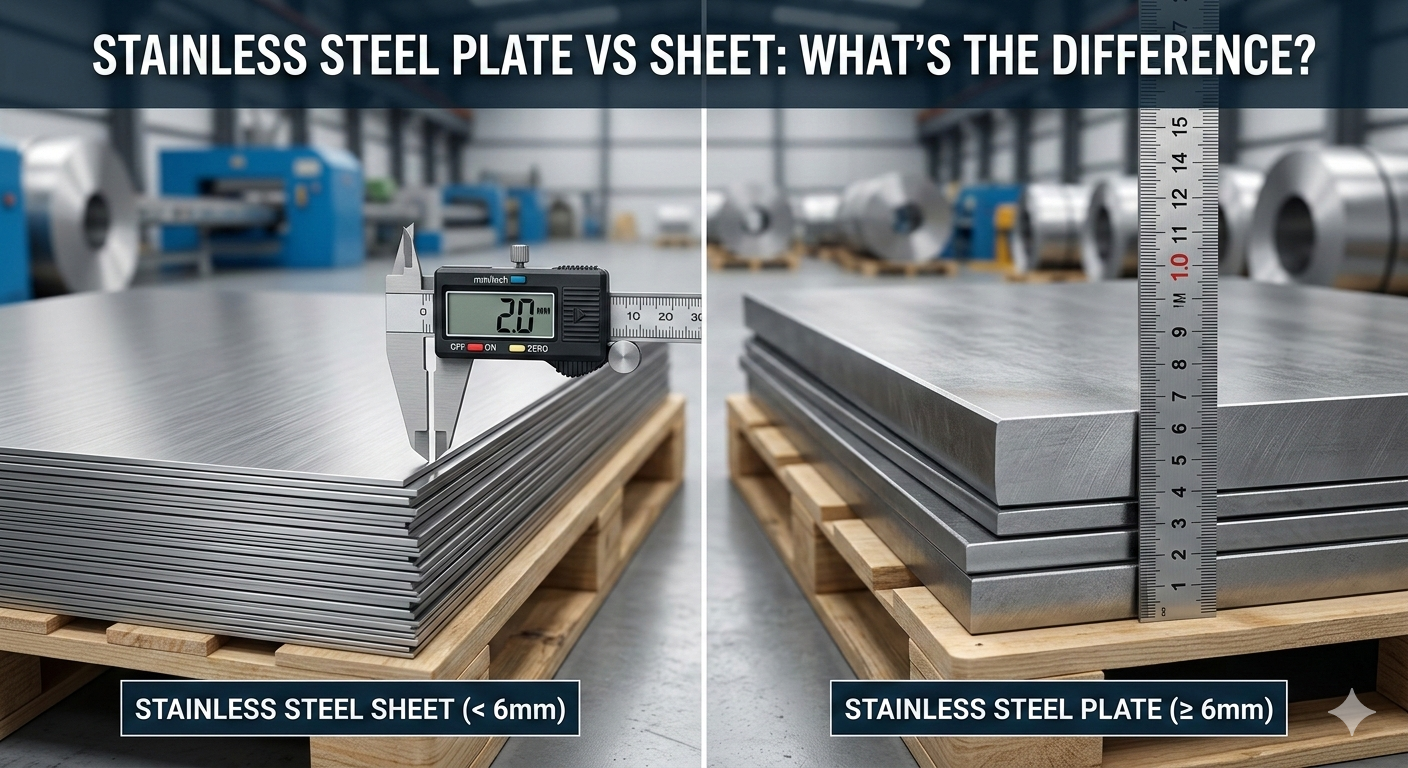
Key Differences Between Stainless Steel Plate and Sheet
| Feature | Stainless Steel Sheet | Stainless Steel Plate |
|---|---|---|
| Thickness | Typically less than 6 mm | Typically 6 mm or thicker |
| Manufacturing Process | Mostly cold rolled | Mostly hot rolled |
| Strength | Moderate strength | High structural strength |
| Weight | Lighter | Heavier |
| Typical Applications | Appliances, decoration, automotive | Heavy industry, shipbuilding, pressure vessels |
| Surface Finish | Wide variety of decorative finishes | Usually industrial finish |
How to Choose Between Stainless Steel Plate and Sheet
Selecting between stainless steel sheet and plate depends on the specific requirements of the project. Several factors should be considered before making a decision.
1. Thickness Requirement
If the application requires thin materials for fabrication or forming, stainless steel sheets are the preferred choice. For structural or load-bearing applications, stainless steel plates provide the necessary strength.
2. Mechanical Strength
Projects involving heavy loads, high pressure, or industrial environments typically require stainless steel plates due to their superior mechanical performance.
3. Surface Appearance
When visual appearance and surface finish are important, such as in architectural or decorative uses, stainless steel sheets offer more finishing options.
4. Fabrication Needs
Sheets are easier to cut, bend, and shape, making them ideal for precision manufacturing and custom fabrication.
Common Stainless Steel Grades Used for Plates and Sheets
Both stainless steel sheets and plates are available in a variety of stainless steel grades depending on the required corrosion resistance and strength.
- 304 Stainless Steel – The most widely used grade with excellent corrosion resistance.
- 316 Stainless Steel – Superior corrosion resistance, especially in marine and chemical environments.
- 430 Stainless Steel – A cost-effective ferritic stainless steel often used in appliances.
- 321 Stainless Steel – Heat-resistant stainless steel used in high-temperature environments.
Conclusion
Although stainless steel plate and stainless steel sheet may look similar, the key difference lies in thickness and intended applications. Sheets are thinner and suitable for precision fabrication and decorative uses, while plates are thicker and designed for heavy-duty structural and industrial applications.
Understanding these differences ensures that engineers and buyers choose the most suitable stainless steel material for their projects, improving both performance and cost efficiency.
FAQ
1. What thickness defines stainless steel sheet and plate?
In most industrial standards, stainless steel sheets are defined as materials with a thickness below approximately 6 mm, while plates are generally 6 mm or thicker.
2. Is stainless steel plate stronger than sheet?
Yes. Stainless steel plates are thicker and therefore offer greater structural strength and load-bearing capacity compared with sheets.
3. Can stainless steel sheets be used for structural applications?
Sheets can be used for light structural applications, but for heavy loads or high-pressure environments, stainless steel plates are usually recommended.
4. Are stainless steel sheets easier to fabricate?
Yes. Stainless steel sheets are easier to cut, bend, stamp, and shape, making them suitable for manufacturing processes that require precise fabrication.
5. Which stainless steel grades are commonly used for plates and sheets?
Common grades include 304, 316, 430, and 321 stainless steel, each offering different levels of corrosion resistance, strength, and temperature tolerance.
