
AISI 441 vs 304 Stainless Steel: Heat Resistance, Corrosion, Cost & Applications
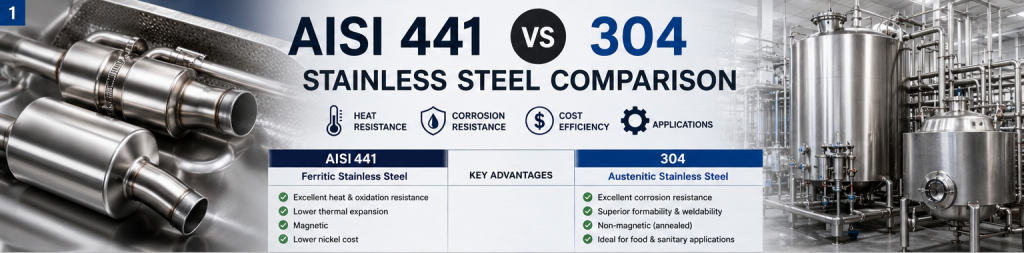
Choosing between AISI 441 stainless steel and 304 stainless steel is a common decision for automotive manufacturers, appliance producers, engineering contractors, fabricators and industrial buyers. Both grades belong to the stainless steel family, but their performance advantages are very different.
AISI 441 is a stabilized ferritic stainless steel designed for heat resistance, thermal fatigue resistance, low thermal expansion and cost efficiency. 304 stainless steel is a chromium-nickel austenitic stainless steel widely used for corrosion resistance, formability, hygiene and decorative surface quality.
This guide compares AISI 441 vs 304 stainless steel from the perspective of chemical composition, structure, corrosion resistance, heat resistance, thermal expansion, weldability, cost and real-world applications. For more stainless steel knowledge, visit the Jude Steel Knowledge Center.
Fast Comparison: AISI 441 vs 304 Stainless Steel
| Feature | AISI 441 Stainless Steel | 304 Stainless Steel |
|---|---|---|
| Steel Family | Ferritic stainless steel | Austenitic stainless steel |
| Magnetism | Magnetic | Usually non-magnetic in annealed condition |
| Nickel Content | Very low or minimal | Approximately 8.0%–10.5% |
| Corrosion Resistance | Good in mild environments | Excellent general corrosion resistance |
| Heat Resistance | Excellent for thermal cycling | Good, but higher thermal expansion |
| Formability | Good for many formed parts | Superior for deep drawing and complex forming |
| Cost | Lower and more stable because of low nickel content | Higher due to nickel content |
| Typical Applications | Automotive exhaust, mufflers, heat shields, thermal equipment | Food equipment, kitchen systems, tanks, architecture, decorative panels |
1. What Is AISI 441 Stainless Steel?
AISI 441 stainless steel is a ferritic stainless steel grade with high chromium content and stabilization elements such as titanium and niobium. These additions help improve weldability, high-temperature stability and resistance to intergranular corrosion.
Unlike 304 stainless steel, AISI 441 contains little or no nickel. This makes it a cost-efficient stainless steel solution for applications where oxidation resistance, heat stability and dimensional control are more important than maximum corrosion resistance.
You can view the related grade page here: AISI 441 Stainless Steel Grade.
Main Features of AISI 441
- Ferritic stainless steel structure
- Magnetic material
- Stabilized with titanium and niobium
- Good weldability compared with ordinary ferritic stainless steels
- Excellent high-temperature oxidation resistance
- Lower thermal expansion than austenitic stainless steels
- Good thermal fatigue resistance
- Cost advantage due to low nickel content
- Commonly used in automotive exhaust systems and heat-resistant components
2. What Is 304 Stainless Steel?
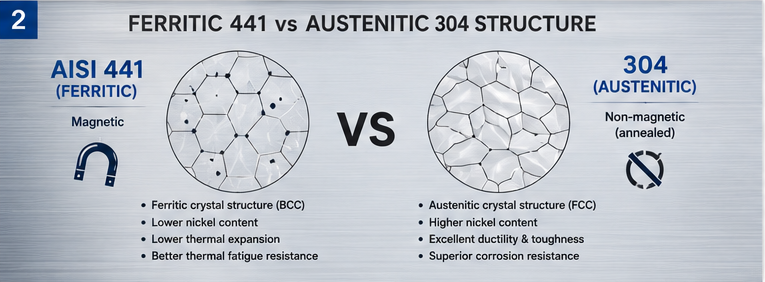
304 stainless steel is a chromium-nickel austenitic stainless steel and one of the most widely used stainless steel grades in the world. It offers excellent corrosion resistance, formability, weldability, ductility and surface appearance.
304 stainless steel is commonly supplied as sheet, plate, coil, strip, pipe and fabricated products. Jude Steel supplies stainless steel sheet, stainless steel coil and customized stainless steel processing services for global industrial buyers.
Main Features of 304 Stainless Steel
- Excellent general corrosion resistance
- Superior ductility and deep drawing performance
- Good weldability
- Hygienic and easy to clean
- Suitable for polished, brushed and decorative finishes
- Widely used in food, kitchen, architectural and industrial applications
3. Chemical Composition Comparison
Chemical composition is the foundation of the performance difference between AISI 441 and 304 stainless steel. 304 relies on chromium and nickel for corrosion resistance and ductility, while AISI 441 uses chromium plus titanium and niobium stabilization for heat stability and improved weld performance.
| Element | AISI 441 Stainless Steel | 304 Stainless Steel |
|---|---|---|
| Chromium (Cr) | Approximately 17.0%–19.5% | Approximately 18.0%–20.0% |
| Nickel (Ni) | Low or minimal | Approximately 8.0%–10.5% |
| Carbon (C) | Low carbon, typically ≤0.03% | ≤0.08% |
| Titanium (Ti) | Added for stabilization | Usually not added |
| Niobium (Nb) | Added for stabilization | Usually not added |
| Microstructure | Ferritic | Austenitic |
| Magnetic Property | Magnetic | Usually non-magnetic in annealed condition |
Why Titanium and Niobium Stabilization Matters
Titanium and niobium help bind carbon during heating and welding. This reduces the risk of chromium carbide precipitation, improves weld-area stability and helps maintain corrosion resistance after thermal exposure.
This stabilization design is one of the key reasons AISI 441 is frequently used in automotive exhaust systems, mufflers, catalytic converter shells and other heat-cycle components.
4. Mechanical Properties Comparison
Both AISI 441 and 304 stainless steel offer reliable mechanical performance, but they are optimized for different manufacturing requirements.
| Property | AISI 441 Stainless Steel | 304 Stainless Steel |
|---|---|---|
| Yield Strength | Generally higher than annealed 304 | Moderate |
| Tensile Strength | Good | Excellent |
| Ductility | Moderate to good | Excellent |
| Deep Drawing | Limited compared with 304 | Excellent |
| Thermal Expansion | Lower | Higher |
| Thermal Fatigue Resistance | Excellent | Good |
304 stainless steel is usually easier to form into complex shapes because of its excellent ductility. AISI 441 provides better dimensional stability under heat because ferritic stainless steels generally have lower thermal expansion.
5. Corrosion Resistance: Which Grade Performs Better?
304 stainless steel generally offers better all-around corrosion resistance. It performs well in atmospheric environments, food processing equipment, commercial kitchen systems, fresh water, architectural applications and many mild chemical environments.
AISI 441 also provides good corrosion resistance in mild environments, but it is not primarily selected for aggressive corrosion service. Its key advantage is high-temperature oxidation resistance and thermal cycling stability.
| Environment | Better Choice | Reason |
|---|---|---|
| Food processing equipment | 304 Stainless Steel | Better hygiene, cleanability and general corrosion resistance |
| Commercial kitchen equipment | 304 Stainless Steel | Good surface finish and long-term cleaning resistance |
| Automotive exhaust system | AISI 441 | Better thermal cycling performance and cost efficiency |
| High-temperature oxidation | AISI 441 | Excellent heat stability and lower expansion |
| Decorative architectural panels | 304 Stainless Steel | Better polishability and surface appearance |
| Marine or chloride-rich environment | 316L or Duplex Stainless Steel | Higher chloride corrosion resistance is required |
For marine or chloride-rich environments, 304 may not be enough. In that case, 316L or duplex stainless steel should be considered. You can also read Jude Steel’s related article: 316 vs 316L Stainless Steel.
6. Heat Resistance and Thermal Stability
Heat resistance is where AISI 441 shows one of its strongest advantages. Because of its ferritic structure and stabilization design, AISI 441 performs well under repeated heating and cooling cycles.
AISI 441 Heat Performance
- Excellent resistance to high-temperature oxidation
- Good resistance to thermal fatigue
- Lower thermal expansion than 304 stainless steel
- Better dimensional stability in exhaust systems
- Suitable for repeated heating and cooling cycles
304 Heat Performance
- Good heat resistance in many industrial conditions
- Better toughness at low and moderate temperatures
- Higher thermal expansion than ferritic grades
- May be less cost-effective in automotive exhaust applications
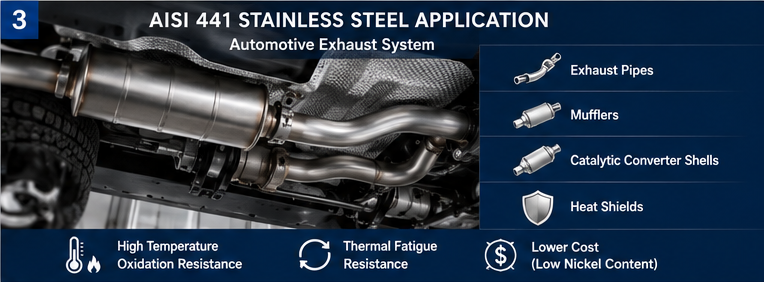
For automotive exhaust systems, mufflers, catalytic converter shells and heat shields, AISI 441 is often more suitable than 304 because it combines high-temperature stability with lower alloy cost.
7. Thermal Expansion: Why It Matters
Thermal expansion describes how much a material changes dimension when heated. In exhaust systems and heat-cycle components, excessive thermal expansion may cause distortion, stress concentration, fatigue cracking and reduced service life.
| Factor | AISI 441 Stainless Steel | 304 Stainless Steel |
|---|---|---|
| Thermal Expansion | Lower | Higher |
| Distortion Under Heat | Lower risk | Higher risk |
| Thermal Fatigue Resistance | Excellent | Good |
| Exhaust System Suitability | Excellent | Moderate to good |
This is another reason why AISI 441 is widely used in automotive exhaust systems and other thermal cycling components.
8. Welding and Fabrication
AISI 441 Weldability
AISI 441 is easier to weld than many unstabilized ferritic stainless steels because titanium and niobium improve weld stability. It is suitable for welded automotive exhaust components, appliance parts and heat-resistant structures.
304 Weldability
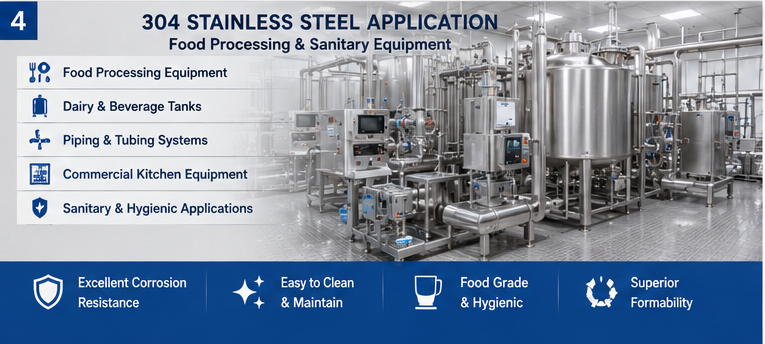
304 stainless steel has excellent general weldability and is easier to fabricate for tanks, sheet metal parts, food equipment, kitchen equipment and architectural products.
For complex forming and deep drawing, 304 is usually the better choice. For heat-resistant welded parts where thermal expansion must be controlled, AISI 441 may deliver better value.
9. Cost Comparison
AISI 441 usually has a cost advantage because it contains little or no nickel. Since nickel prices can fluctuate significantly, 304 stainless steel often has greater price volatility.
| Cost Factor | AISI 441 Stainless Steel | 304 Stainless Steel |
|---|---|---|
| Nickel Cost Exposure | Low | High |
| Raw Material Cost | Lower | Higher |
| Processing Cost | Moderate | Moderate |
| Lifecycle Value | Excellent for heat-resistant applications | Excellent for corrosion, hygiene and forming applications |
The best choice should not be based on raw material price alone. Working environment, product lifespan, maintenance requirements, surface finish expectations and forming complexity should also be considered.
10. Typical Applications of AISI 441 Stainless Steel
- Automotive exhaust pipes
- Mufflers
- Catalytic converter shells
- Heat shields
- High-temperature appliance components
- Burner components
- Thermal cycling structures
- Industrial heat-resistant equipment
11. Typical Applications of 304 Stainless Steel
- Food processing equipment
- Commercial kitchen equipment
- Stainless steel tanks
- Architectural panels
- Decorative stainless steel sheets
- Medical and laboratory equipment
- Water handling systems
- General industrial fabrication
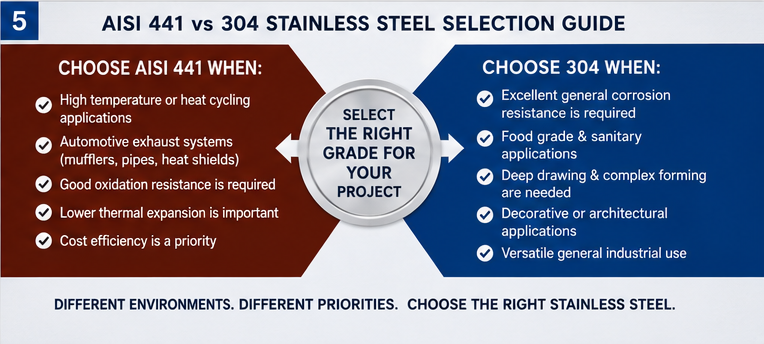
12. AISI 441 vs 304 Stainless Steel: Quick Selection Guide
| Project Requirement | Recommended Grade |
|---|---|
| Automotive exhaust system | AISI 441 |
| Repeated high-temperature cycling | AISI 441 |
| Cost-sensitive heat-resistant components | AISI 441 |
| Food-grade equipment | 304 Stainless Steel |
| Decorative architecture | 304 Stainless Steel |
| Deep drawing and complex forming | 304 Stainless Steel |
| Marine or chloride-rich environment | 316L or Duplex Stainless Steel |

13. Which Grade Should You Choose?
Choose AISI 441 Stainless Steel If:
- You need excellent heat resistance
- The component experiences repeated heating and cooling
- Lower thermal expansion is important
- You want to reduce nickel-related material cost
- The application is automotive exhaust, muffler, heat shield or thermal equipment
Choose 304 Stainless Steel If:
- You need excellent general corrosion resistance
- Food-grade or hygienic performance is required
- Deep drawing or complex forming is important
- The product requires polished or decorative finishing
- You need a universal stainless steel grade for broad industrial use
Frequently Asked Questions
Is AISI 441 better than 304 stainless steel?
AISI 441 is better for high-temperature exhaust systems, thermal cycling and cost-sensitive heat-resistant parts. 304 stainless steel is better for general corrosion resistance, food-grade use, deep drawing and decorative applications.
Is AISI 441 stainless steel magnetic?
Yes. AISI 441 is a ferritic stainless steel, so it is magnetic. 304 stainless steel is usually non-magnetic in the annealed condition, although it may become slightly magnetic after cold working.
Which is more corrosion resistant, AISI 441 or 304 stainless steel?
304 stainless steel generally provides better all-around corrosion resistance in food, water, architectural and mild chemical environments. AISI 441 performs well in high-temperature oxidation and automotive exhaust environments.
Can AISI 441 replace 304 stainless steel?
AISI 441 can replace 304 in selected automotive, appliance and heat-resistant applications. It should not be used as a direct replacement for 304 in food-grade, marine, highly decorative or strongly corrosive applications without engineering evaluation.
Why is AISI 441 used in automotive exhaust systems?
AISI 441 has good high-temperature oxidation resistance, thermal fatigue resistance, low thermal expansion and lower nickel-related cost, making it suitable for exhaust pipes, mufflers and heat shields.
Which grade is more cost-effective?
AISI 441 is usually more cost-effective for heat-resistant applications because it contains little or no nickel. 304 costs more but offers broader corrosion resistance, formability and surface finish options.
Conclusion
AISI 441 and 304 stainless steel are both valuable engineering materials, but they are designed for different purposes. AISI 441 is a stabilized ferritic stainless steel optimized for heat resistance, thermal fatigue resistance, lower thermal expansion and cost efficiency. It is especially suitable for automotive exhaust systems, mufflers, heat shields and high-temperature components.
304 stainless steel is a universal austenitic stainless steel with excellent corrosion resistance, formability, hygienic performance and decorative surface quality. It remains the preferred choice for food processing equipment, kitchen systems, architectural panels, tanks and general industrial fabrication.
For industrial buyers, the right choice depends on the working environment. If heat cycling and cost efficiency are the priority, choose AISI 441. If corrosion resistance, hygiene and formability are critical, choose 304 stainless steel. Jude Steel supplies stainless steel sheets, coils and customized processing services for global buyers. Visit Judesteel.com, explore stainless steel sheet, or check stainless steel coil solutions for your next project.
