
How to Choose Stainless Steel: The Ultimate Selection Guide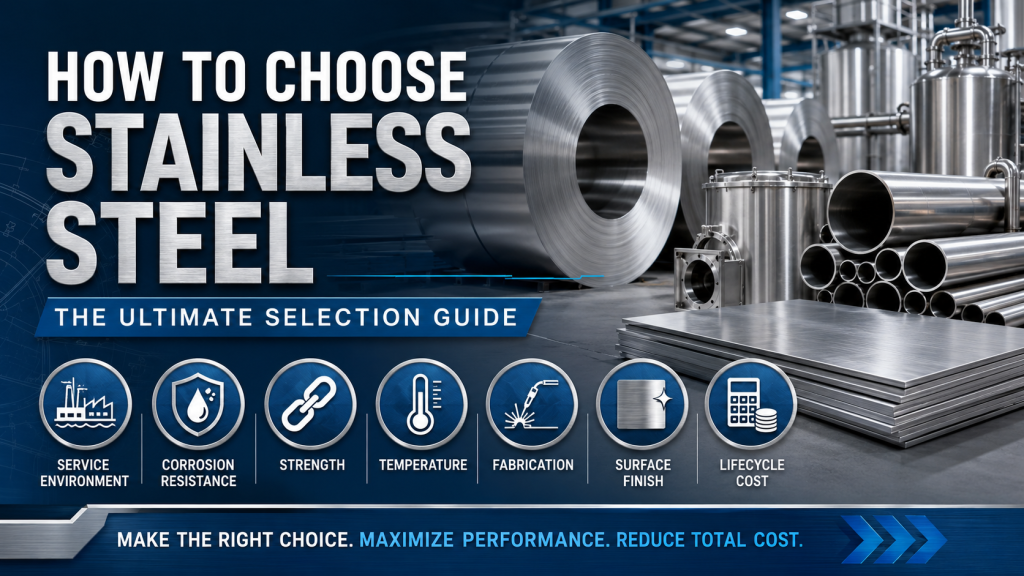
Choosing the right stainless steel grade is one of the most important decisions in any industrial, architectural, marine, food processing, chemical or manufacturing project. The wrong material can lead to rust, pitting, cracking, welding failure, product rejection, high maintenance cost and premature replacement.
The challenge is that there is no single “best” stainless steel for every application. A grade that performs well indoors may fail in a coastal environment. A high-strength duplex grade may be excellent for chloride service but unnecessary for light decorative panels. A heat-resistant grade may work in a furnace but may not be the right choice for seawater.
This guide explains how to choose stainless steel based on service environment, corrosion resistance, mechanical strength, operating temperature, fabrication requirements, surface finish, product form, lifecycle cost and industry standards. For related products, visit stainless steel sheet, stainless steel coil, stainless steel strip and the Jude Steel Stainless Steel Grade Center.
Quick Answer: How to Choose Stainless Steel
The best stainless steel is the grade that matches the real working condition. Before selecting a grade, buyers should confirm where the material will be used, what it will contact, how it will be processed, how long it must last and what failure risks must be avoided.
| Selection Factor | Why It Matters | Typical Grade Direction |
|---|---|---|
| Service environment | Indoor, outdoor, coastal, marine, chemical and high-humidity environments require different corrosion resistance levels | 304, 316L, 2205, 2507, 904L |
| Corrosion resistance | Chlorides, acids, alkalis and cleaning chemicals can cause pitting, crevice corrosion or stress corrosion cracking | 316L, 2205, 2507, 904L, nickel alloys |
| Mechanical strength | Structures, pressure systems and heavy-duty equipment may require higher yield strength | 304, 316L, 2205, 2507, 17-4PH |
| Operating temperature | High temperature can affect oxidation resistance, strength and scaling behavior | 309S, 310S, 321, 347, 253MA |
| Fabrication process | Welding, bending, cutting, forming and polishing affect grade selection | 304, 304L, 316L, 321, 347 |
| Surface finish | Visible products require better appearance, cleanability and surface consistency | 304, 316L, 430, decorative stainless steel |
| Lifecycle cost | The cheapest grade may cost more if it fails, corrodes or needs frequent maintenance | Depends on environment and service life |
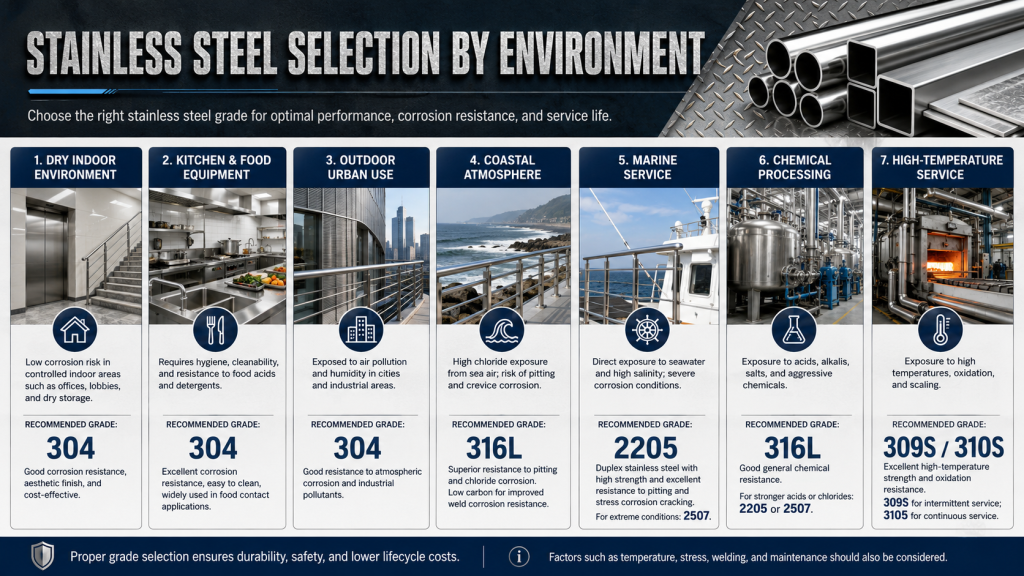
1. Start with the Service Environment
The service environment is often the most important factor in stainless steel selection. Stainless steel resists corrosion because chromium forms a passive oxide layer on the surface, but that passive layer can be damaged by chlorides, acids, high temperature, poor cleaning or unsuitable design.
Questions to Ask First
- Will the stainless steel be used indoors or outdoors?
- Will it be exposed to rain, humidity or salt spray?
- Will chlorides, seawater or de-icing salts be present?
- Will the surface contact food, chemicals, acids or alkalis?
- Will cleaning chemicals be used frequently?
- Will the material operate at high temperature?
- Is the part decorative, structural or pressure-bearing?
- Can the part be easily maintained or replaced?
| Environment | Common Risk | Recommended Grade Direction |
|---|---|---|
| Dry indoor environment | Low corrosion risk | 304, 430, 201 depending on appearance and budget |
| Kitchen and food equipment | Moisture, cleaning, food residues and hygiene requirements | 304, 304L, 316L |
| Outdoor urban environment | Rain, pollution and surface staining | 304 or 316L depending on exposure |
| Coastal atmosphere | Salt spray and chloride pitting | 316L, 2205, 2507 |
| Seawater or marine service | Severe chloride corrosion and crevice corrosion | 2205, 2507, 904L, 254SMO or nickel alloy |
| Chemical processing | Acids, alkalis, chlorides, temperature and process media | 316L, 904L, 2205, 2507 or nickel alloy |
| High-temperature service | Oxidation, scaling and thermal cycling | 309S, 310S, 321, 347, 253MA |
2. Evaluate Corrosion Resistance Requirements
Corrosion resistance is one of the main reasons buyers choose stainless steel. However, corrosion resistance varies greatly between grades. 304 is excellent for many normal environments, but it may not be enough for chloride-rich, marine or chemical service.
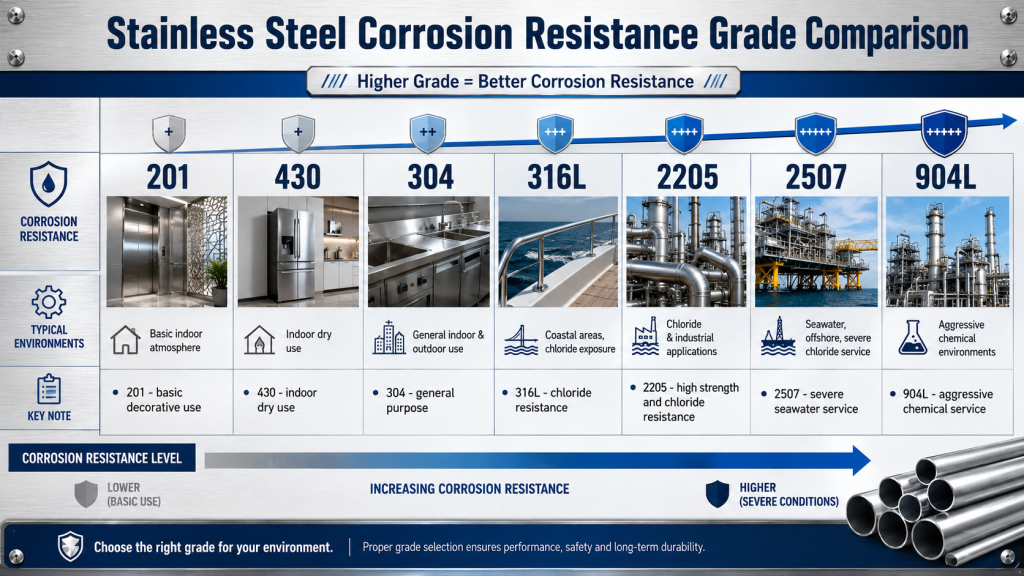
| Grade | Corrosion Resistance Level | Best Use |
|---|---|---|
| 201 / 202 | Basic | Low-cost indoor decorative applications |
| 430 | Good in dry indoor environments | Appliances, indoor panels, decorative sheets |
| 304 | Good general corrosion resistance | Kitchen equipment, tanks, sheets, coils, general fabrication |
| 316L | Very good chloride resistance | Food processing, coastal equipment, chemical equipment, medical equipment |
| 2205 Duplex | Excellent chloride and stress corrosion resistance | Pressure vessels, chemical tanks, heat exchangers, offshore structures |
| 2507 Super Duplex | Outstanding chloride resistance | Seawater, desalination, offshore, severe chloride service |
| 904L / 254SMO | Exceptional in selected severe environments | Chemical processing, acid systems, high-chloride applications |
3. Determine Mechanical Strength Requirements
Some projects only need corrosion resistance and appearance. Others require strength, pressure resistance, impact resistance or structural support. The required strength can change the grade selection.
Austenitic grades such as 304 and 316L provide good toughness and formability. Duplex stainless steels such as 2205 and 2507 offer much higher yield strength and stronger resistance to chloride stress corrosion cracking.
| Mechanical Requirement | Suitable Grade Direction | Typical Applications |
|---|---|---|
| General sheet and coil fabrication | 304, 304L, 316L | Panels, tanks, enclosures, kitchen equipment |
| Higher strength structural parts | 2205, 2507 | Offshore structures, bridges, pressure systems |
| High hardness or wear resistance | 410, 420, 440C | Blades, shafts, wear parts, valve components |
| High strength plus corrosion resistance | 17-4PH, 15-5PH | Aerospace, shafts, fasteners, precision components |
| Spring and elastic performance | 301, 302, 304 spring temper | Springs, clips, washers, formed strip parts |
Strength Selection Tip
- Use 304 or 316L when forming, welding and general corrosion resistance are most important.
- Use 2205 when higher strength and better chloride resistance are required.
- Use martensitic grades when hardness and wear resistance are more important than maximum corrosion resistance.
- Use precipitation hardening grades when high strength and dimensional stability are required.
4. Consider Operating Temperature
Temperature can change stainless steel performance dramatically. A grade that works well at room temperature may oxidize, scale, soften or lose strength at high temperature. For heat service, oxidation resistance, creep strength and thermal cycling must be evaluated.
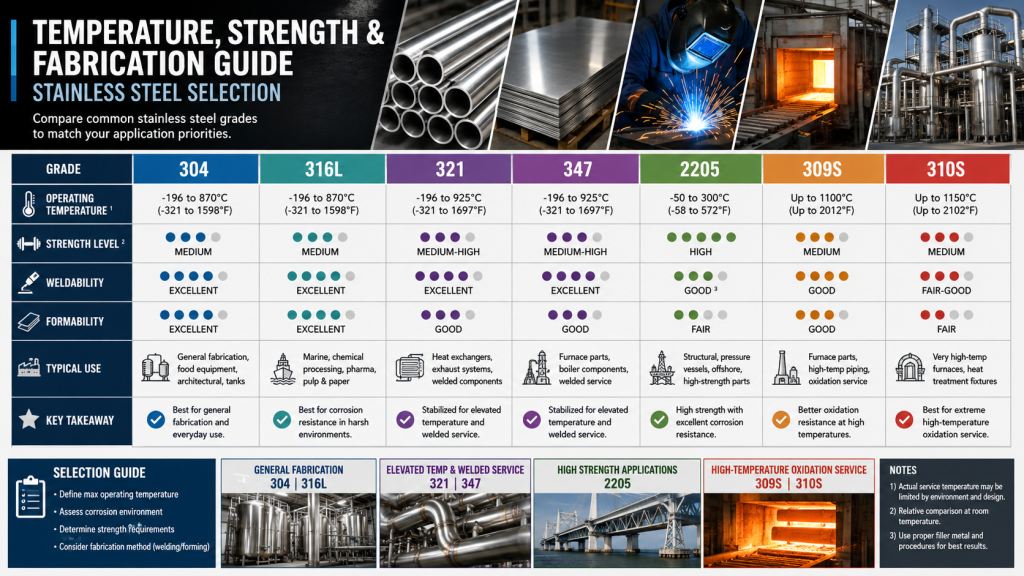
| Temperature Condition | Common Grade Direction | Notes |
|---|---|---|
| Room temperature and normal indoor use | 304, 316L, 430 | Most common applications |
| Moderate heat and intermittent service | 304H, 316H, 321, 347 | Check temperature, stress and welding requirements |
| High-temperature oxidation | 309S, 310S, 253MA | Used for furnaces, heat treatment, burners and thermal equipment |
| Automotive exhaust | 409L, 439, 441 | Ferritic grades are common for exhaust and thermal cycling |
| Extreme heat or special atmosphere | Heat-resistant stainless steel or nickel alloy | Final selection depends on atmosphere, temperature and load |
5. Review Fabrication Requirements
The best grade on paper is not always the easiest grade to process. Welding, bending, deep drawing, machining, polishing, laser cutting and surface finishing can all affect stainless steel selection.
| Fabrication Process | Recommended Grade Direction | Important Consideration |
|---|---|---|
| General welding | 304L, 316L | Low-carbon grades help reduce intergranular corrosion risk |
| Heavy welding or high-temperature exposure | 321, 347, 316Ti | Stabilized grades may improve performance in selected conditions |
| Deep drawing | 304, 304L | Good ductility and formability |
| Bending and sheet fabrication | 304, 316L, 430 | Depends on thickness, bend radius and surface requirement |
| Machining | 303, 416 or suitable machining condition | Free-machining grades may improve productivity but may reduce corrosion resistance |
| Polishing and brushing | 304, 316L, 430 | Surface consistency and raw material quality are important |
| Duplex welding | 2205, 2507 with controlled procedure | Heat input and filler metal must be controlled carefully |
For custom stainless steel processing, Jude Steel provides services such as laser cutting, bending, brushing and polishing.
6. Choose the Right Product Form
Not every stainless steel grade is available in every size, thickness, finish or product form. Before finalizing a grade, buyers should confirm availability in sheet, coil, strip, plate, pipe, tube, bar or custom processed form.
| Product Form | Common Grade Options | Typical Use |
|---|---|---|
| Stainless steel sheet | 304, 316L, 430, 201, 2205 | Panels, enclosures, equipment, decoration, fabrication |
| Stainless steel coil | 304, 316L, 430, 409L, 441 | Mass production, appliances, automotive, roofing, processing |
| Stainless steel strip | 301, 304, 316L, 430 | Springs, clips, gaskets, precision components |
| Stainless steel plate | 304, 316L, 2205, 2507 | Tanks, pressure vessels, structures, chemical equipment |
| Stainless steel pipe / tube | 304, 316L, 321, 2205 | Pipelines, heat exchangers, fluid systems, structural tubing |
| Stainless steel bar | 304, 316L, 410, 420, 17-4PH | Shafts, fasteners, machined parts, valve components |
Product Form Checklist
- Grade
- Thickness or diameter
- Width and length
- Surface finish
- Edge condition
- Tolerance
- Heat treatment condition
- Certificate requirement
- Packaging and export requirement
7. Consider Surface Finish and Appearance
Surface finish affects appearance, cleanability, corrosion behavior and downstream processing. Decorative applications require consistent color, texture and surface quality. Food equipment requires smooth, cleanable surfaces. Industrial parts may only need a functional finish.
| Surface Finish | Typical Use | Common Grade Options |
|---|---|---|
| 2B | General sheet and coil, equipment, fabrication | 304, 316L, 430 |
| BA | Bright decorative surfaces, appliances, kitchen panels | 304, 430 |
| No.4 / Brushed | Elevator panels, kitchen equipment, architectural decoration | 304, 316L, 430 |
| Hairline | Decorative panels, interior design, high-end appliance surfaces | 304, 316L, 430 |
| Mirror finish | Decorative projects, signage, interior panels | 304, 316L |
| Pickled surface | Hot rolled plate, industrial and structural applications | 304, 316L, 2205 |
8. Compare Lifecycle Cost, Not Just Purchase Price
Many buyers focus only on the initial price per ton. This can be risky. A cheaper grade may require more maintenance, fail earlier or cause product rejection. A more expensive grade may reduce downtime, extend service life and lower total cost.
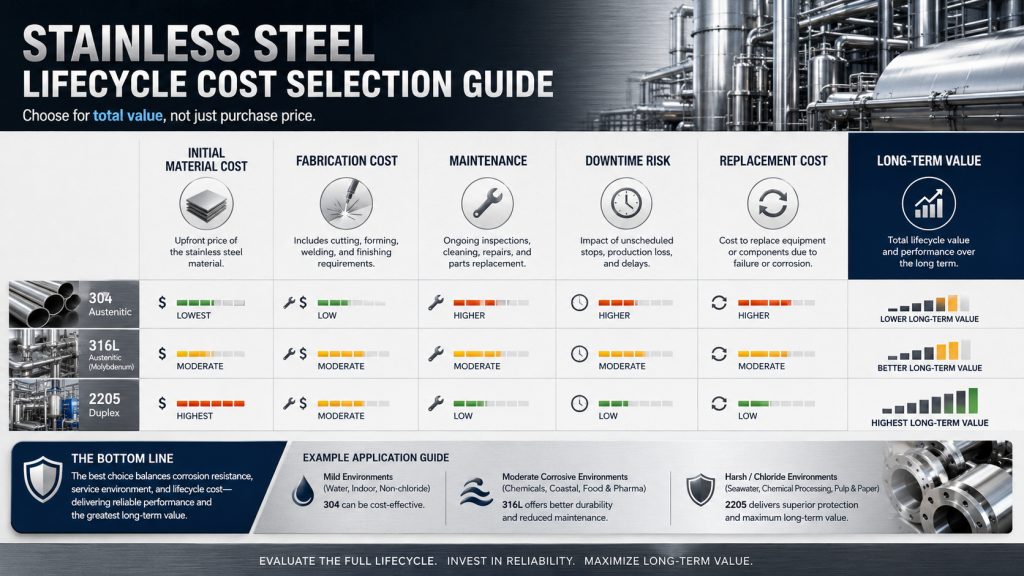
| Cost Factor | Low Initial Cost Risk | Better Selection Approach |
|---|---|---|
| Material price | Lower grade may be attractive at first | Compare performance against real service environment |
| Fabrication cost | Difficult processing can increase total cost | Select a grade that matches welding, forming and machining needs |
| Maintenance | Pitting, rust stains or cleaning problems can increase maintenance | Choose corrosion resistance level based on environment |
| Downtime | Material failure can stop production | Use higher-grade material when failure cost is high |
| Replacement | Early replacement increases total cost | Evaluate expected service life and maintenance access |
| Customer acceptance | Surface defects or corrosion can cause rejection | Confirm surface finish, packaging and quality inspection |
9. Check Industry Standards and Certification Requirements
Some industries require specific standards, test certificates, surface requirements, pressure codes or food-contact regulations. Buyers should confirm these requirements before selecting material.
| Industry | Common Requirement | Common Grade Direction |
|---|---|---|
| Food processing | Cleanability, corrosion resistance and hygiene | 304, 304L, 316L |
| Pharmaceutical equipment | Clean surface, low contamination risk and documentation | 316L, high-quality polished stainless steel |
| Chemical processing | Acid resistance, chloride resistance and pressure safety | 316L, 904L, 2205, 2507, nickel alloys |
| Marine and offshore | Chloride resistance, strength and fatigue performance | 316L, 2205, 2507, super duplex |
| Architecture | Appearance, corrosion resistance and surface durability | 304, 316L, 430 depending on environment |
| High-temperature equipment | Oxidation resistance and thermal stability | 309S, 310S, 321, 347 |
Documents Buyers May Need
- Mill test certificate
- Chemical composition report
- Mechanical property report
- Surface inspection report
- Dimension and tolerance confirmation
- ASTM, EN, JIS or GB standard confirmation
- Third-party inspection report if required
10. Common Stainless Steel Grades and Typical Uses
| Grade | Main Advantage | Typical Uses |
|---|---|---|
| 201 | Lower cost decorative stainless steel | Indoor decoration, furniture, low-corrosion applications |
| 304 | Best general-purpose balance | Kitchen equipment, tanks, sheet, coil, food equipment, fabrication |
| 304L | Better for welding than standard 304 | Welded tanks, vessels, piping and corrosion-critical fabrication |
| 316L | Better chloride resistance than 304 | Food processing, coastal equipment, chemical equipment, medical devices |
| 321 | Titanium-stabilized for selected heat and welding applications | Heat exchangers, exhaust systems, thermal equipment |
| 430 | Economical ferritic stainless steel | Appliances, indoor decoration, kitchen panels, elevator panels |
| 409L / 439 / 441 | Ferritic exhaust and heat-related performance | Automotive exhaust, mufflers, heat shields, thermal cycling parts |
| 2205 | High strength and strong chloride resistance | Chemical tanks, heat exchangers, offshore, structural components |
| 2507 | Severe chloride and seawater resistance | Desalination, offshore, seawater systems, severe corrosion service |
| 310S | High-temperature oxidation resistance | Furnaces, burners, heat treatment equipment, thermal processing |
| 17-4PH | High strength with good corrosion resistance | Shafts, aerospace parts, fasteners, precision components |
11. Stainless Steel Selection Flow
For practical purchasing, buyers can follow a simple decision flow:
| Step | Question | Selection Direction |
|---|---|---|
| 1 | Is the environment dry indoor? | 304, 430 or 201 may be enough depending on appearance and budget |
| 2 | Is the environment wet, food-related or frequently cleaned? | 304 or 316L is usually safer |
| 3 | Are chlorides, salt or coastal exposure present? | 316L, 2205 or 2507 should be evaluated |
| 4 | Is high strength required? | 2205, 2507 or 17-4PH may be needed |
| 5 | Is high temperature involved? | 309S, 310S, 321, 347 or heat-resistant alloys should be considered |
| 6 | Will the material be welded heavily? | 304L, 316L or stabilized grades may be better |
| 7 | Is appearance important? | Confirm surface finish, polishing, brushing and packaging requirements |
| 8 | Is failure expensive? | Select by lifecycle cost, not just initial price |
12. Common Buyer Mistakes to Avoid
- Choosing stainless steel only by price
- Using 304 in coastal or chloride-rich environments without evaluation
- Using 430 in wet or outdoor service where it may rust or stain
- Ignoring welding requirements and carbon content
- Ignoring surface finish and cleaning method
- Over-specifying expensive grades where 304 or 316L is enough
- Under-specifying cheap grades where failure risk is high
- Not checking availability in the required product form
- Not requesting material certificates when required
- Comparing only initial cost instead of lifecycle cost
Frequently Asked Questions
What is the best stainless steel grade?
There is no single best stainless steel grade for every project. 304 is a strong general-purpose choice, 316L is better for chloride environments, 2205 offers higher strength and chloride resistance, 430 is economical for indoor decoration, and 310S is suitable for high-temperature oxidation.
How do I choose between 304 and 316L stainless steel?
Choose 304 for general indoor, kitchen and mild industrial environments. Choose 316L when the application involves chlorides, coastal atmosphere, marine environment, chemical cleaning or better pitting resistance.
When should I choose 2205 duplex stainless steel?
Choose 2205 when you need higher strength and better chloride stress corrosion resistance than 304 or 316L can provide. It is often used in chemical tanks, heat exchangers, offshore structures and pressure systems.
Which stainless steel is best for high temperature?
For high-temperature oxidation and heat service, grades such as 309S, 310S, 321, 347 and selected heat-resistant stainless steels should be evaluated according to temperature, atmosphere, load and thermal cycling.
Is 430 stainless steel a good choice?
430 stainless steel is a good economical choice for dry indoor decorative applications, appliances, kitchen panels and elevator panels. It is not the best choice for coastal, wet or highly corrosive environments.
Should I choose stainless steel only by price?
No. Buyers should consider lifecycle cost, including maintenance, downtime, replacement, surface cleaning, corrosion risk and service life. A lower-cost grade may become more expensive if it fails early.
What information should I provide when requesting a stainless steel quotation?
You should provide grade, product form, thickness, width, length, surface finish, tolerance, quantity, application, service environment, fabrication method, certification requirement and packaging requirement.
Conclusion
Choosing stainless steel is not about selecting the most expensive or most popular grade. It is about matching the material to the real working environment. The right grade should provide enough corrosion resistance, mechanical strength, temperature stability, fabrication performance, surface quality and service life at a reasonable lifecycle cost.
For general indoor and food-related applications, 304 is often a practical starting point. For chloride, coastal or chemical environments, 316L, 2205, 2507 or higher alloys may be needed. For decorative cost control, 430 may be suitable. For high-temperature service, 309S, 310S, 321 or 347 should be evaluated.
Jude Steel supplies stainless steel sheets, coils, strips and customized processing services for global buyers. Explore more at Judesteel.com, or visit our pages for stainless steel sheet, stainless steel coil, stainless steel strip and the Stainless Steel Grade Center.
