
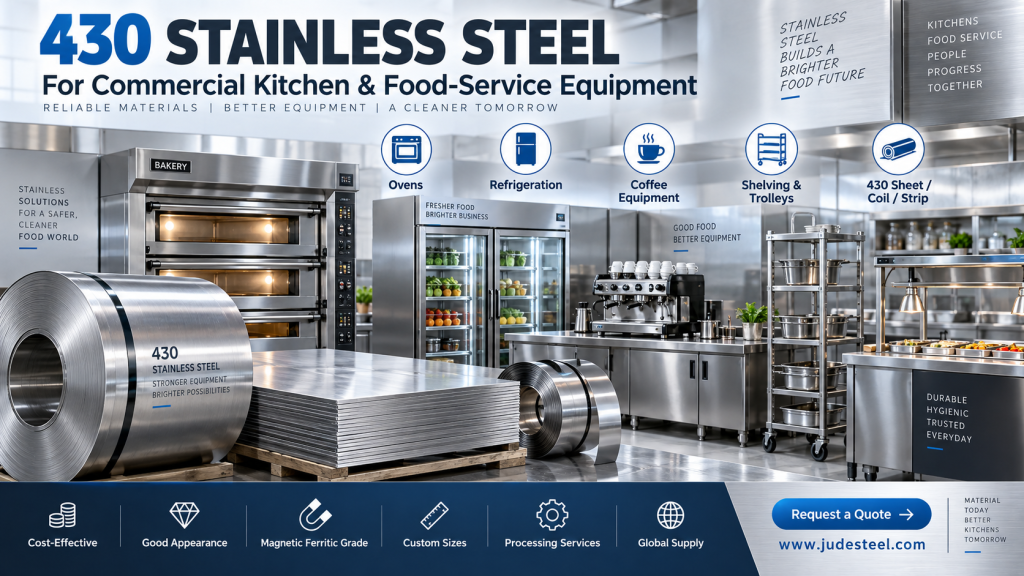
Which Commercial Kitchen Products Should Use 430 Stainless Steel?
Type 430 stainless steel is widely used in commercial food-service equipment, but it should not be treated as a lower-cost substitute for 304 in every kitchen application.
A bakery oven panel, refrigerator cabinet and seafood preparation sink may all be classified as commercial-kitchen equipment, but they operate in very different corrosion environments.
Type 430 / UNS S43000 performs best where manufacturers need an economical ferritic stainless steel with good surface appearance, useful formability, magnetic behavior and adequate corrosion resistance for mild indoor service.
This makes 430 particularly relevant to commercial ovens, appliance panels, refrigeration cabinets, coffee equipment, heated merchandisers, trolleys and other food-service components that are not continuously exposed to salt, acids or aggressive sanitation chemicals.
This guide connects:
finished kitchen equipment → 430 raw material → surface finish → fabrication → corrosion environment → RFQ.
Quick Answer: Where Does Type 430 Fit in Commercial Food-Service Equipment?
Type 430 may be considered for commercial food-service products such as:
- commercial oven panels
- bakery oven components
- gas cooking equipment panels
- burner-range housings
- conveyor toaster housings
- heated display and merchandiser panels
- coffee-machine housings
- coffee servers
- refrigerator and freezer cabinet panels
- display-refrigeration panels
- wall cupboards
- shelving and racks
- restaurant trolleys
- selected dishwasher panels
- equipment covers and enclosures
- selected low-corrosion trays and food-service components
Type 430 should not automatically be specified for equipment exposed to high salt, acidic foods, aggressive chloride cleaners, permanent wet conditions or coastal environments.
Why Do Manufacturers Use 430 in Commercial Kitchen Equipment?
Type 430 is a ferritic stainless steel containing approximately 16–18% chromium under ASTM A240.
Unlike 304 and 316L, standard 430 contains little or no intentional nickel addition.
This gives the grade several useful characteristics for commercial equipment manufacturers:
- more stable raw-material cost relative to nickel-rich austenitic grades
- magnetic behavior
- lower thermal expansion than conventional austenitic stainless steels
- good appearance in cold-rolled finishes
- useful bending and forming performance for suitable geometries
- good performance in many mildly corrosive indoor environments
Ferritic stainless steels are already established in commercial food equipment including ovens, refrigerators, coffee machines, trolleys and display equipment.
For basic material information, see the
JUDE Steel Type 430 Stainless Steel Grade Page.
430 Standards and Grade Designations
| System | Designation | Procurement Note |
|---|---|---|
| ASTM / Type | Type 430 | Standard ferritic stainless steel grade |
| UNS | S43000 | Primary UNS designation |
| EN | 1.4016 / X6Cr17 | Common European Type 430-family reference |
| JIS | SUS430 | Use with the applicable JIS product standard |
| ASTM flat product | ASTM A240/A240M Type 430 / S43000 | Plate, sheet and strip |
| EN flat product | EN 10088-2 1.4016 | Confirm delivery condition and surface |
| JIS cold rolled | JIS G 4305 SUS430 | Relevant to cold-rolled sheet and coil |
| JIS hot rolled | JIS G 4304 SUS430 | Relevant to hot-rolled flat products |
Type 430, EN 1.4016 and SUS430 are commonly cross-referenced because they belong to a similar ferritic stainless steel family.
They should not automatically be treated as contractually identical materials.
A purchase order should state one governing standard and separately identify any customer-specific chemistry, mechanical or surface requirements.
ASTM A240 Type 430 / UNS S43000 Chemical Composition
The following values are ASTM A240 specification limits for Type 430 flat products. They are not producer-specific typical values.
| Element | ASTM A240 S43000, wt.% |
|---|---|
| Carbon (C) | 0.12 max. |
| Manganese (Mn) | 1.00 max. |
| Silicon (Si) | 1.00 max. |
| Phosphorus (P) | 0.040 max. |
| Sulfur (S) | 0.030 max. |
| Chromium (Cr) | 16.0–18.0 |
| Nickel (Ni) | 0.75 max. |
A producer may publish typical chemistry such as approximately 16–17% chromium, but delivered material should be accepted against the governing material standard and mill test certificate.
Standard Type 430 should also not be confused with stabilized grades such as 430Ti, 439 or 441.
Which Commercial Kitchen Products Use 430 Stainless Steel?
1. Commercial Ovens and Bakery Ovens
Commercial ovens are one of the clearest applications for ferritic stainless steel.
Type 430 may be used for selected:
- oven exterior panels
- internal liners
- door panels
- control-panel housings
- trim components
- equipment covers
The material provides an attractive stainless appearance and can perform well where the environment is primarily indoor and the cleaning chemistry is compatible with the grade.
For components requiring extensive welding or severe deep forming, the manufacturer should compare standard 430 with stabilized ferritic grades or 304.
2. Gas Ranges and Cooking Equipment Panels
430 stainless steel is also used in gas cooking equipment and burner-range components.
Possible applications include:
- side panels
- back panels
- burner surrounds
- control housings
- equipment facings
- heat shields in suitable temperature ranges
Material selection should consider both operating temperature and exposure to food residues, grease and cleaning chemicals.
3. Heated Merchandisers and Conveyor Toasters
Heated food-display equipment and conveyor toasters often require stainless steel sheet for:
- outer housings
- internal panels
- covers
- frames
- decorative surfaces
Type 430 can provide a practical combination of appearance, heat-related dimensional stability and material economy for suitable designs.
4. Coffee Machines and Coffee Servers
430 stainless steel may be used in selected coffee-machine and beverage-equipment components where the corrosion environment remains moderate.
Potential components include:
- machine housings
- decorative panels
- drip-area covers outside severe wet zones
- equipment frames
- coffee-server components
Components exposed continuously to acidic beverage residues, chlorides or aggressive descaling chemicals may require 304 or another more corrosion-resistant grade.
5. Refrigerators and Display Cabinets
Commercial refrigeration equipment is another established ferritic-stainless application.
Type 430 may be considered for:
- refrigerator cabinet panels
- freezer exterior panels
- door skins
- internal panels in compatible environments
- display-merchandiser housings
- equipment covers
The buyer should separate decorative-panel requirements from food-contact and condensate-exposed requirements.
A visible refrigerator door panel and a permanently wet internal drain area should not automatically use the same material.
6. Wall Cabinets, Shelving and Restaurant Trolleys
Commercial-kitchen furniture can use Type 430 where the corrosion exposure is relatively mild.
Possible products include:
- wall cupboards
- storage cabinets
- shelving
- racks
- restaurant trolleys
- service carts
- equipment stands
For these products, manufacturers often focus on:
- sheet thickness
- flatness
- surface appearance
- bending performance
- edge safety
- protective film
7. Selected Dishwasher Panels
Ferritic stainless steels, including Type 430-family materials, have been used in dishwasher panels and related appliance components.
However, dishwasher service can involve moisture, detergents, chlorides and elevated temperature.
The distinction between an exterior housing and a continuously wet internal component is therefore important.
Where corrosion exposure is severe, 304 or another higher-performance grade may be more appropriate.
8. Appliance Covers and Equipment Enclosures
One of the strongest uses of 430 in commercial food-service equipment is in components that require stainless appearance but do not face severe direct food-contact corrosion.
Examples include:
- machine covers
- electrical enclosures
- control-panel housings
- equipment sidewalls
- rear panels
- protective guards
These applications can provide a strong cost-performance case for Type 430.
Equipment-to-Raw-Material Procurement Matrix
| Commercial Equipment | Possible 430 Raw Material | Main Buying Requirement |
|---|---|---|
| Commercial oven panel | Cold-rolled sheet / coil | Thickness, surface, bending and appearance |
| Burner-range panel | Sheet / coil | Temperature, surface and forming |
| Conveyor toaster housing | Sheet | Surface and dimensional consistency |
| Coffee-machine housing | BA / 2B / polished sheet | Appearance, forming and cleaning environment |
| Refrigerator cabinet | Sheet / coil | Surface, flatness and condensation exposure |
| Display merchandiser | Sheet / coil | Appearance and forming |
| Wall cupboard | Sheet | Bending, flatness and surface |
| Shelf / trolley | Sheet / strip | Edge, strength, surface and cleaning |
| Dishwasher housing | Sheet | Detergent exposure and corrosion requirement |
| Equipment cover | Sheet / coil | Surface and cost efficiency |
2B vs BA vs No.4 for Commercial Kitchen Equipment
2B
2B is a widely used cold-rolled mill finish for appliance panels, housings and general fabricated components.
It provides a relatively smooth and uniform industrial surface.
For a detailed explanation of the finish, see the
JUDE Steel 430 2B Stainless Steel Buying Guide.
BA
Bright-annealed material provides a brighter and more reflective appearance.
It may be useful for visible coffee-machine panels, appliance components or decorative commercial-equipment parts.
No.4 / Brushed Finish
No.4-style brushed finishes are often selected for visible kitchen equipment because they produce a directional decorative appearance.
A surface name alone does not define corrosion resistance or hygienic suitability.
The buyer should also specify:
- surface direction
- grit or appearance standard
- protective film
- critical visible side
- scratch acceptance
Why Is Standard 430 Not the Best Choice for Heavy Welding?
Standard Type 430 is an unstabilized ferritic stainless steel.
It should not be confused with stabilized grades such as 430Ti, 439 or 441.
Extensive welding can create greater metallurgical and fabrication challenges in standard 430 than in stabilized ferritic grades or conventional austenitic grades.
For products containing:
- long continuous welds
- deep fabricated basins
- complex welded corners
- highly stressed welded joints
- severe forming followed by welding
manufacturers should evaluate 304, 430Ti, 439, 441 or another suitable grade rather than automatically choosing standard 430.
Direct Food Contact: When Is 430 Appropriate?
The phrase “food grade stainless steel” does not describe one alloy specification.
Type 430 can be used in selected food-contact and food-service applications where the corrosion environment, surface condition, cleaning procedure and equipment design are compatible with the grade.
However, 430 has less corrosion margin than 304 or 316L in environments containing:
- salt
- brine
- acidic sauces
- chloride-rich cleaners
- persistent moisture
- coastal exposure
For equipment that will continuously contact wet, salty or acidic food, Type 304 or 316L may provide a more robust lifecycle solution.
For a broader material-selection discussion, see the
JUDE Steel Food Grade Stainless Steel Guide.
430 vs 304 vs 316L vs 441 for Commercial Kitchen Equipment
| Grade | Main Strength | Typical Commercial-Kitchen Position |
|---|---|---|
| 430 | Economical ferritic grade with good appearance | Oven panels, refrigerator cabinets, housings, cupboards and selected low-corrosion components |
| 304 | Better corrosion resistance, welding and deep-forming balance | Sinks, worktables, wet food-contact surfaces, heavily fabricated kitchen equipment |
| 316L | Mo-enhanced chloride resistance + low carbon | Salt, seafood, aggressive cleaning and coastal environments |
| 441 | Stabilized ferritic grade with improved welding and thermal performance | Selected welded, heated or more demanding ferritic food-service equipment |
This is not a simple ranking from low grade to high grade.
A refrigerator door and a seafood sink solve different material-selection problems.
When Should Manufacturers Upgrade From 430?
Consider upgrading from standard Type 430 when the component requires:
- continuous wet food contact
- high salt or chloride exposure
- acidic-food resistance
- aggressive cleaning chemicals
- coastal service
- extensive welding
- severe deep drawing
- higher cosmetic durability in corrosive environments
Possible alternatives include:
- 304 for general food-contact and welded kitchen equipment
- 316L for chlorides, salt and aggressive cleaning
- 441 or another stabilized ferritic grade where ferritic cost and thermal properties remain desirable
Should a Manufacturer Buy Coil, Sheet or Strip?
430 Stainless Steel Coil
Coil is useful for high-volume continuous manufacturing, stamping and automated sheet-metal production.
JUDE Steel supplies
Type 430 stainless steel coil
with multiple cold-rolled surface options.
430 Stainless Steel Sheet
Sheet is commonly selected for oven panels, refrigerator doors, cabinets, equipment covers and lower-volume fabricated components.
JUDE Steel’s
stainless steel sheet range
includes Type 430 and cut-to-size options.
430 Stainless Steel Strip
Strip can be useful for:
- narrow trim
- brackets
- frames
- edge components
- continuous roll-formed parts
JUDE Steel publishes
430 stainless steel strip
with slit, deburred and round-edge processing options.
What Should a 430 Commercial-Kitchen RFQ Include?
- Finished equipment: oven, refrigerator, coffee machine, trolley, cabinet, toaster or another product.
- Component: door panel, side panel, inner liner, housing, shelf, bracket or cover.
- Grade: Type 430 / UNS S43000 or the required EN/JIS designation.
- Standard: ASTM A240/A240M, EN 10088-2, JIS G 4305 or customer specification.
- Product form: coil, sheet, strip or cut blank.
- Thickness: nominal value and tolerance.
- Width / length: finished or raw-material dimensions.
- Surface finish: 2B, BA, No.4 or customer-specific finish.
- Visible side: identify Side A where cosmetic quality is critical.
- Protective film: type and side where required.
- Forming: bending, stamping, drawing or roll forming.
- Welding: identify if the component requires spot or continuous welding.
- Food contact: direct, indirect or non-food-contact component.
- Cleaning environment: detergent, chloride cleaner, acidic cleaner or ordinary wash-down.
- Operating temperature: where relevant.
- Edge requirement: mill, slit, deburred or rounded.
- Appearance requirement: gloss, scratch limit or approved sample.
- Quantity: prototype, trial order and annual requirement.
- Processing: cutting, shearing, brushing or laser cutting.
- Certification: MTC / customer documentation.
- Destination: country, port and delivery schedule.
Example 430 Commercial-Oven Material RFQ
Application: Commercial Bakery Oven Exterior Panels
Material: Type 430 / UNS S43000
Specification: ASTM A240/A240M
Product: Cold-Rolled Stainless Steel Sheet
Thickness: 0.80 mm
Sheet Size: 1219 × 2438 mm
Surface: No.4 brushed
Critical Surface: Side A cosmetic surface
Protective Film: Required on visible side
Fabrication: Laser cutting + bending
Welding: Limited spot welding
Food Contact: No direct food contact
Quantity: 8 MT trial order
Annual Demand: Approximately 120 MT
Certificate: Mill Test Certificate required
Destination: Chicago, USA
Incoming Inspection for 430 Sheet and Coil
Depending on the equipment specification, incoming inspection may include:
- grade and heat number
- mill test certificate
- chemical composition
- thickness
- width and length
- flatness
- surface finish
- scratches and roll marks
- protective film
- edge condition
- coil ID and weight
- traceability
For visible kitchen-equipment panels, an approved surface sample can be more useful than relying only on a generic finish name.
How JUDE Steel Supports Food-Service Equipment Manufacturers
JUDE Steel supplies Type 430 stainless steel sheet, coil and strip for appliance, commercial-kitchen and general manufacturing applications.
Relevant product and processing options include:
- 430 stainless steel sheet
- 430 stainless steel coil
- 430 stainless steel strip
- stainless steel processing services
- laser cutting
- custom shearing
Specific Type 430 thickness, width, finish, protective film, processing tolerance, mill origin, certification and stock availability should be confirmed for every inquiry.
Frequently Asked Questions
Is Type 430 suitable for commercial oven panels?
Yes, Type 430 is widely relevant to commercial oven and cooking-equipment panels where the corrosion environment is moderate and the fabrication requirements are compatible with the grade.
Can Type 430 be used for refrigerator panels?
Yes. Ferritic stainless steels are established materials for refrigerator and display-equipment panels. Permanently wet or chloride-exposed internal areas should be evaluated separately.
Can 430 stainless steel contact food?
Type 430 can be used in selected food-contact applications where the food chemistry, corrosion environment, cleaning procedure and surface condition are compatible with the grade. It should not automatically replace 304 or 316L in wet, salty or acidic food-contact service.
Should a restaurant-equipment manufacturer use 430 or 304?
430 can be economical for panels, cabinets, housings and other mild indoor applications. 304 usually provides a stronger combination of corrosion resistance, deep formability and weldability for sinks, wet food-contact surfaces and heavily fabricated equipment.
Why is 430 stainless steel magnetic?
Type 430 has a ferritic crystal structure, so it is normally magnetic. This distinguishes it from annealed 304 and 316L, which are usually substantially non-magnetic before cold working.
Is 430 suitable for dishwasher components?
It can be used in selected dishwasher panels and housings, but detergent chemistry, chlorides, temperature and permanent moisture should be reviewed before specifying the grade for internal wetted components.
Is standard Type 430 good for welding?
Standard Type 430 is an unstabilized ferritic grade and is not the preferred choice for heavily welded fabrication. Stabilized ferritic grades or austenitic grades may provide better performance where extensive welding is required.
Which 430 surface is best for commercial kitchen equipment?
2B is a practical general-purpose industrial finish, BA provides a brighter appearance, and No.4 is commonly selected for visible brushed panels. The correct finish depends on appearance, fabrication and cleaning requirements.
When should 316L be used instead of 430?
316L should be evaluated when equipment faces higher chloride exposure, salt-rich foods, aggressive cleaning chemistry, seafood processing, coastal environments or other corrosion conditions beyond the practical range of Type 430.
Request Type 430 Material for Commercial Kitchen Equipment
Manufacturing commercial ovens, refrigerators, coffee machines, catering equipment or stainless steel kitchen furniture?
Send JUDE Steel your:
Equipment Drawing + Component + Grade + Thickness + Dimensions + Surface Finish + Quantity + Destination
For visible or corrosion-sensitive components, also include:
Critical Surface + Protective Film + Forming Method + Welding Requirement + Cleaning Environment + Annual Demand
Technical note:
This article is intended for preliminary raw-material selection and procurement guidance. Final material selection should follow the actual food-contact condition, cleaning chemicals, moisture, temperature, fabrication method, equipment design and applicable customer or regulatory requirements.
