
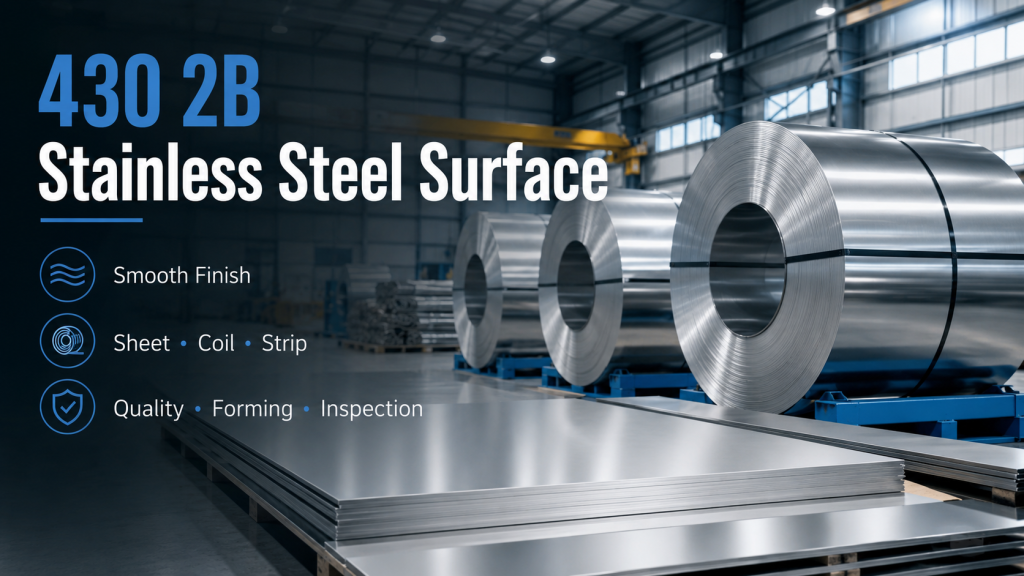
 430 2B Stainless Steel Surface: Quality, Forming, Defects and Buyer Specification
The quality of a 430 2B stainless steel surface cannot be judged by the words “430 2B” alone. Type 430 defines the ferritic stainless steel alloy, while 2B defines a cold-rolled surface condition. For appearance-sensitive or high-volume manufacturing, buyers must also control surface uniformity, scratches, roll marks, flatness, camber, edge burr, forming direction and protective-film requirements.
These factors become especially important when 430 stainless steel sheet or coil is used for appliance panels, kitchen equipment, stamped components, metal housings and products that remain visible after forming.
This guide explains how 430 2B surfaces are produced, why their appearance may vary, what happens to the surface during forming, how common defects should be evaluated and what international buyers should include in a purchase specification.
Quick Answer: What Is a 430 2B Stainless Steel Surface?
430 2B stainless steel is Type 430 ferritic stainless steel supplied with a general-purpose cold-rolled No. 2B surface finish.
- Alloy: Type 430 / UNS S43000
- Common EN reference: EN 1.4016 / X6Cr17
- Common JIS reference: SUS430
- Structure: Ferritic
- Magnetic response: Normally magnetic
- Finish: No. 2B cold-rolled surface
- Appearance: Smooth and moderately bright, without an intentional decorative grain pattern
- Typical product forms: Sheet, coil and strip
For appearance-critical orders, 2B should be treated as the starting surface specification—not the complete visual acceptance specification.
What Does 430 2B Stainless Steel Really Mean?
The description contains two separate technical requirements.
430 Defines the Alloy
Type 430 is a non-hardenable ferritic stainless steel commonly identified as UNS S43000.
A common European cross-reference is EN 1.4016 / X6Cr17, while the corresponding Japanese designation commonly used in purchasing is SUS430.
For material information, see JUDE’s
430 stainless steel
grade page.
2B Defines the Surface
2B describes a cold-rolled stainless steel surface produced after rolling, annealing, descaling and a light final rolling pass using smooth rolls.
The finish is widely used because it provides a practical combination of surface consistency, dimensional control and suitability for additional processing.
The alloy determines the fundamental corrosion, forming and physical behavior. The 2B designation primarily defines how the flat product surface is produced and delivered.
How Is a 2B Stainless Steel Surface Produced?
1. Cold Rolling
Hot-rolled or intermediate stainless steel is cold reduced toward the final thickness. This step improves dimensional control and influences the final surface condition.
2. Annealing
Cold working increases strength and reduces ductility. Annealing restores the required material condition for the specified product.
3. Descaling
Oxides produced during conventional annealing are removed using the applicable descaling and pickling process.
4. Final Light Cold-Roll Pass
The annealed and descaled strip receives a light final pass on polished rolls to produce the smoother and brighter appearance associated with 2B.
This production route is one reason why 2B should not be described as a mechanically polished decorative surface.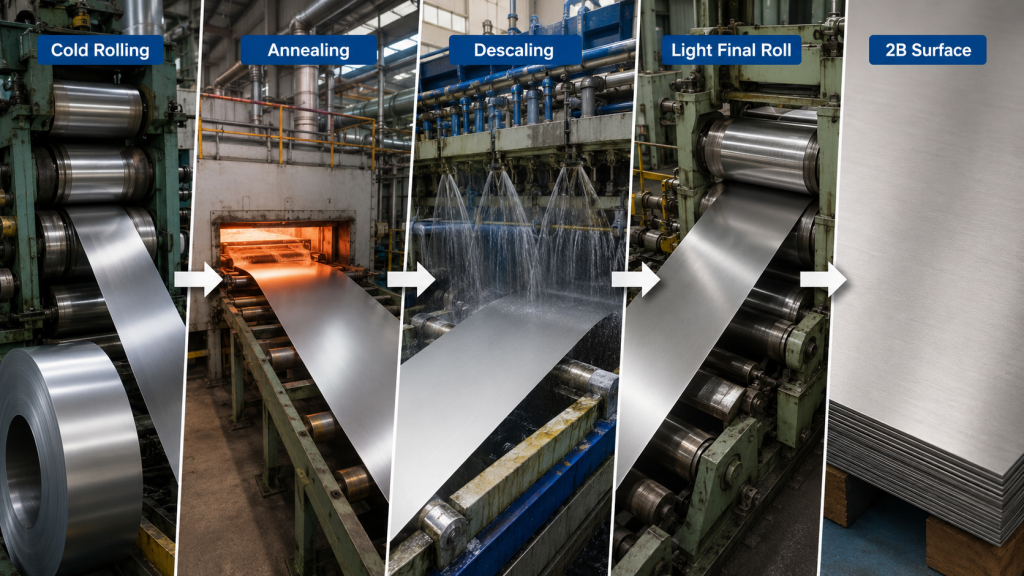
430 2B Standards and Grade References
| System | Designation | Relevant Flat-Product Standard | Buyer Note |
|---|---|---|---|
| ASTM / UNS | Type 430 / UNS S43000 | ASTM A240/A240M-26 | ASTM A480/A480M-25b provides applicable general flat-product requirements. |
| EN | 1.4016 / X6Cr17 | EN 10088-2:2024 | Use the exact European grade and delivery requirements stated in the order. |
| JIS | SUS430 | JIS G 4305:2021 for cold-rolled sheet and strip | Confirm JIS requirements rather than assuming ASTM equivalence. |
Type 430, SUS430 and EN 1.4016 are commonly cross-referenced, but they belong to separate standards. Do not mix chemistry or mechanical-property limits from different specifications unless the order explicitly requires and permits dual certification.
What Should a Good 430 2B Surface Look Like?
For general industrial use, a 2B surface is expected to be reasonably smooth, bright and uniform for its production route.
However, “acceptable” depends on the final application.
Important characteristics may include:
- consistent visual tone;
- reasonable brightness uniformity;
- absence of unacceptable scratches;
- absence of severe dents;
- controlled roll marks;
- no unacceptable rust staining;
- no severe edge damage;
- no contamination affecting the final application.
A hidden machine cover and a visible appliance panel do not need identical cosmetic acceptance standards.
Does 2B Have a Standard Ra?
The finish designation itself should not be treated as a universal roughness guarantee.
If roughness affects adhesion, cleaning, polishing, friction or appearance, the required Ra range and test method should be written separately into the purchase specification.
Does 2B Have a Standard Gloss Value?
The same purchasing principle applies to gloss.
If visible appearance is commercially important, define a measurable gloss range or approve a physical reference sample rather than relying only on the description “2B.”
Why Can 430 2B Look Different From One Mill to Another?
Two coils may both be correctly supplied as 430 2B while showing modest differences in visual appearance.
Possible contributors include:
- cold-rolling schedule;
- roll condition;
- final pass conditions;
- annealing and descaling route;
- material thickness;
- surface cleanliness;
- coil processing;
- lighting and viewing angle.
This matters most when several coils will be used side-by-side on one visible finished product.
Ask whether coils need to come from the same approved surface route or production lot, and define an approved visual sample when practical.
430 2B Sheet, Coil and Strip
430 2B Sheet
Stainless steel sheet
is suitable for individual blanks, lower-volume production, equipment panels and sheet-based fabrication.
Important controls include thickness, sheet dimensions, flatness and critical surface side.
430 2B Coil
Stainless steel coil
supports continuous feeding, automated blanking and high-volume production.
Coil projects should also define coil weight, ID, maximum OD, camber and permitted welds where relevant.
430 2B Strip
Stainless steel strip
is suitable for narrower stamped components, clips, brackets and formed parts.
Width tolerance, edge burr and camber become especially important as strip width decreases.
Custom Processing
JUDE’s
strip processing
supports customized widths and downstream coil processing.
Surface protection should remain part of the processing specification when cosmetic quality is important.
Critical Side vs Non-Critical Side
One of the most useful requirements in a stainless steel surface specification is identifying the critical side.
For example:
- The front of an appliance panel may be appearance critical.
- The hidden rear surface may permit greater cosmetic variation.
- A stamped component may have one visible face and one assembly face.
Without this information, the supplier does not know which face has the strictest cosmetic requirement.
Recommended Drawing Note
An appearance-sensitive drawing can identify:
- Side A — critical visible surface;
- Side B — functional non-visible surface;
- scratch acceptance;
- film requirement;
- inspection lighting;
- reference sample.
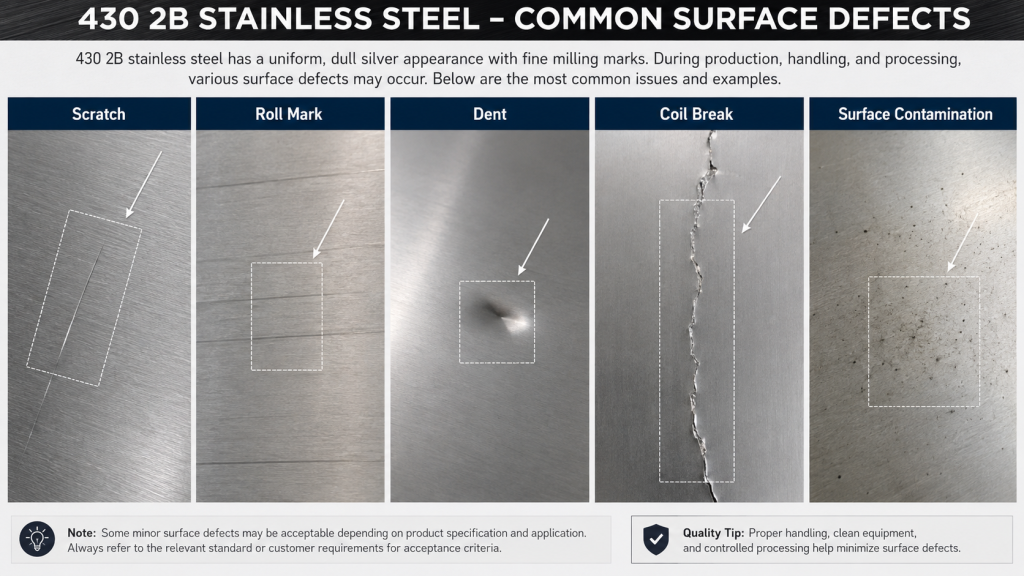
Common 430 2B Surface Defects
| Surface Condition | Possible Source | Why It Matters | Buyer Control |
|---|---|---|---|
| Scratch | Handling, slitting, leveling or transport | Visible after forming or polishing | Define scratch acceptance and film requirement |
| Roll mark | Rolling or processing equipment | Can remain visible on exposed components | Use reference sample or defect criteria |
| Dent | Handling or coil contact | Can affect both appearance and flatness | Inspect incoming sheet or coil |
| Coil-break mark | Coil shape and processing behavior | May become visible after leveling or forming | Discuss application and leveling requirements |
| Rust staining | Iron contamination, moisture or chloride deposits | Creates cosmetic or corrosion concern | Control storage and contamination |
| Uneven tone | Surface processing or production variation | Can create mismatch between visible panels | Use an approved sample for critical products |
| Film residue | Incorrect film or excessive storage | Creates cleaning and finishing problems | Specify film type and storage limits |
Coil Breaks, Roller Marks and Handling Damage
When 430 2B is purchased as coil, the material may pass through multiple operations before becoming a finished component:
- uncoiling;
- leveling;
- slitting;
- blanking;
- feeding;
- forming.
Each process creates a potential surface-contact point.
For appearance-sensitive products, processors should control:
- cleanliness of work rolls;
- guide surfaces;
- coil tension;
- contact pressure;
- metal chips;
- carbon-steel contamination;
- storage between operations.
A steel mill may supply an acceptable 2B surface that is subsequently damaged during service-center or component-manufacturing operations. Surface complaints should therefore consider the complete processing chain.
Why Can 430 Develop Ridging or Roping After Forming?
Ferritic stainless steels can develop visible longitudinal ridging or roping after significant plastic deformation.
This is not the same as a scratch.
Ridging is related to the material’s microstructure, texture and forming behavior and may become more visible after:
- deep drawing;
- stretch forming;
- polishing;
- high-gloss finishing;
- viewing under directional light.
For hidden industrial parts, slight ridging may be irrelevant. For high-visibility appliance or decorative components, it can become an important appearance requirement.
How Should Buyers Control Ridging Risk?
- Describe the actual forming process.
- Provide the drawing or forming depth.
- Confirm blank orientation.
- Request a forming trial for critical products.
- Discuss whether a deep-drawing-quality ferritic material is required.
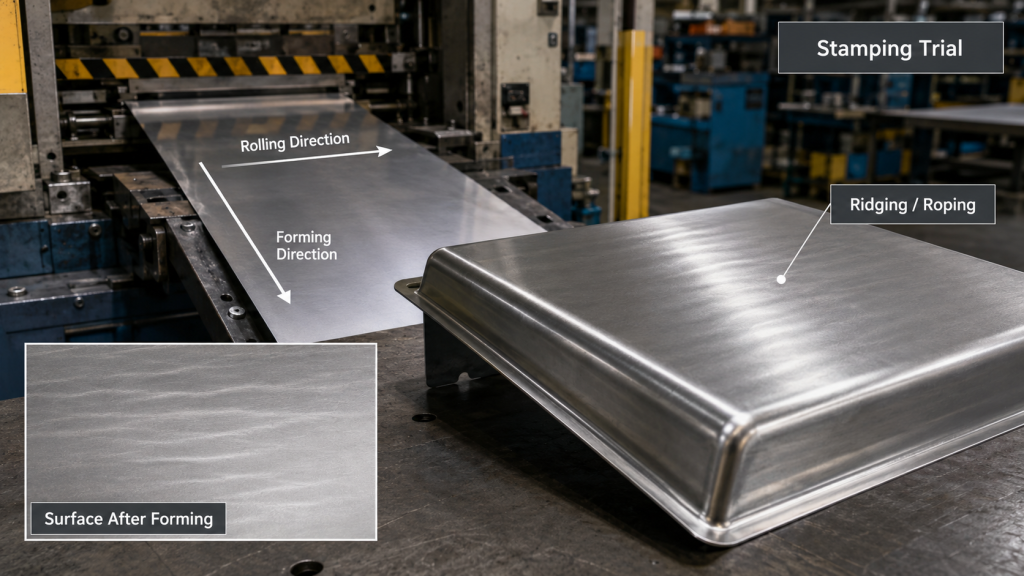
Why Does Rolling Direction Matter?
Cold-rolled stainless steel has directional characteristics created by rolling and microstructural development.
The orientation of a blank relative to the rolling direction may influence:
- bending behavior;
- drawing response;
- surface appearance;
- ridging visibility;
- dimensional behavior.
A customer producing a simple flat cover may not need a special direction requirement, while a highly formed visible panel may require trials in different orientations.
Bending and Stamping 430 2B Stainless Steel
430 provides useful cold-forming capability for many moderate forming operations.
Manufacturing success depends on more than grade alone.
Important variables include:
- material thickness;
- bend radius;
- blank shape;
- rolling direction;
- tool radius;
- lubrication;
- surface cleanliness;
- forming speed;
- required appearance.
Simple Bending
Standard 430 is practical for many bending applications when the tooling, bend radius and material condition are appropriate.
Deep Drawing
More severe drawing places greater demands on ductility and surface stability. A manufacturing trial may be more useful than relying only on minimum mechanical-property values from a generic datasheet.
Stamping Visible Parts
For visible parts, acceptance should be checked after forming as well as before forming because the manufacturing process can reveal surface features that are difficult to see on a flat sheet.
430 2B vs 430 BA: What Changes?
| Item | 430 2B | 430 BA |
|---|---|---|
| Base alloy | Type 430 | Type 430 |
| Finish category | General-purpose cold-rolled finish | Bright-annealed finish |
| Final processing route | Annealed, descaled and lightly cold rolled on smooth rolls | Bright annealed in a controlled atmosphere after cold rolling |
| Typical appearance | Smooth and moderately bright | Smoother and normally more reflective |
| Typical use | General fabrication, stamping and further finishing | Visible components requiring a brighter as-delivered surface |
| Mirror finish? | No | No — BA is not automatically No.8 mirror |
The two materials may have the same base grade while requiring very different surface-acceptance criteria.
Does the 2B Finish Improve Corrosion Resistance?
The corrosion resistance of the product is determined primarily by the stainless steel alloy, environment and surface condition.
A clean, relatively smooth 2B surface can be easier to maintain than a heavily scaled or contaminated surface, but it does not transform Type 430 into a higher-alloy stainless steel.
430 should be used with greater caution in environments involving:
- persistent chloride deposits;
- road salt;
- coastal salt exposure;
- aggressive acidic cleaners;
- trapped moisture;
- contaminated crevices.
For additional guidance, see JUDE’s article:
Is 430 Stainless Steel Really Rust-Proof?
“Stainless” does not mean immune to corrosion. The final service environment should be reviewed before selecting Type 430 solely for cost or appearance.
Does 430 2B Need Protective Film?
Not every industrial 2B product needs protective film.
Film becomes more valuable when:
- one side remains visible after fabrication;
- the material undergoes laser cutting;
- multiple forming stages are required;
- sheets are manually handled;
- the finished product has strict cosmetic requirements.
Film Specification
Where film is required, define:
- film type;
- adhesion;
- thickness;
- UV resistance if relevant;
- maximum storage time;
- forming compatibility;
- maximum processing temperature;
- residue acceptance.
Leaving unsuitable protective film on stainless steel for excessive periods or exposing it to uncontrolled heat can make removal difficult.
Surface Quality Is Not Enough: Flatness, Camber and Burr Matter
A visually attractive 430 2B coil can still perform poorly on an automated production line if dimensional and shape requirements are not controlled.
| Parameter | Why It Matters | Typical Application Concern |
|---|---|---|
| Thickness tolerance | Affects forming force and final dimensions | Stamping and precision parts |
| Flatness | Affects feeding and appearance | Large panels and cut sheet |
| Camber | Causes strip to move laterally during feeding | Narrow strip and progressive dies |
| Edge burr | Can affect assembly, safety and cracking | Slit strip and stamped components |
| Coil set | Can influence leveling and blank flatness | Continuous coil processing |
| Width tolerance | Affects die feeding and material yield | Precision slit strip |
How to Inspect Incoming 430 2B Stainless Steel
Step 1 — Verify Identification
Check the grade, standard, heat number, coil number and delivery identification against the purchase order.
Step 2 — Review the MTC
Confirm the reported material designation, chemistry and applicable mechanical properties against the governing specification.
Step 3 — Measure Thickness and Width
Use calibrated equipment and sample according to the applicable dimensional or customer inspection plan.
Step 4 — Inspect the 2B Surface
Evaluate the critical face for scratches, dents, roll marks, staining and other agreed cosmetic criteria.
Step 5 — Check Flatness or Camber
Apply project-specific limits when the normal product tolerance is insufficient for the customer’s production line.
Step 6 — Inspect Slit Edges
Check width, burr, edge wave and physical damage after slitting.
Step 7 — Confirm Protective Film
Where film is specified, verify the correct side, adhesion, damage and labeling.
Step 8 — Perform a Forming Trial When Necessary
For high-visibility or deep-drawn products, a production trial can reveal ridging, surface marking or forming issues that flat-sheet inspection cannot predict completely.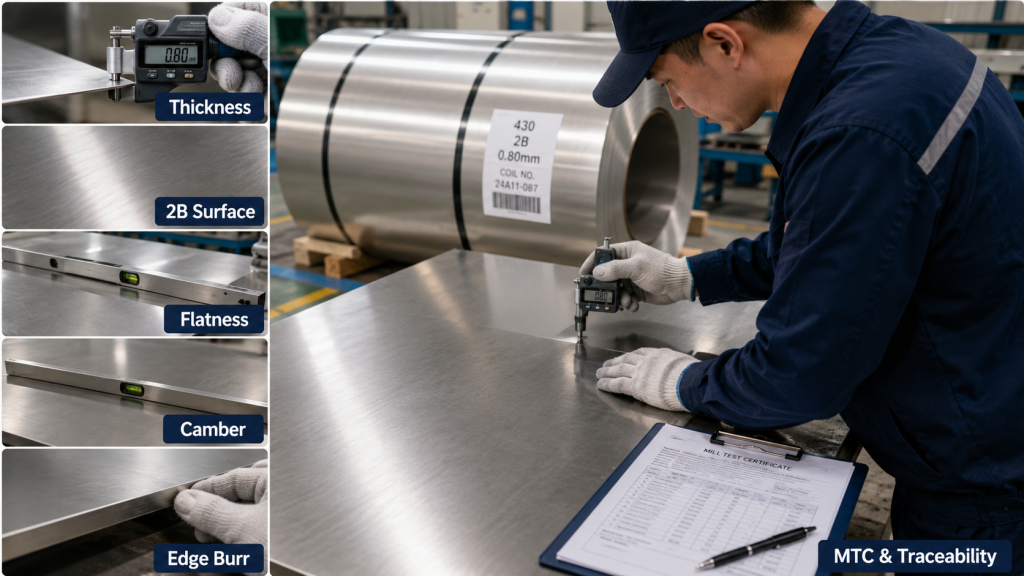
MTC and Heat-Number Traceability
Surface approval does not replace material verification.
A complete order should maintain traceability between:
- the mill test certificate;
- heat number;
- coil number;
- packing label;
- processed strip or sheet where required.
JUDE provides selected documentation on its
inspection report
page, including SUS430-related inspection documentation.
If material is slit or cut into multiple smaller products, the processor should define how original material identification is transferred where project traceability requires it.
Common 430 2B Purchasing Mistakes
This does not define dimensional tolerance, surface acceptance, critical side, edge condition or protective film.
If roughness is critical, state a separate measurable requirement and inspection method.
Appearance-sensitive orders should use an approved reference sample or measurable criteria.
Forming may reveal ridging or surface features that were not obvious before stamping.
The supplier needs to know which surface will remain visible on the finished product.
A surface-perfect coil may still cause production problems if strip geometry is unsuitable.
Material selection must reflect the real service environment.
JUDE 430 2B Product and Processing Options
JUDE’s published stainless steel flat-product range includes Type 430 and 2B surface options for sheet, coil and strip.
430 Stainless Steel
— grade information and material references.
Stainless Steel Sheet
— for cut sheet, panels, blanks and fabricated components.
Stainless Steel Coil
— for high-volume blanking and continuous manufacturing.
Stainless Steel Strip
— for narrow-width and precision processing applications.
Strip Processing
— for customized widths and downstream coil processing.
Exact 430 2B dimensions, inventory, coil weight, tolerances, film and appearance requirements should be confirmed for each quotation.
430 2B Stainless Steel RFQ Specification
For a technically complete inquiry, provide:
- Exact grade:
ASTM Type 430 / UNS S43000, EN 1.4016, SUS430 or another required designation. - Governing standard:
ASTM A240/A240M-26, EN 10088-2:2024, JIS G 4305:2021 or another project specification. - Product form:
Sheet, coil, strip or cut blank. - Finish:
2B. - Thickness:
Nominal thickness and tolerance. - Width:
Nominal width and tolerance. - Sheet length:
Required length and tolerance when ordering sheet. - Coil data:
Coil weight, ID and maximum OD. - Critical surface:
Identify Side A, Side B or both sides. - Surface acceptance:
Scratch, dent, roll-mark, tone and reference-sample requirements. - Surface roughness:
Specify Ra and test method only when required. - Gloss:
Specify measurement conditions if appearance requires numerical control. - Flatness:
State any project-specific requirement. - Camber:
State maximum allowable camber for coil or strip. - Edge:
Mill edge, slit edge, deburred or rounded. - Burr:
Define maximum burr when precision slitting is required. - Protective film:
State side, film type, adhesion and storage requirement. - Forming process:
Bending, stamping, drawing, roll forming or other operation. - Appearance after forming:
State whether ridging or roping control is commercially important. - Inspection:
MTC, heat-number traceability, dimensional report, surface inspection or third-party inspection. - Quantity:
Sheets, coils, pieces or total weight. - Destination:
Country, port, Incoterm and required delivery date.
Frequently Asked Questions
What does 430 2B stainless steel mean?
430 identifies the ferritic stainless steel grade. 2B identifies the general-purpose cold-rolled surface finish.
Is 430 2B stainless steel a mirror finish?
No. 2B is relatively smooth and bright, but a true mirror appearance normally requires additional surface processing.
Does 2B stainless steel have a fixed surface roughness?
The 2B finish designation should not be used as a universal Ra guarantee. If roughness is critical to the application, specify the required range and test method separately.
Why do two 430 2B coils sometimes look slightly different?
Production route, roll condition, thickness, surface processing and viewing conditions can affect visual appearance even when both products meet a 2B finish requirement.
Why does 430 stainless steel sometimes show lines after forming?
Ferritic stainless steel can develop ridging or roping after plastic deformation. Its visibility depends on material condition, forming severity, orientation and final surface appearance.
Can 430 2B be stamped?
Yes. Type 430 is used for many cold-forming and stamping operations. More severe drawing or highly visible components may require forming trials or a grade optimized for enhanced formability.
Is 430 2B better than 430 BA?
Neither finish is universally better. 2B is widely used for general manufacturing and further processing, while BA is normally selected when a brighter as-delivered appearance is required.
Does 430 2B stainless steel rust?
It can. Type 430 provides useful corrosion resistance in appropriate environments, but chloride deposits, salt, iron contamination and trapped moisture can cause staining or localized corrosion.
Does 430 2B always need protective film?
No. Film is mainly useful for appearance-sensitive products or manufacturing routes where scratching during handling and forming is a significant risk.
How should buyers inspect 430 2B stainless steel?
Verify the MTC and material identification, measure dimensions, inspect the critical surface, check flatness or camber, evaluate edge quality and perform a forming trial when the finished appearance is critical.
Conclusion
A 430 2B stainless steel purchase should not stop at the words “430 2B.”
Type 430 defines the ferritic stainless steel alloy, while 2B defines the cold-rolled surface condition. The finished manufacturing result also depends on thickness tolerance, flatness, camber, edge quality, forming direction, protective film and surface acceptance.
For ordinary industrial components, the standard 2B designation may be sufficient. For appliance panels, decorative components and other appearance-critical products, an approved sample and clearly defined surface criteria can significantly reduce disputes between buyers, processors and material suppliers.
The most reliable purchasing specification therefore combines material grade, product standard, dimensional requirements, surface quality, processing route and inspection requirements before production starts.
Request a 430 2B Stainless Steel Surface Review
Send JUDE your grade, standard, sheet or coil format, thickness, width, critical surface, 2B appearance requirement, flatness, camber, edge, protective film, forming process, quantity and destination.
For visible stamped parts, also provide the finished component drawing, blank orientation and any requirements related to scratches, ridging, gloss or approved surface samples.
