
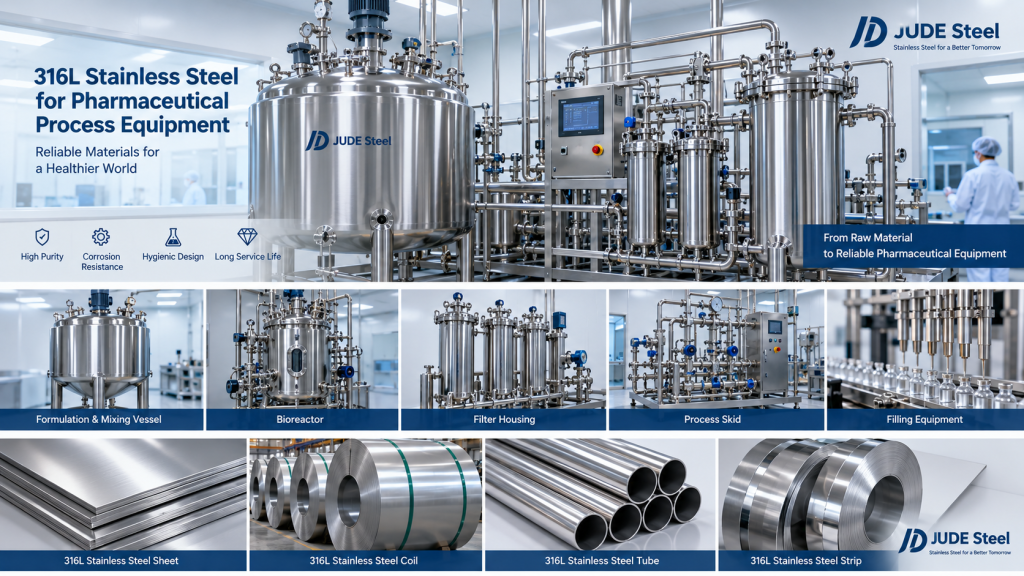
Which Pharmaceutical and Medical Equipment Uses 316L Stainless Steel?
316L stainless steel is one of the most widely specified stainless steels for pharmaceutical and bioprocess equipment, but the phrase “316L pharmaceutical grade” is not a complete material specification.
A pharmaceutical formulation vessel, a sanitary process skid and a surgical implant may all be described commercially as “316L,” yet they do not necessarily use the same material standard or metallurgical requirements.
For pharmaceutical process equipment, Type 316L / UNS S31603 is widely used because its low carbon content supports welded fabrication while its molybdenum addition provides additional resistance to localized corrosion compared with the 304 stainless steel family in many compatible environments.
However, material chemistry alone does not create a hygienic or validated pharmaceutical system.
Surface finish, weld quality, drainability, cleanability, process chemistry, cleaning procedures, sterilization, fabrication and project standards must also be controlled.
This guide connects:
pharmaceutical equipment → 316L raw material → product standard → hygienic surface → fabrication → validation requirements → RFQ.
Quick Answer: Where Does 316L Fit in Pharmaceutical Manufacturing?
Depending on the pharmaceutical process, equipment specification and cleaning environment, Type 316L may be considered for:
- formulation tanks;
- mixing vessels;
- bioreactor shells;
- fermentation vessels;
- buffer preparation tanks;
- media preparation vessels;
- pharmaceutical filter housings;
- high-purity process skids;
- sanitary manifolds;
- product-transfer systems;
- filling-machine product-contact components;
- dosing systems;
- selected clean-utility components;
- selected non-implant medical-equipment components.
316L is not automatically required for every pharmaceutical component.
The correct grade and surface specification should be selected according to the actual product, cleaning chemistry, sterilization method, temperature, chloride exposure, fabrication and regulatory or customer requirements.
Why Is 316L Widely Used in Pharmaceutical Processing?
Type 316L is a low-carbon chromium-nickel-molybdenum austenitic stainless steel.
Its two most important metallurgical features for pharmaceutical fabrication are:
- molybdenum: providing greater resistance to localized corrosion than conventional 304-family stainless steel in many chloride-containing environments;
- low carbon: reducing susceptibility to sensitization-related intergranular corrosion after welding.
These properties are useful because pharmaceutical equipment frequently combines:
- welded construction;
- repeated cleaning;
- hot water or steam exposure;
- chemical sanitization;
- high surface-quality requirements;
- strict contamination control.
The grade still has corrosion limits.
Hot concentrated chlorides, aggressive halide cleaners, unfavorable crevices or process chemicals outside the proven operating range may require another alloy.
For basic grade information, see the
JUDE Steel 316L Stainless Steel Grade Page.
316L Grade Designations and Product Standards
| Product / System | Designation | Procurement Note |
|---|---|---|
| Common grade | Type 316L | Low-carbon Cr-Ni-Mo austenitic stainless steel |
| UNS | S31603 | Common industrial 316L UNS designation |
| EN | 1.4404 / X2CrNiMo17-12-2 | Common European counterpart |
| JIS | SUS316L | Use with the applicable JIS product specification |
| Sheet / plate / strip | ASTM A240/A240M S31603 | Flat products for vessels, panels and fabricated parts |
| Sanitary tubing | ASTM A270/A270M TP316L | Sanitary tubing; pharmaceutical supplementary requirements may be specified where applicable |
| General tubing | ASTM A269/A269M TP316L | General-service tubing; not automatically equivalent to a pharmaceutical hygienic specification |
| Process pipe | ASTM A312/A312M TP316L | Process piping where the design specification requires it |
| High-purity bioprocess equipment | ASME BPE where project-specified | Covers much more than alloy chemistry |
A professional purchase order should therefore specify both the alloy and the product standard.
Writing only “pharmaceutical-grade 316L” does not identify the required product form, surface, dimensional tolerance or hygienic fabrication requirements.
ASTM A240 Type 316L / UNS S31603 Chemical Composition
The following values are ASTM A240 specification limits for Type 316L flat products.
They are not producer-specific typical heat chemistry.
| Element | ASTM A240 S31603, wt.% |
|---|---|
| Carbon (C) | 0.030 max. |
| Manganese (Mn) | 2.00 max. |
| Silicon (Si) | 0.75 max. |
| Phosphorus (P) | 0.045 max. |
| Sulfur (S) | 0.030 max. |
| Chromium (Cr) | 16.0–18.0 |
| Nickel (Ni) | 10.0–14.0 |
| Molybdenum (Mo) | 2.0–3.0 |
| Nitrogen (N) | 0.10 max. |
Actual heat-analysis values should be verified against the Mill Test Certificate and the governing specification.
Which Pharmaceutical Products Use 316L Stainless Steel?
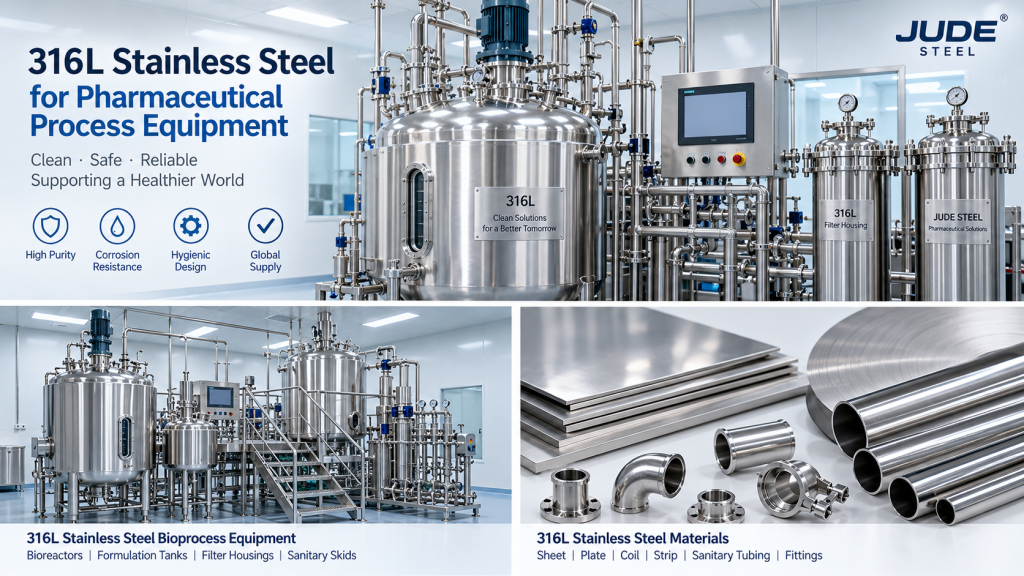
1. Formulation and Mixing Vessels
Pharmaceutical formulation vessels are used to combine active ingredients, excipients, solvents, water or other process materials.
316L sheet and plate may be used for selected:
- vessel shells;
- heads;
- internal product-contact surfaces;
- covers;
- selected agitator-related components;
- fabricated nozzles and attachments where the applicable product standard permits.
Raw-material selection should consider:
- process chemistry;
- operating temperature;
- cleaning chemicals;
- sterilization;
- welding;
- required internal surface finish.
For flat material, buyers can review
JUDE Steel 316L Stainless Steel Sheet and Plate.
2. Bioreactors and Fermentation Vessels
316L is frequently specified for metallic bioreactor and fermentation-vessel product-contact surfaces when the process specification requires a corrosion-resistant, weldable austenitic stainless steel.
The equipment manufacturer may need to control:
- base material;
- internal surface roughness;
- weld profile;
- weld discoloration;
- dead legs;
- drainability;
- cleanability;
- passivation or electropolishing where specified.
The words “316L bioreactor” therefore describe only part of the final equipment specification.
3. Buffer and Media Preparation Tanks
Buffer and media preparation systems often require stainless surfaces that can tolerate repeated cleaning while limiting contamination risk.
316L may be used for:
- tank shells;
- covers;
- transfer connections;
- mixing-system components;
- supporting sanitary process assemblies.
Actual compatibility must be checked against the formulation and cleaning chemistry.
4. Pharmaceutical Filter Housings
Filter housings used in liquid, gas or sterile-processing systems can contain 316L product-contact components.
Important procurement requirements may include:
- grade;
- pressure rating;
- surface roughness;
- internal polish;
- weld condition;
- connection type;
- passivation;
- electropolishing where specified;
- documentation and traceability.
The filter element, seals and complete housing design must also be selected for the actual process.
5. High-Purity Process Skids
Pharmaceutical skids combine multiple components into one processing module.
A typical 316L skid may contain:
- tubing;
- valves;
- manifolds;
- filter housings;
- small vessels;
- pump wetted parts;
- instrument connections;
- supporting fabricated panels.
Not every component must use the same material or surface specification.
The product-contact boundary should be clearly identified on the P&ID, fabrication drawing or bill of materials.
6. Sanitary Manifolds and Transfer Systems
High-purity product-transfer systems can use TP316L tubing together with hygienically designed fittings, valves and welded assemblies.
ASTM A270/A270M is a sanitary tubing specification that can be relevant where the project requires applicable TP316L sanitary tubing.
The purchaser should separately define:
- tube OD;
- wall thickness;
- internal surface;
- external surface;
- maximum Ra where required;
- welded or seamless construction;
- supplementary pharmaceutical requirements where applicable.
7. Filling and Dosing Equipment Components
Selected pharmaceutical filling and dosing machines use 316L in product-contact components because the material combines corrosion resistance, fabrication capability and high-quality surface finishing.
Possible parts include:
- product hoppers;
- small reservoirs;
- transfer manifolds;
- filling nozzles;
- dosing chambers;
- selected valve bodies and wetted fabricated parts.
Precision machined components may require product standards other than ASTM A240.
The engineering drawing should identify the correct starting material.
8. Selected Non-Implant Medical Equipment Components
316L may also be selected for non-cutting medical-equipment components where corrosion resistance, cleaning and surface quality are important.
Examples may include:
- sterilization trays;
- instrument trays;
- medical-equipment housings;
- selected non-cutting reusable components;
- laboratory and healthcare processing equipment.
However, this does not make standard ASTM A240 S31603 an implant-grade material.
Equipment-to-Raw-Material Procurement Matrix
| Finished Product | Possible 316L Raw Material | Main Procurement Requirement |
|---|---|---|
| Formulation vessel | A240 S31603 sheet / plate | Thickness, surface, welding and process chemistry |
| Bioreactor shell | A240 S31603 sheet / plate | Internal finish, traceability, fabrication and validation requirements |
| Buffer / media tank | Sheet / plate | Product chemistry, CIP/SIP conditions and surface |
| Filter housing | Sheet / tube / bar / forging | Pressure, surface and product-contact requirements |
| High-purity skid | Sheet + tube + project-specified components | Product-contact boundary, welds and documentation |
| Sanitary transfer line | TP316L tubing | Tube standard, OD, wall and internal finish |
| Filling-machine component | Sheet / tube / bar | Drawing, surface, tolerances and product chemistry |
| Medical-equipment tray | Sheet / strip | Forming, surface and cleaning environment |
| Surgical implant | Dedicated implant material | Do not substitute ordinary ASTM A240 S31603 for ASTM F138/F139 or ISO 5832-1 material |
ASTM A240 vs ASTM A270 vs ASTM A269
ASTM A240/A240M
ASTM A240/A240M covers stainless steel plate, sheet and strip.
It is relevant to flat products used to manufacture vessel shells, covers, panels and other fabricated pharmaceutical-equipment components.
ASTM A270/A270M
ASTM A270/A270M covers stainless steel sanitary tubing.
The specification provides multiple surface-finish options and allows additional pharmaceutical-quality requirements to be ordered where applicable.
An ASTM A270 designation alone still does not define every ASME BPE or customer-specific requirement.
ASTM A269/A269M
ASTM A269/A269M covers austenitic stainless steel tubing for general corrosion-resisting and low- or high-temperature service.
It should not automatically be substituted for a dedicated sanitary or high-purity tubing specification.
Purchasing rule:
specify the product standard according to the final function of the tube, not simply because each standard can include TP316L.
What Does ASME BPE Mean for a 316L Pharmaceutical Project?
ASME BPE is an international standard for equipment and systems used in bioprocessing, pharmaceutical and other high-purity applications.
It addresses much more than stainless steel grade selection.
Depending on the project scope, BPE requirements can address areas such as:
- materials;
- hygienic design;
- fabrication;
- welding;
- surface finish;
- inspection;
- testing;
- certification.
Therefore:
ASTM A240 Type 316L does not automatically equal ASME BPE-compliant equipment.
If ASME BPE compliance or certification is required, it should be explicitly stated in the equipment or component purchase specification.
Official reference:
ASME Bioprocessing Equipment Standard.
Surface Roughness, Polishing and Electropolishing
316L chemistry alone does not create a pharmaceutical product-contact surface.
The project may also control:
- maximum surface roughness;
- mechanical polish;
- grit sequence;
- electropolishing;
- surface defects;
- direction of polishing;
- critical product-contact side.
The RFQ should state the actual maximum Ra or approved surface specification where required.
Do not write only:
“pharmaceutical polish.”
Electropolishing should also not be described as universally mandatory for every pharmaceutical 316L component.
Its use depends on the hygienic design, service, customer standard and validation strategy.
Welding, Heat Tint and Cleanability
Low carbon makes 316L well suited to welded fabrication, but the grade does not eliminate welding-quality requirements.
Product-contact weld specifications may control:
- joint design;
- orbital or manual welding procedure;
- purging;
- penetration;
- weld profile;
- heat discoloration;
- grinding or polishing;
- inspection;
- cleanability.
Crevices, incomplete penetration or severe surface defects can compromise hygienic performance even when the base metal is correctly certified as Type 316L.
Passivation and Surface Treatment
After fabrication, pharmaceutical stainless steel systems may require cleaning and passivation according to the project specification.
Passivation should not be marketed as a coating that makes 316L immune to corrosion.
The objective is to produce a clean surface and support formation of the stainless steel’s protective passive condition.
Final procedures should follow the fabricator’s validated process and applicable customer standard.
316L S31603 vs Implant-Grade S31673
This distinction is essential for medical-device buyers.
| Material | Typical Standard | Primary Use |
|---|---|---|
| Type 316L / UNS S31603 | ASTM A240, A270, A269 and other industrial product standards | Pharmaceutical equipment, process equipment and many non-implant applications |
| UNS S31673 | ASTM F138 / ASTM F139 | Wrought stainless steel for surgical-implant manufacturing |
| ISO implant stainless steel | ISO 5832-1:2024 | Surgical implant material corresponding to UNS S31673 |
UNS S31673 uses tighter chemical, metallurgical and product requirements than ordinary commercial Type 316L S31603.
It is often informally associated with terms such as implant-grade 316L or 316LVM, but the buyer should order to the actual ASTM, ISO and device specification rather than relying on a marketing name.
Why Is ASTM A240 Type 316L Not Automatically Implant Grade?
ASTM A240 S31603 is a stainless steel flat-product specification used broadly in industrial applications.
ASTM F138 and F139 are dedicated surgical-implant material specifications for UNS S31673.
ASTM F138 applies to implant bar and wire, while ASTM F139 applies to implant sheet and strip.
ISO 5832-1:2024 likewise identifies its wrought surgical-implant stainless steel with UNS S31673.
A supplier should therefore never replace an ASTM F138, F139 or ISO 5832-1 requirement with ordinary A240 S31603 merely because both materials are commercially described as 316L-family stainless steels.
Official references:
- ASTM F138 — Surgical Implant Bar and Wire
- ASTM F139 — Surgical Implant Sheet and Strip
- ISO 5832-1:2024 — Wrought Stainless Steel for Surgical Implants
316L vs 304L in Pharmaceutical Equipment
| Factor | 304L | 316L |
|---|---|---|
| Low-carbon welded fabrication | Yes | Yes |
| Molybdenum | No deliberate Mo addition | 2.0–3.0% under ASTM A240 |
| Localized corrosion resistance | Suitable for many mild environments | Greater margin in many chloride-containing environments |
| Pharmaceutical use | Application dependent | Very widely considered for product-contact equipment |
| Cost | Generally lower alloy cost | Higher alloy content |
316L should not be selected only because it is perceived as a “higher grade.”
If 304L satisfies the validated corrosion, cleaning and hygienic requirements, it may remain a technically appropriate material for selected non-critical components.
When Is 316L Not Enough?
Another alloy may require evaluation when pharmaceutical equipment experiences:
- high chloride concentrations;
- hot chloride-containing solutions;
- aggressive halogen-based cleaning chemicals;
- process chemistry outside the validated range of 316L;
- severe crevice conditions;
- customer specifications requiring higher-alloy stainless steel.
Possible alternatives may include higher-molybdenum austenitic stainless steels or duplex grades depending on the corrosion mechanism and equipment-design requirements.
What Should a Pharmaceutical 316L RFQ Include?
- Finished equipment: bioreactor, formulation tank, filter housing, skid, manifold or filling component.
- Product-contact status: direct product contact, clean utility or non-contact component.
- Exact grade: Type 316L / UNS S31603 or another specified material.
- Material standard: ASTM A240, A270, A269, EN, JIS or customer specification.
- ASME BPE: state whether BPE requirements apply.
- Product form: sheet, plate, coil, strip, tube or machined starting material.
- Dimensions: thickness, width, length, OD and wall thickness as applicable.
- Internal surface: state the required finish.
- Maximum Ra: where specified.
- Electropolishing: required or not required.
- Passivation: state the applicable procedure if specified.
- Process medium: actual pharmaceutical product or solution.
- Cleaning chemistry: chemical, concentration and temperature.
- Sterilization: SIP, steam or other validated process where relevant.
- Operating temperature: normal and maximum.
- Chloride content: where relevant.
- Welding requirement: including product-contact weld specifications.
- Inspection: PMI, surface inspection or project-specific tests.
- Documentation: MTC, heat-number traceability and required quality records.
- Processing: cutting, polishing or drawing-based fabrication.
- Quantity: prototype, trial or production volume.
- Drawing: equipment or component drawing.
- Destination: country, port and delivery schedule.
Example 316L Pharmaceutical Process-Skid RFQ
Application: Pharmaceutical Buffer Preparation and Transfer Skid
Material: Type 316L / UNS S31603
Flat Material: ASTM A240/A240M
Sanitary Tubing: ASTM A270/A270M TP316L where specified
Project Standard: ASME BPE requirements per attached specification
Product-Contact Surface: Customer surface specification attached
Maximum Ra: Per approved equipment specification
Electropolishing: As identified on the drawing
Welding: Hygienic weld specification attached
Process Medium: Buffer solution data attached
Cleaning: CIP chemistry and temperature attached
Sterilization: SIP requirements attached
Documentation: MTC + heat-number traceability + project quality documentation
Quantity: Bill of materials attached
Destination: Basel, Switzerland
Incoming Inspection and Documentation
Depending on the pharmaceutical project, incoming material verification may include:
- grade confirmation;
- heat number;
- Mill Test Certificate;
- chemical composition;
- mechanical properties;
- dimensions;
- surface condition;
- surface roughness where specified;
- PMI where required;
- traceability;
- material-standard verification;
- customer-required documentation.
The material certificate should be matched to the actual heat number and delivered product rather than accepted as a generic 316L certificate.
How JUDE Steel Supports Pharmaceutical Equipment Manufacturers
JUDE Steel supplies Type 316L stainless steel flat products for international process-equipment and pharmaceutical-equipment manufacturers.
Relevant product and service pages include:
- 316L Stainless Steel Grade
- 316L Stainless Steel Sheet and Plate
- 316L Stainless Steel Coil
- 316L Stainless Steel Strip
- Stainless Steel Processing Services
- JUDE Steel Certifications
Specific grade, mill origin, surface roughness, sanitary tubing, electropolishing, pharmaceutical documentation and project-standard availability should be confirmed for each inquiry rather than assumed from a general 316L product listing.
Frequently Asked Questions
Is 316L mandatory for every pharmaceutical equipment component?
No. 316L is widely specified for product-contact pharmaceutical equipment, but the required material depends on process chemistry, cleaning, hygienic design, equipment function and the customer’s validated specification.
Does ASTM A240 316L automatically comply with ASME BPE?
No. ASTM A240 specifies stainless steel flat material, while ASME BPE addresses broader requirements for high-purity bioprocess equipment, including design, fabrication, surface, inspection and testing requirements.
Is ASTM A270 required for pharmaceutical tubing?
ASTM A270 is a widely relevant sanitary-tubing specification and allows pharmaceutical supplementary requirements to be specified. The project may additionally require ASME BPE or another customer-specific tubing specification.
Is UNS S31603 an implant-grade stainless steel?
Ordinary UNS S31603 supplied to industrial standards such as ASTM A240 should not automatically be treated as surgical-implant material. ASTM F138, ASTM F139 and ISO 5832-1 identify UNS S31673 for the relevant wrought surgical-implant stainless steel.
What is the difference between 316L and 316LVM?
“316LVM” is commonly used in the medical industry for highly controlled implant stainless steel, but buyers should order to the exact implant specification. ASTM F138 and F139 identify UNS S31673, which is different from ordinary industrial UNS S31603.
Is electropolishing mandatory for every 316L pharmaceutical component?
No. Electropolishing is specified for certain high-purity product-contact surfaces but is not universally mandatory. The required finish must follow the equipment and validation specification.
What surface roughness should be specified for pharmaceutical 316L?
There is no single universal Ra value for every pharmaceutical component. The maximum surface roughness should come from the applicable ASME BPE, customer, equipment or validated process requirement.
Can 316L be used in WFI and clean-utility systems?
316L is widely considered for high-purity and clean-utility components, but suitability depends on the system design, water chemistry, surface specification, weld quality, passivation, operating temperature and applicable project standard.
Can JUDE Steel supply implant-grade ASTM F138 or F139 material?
Implant material should never be assumed from a general 316L stock listing. Buyers requiring ASTM F138, ASTM F139 or ISO 5832-1 material should submit the complete specification so availability, mill route, documentation and qualification can be reviewed separately.
What should I send JUDE Steel for a pharmaceutical 316L quotation?
Send the equipment drawing, product-contact status, exact grade and material standard, dimensions, surface and Ra requirement, welding specification, cleaning and sterilization conditions, certification requirements, quantity and destination.
Request 316L Stainless Steel for Pharmaceutical Equipment
Manufacturing pharmaceutical vessels, bioreactors, filter housings, high-purity skids or hygienic process components?
Send JUDE Steel your:
Equipment Drawing + Product-Contact Area + Grade + Material Standard + Dimensions + Surface / Ra + Quantity + Destination
For high-purity projects, also include:
ASME BPE Requirement + Welding Specification + Electropolishing / Passivation + CIP/SIP Conditions + Process Chemistry + Inspection and Documentation Requirements
Technical note:
This article is intended for preliminary raw-material selection and procurement guidance. Final pharmaceutical or medical-device material suitability depends on the exact material standard, process chemistry, cleaning and sterilization conditions, hygienic design, surface finish, welding procedure, validation requirements and applicable regulatory or customer specifications. Ordinary Type 316L / UNS S31603 should not be substituted for dedicated surgical-implant UNS S31673 material without explicit engineering and regulatory approval.
