
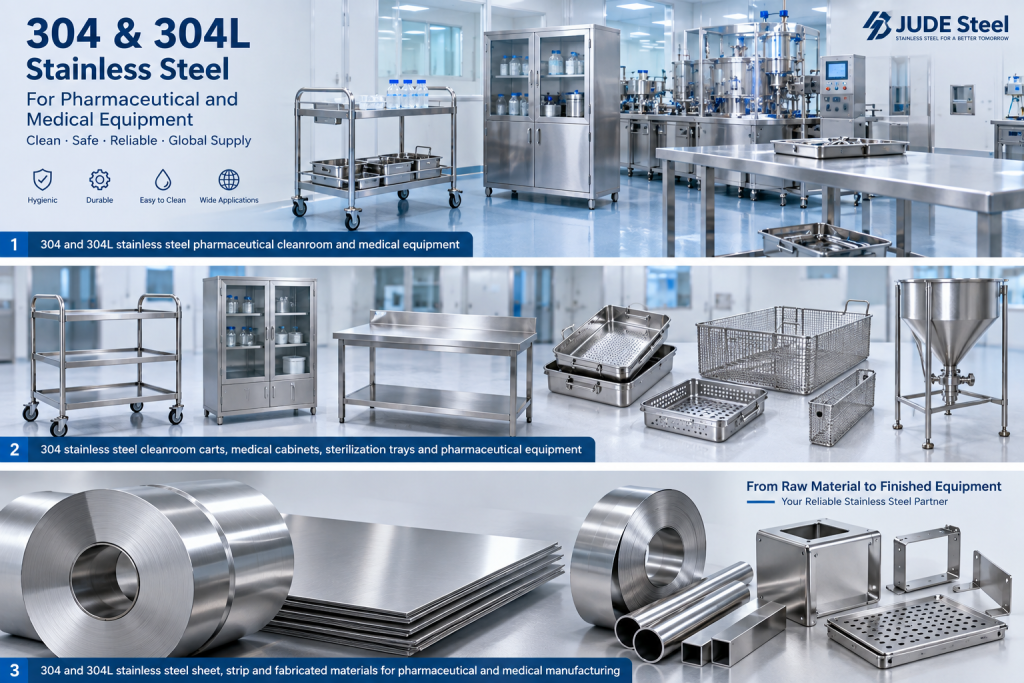
Where Should Pharmaceutical and Medical Manufacturers Use 304 or 304L Stainless Steel?
Type 304 and Type 304L stainless steel are widely used throughout pharmaceutical plants, medical-device factories, laboratories and cleanroom environments, but they should not be treated as universal substitutes for 316L.
A cleanroom trolley, a sterilization basket and a high-purity pharmaceutical process line can all be made from stainless steel, yet they do not create the same corrosion, welding, surface or documentation requirements.
Type 304 / UNS S30400 is a practical general-purpose material for many cleanroom, medical-equipment and support applications.
Type 304L / UNS S30403 provides similar general corrosion behavior with a lower carbon limit that reduces susceptibility to sensitization-related intergranular corrosion after welding.
The most useful purchasing question is therefore not:
“Is 304 pharmaceutical grade?”
A better question is:
which pharmaceutical and medical components can use 304 or 304L, which parts require 316L, and what raw material and surface specification should the manufacturer purchase?
Quick Answer: Where Do 304 and 304L Fit?
Depending on the actual process environment and customer specification, Type 304 or 304L may be considered for:
- cleanroom trolleys;
- medical carts;
- pharmaceutical cabinets;
- cleanroom worktables;
- equipment housings;
- machine guards;
- sterilization trays;
- sterilization baskets;
- instrument trays;
- storage racks and shelving;
- dry-product hoppers;
- selected powder-handling components;
- mild-service utility tanks;
- selected welded vessels;
- non-wetted process-skid frames;
- equipment supports and fabricated enclosures.
Components exposed to aggressive chlorides, demanding product-contact chemistry, high-purity water, aggressive cleaning chemicals or particularly stringent hygienic requirements should be evaluated separately.
In many of those applications, 316L may provide a more appropriate corrosion margin.
304 vs 304L: What Is the Real Difference?
304 and 304L belong to the same chromium-nickel austenitic stainless steel family.
Their most important difference is carbon content.
| Factor | Type 304 | Type 304L |
|---|---|---|
| UNS | S30400 | S30403 |
| Maximum carbon | 0.080% | 0.030% |
| General corrosion behavior | Broadly suitable for many mild environments | Broadly similar to 304 in comparable service |
| Welded fabrication | Widely weldable | Lower carbon reduces sensitization-related risk after welding |
| Chloride resistance | Limited in aggressive chloride conditions | Low carbon does not create a major chloride-resistance upgrade |
| Typical selection logic | Formed sheet products and general cleanroom equipment | Extensively welded equipment where the environment is compatible |
The “L” suffix means low carbon.
It does not mean that 304L is automatically more corrosion resistant than 304 in every environment.
If chloride pitting or crevice corrosion is the controlling damage mechanism, 316L or another more highly alloyed stainless steel may be required.
304 and 304L Grade Designations and Product Standards
| Product / System | Type 304 | Type 304L |
|---|---|---|
| UNS | S30400 | S30403 |
| EN | 1.4301 / X5CrNi18-10 | 1.4307 / X2CrNi18-9 |
| JIS | SUS304 | SUS304L |
| Plate / sheet / strip | ASTM A240/A240M S30400 | ASTM A240/A240M S30403 |
| Sanitary tubing | ASTM A270/A270M TP304 where specified | ASTM A270/A270M TP304L where specified |
| General tubing | ASTM A269/A269M TP304 | ASTM A269/A269M TP304L |
| Process pipe | ASTM A312/A312M TP304 | ASTM A312/A312M TP304L |
EN 1.4306 / X2CrNi19-11 is another low-carbon Cr-Ni stainless steel grade, but it is a separate EN designation and should not automatically be treated as identical to 1.4307.
For JUDE Steel grade information, see:
ASTM A240 Chemical Composition: 304 vs 304L
The values below are ASTM A240 specification limits for applicable flat products.
They are not producer-specific typical heat chemistry.
| Element | Type 304 / S30400 | Type 304L / S30403 |
|---|---|---|
| Carbon (C) | 0.080 max. | 0.030 max. |
| Manganese (Mn) | 2.00 max. | 2.00 max. |
| Silicon (Si) | 0.75 max. | 0.75 max. |
| Phosphorus (P) | 0.045 max. | 0.045 max. |
| Sulfur (S) | 0.030 max. | 0.030 max. |
| Chromium (Cr) | 18.0–20.0 | 18.0–20.0 |
| Nickel (Ni) | 8.0–10.5 | 8.0–12.0 |
| Nitrogen (N) | 0.10 max. | 0.10 max. |
Actual supplied chemistry should be verified against the Mill Test Certificate and applicable product standard.
Which Pharmaceutical and Medical Products Use 304 or 304L?
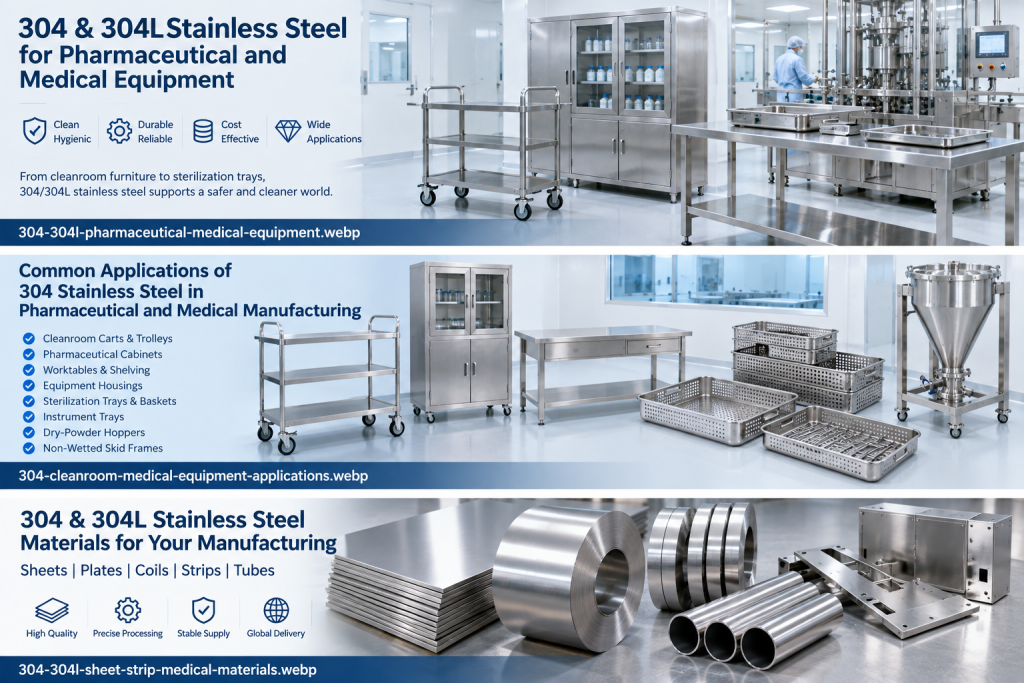
1. Cleanroom Trolleys and Medical Carts
Cleanroom and medical carts are strong applications for Type 304 because the finished product often needs:
- corrosion resistance in normal indoor environments;
- smooth cleanable surfaces;
- good forming capability;
- good appearance;
- mechanical durability;
- cost control.
Possible components include:
- cart tops;
- shelves;
- drawer panels;
- side panels;
- frames;
- handles;
- equipment mounting plates.
Where the cart is exposed to aggressive disinfectants or high chloride levels, the cleaning environment should be reviewed before final material selection.
2. Pharmaceutical Cabinets and Worktables
Type 304 is widely suited to stainless cabinets, cleanroom furniture and work surfaces where corrosion exposure remains moderate.
Raw-material requirements may include:
- cold-rolled sheet;
- 2B or brushed finish;
- flatness control;
- protective film;
- bending performance;
- weld finishing;
- rounded or deburred edges.
JUDE Steel supplies
304 and 304L stainless steel sheet and plate
for fabricated equipment and panels.
3. Equipment Housings and Machine Guards
Pharmaceutical filling, tablet-compression, inspection and packaging machines frequently contain stainless steel housings and protective panels.
For non-product-contact surfaces, Type 304 can provide an effective combination of:
- appearance;
- formability;
- cleanability;
- corrosion resistance;
- fabrication economy.
Possible parts include:
- machine doors;
- guards;
- control-box housings;
- side covers;
- inspection-machine enclosures;
- packaging-machine panels.
4. Sterilization Trays and Baskets
Type 304 can be considered for selected sterilization trays, handling baskets and reusable instrument-management components.
The application should be evaluated against:
- sterilization method;
- cleaning chemicals;
- chloride contamination;
- surface finish;
- drainage;
- repeated-use requirements.
The fact that a tray enters an autoclave does not automatically mean that any Type 304 construction will have unlimited sterilization life.
5. Instrument Trays and Handling Equipment
304 stainless steel is a practical candidate for selected medical and laboratory handling products such as:
- instrument trays;
- storage trays;
- laboratory racks;
- cleanroom shelves;
- equipment baskets;
- transport containers.
These applications should be distinguished from surgical cutting instruments and permanent implants, which use dedicated material families and specifications.
6. Dry-Powder Hoppers and Feeding Components
Selected dry pharmaceutical-powder systems can use Type 304 or 304L when the formulation and cleaning environment are compatible with the alloy.
Possible components include:
- powder hoppers;
- feed chutes;
- dry-product bins;
- transfer funnels;
- selected feeder housings.
A dry-product application should not automatically be assumed to be mild.
Actual product chemistry, cleaning procedure, moisture and contamination-control requirements should be reviewed.
7. Mild-Service Welded Tanks and Vessels
304L becomes more relevant where a pharmaceutical or laboratory vessel contains extensive welded fabrication and the process chemistry is otherwise compatible with the 304 family.
Possible applications can include:
- selected utility tanks;
- mild-service mixing tanks;
- non-aggressive wash tanks;
- selected laboratory vessels;
- equipment reservoirs.
The lower carbon limit of 304L reduces sensitization-related risk after welding.
This does not give 304L the molybdenum-enhanced chloride resistance of 316L.
8. Non-Wetted Skid Frames and Equipment Supports
High-purity pharmaceutical skids may use 316L for product-contact piping while using 304 or 304L for non-wetted structural and enclosure components.
Examples include:
- skid frames;
- support legs;
- equipment bases;
- instrument brackets;
- electrical enclosures;
- protective covers.
Separating product-contact and non-product-contact materials can improve cost efficiency without reducing the metallurgy of the critical wetted system.
Equipment-to-Raw-Material Procurement Matrix
| Finished Product | Possible Material | Starting Form | Main Buying Check |
|---|---|---|---|
| Cleanroom trolley | 304 | Sheet / tube | Surface, forming, cleaning environment |
| Medical cart | 304 | Sheet / tube | Finish, welds, disinfectant exposure |
| Pharmaceutical cabinet | 304 | Cold-rolled sheet | Flatness, appearance, protective film |
| Machine housing | 304 | Sheet / coil | Bending, surface, cosmetic side |
| Sterilization tray | 304 / 304L | Sheet / strip | Forming, drainage and sterilization chemistry |
| Dry-product hopper | 304 / 304L | Sheet | Product chemistry, surface and cleaning |
| Welded mild-service vessel | 304L | Sheet / plate | Welding, chemistry and cleaning environment |
| Non-wetted skid frame | 304 / 304L | Sheet / tube / plate | Structural fabrication and cleaning |
| High-purity wetted process system | Evaluate 316L | Project-specific | Process chemistry, chloride, BPE and surface requirements |
ASTM A240 vs ASTM A270 vs ASTM A269
ASTM A240/A240M
ASTM A240/A240M covers stainless steel plate, sheet and strip.
It is relevant to raw material used to manufacture:
- cabinets;
- worktables;
- machine panels;
- trays;
- hoppers;
- welded vessel shells;
- equipment enclosures.
ASTM A270/A270M
ASTM A270/A270M covers sanitary stainless steel tubing with specified surface-finish options.
The standard allows pharmaceutical-quality supplementary requirements to be requested.
This does not mean that every commercial tube marked ASTM A270 automatically satisfies every pharmaceutical high-purity project.
The purchaser should specify any required:
- pharmaceutical supplementary requirement;
- internal finish;
- external finish;
- maximum roughness average;
- inspection and documentation.
Official reference:
ASTM A270/A270M Sanitary Tubing
.
ASTM A269/A269M
ASTM A269/A269M covers general-service austenitic stainless steel tubing.
It should not automatically replace a sanitary tubing specification when the finished system requires specific hygienic or pharmaceutical surface requirements.
Why Is 304L Often Preferred for Welded Equipment?
The main metallurgical reason to select 304L rather than conventional 304 is its lower maximum carbon content.
During relevant welding thermal cycles, carbon can combine with chromium and form chromium-rich carbides near grain boundaries.
Lower carbon reduces this tendency and therefore reduces susceptibility to sensitization-related intergranular corrosion.
This can make 304L particularly useful for:
- large welded cabinets;
- welded tanks;
- fabricated vessels;
- frames with extensive welded joints;
- equipment that cannot conveniently be solution annealed after fabrication.
304L does not automatically provide a major improvement in pitting resistance.
Surface Finish and Cleanability
The stainless steel grade and surface finish are separate purchasing requirements.
Depending on the component, a pharmaceutical or medical-equipment manufacturer may specify:
- 2B;
- BA;
- No.4 / brushed surface;
- mechanically polished surface;
- project-specific maximum Ra;
- electropolishing where required.
A cleanroom cabinet may only require a consistent brushed or 2B surface.
A product-contact component can require a much more tightly controlled finish.
The RFQ should therefore state the actual finish rather than using vague phrases such as:
“medical finish” or “pharmaceutical surface.”
Cleaning and Sterilization Limitations
304 and 304L can perform well under many routine cleaning conditions, but neither grade should be marketed as resistant to every disinfectant or sterilization chemistry.
Material review should consider:
- chloride concentration;
- hypochlorite exposure;
- acidic cleaners;
- alkaline cleaners;
- temperature;
- contact time;
- rinse quality;
- drying;
- crevices and deposits.
Repeated exposure to aggressive chloride-containing cleaning solutions can increase pitting risk.
304 vs 304L vs 316L for Pharmaceutical and Medical Equipment
| Grade | Main Advantage | Typical Screening Position |
|---|---|---|
| 304 | General-purpose corrosion resistance, formability and cost efficiency | Cleanroom furniture, carts, housings, trays and non-wetted equipment |
| 304L | 304-family properties with lower carbon for welded fabrication | Welded mild-service tanks, frames and fabricated equipment |
| 316L | Low carbon + molybdenum-enhanced localized-corrosion resistance | More demanding pharmaceutical product-contact and chloride-bearing service |
This is not a simple quality ranking.
The correct choice depends on the actual environment.
When Should a Buyer Upgrade to 316L?
316L should be evaluated instead of 304 or 304L when the component faces conditions such as:
- higher chloride exposure;
- chloride-containing cleaning chemistry;
- aggressive product-contact solutions;
- high-purity wetted process requirements;
- more severe corrosion consequences;
- customer or ASME BPE specifications requiring 316L;
- process history demonstrating inadequate 304-family corrosion performance.
JUDE Steel’s
316L Stainless Steel Grade Page
can be used as a starting reference when a higher corrosion margin is required.
Product Contact vs Non-Product Contact
One of the most useful cost-control steps in pharmaceutical equipment procurement is to define the product-contact boundary.
For example, a process skid may use:
- 316L sanitary tubing for wetted product-contact lines;
- 304 stainless steel for support frames;
- 304 sheet for electrical enclosures;
- 304 or 304L for guards and machine covers.
Using the same premium alloy for every visible stainless component may increase cost without adding equivalent process value.
The P&ID, equipment drawing and bill of materials should identify each material zone separately.
What Does ASME BPE Mean for a 304 or 304L Project?
ASME BPE is not simply a stainless steel grade specification.
It addresses requirements for high-purity bioprocessing equipment and systems, including areas such as:
- materials;
- design;
- fabrication;
- welding;
- surface requirements;
- inspection;
- testing;
- certification.
Therefore, a component made from ASTM A240 Type 304L should not be described as automatically ASME BPE compliant.
When BPE requirements apply, the buyer should specify them explicitly.
Official reference:
ASME Bioprocessing Equipment
.
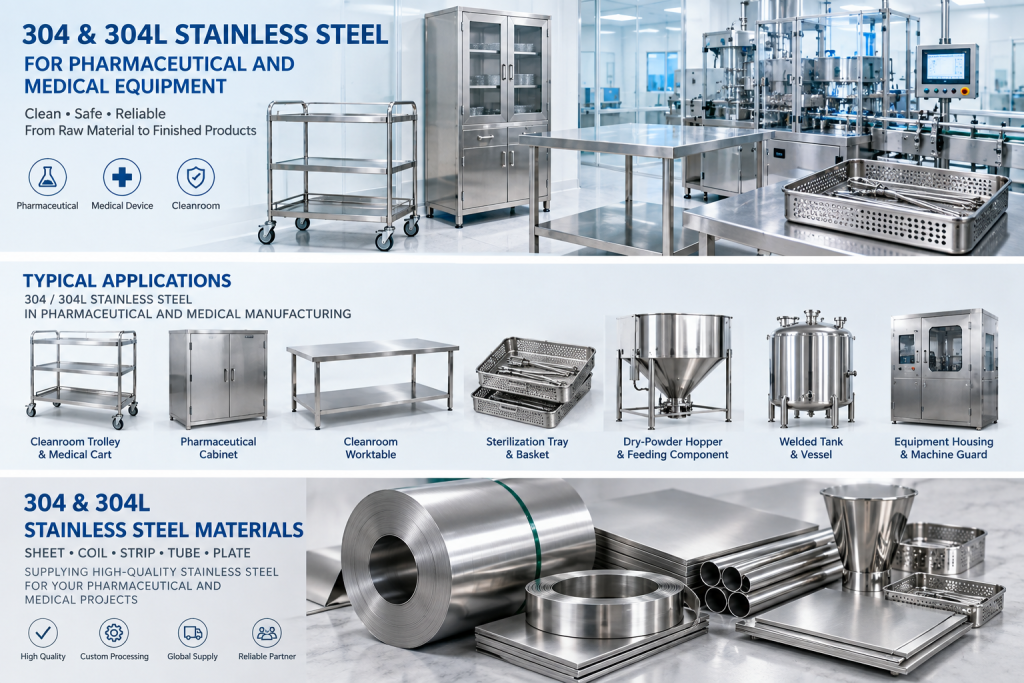 Why 304 and 304L Are Not Automatically “Medical Grade”
“Medical grade” is not a complete stainless steel purchase specification.
Type 304 and 304L are widely used in medical-equipment and healthcare-related products, but their suitability depends on the finished device.
They can be reasonable materials for selected:
- medical carts;
- equipment housings;
- instrument trays;
- sterilization baskets;
- laboratory racks;
- non-implant reusable equipment.
They should not automatically be marketed as materials for permanent surgical implants or specialized surgical cutting instruments.
Those applications use separate material families, standards and device-validation requirements.
What Should a 304 / 304L Pharmaceutical or Medical RFQ Include?
- Finished product: trolley, cabinet, tray, hopper, vessel, frame or equipment housing.
- Industry: pharmaceutical, medical, laboratory or cleanroom equipment.
- Product-contact status: direct contact, indirect contact or non-contact.
- Exact grade: Type 304 / S30400 or Type 304L / S30403.
- Product standard: ASTM A240, A270, A269, EN, JIS or project specification.
- Product form: sheet, plate, coil, strip or tube.
- Thickness: nominal value and tolerance.
- Width and length: or coil dimensions.
- Surface finish: 2B, BA, No.4 or project-specific finish.
- Maximum Ra: where required.
- Visible side: identify cosmetic-critical surfaces.
- Protective film: where required.
- Forming: bending, deep drawing, stamping or rolling.
- Welding: identify continuous or spot welding requirements.
- Post-weld finish: grinding, polishing, pickling or passivation where specified.
- Cleaning chemicals: provide actual chemistry where corrosion matters.
- Sterilization method: where applicable.
- Operating temperature: where relevant.
- Documentation: MTC / EN 10204 / customer documentation.
- Processing: cutting, shearing, polishing or slitting.
- Drawing: provide approved part or equipment drawing.
- Quantity: prototype, trial or annual demand.
- Destination: country, port and delivery schedule.
Example 304 Cleanroom Equipment RFQ
Finished Product: Pharmaceutical Cleanroom Mobile Trolley
Material: Type 304 / UNS S30400
Material Standard: ASTM A240/A240M
Product: Cold-Rolled Stainless Steel Sheet
Thickness: 1.20 mm and 1.50 mm
Surface: No.4 brushed
Critical Surface: Visible Side A
Protective Film: Required
Fabrication: Laser cutting + bending + welding
Product Contact: No direct pharmaceutical product contact
Cleaning: Customer disinfectant data attached
Quantity: 12 MT initial production order
Annual Demand: Approximately 150 MT
Certificate: Mill Test Certificate required
Destination: New Jersey, USA
Example 304L Welded-Vessel RFQ
Application: Mild-Service Pharmaceutical Utility Vessel
Material: Type 304L / UNS S30403
Material Standard: ASTM A240/A240M
Product: Cold-Rolled Sheet / Hot-Rolled Plate as drawing requires
Thickness: Drawing attached
Surface: Fabrication starting finish per drawing
Process Medium: Utility fluid data sheet attached
Chloride Level: Process analysis attached
Cleaning Chemistry: Customer cleaning specification attached
Welding: Extensive welded fabrication
Post-Weld Cleaning: Fabricator specification attached
Documentation: MTC + full heat-number traceability
Quantity: BOM attached
Destination: Singapore
Incoming Inspection
Depending on the project, incoming inspection may include:
- grade verification;
- heat number;
- Mill Test Certificate;
- chemical composition;
- carbon content for 304L;
- mechanical properties;
- thickness;
- width and length;
- flatness;
- surface finish;
- protective film;
- edge condition;
- PMI where required;
- traceability.
For sanitary tubing, inspection should additionally follow the applicable tube specification and purchaser-defined surface requirements.
How JUDE Steel Supports Pharmaceutical and Medical Equipment Manufacturers
JUDE Steel supplies Type 304 and 304L stainless steel flat products for international pharmaceutical, laboratory, cleanroom and medical-equipment manufacturers.
Relevant JUDE Steel resources include:
- Type 304 Stainless Steel
- Type 304L Stainless Steel
- Stainless Steel Sheet & Plate
- Stainless Steel Coil
- Stainless Steel Strip
- Processing Services
- Stainless Steel Polishing
Specific grade, thickness, finish, maximum Ra, protective film, processing tolerance, documentation and availability should be confirmed for each project.
Frequently Asked Questions
Is Type 304 stainless steel suitable for pharmaceutical equipment?
Yes, Type 304 can be suitable for many pharmaceutical cleanroom, support and non-product-contact applications where the corrosion and cleaning environment is compatible. More demanding wetted process systems may require 316L or another alloy.
Should I choose 304 or 304L for welded equipment?
304L is often preferred where extensive welded fabrication and sensitization-related intergranular-corrosion resistance are important because its maximum carbon content is lower than standard 304.
Is 304L more corrosion resistant than 304?
304L provides an advantage against sensitization-related intergranular corrosion in welded or thermally affected material. Its lower carbon content does not give it a major improvement in chloride pitting resistance compared with 304.
Can Type 304 be used for cleanroom furniture?
Yes. Type 304 is widely suitable for cabinets, carts, worktables, shelves, housings and similar cleanroom equipment where the cleaning environment is compatible with the alloy.
Can 304 stainless steel be used for sterilization trays?
It can be used for selected reusable trays and baskets. The manufacturer should still review sterilization method, cleaning chemistry, chloride contamination, surface condition and expected cycle life.
Can 304 or 304L contact pharmaceutical products?
They can be used in selected compatible product-contact applications, but suitability depends on the drug or process chemistry, cleaning and sterilization conditions, hygienic design and customer specification. 316L is commonly evaluated where greater localized-corrosion resistance or high-purity process requirements apply.
When should 316L replace 304 or 304L?
316L should be evaluated when chloride exposure, aggressive cleaning, higher corrosion consequence, demanding wetted service or customer high-purity specifications require a greater localized-corrosion margin.
Does ASTM A270 automatically mean pharmaceutical-quality tubing?
No. ASTM A270 covers sanitary tubing and allows pharmaceutical-quality supplementary requirements to be ordered. The required supplementary requirements and surface specifications should be stated explicitly in the purchase order.
Does Type 304L automatically comply with ASME BPE?
No. ASME BPE addresses equipment and system requirements beyond raw-material chemistry, including design, fabrication, surface condition, inspection and testing. The project must explicitly define the applicable BPE requirements.
Are Type 304 and 304L implant-grade materials?
They should not be marketed as general implant-grade stainless steels. Permanent implants and specialized medical devices use dedicated material specifications and device-validation requirements.
What should I send JUDE Steel for a pharmaceutical or medical 304/304L quotation?
Send the finished-product drawing, product-contact status, exact grade, material standard, thickness, dimensions, surface finish, forming and welding requirements, cleaning or sterilization conditions, documentation, quantity and destination.
Request 304 or 304L Stainless Steel for Pharmaceutical and Medical Equipment
Manufacturing cleanroom furniture, medical carts, sterilization trays, pharmaceutical cabinets, dry-product equipment or welded support systems?
Send JUDE Steel your:
Drawing + Finished Product + Product-Contact Status + Grade + Material Standard + Thickness + Surface + Quantity + Destination
For welded or regularly cleaned equipment, also include:
Welding Requirement + Surface / Ra + Cleaning Chemistry + Sterilization Method + Protective Film + Documentation Requirements
Send Your 304 / 304L Stainless Steel RFQ →
Technical note:
This article is intended for preliminary raw-material selection and procurement guidance. Final pharmaceutical or medical-equipment material selection should follow the actual product-contact status, process chemistry, cleaning and sterilization environment, hygienic design, fabrication method, corrosion risk and applicable customer or regulatory requirements. Type 304 and 304L should not automatically be substituted for Type 316L in higher-chloride or high-purity wetted service.
