
2205 Duplex Stainless Steel: Strength & Corrosion Resistance
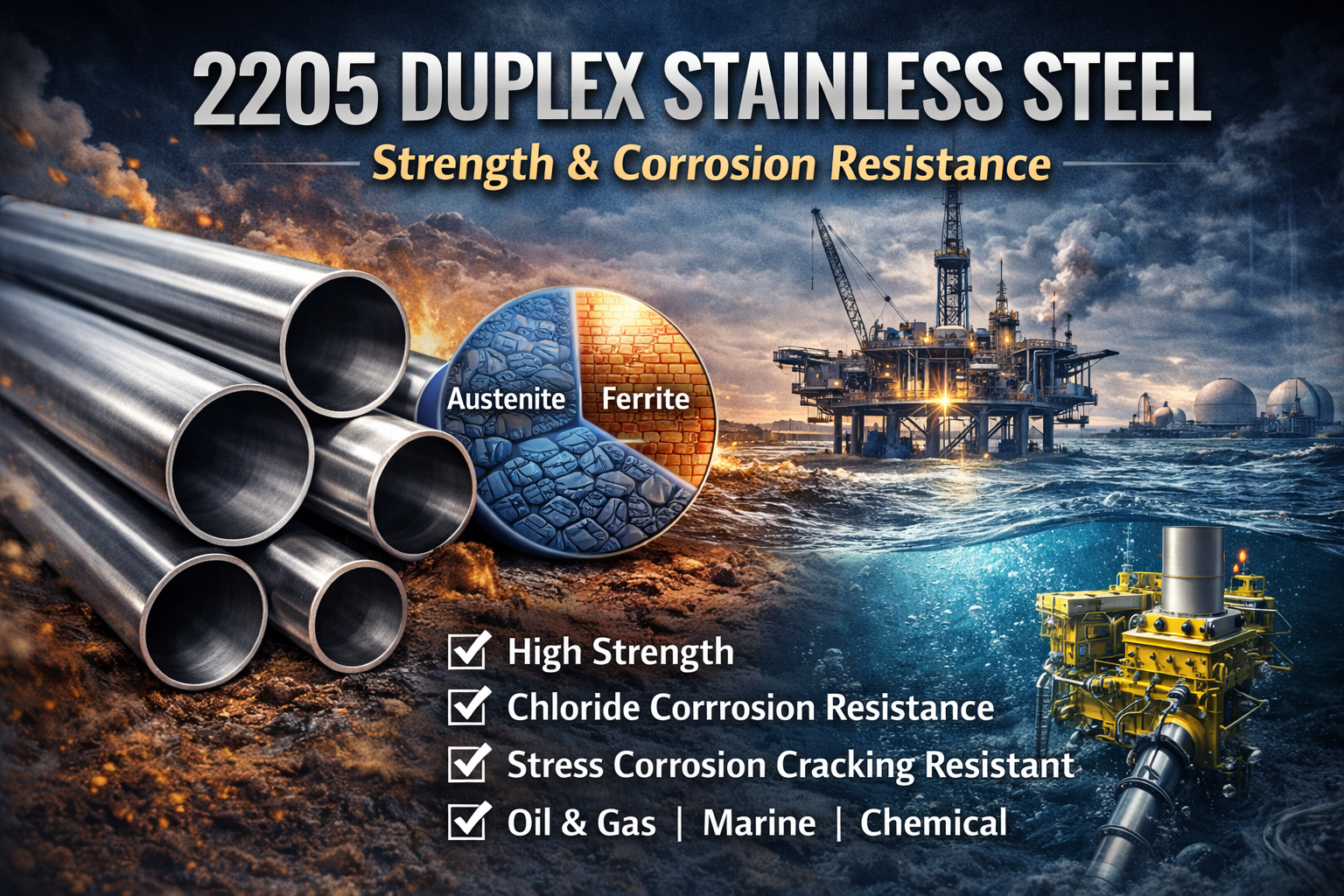
2205 duplex stainless steel is a high-performance material that combines the best properties
of austenitic and ferritic stainless steels. Known for its exceptional strength and superior
corrosion resistance, 2205 is widely used in demanding environments such as marine, chemical,
and oil & gas industries.
With its balanced microstructure and enhanced mechanical performance, 2205 duplex stainless steel
has become a preferred choice for applications requiring durability, reliability, and long service life.
1. What Is 2205 Duplex Stainless Steel?
2205 duplex stainless steel (UNS S32205 / S31803) is a nitrogen-enhanced duplex stainless steel
consisting of approximately equal parts austenite and ferrite. This dual-phase structure provides
a unique combination of high strength and excellent resistance to corrosion.
The grade is designed to overcome the limitations of standard austenitic stainless steels,
particularly in chloride-rich and high-stress environments.
2. Chemical Composition of 2205 Duplex Stainless Steel
| Element | Content (%) |
|---|---|
| Carbon (C) | ≤ 0.03 |
| Chromium (Cr) | 21.0 – 23.0 |
| Nickel (Ni) | 4.5 – 6.5 |
| Molybdenum (Mo) | 2.5 – 3.5 |
| Nitrogen (N) | 0.08 – 0.20 |
| Manganese (Mn) | ≤ 2.0 |
| Silicon (Si) | ≤ 1.0 |
| Phosphorus (P) | ≤ 0.03 |
| Sulfur (S) | ≤ 0.02 |
| Iron (Fe) | Balance |
3. Key Properties of 2205 Duplex Stainless Steel
3.1 High Strength
2205 duplex stainless steel offers nearly twice the yield strength of standard austenitic
stainless steels such as 304 and 316. This allows for reduced material thickness and weight
in structural applications.
- Tensile Strength: ≥ 620 MPa
- Yield Strength: ≥ 450 MPa
- Elongation: ≥ 25%
3.2 Excellent Corrosion Resistance
The combination of chromium, molybdenum, and nitrogen provides outstanding resistance to:
- Pitting corrosion
- Crevice corrosion
- Stress corrosion cracking (SCC)
This makes 2205 particularly suitable for chloride-rich environments such as seawater and
chemical processing systems.
3.3 Superior Resistance to Stress Corrosion Cracking
Compared to austenitic stainless steels, duplex grades like 2205 exhibit significantly improved
resistance to stress corrosion cracking, especially in high-temperature chloride environments.
3.4 Good Weldability
2205 can be welded using standard methods, although careful control of heat input is required
to maintain the balanced duplex microstructure.
3.5 Cost Efficiency
Despite its high performance, 2205 is often more cost-effective than high-alloy stainless steels
due to its lower nickel content.
4. Applications of 2205 Duplex Stainless Steel
4.1 Oil and Gas Industry
- Pipelines and flowlines
- Pressure vessels
- Subsea equipment
4.2 Marine Engineering
- Seawater piping systems
- Ship components
- Offshore platforms
4.3 Chemical Processing
- Storage tanks
- Heat exchangers
- Reactor vessels
4.4 Desalination Plants
- Evaporators
- High-pressure piping
4.5 Structural and Industrial Equipment
- Bridges and load-bearing structures
- Industrial machinery
5. Advantages of 2205 Duplex Stainless Steel
- High strength-to-weight ratio
- Excellent resistance to chloride corrosion
- Improved resistance to stress corrosion cracking
- Cost-effective compared to high-alloy grades
6. Limitations of 2205 Duplex Stainless Steel
- More complex welding requirements
- Limited use at extremely high temperatures (>300°C)
- Requires careful heat treatment control
7. 2205 vs 316 Stainless Steel
While 316 stainless steel offers good corrosion resistance, 2205 provides significantly higher
strength and better resistance to pitting and stress corrosion cracking. As a result, 2205 is
often preferred in aggressive environments.
8. FAQ
Q1: What makes 2205 duplex stainless steel unique?
Its dual-phase microstructure provides a combination of high strength and excellent corrosion resistance.
Q2: Is 2205 better than 316 stainless steel?
In chloride environments, 2205 offers superior corrosion resistance and strength compared to 316.
Q3: Can 2205 be used in seawater applications?
Yes, it is widely used in marine and desalination systems due to its excellent resistance to seawater corrosion.
Q4: Is 2205 stainless steel easy to weld?
It is weldable, but requires controlled procedures to maintain the correct phase balance.
Q5: What industries use 2205 duplex stainless steel?
Oil & gas, marine, chemical processing, desalination, and construction industries commonly use this grade.
Conclusion
2205 duplex stainless steel stands out as a high-strength, corrosion-resistant material designed
for demanding environments. Its unique microstructure, combined with excellent performance and
cost efficiency, makes it an ideal choice for industries requiring durability and long-term reliability.
