
2205 Stainless Steel for Water-Recovery Equipment
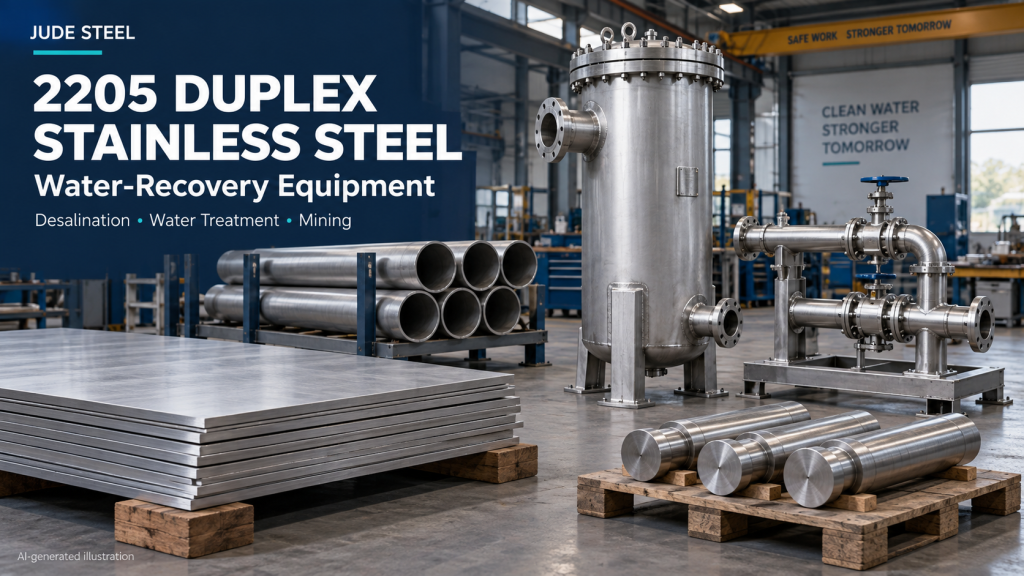 2205 duplex stainless steel can be specified for fabricated
filter housings, water-recovery vessels, transfer piping,
heat-exchanger components and selected pump parts.
These opportunities occur in desalination, industrial water treatment
and mining, where the approved design calls for a combination of
strength and corrosion resistance.
For an equipment manufacturer, the useful purchasing question is
specific: which component needs plate, which needs pipe, and which
needs bar or a forging? This guide connects those products to
raw-material specifications, service checks and an inquiry package
that can be priced and inspected.
Which water-recovery products can be manufactured from 2205?
The following are candidate manufacturing routes after the equipment
designer has approved 2205 for the actual duty. The table uses
UNS S32205 for the wrought material; the purchase order must also
state the required standard edition and delivery condition.
| Product or component | Starting material | Specification to confirm |
|---|---|---|
| Fabricated filter housings and strainer bodies | Plate for rolled shells, covers and internal supports | ASTM A240/A240M, UNS S32205, for the flat stock |
| Water-recovery tanks and conditioning-vessel internals | Plate or sheet for walls, baffles and fabricated mixer blades | ASTM A240/A240M, UNS S32205 |
| Screen panels and perforated strainer baskets | Sheet subsequently perforated, formed and joined | ASTM A240/A240M for the sheet; separate finished-screen drawings |
| Heat exchangers and thermal-desalination assemblies | Tube for heat-transfer bundles; plate for selected shells or tubesheets | ASTM A789/A789M for tube; ASTM A240/A240M for plate; UNS S32205 |
| Water-transfer lines and pipe headers | Seamless or welded pipe | ASTM A790/A790M, UNS S32205 |
| Machined pump shafts, sleeves and valve stems | Bar or another drawing-approved machining blank | ASTM A276/A276M for general-purpose bar; A479/A479M where the pressure-equipment specification requires it; UNS S32205 |
| Forged flanges and forged valve components | Forgings made to the approved component specification | ASTM A182/A182M F60, UNS S32205 |
These product-form distinctions are reflected in
Alleima’s 2205 technical datasheet.
ASTM also defines the flat-product scope on its
A240/A240M specification page.
A material certificate does not establish the completed equipment’s
pressure rating or design-code compliance.
Where 2205 fits in desalination, water treatment and mining
Desalination: separate thermal equipment from seawater RO piping
IMOA documents 2205 evaporators in thermal desalination and identifies
its use in brackish-water applications. The same
desalination materials discussion
identifies more highly alloyed materials, including 2507 and
6% molybdenum austenitic grades, for seawater reverse-osmosis
high-pressure piping.
Consequently, an approved 2205 chamber or brackish-water component
is not evidence that 2205 suits every seawater intake, concentrate
line or pump on the project. Include feed composition, concentration
effects, temperature, chlorination and shutdown exposure in the
component review.
Water treatment: account for deposits, cleaning and idle periods
Filter bodies, screens and process vessels can expose metal to
retained solids, gasket crevices and cleaning chemicals. Ask the
owner for the operating envelope at the wetted surface, including
cleaning and disinfection cycles. The routine bulk-water analysis
may not describe conditions beneath deposits.
Alleima’s guidance on
microbiologically influenced corrosion
identifies limitations for 2205 in natural seawater. Avoid specifying
it as immune to pitting or crevice attack. For less demanding
equipment duties, JUDE’s
316L water-equipment guide
provides a separate starting point for comparison.
Mining: distinguish recovered water from abrasive or acidic process streams
Mine-water conditioning vessels, reuse-water piping and selected
pump components are candidates for a 2205 assessment. Outokumpu’s
Metso equipment discussion
shows how duplex grade selection changes with process severity;
it does not assign one grade to all mining duties.
Record solids concentration, particle characteristics and flow
conditions alongside the chemical analysis. Corrosion resistance
alone does not establish abrasion life. Acidic leach solutions,
slurry impact zones and concentrated chemical dosing points need
their own material evaluation.
Specify S32205 explicitly when that is the approved grade
The commercial name “2205” can refer to UNS S31803 or UNS S32205.
S32205 has higher minimum chromium, molybdenum and nitrogen
requirements. An offer stating only “2205” therefore leaves an
important acceptance question open.
EN 1.4462 is a commonly associated European designation. If the
project requires EN compliance, identify the applicable EN product
standard and its requirements; a cross-reference alone does not
establish dual certification.
State the required delivery condition, commonly solution annealed
for these corrosion-service orders. Keep manufacturer-specific
datasheet values separate from contractual guarantees.
Mechanical-property limits depend on the specified product standard,
dimensions and condition; a single strength figure should not be
applied to plate, tube, bar and forgings indiscriminately.
Build duplex-specific checks into the inspection plan
Agree the inspection plan before ordering so the mill, stockholder,
processor and fabricator understand which records and tests belong
to each supply stage.
- Identity and traceability:
link the order line, heat number, material markings and inspection
certificate. Maintain identification after cutting or machining. - Delivery condition:
verify the specified heat treatment and any additional records
required by the project. A chemistry match does not describe the
full metallurgical condition. - Duplex examination:
where required, define the applicable test method, sampling,
acceptance criteria and reporting. Do not reduce the purchase
requirement to the words “duplex tested.”
ASTM A923
addresses detrimental intermetallic phases in specified duplex
stainless steels. Its scope explains that meeting chemistry and
mechanical requirements does not necessarily demonstrate their
absence. Select the applicable method with the project
specification; an A923 result is not a guarantee against every
form of service corrosion.
Fabrication needs its own controls. The welding procedure should
address filler selection, heat input, interpass temperature and
the required final condition. Assign responsibility for weld-oxide
removal and final surface restoration.
IMOA’s duplex fabrication guide
explains why these steps affect performance. Treat phase-balance
limits as specified acceptance criteria, rather than assuming
every product or weld must be exactly 50% ferrite.
Turn the equipment drawing into comparable quotation lines
A mixed order described as “2205 material for a water skid” makes
price comparisons unreliable. Use separate lines for different
manufacturing routes. The following is an illustrative purchasing
structure, not a completed equipment design.
- Housing shell blanks:
identify the plate specification, blank dimensions, rolling
allowance and whether edge preparation is included. - Header pipe:
identify outside diameter, wall thickness, length, manufacturing
route and end preparation. List flanges and other fittings
separately. - Pump shaft stock:
provide the approved bar specification, starting diameter,
cut length, machining allowance and any inspection requirements
for the section. - Screen blanks:
distinguish solid sheet supply from perforating, forming and
joining. Include opening geometry, tolerances and the drawing
revision when quoting finished screens.
For plate-based parts, review JUDE’s
stainless steel sheet and plate range.
If you need prepared blanks, include drawings with your
laser-cutting inquiry.
Confirm the available thickness range, processing scope and
cut-piece identification in the offer.
Attach these project details to the material schedule:
- Service:
equipment tag, wetted component, approved material selection,
water analysis and operating/cleaning conditions relevant to
the request. - Purchase basis:
specification edition, units, dimensions, tolerances, delivery
condition and surface requirements. - Acceptance:
certificate type, additional testing, inspection stages and
requirements for retained or transferred markings. - Supply:
quantity per item, permitted substitutions, required arrival
date, destination, packaging and delivery terms.
Ask bidders to separate material, processing, testing and freight
where applicable, and to list deviations against each line.
This makes a lower price explainable: it may reflect a different
blank size, document package or processing scope.
Frequently asked questions
Can dual-certified S31803/S32205 material be accepted?
It can be considered when the supplied product is documented as
meeting the relevant requirements for both designations and the
project permits it. Check the actual certificate and ordered
product specification. A combined trade description in a
quotation is not sufficient evidence.
Can a ring cut from A240 plate replace an A182 F60 forged flange?
It cannot be accepted as the specified forging merely because its
chemistry is similar. Plate and forgings have different product
requirements and manufacturing histories. Any change of construction
route needs design approval and the appropriate material and
component specifications.
What if the pump casing or impeller will be cast?
Specify the approved casting grade and casting standard. A wrought
S32205 bar or plate specification does not define the acceptance
requirements for a casting. Ask the foundry to identify the cast
grade, heat treatment and inspection scope separately.
Can 2205’s higher strength justify an immediate reduction in wall thickness?
Only an approved redesign can establish that. Pressure-code
calculations, stiffness, buckling, fatigue, minimum fabrication
thickness and corrosion or erosion allowances may control the
section. Do not reduce an existing drawing’s thickness by applying
a simple strength ratio.
Request 2205 material for your water-equipment project
Send JUDE Steel a component material schedule for your desalination,
water-treatment or mining project. Include the approved grade,
product standards, dimensions, drawing revisions, quantities and
delivery destination. Identify plate blanks, pipe, tube, bar and
forged items separately so availability and scope can be confirmed.
Email drawings and specifications to
support@jiscojude.com
using the subject
2205 Water Equipment Material RFQ.
Request an offer stating material condition, included processing,
inspection documents and delivery terms for each item.
