
316L Stainless Steel for Mining Water Treatment and Desalination Equipment
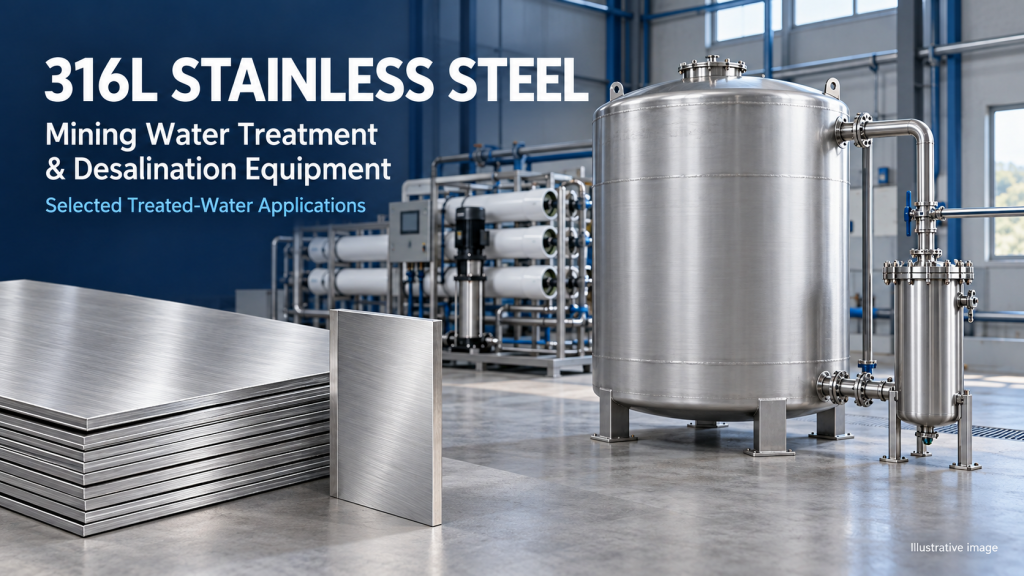 316L stainless steel can be specified for treated-water
tanks, selected filter housings, strainer baskets and fabricated
internals in mining water-treatment and desalination projects.
Its suitability depends on the water touching each component,
including cleaning and shutdown conditions.
For equipment manufacturers, the purchasing sequence starts with
an approved material selection, followed by the product form,
fabrication requirements and inspection documents. A purchase
description such as “316L for a desalination plant” leaves too
much unresolved: the same site can contain seawater intake
equipment, concentrated reject streams and comparatively mild
treated-water circuits.
Identify the Water Stream Before Choosing 316L
Reverse osmosis (RO) produces a permeate stream with reduced
dissolved salts and a concentrate stream containing the rejected
salts. Identify the exact stream and operating envelope on the
equipment datasheet.
- RO permeate and treated-water storage:
potential applications for 316L, subject to the actual chemistry,
disinfection regime and equipment design. - Treated mine-water reuse:
assess residual chlorides, pH, dissolved species and suspended
solids after treatment. Clarification alone does not remove
dissolved salts. - Seawater intake and RO concentrate:
require a separate corrosion assessment. Do not carry a 316L
specification from the permeate side into these circuits. - Acidic mine drainage, abrasive slurry and chemical dosing:
require assessment of acid chemistry, erosion and the exact
dosing chemical, including its concentrated form.
There is no universal chloride concentration below which 316L
is guaranteed to remain corrosion-free. Temperature, crevices,
deposits, oxidants and operating conditions affect the result.
The Nickel Institute paper
Stainless Steels and Drinking Water Around the World,
hosted by IMOA, explains why water-service grade selection depends
on conditions and why seawater can require more highly alloyed grades.
Which Equipment Parts Can Be Made from 316L?
The following examples translate an approved 316L equipment
specification into raw-material purchasing needs. They are
candidates for suitable service conditions, rather than a
recommendation to use one grade throughout the plant.
| Product being manufactured | 316L starting material | Application and purchasing check |
|---|---|---|
| Treated-water and RO permeate tanks | Sheet or plate for shells, floors, roofs, covers and internal baffles; coil-derived blanks for repeat production. | Confirm storage chemistry, disinfection exposure, drainage and the engineer’s thickness requirements. |
| Cartridge and polishing-filter housings | Sheet or plate for fabricated shells, end covers and internal support plates. Some designs use pipe or forgings instead. | Confirm feed-water compatibility, design pressure, closures and the finished housing’s manufacturing requirements. |
| Strainer baskets and screen panels | Sheet for subsequent perforating, forming and joining; strip for selected frames and supports. | Suitable applications may occur in clarified reuse-water circuits. Review solids loading, abrasion, openings and cleaning access. |
| Collection troughs, weir plates and baffles | Cut and bent sheet or plate, with thickness and edge details defined on drawings. | Assess the treated stream, deposits, intermittent wetting and crevices at supports or joints. |
| Equipment covers and guard panels | Formed sheet, with the finish and protective film agreed before processing. | Evaluate external salt spray, washdown chemicals and site exposure separately from the internal process water. |
For background on stainless steel storage tanks and water systems,
see the
Euro Inox selection guidance.
The table above is a purchasing guide; the equipment designer
determines the final construction and material requirements.
What the Low-Carbon Grade Contributes
316L is a molybdenum-alloyed austenitic stainless steel. Its low
carbon content reduces susceptibility to sensitization and
associated intergranular corrosion after welding. Molybdenum
improves resistance to localized corrosion compared with common
molybdenum-free grades such as 304L.
Outokumpu’s Supra grade information
identifies 316L as UNS S31603 and lists EN 1.4404 as a corresponding
product grade.
The “L” designation does not provide immunity to chloride pitting,
crevice corrosion or chloride stress-corrosion cracking. Nor does
316L’s corrosion resistance establish its suitability for abrasive
mining duty. Solids impact and erosion need their own assessment.
Specify the Grade and the Correct Product Standard
For an ASTM flat-product order, identify
316L / UNS S31603 and the required edition of
ASTM A240/A240M,
which covers stainless steel plate, sheet and strip. The purchase
order should also identify dimensions, delivery condition, finish,
tolerances and required inspection documents.
If the project specifies EN 1.4404, state the applicable EN product
standard and acceptance requirements. A familiar grade
cross-reference does not establish compliance with another standard.
The same principle applies to JIS orders: specify the required
designation and product standard rather than accepting an
unsupported equivalence claim.
Pipe, tube, forgings and castings need their own applicable
specifications. A240-certified sheet does not establish the
pressure rating or approval of a completed filter housing or vessel.
Those requirements belong in the equipment design and
manufacturing specification.
Choose Sheet, Plate, Coil or Cut Blanks
Stainless steel sheet and plate
suit drawing-based orders for tank panels, covers and internal
components. Submit the finished dimensions, forming allowances,
flatness requirements and surface restrictions so the quotation
can distinguish full sheets from prepared blanks.
Stainless steel coil
can suit repeated shell or panel production where the fabricator
has suitable handling, leveling and cutting equipment. Agree coil
width, weight limits, inside diameter, edge condition and
traceability after cutting.
For
laser-cut blanks,
provide the drawing revision, material thickness, hole sizes,
edge requirements and dimensional tolerances. Identify any later
bending, perforating, welding or surface treatment; confirm which
operations are included in the quotation.
Specify a measurable surface roughness when the design requires
it. A finish description such as “2B” or “polished” does not by
itself define the maximum roughness, weld finish or cleanliness
of a completed component.
Protect the Surface During Fabrication and Inspection
Keep stainless steel clear of carbon-steel grinding dust and
contaminated tooling. Use the specified welding procedure and
address weld heat tint, surface oxides and associated chromium
depletion before service. IMOA’s
austenitic stainless steel fabrication guide
explains the different purposes of cleaning, pickling and
passivation.
Passivation alone should not be specified as the means of removing
weld heat tint. Where chemical passivation is required,
ASTM A967/A967M
provides treatment and verification provisions; the contract still
needs to define the applicable procedure and acceptance criteria.
At receipt, match material markings to the mill test report and
order line. Check the specified grade, heat number, chemical and
mechanical results, dimensions, condition and surface. Maintain
identification when stock is divided into blanks. Brochure values
are not a substitute for the contractual requirements and supplied
material’s inspection results.
What to Include in a 316L Water-Equipment RFQ
Give the supplier a material schedule linked to the component
drawings. A useful inquiry contains:
- Application:
component name, equipment tag and whether the part contacts feed
water, treated mine water, RO permeate, concentrate or only the
external environment. - Approved material:
grade, product standard and edition, delivery condition and
permitted substitutions, if any. - Service information:
water analysis, normal and maximum temperatures, operating and
cleaning chemistry, and solids exposure where relevant. - Dimensions:
thickness, width and length for sheets or blanks; width, weight
and handling limits for coils. - Manufacturing details:
drawings, revision numbers, cutting or forming scope, tolerances,
edge preparation and finish requirements. - Inspection and traceability:
required mill documentation, inspection certificate type,
additional tests and identification of cut pieces. - Commercial details:
quantity by line item, destination, requested delivery date,
packaging requirements and preferred delivery terms.
Ask each bidder to list deviations, included processing and
document scope against the same schedule. This makes quotations
easier to compare and exposes differences that a price-per-tonne
comparison can miss.
Frequently Asked Questions
Can dual-certified 316/316L material be accepted?
It can be considered when the material meets both grades’
requirements under the specified product standard, the inspection
documents establish that compliance, and the project permits it.
A combined grade label in a quotation is insufficient evidence.
Does every component on an RO skid need to be 316L?
No. Membrane pressure vessels, piping, tanks, guards and supports
perform different functions and may use different materials.
Review the approved bill of materials item by item; approval of
316L tank sheet does not determine the material of the membrane
pressure vessels.
Does a 316L mill certificate prove drinking-water approval?
No. A mill certificate documents the supplied material against
its stated specification. A drinking-water project may also
require applicable contact-material approvals and evidence
covering the finished assembly, including seals, coatings and
other wetted parts.
Can the same 316L spare part be reordered after the water
chemistry changes?
Have the equipment owner reassess the material selection first.
A replacement matching the old drawing may no longer suit a
changed feed source, higher concentration, different disinfectant
or revised cleaning cycle. Update the drawing and purchase
specification where necessary.
Request 316L Material for Your Equipment Project
Send JUDE Steel your approved 316L specification, sheet or coil
dimensions, drawings, quantities and delivery destination.
Identify the parts as treated-water tank panels, filter-housing
blanks, internal plates or another defined component, and
include the required inspection documents.
Ask for a quotation stating the available material, proposed
processing, certificate scope, packing and delivery schedule
for each line item.
For drawings and material schedules, email
support@jiscojude.com.
