
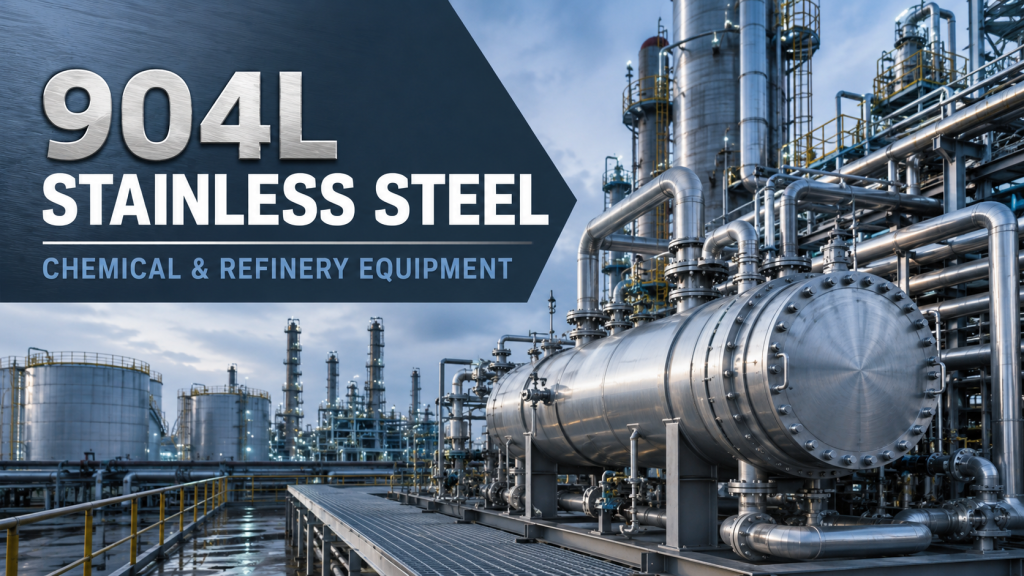
Which Chemical and Refinery Equipment Uses 904L Stainless Steel?
904L stainless steel is used in chemical and petrochemical processing where conventional austenitic grades may not provide enough corrosion resistance, particularly in selected reducing-acid environments.
However, specifying “904L stainless steel” alone is not enough for an industrial purchase.
A sulfuric-acid tank fabricator may require ASTM A240 UNS N08904 plate, while a chemical piping contractor may need ASTM A312 N08904 pipe together with compatible fittings and forged components.
The practical procurement question is therefore:
which chemical, petrochemical and refinery equipment may use 904L, and what raw-material form and product standard should be specified for each component?
This guide connects process equipment, service conditions, 904L product forms and RFQ requirements for industrial buyers.
Quick Answer: What Equipment Can Be Made From 904L?
Where process chemistry and engineering evaluation justify UNS N08904, 904L may be considered for components such as:
- sulfuric-acid storage tanks
- acid process vessels
- reactor vessels
- heat exchangers
- acid coolers
- process piping
- acid transfer piping
- flanges
- valve components
- elbows, tees and reducers
- scrubber components
- flue-gas cleaning equipment
- pump and valve components
- selected petrochemical process equipment
904L should not be interpreted as a universal material for every acid, chloride or refinery environment. Final selection depends on chemical concentration, temperature, pressure, contaminants, flow conditions, fabrication and the applicable design code.
Why Is 904L Selected for Acid-Handling Process Equipment?
904L is a low-carbon, high-alloy austenitic stainless steel containing substantial nickel and molybdenum together with a deliberate copper addition.
The combination provides a corrosion-resistance profile that is particularly valuable in selected reducing-acid environments.
Copper is especially relevant to the alloy’s performance in sulfuric-acid service, while nickel helps maintain a stable austenitic structure and contributes to resistance in aggressive process environments.
Molybdenum improves resistance to localized corrosion compared with conventional 300-series stainless steels in many environments.
For this reason, 904L has established applications in chemical and petrochemical process equipment, including sulfuric-acid handling, heat exchangers, tanks, reactor vessels, piping, flanges and valves.
For basic grade information, see the
JUDE Steel 904L stainless steel material page.
904L Grade Designations and Product Standards
“904L” is a widely used commercial grade name, but a professional purchase order should also identify the governing material and product standard.
| System / Product | Common Designation | Procurement Note |
|---|---|---|
| Common grade | 904L | Commercial grade name; not a complete purchasing specification |
| UNS | N08904 | Principal Unified Numbering System designation |
| EN | 1.4539 / X1NiCrMoCu25-20-5 | Common European designation |
| JIS | SUS890L | Japanese designation; confirm the applicable JIS product standard |
| Plate, sheet and strip | ASTM A240/A240M N08904 | Flat-rolled stainless steel products |
| Process pipe | ASTM A312/A312M N08904 | Seamless, welded and heavily cold-worked austenitic stainless steel pipe |
| General-service tubing | ASTM A269/A269M N08904 | Seamless and welded austenitic stainless steel tubing |
| Forged flange / valve part | ASTM A182/A182M F904L | Use where this forged-product grade is specified by the project |
| Wrought piping fitting | ASTM A403/A403M WP904L | Used for applicable wrought pressure-piping fittings |
| Bar / machined component | ASTM A479/A479M N08904 | Confirm final component and pressure-service requirements |
The product standard matters because plate, pipe, tubing, bar, forgings and fittings are manufactured and inspected under different requirements.
A purchase order that states only “904L” leaves important questions about dimensional tolerances, mechanical properties, heat treatment, testing and certification unanswered.
ASTM A240 UNS N08904 Chemical Composition
The following values are specification limits for ASTM A240 UNS N08904 flat products. They should not be confused with a producer’s typical heat analysis.
| Element | ASTM A240 UNS N08904, wt.% |
|---|---|
| Carbon (C) | 0.020 max. |
| Manganese (Mn) | 2.00 max. |
| Silicon (Si) | 1.00 max. |
| Phosphorus (P) | 0.045 max. |
| Sulfur (S) | 0.035 max. |
| Chromium (Cr) | 19.0–23.0 |
| Nickel (Ni) | 23.0–28.0 |
| Molybdenum (Mo) | 4.0–5.0 |
| Copper (Cu) | 1.0–2.0 |
| Nitrogen (N) | 0.10 max. |
Typical producer values may fall near the middle of these ranges, but the mill test certificate should be checked against the actual specification required by the purchase order.
Which Chemical and Refinery Equipment Uses 904L?
1. Sulfuric Acid Storage and Process Tanks
Sulfuric-acid handling is one of the best-known application areas for 904L.
The copper, nickel and molybdenum alloying system can provide useful corrosion resistance in selected sulfuric-acid concentration and temperature ranges.
Depending on the process conditions, ASTM A240 N08904 plate may be evaluated for:
- sulfuric-acid storage tanks
- acid day tanks
- process tanks
- acid-containing vessel shells
- tank bottoms
- heads and formed sections
- nozzle reinforcement components
The phrase “sulfuric acid service” is not enough to approve a material.
The buyer or materials engineer should identify acid concentration, operating temperature, contamination, flow condition and expected concentration changes during startup, shutdown or upset conditions.
2. Heat Exchangers and Acid Coolers
904L may be selected for heat-transfer equipment where one or both process streams create a corrosion environment that is too aggressive for conventional 316L.
Potential applications include:
- shell-and-tube heat exchangers
- acid coolers
- process condensers
- heat-exchanger shells
- channel components
- tubesheets
- selected heat-exchanger tubing
The required raw material depends on the component.
A tubesheet or shell may be manufactured from ASTM A240 N08904 plate, while tubing should be purchased under the applicable tubing specification, such as ASTM A269/A269M when appropriate.
3. Reactor and Chemical Process Vessels
Chemical reactors and process vessels may require 904L when the contained medium includes reducing acids or other conditions in which conventional stainless steel does not provide an adequate corrosion margin.
Possible 904L components include:
- reactor shells
- vessel heads
- internal wetted plates
- nozzles
- agitator-related wetted components
- support or reinforcement components exposed to the process medium
Pressure-retaining equipment must also comply with the applicable pressure-vessel code.
For plate sourcing, JUDE Steel supplies
stainless steel sheet and plate
in a range of cold-rolled and hot-rolled dimensions.
4. Chemical and Acid Process Piping
904L process piping may be used to transport selected corrosive chemical streams where 316L or another lower-alloy grade does not provide the required service life.
A piping package may require:
- seamless or welded process pipe
- elbows
- tees
- reducers
- stub ends
- flanges
- valve components
- branch connections
ASTM A312/A312M N08904 may be applicable to process pipe.
Wrought fittings and forged pressure components should be specified separately rather than assumed to follow the same standard as the straight pipe.
5. Flanges, Valves and Wrought Fittings
A corrosion-resistant pipeline is only as reliable as its joints and pressure-containing components.
Where a complete 904L pressure boundary is required, the system may include:
- weld-neck flanges
- blind flanges
- elbows
- tees
- reducers
- valve bodies
- bonnets
- forged rings
- other pressure-containing components
The purchasing specification should identify the exact ASTM grade, dimensions, pressure class, heat-treatment condition and inspection requirements for each product form.
6. Scrubbers and Flue-Gas Cleaning Equipment
Wet gas-cleaning equipment can experience acidic condensates and chemically aggressive wash liquids.
Depending on the actual chemistry, 904L may be evaluated for:
- scrubber wetted sections
- spray-system components
- circulation piping
- acidic condensate handling
- selected absorber components
- flue-gas cleaning equipment
Material selection must consider the exact acid chemistry, chlorides, temperature, deposits and crevice conditions.
7. Pumps, Valves and Agitator Components
Corrosive process systems also contain rotating and mechanically loaded components.
904L bar, forging or machined stock may be evaluated for selected:
- valve stems
- pump shafts
- agitator shafts
- machined rings
- couplings
- other wetted mechanical components
The final material specification should account for both corrosion resistance and mechanical design requirements.
Equipment-to-Raw-Material Procurement Matrix
| Finished Equipment | Possible 904L Component | Raw-Material Form | Common Specification |
|---|---|---|---|
| Sulfuric-acid tank | Shell / bottom / head | Plate | ASTM A240 N08904 |
| Process vessel | Shell / head | Plate | ASTM A240 N08904 |
| Heat exchanger | Shell / tubesheet | Plate | ASTM A240 N08904 |
| Heat exchanger | Tube | Tube | ASTM A269 N08904 or project specification |
| Process piping | Straight pipe | Pipe | ASTM A312 N08904 |
| Process piping | Elbow / tee / reducer | Wrought fitting | ASTM A403 WP904L where specified |
| Process piping | Flange | Forging | ASTM A182 F904L where specified |
| Valve | Forged component | Forging / bar | Applicable forged or bar specification |
| Pump / agitator | Shaft / machined component | Bar | ASTM A479 N08904 where applicable |
Where May 904L Be Considered in Refinery and Petrochemical Service?
904L should not be described as a general refinery construction material.
Its value is more specific: it can be evaluated where a refinery or petrochemical unit contains a corrosion environment suited to the alloy’s high-nickel, molybdenum and copper chemistry.
Potential screening situations include:
- sulfuric-acid handling systems
- acid transfer and storage equipment
- selected acid-contaminated process streams
- chemical-treatment equipment
- corrosive heat-exchanger service
- selected process piping where lower-alloy stainless steel does not provide sufficient life
The fact that equipment is located inside a refinery does not make 904L automatically appropriate.
Some refinery acid systems are successfully constructed from carbon steel, Alloy 20, nickel alloys or other stainless grades depending on acid concentration, water content, temperature and process design.
Why Do Sulfuric Acid Concentration and Temperature Matter?
One of the most important material-selection mistakes is to describe sulfuric acid as if it were one fixed corrosion environment.
It is not.
Sulfuric-acid corrosivity changes substantially with:
- acid concentration
- temperature
- water content
- contaminants
- oxidizing or reducing species
- flow velocity
- stagnant conditions
- process upsets
A material that performs well at one concentration and temperature may behave very differently when the acid becomes diluted or the temperature rises.
For this reason, an RFQ for critical sulfuric-acid equipment should identify both the normal operating condition and credible startup, shutdown and upset conditions.
When Should 904L Not Be Automatically Specified?
904L is a specialized high-alloy austenitic stainless steel, but higher alloy content does not make it universally superior.
A different material may be more appropriate when:
- 316L already provides adequate corrosion life at substantially lower cost
- the environment is primarily a severe chloride service better addressed by a higher-molybdenum alloy
- duplex stainless steel offers a better combination of strength, chloride resistance and lifecycle cost
- the acid concentration and temperature fall outside the proven corrosion range of 904L
- a nickel-base alloy is required for the actual process chemistry
- the project specification mandates another qualified material
Material selection should therefore be based on actual process conditions and lifecycle economics rather than alloy ranking alone.
316L vs 904L vs 2205 vs 254SMO
| Selection Factor | 316L | 904L | 2205 | 254SMO |
|---|---|---|---|---|
| Microstructure | Austenitic | Austenitic | Duplex | Austenitic |
| Primary positioning | General chemical service | Reducing-acid and selected aggressive chemical service | High-strength chloride service | Severe localized-corrosion and high-chloride service |
| Nickel level | Moderate | High | Lower than 904L | High |
| Molybdenum level | About 2–3% class | 4–5% | About 3% class | About 6% class |
| Copper addition | Not a defining alloy addition | 1–2% | Not a defining alloy addition | Grade-dependent controlled addition |
| Strength | Conventional austenitic level | Conventional high-alloy austenitic level | Substantially higher | Austenitic level |
| Typical selection reason | Cost-effective general corrosion resistance | Selected acid service, especially where reducing-acid resistance matters | Chloride resistance plus high strength | More demanding chloride and localized-corrosion resistance |
This table is intended for preliminary screening only.
The correct material cannot be selected from alloy name alone. Actual acid concentration, chloride content, temperature, pressure, stress, crevice geometry and fabrication must be reviewed.
For comparison with a duplex alternative, see the
JUDE Steel 2205 material page.
Welding and Fabrication Considerations for 904L
The low carbon content of 904L reduces the risk of sensitization during conventional welding, but it does not eliminate the need for proper welding control.
Fabricators should consider:
- qualified welding procedures
- suitable filler metal
- clean joint preparation
- controlled heat input
- interpass temperature
- contamination from carbon steel tools
- post-fabrication cleaning
- pickling and passivation where required
In severe corrosive service, the weld metal and heat-affected zone must provide adequate corrosion performance for the process environment.
JUDE Steel’s available material-processing services can be reviewed on the
Services & Capabilities page.
What Should a 904L RFQ Include?
An inquiry stating only “Please quote 904L stainless steel” normally requires multiple rounds of technical clarification.
A professional chemical-industry RFQ should identify:
- Grade: 904L
- UNS: N08904
- Standard: ASTM A240, A312, A269, A182, A403, A479, EN or project specification
- Product form: plate, sheet, coil, strip, pipe, tube, fitting, forging or bar
- Dimensions: thickness, width, length, OD, wall thickness or schedule
- Quantity: pieces, meters or total weight
- Application: tank, heat exchanger, reactor, piping, valve or other equipment
- Process medium: identify the actual chemical
- Acid concentration: normal and possible upset concentration where relevant
- Operating temperature: normal and maximum
- Design pressure: where relevant
- Chloride content: where relevant
- Surface condition: No.1, 2B or project requirement
- Certificate: EN 10204 3.1, 3.2 or customer requirement
- Testing: PMI, UT, PT, corrosion testing or project-specific inspection
- Processing: cutting, beveling, bending, machining or other fabrication preparation
- Destination: country, port, Incoterm and required delivery date
Example 904L Stainless Steel Plate RFQ
Material: 904L Stainless Steel
UNS: N08904
Specification: ASTM A240/A240M
Product: Hot-Rolled Plate
Application: Sulfuric Acid Process Tank
Thickness: 10 mm
Width: 2000 mm
Length: 6000 mm
Quantity: 18 plates
Surface: No.1
Certificate: EN 10204 3.1
Inspection: PMI and dimensional inspection required
Service Information: Sulfuric acid; detailed concentration and operating temperature attached with project specification
Processing: Cut to final plate dimensions where available
Destination: Houston, Texas, USA
For corrosion-critical process equipment, including the project material specification and process-condition sheet with the inquiry helps reduce technical clarification time.
Inspection and Documentation for 904L Raw Material
904L is a high-value alloy, so incoming material verification is particularly important.
Depending on the project specification, buyers may require:
- heat-number traceability
- mill test certificate review
- chemical composition verification
- mechanical-property verification
- positive material identification (PMI)
- dimension and tolerance inspection
- surface inspection
- ultrasonic testing for plate where specified
- liquid penetrant testing where applicable
- third-party inspection
- project-specific corrosion testing
Additional inspection should be specified because the project requires it rather than automatically added to every 904L purchase.
JUDE Steel’s available company and third-party certificates can be reviewed on the
Certification page.
How JUDE Steel Supports 904L Procurement
JUDE Steel supplies stainless steel sheet, plate, coil and strip and provides processing services for international industrial buyers.
904L is included within JUDE Steel’s published stainless steel grade portfolio.
For flat-product projects, buyers can submit the required UNS or EN designation, dimensions, quantity, surface condition, certification and application for availability confirmation.
Available product categories include:
Because 904L is a specialized high-alloy grade, buyers should confirm actual stock, mill origin, dimensional range, certification and lead time for each inquiry rather than assuming that every size is continuously available.
For pipe, tubing, forgings, fittings or bar, state the exact product specification so sourcing and technical requirements can be reviewed separately from flat products.
Frequently Asked Questions
Is ASTM A240 enough when ordering 904L plate?
No. ASTM A240 identifies the flat-product specification, but the purchase order should also state UNS N08904, dimensions, quantity, surface condition, certification and any supplementary testing required by the project.
Which ASTM standard applies to 904L process pipe?
ASTM A312/A312M is commonly used for seamless, welded and heavily cold-worked austenitic stainless steel process pipe and includes UNS N08904. The project piping code and purchase specification should still be checked before ordering.
Which standard applies to 904L tubing?
ASTM A269/A269M includes UNS N08904 for applicable general corrosion-resistant tubing. Heat-exchanger or special-process applications may require additional project-specific requirements.
Is SUS890L equivalent to 904L?
SUS890L is the Japanese designation commonly associated with the same 904L / UNS N08904 alloy family. Buyers should still specify the governing JIS product standard and should not substitute materials only from a generic cross-reference table.
Why is copper added to 904L stainless steel?
Copper is an intentional alloying addition in 904L and contributes to the alloy’s corrosion resistance in selected reducing-acid environments, particularly sulfuric-acid service.
Can 904L be used for sulfuric acid?
904L is widely used in selected sulfuric-acid applications, but suitability depends strongly on acid concentration, temperature, contamination, flow condition and process operation. The phrase “sulfuric acid service” alone is not sufficient for final material selection.
When should I choose 904L instead of 316L?
904L may be justified when 316L does not provide enough corrosion resistance in the actual chemical environment, particularly in selected reducing-acid services. If 316L already provides adequate lifecycle performance, 904L may add unnecessary alloy cost.
Is 904L better than 254SMO?
Neither alloy is universally better. 904L has a strong position in selected reducing-acid environments, while 254SMO is a higher-molybdenum alloy typically evaluated for more demanding localized-corrosion and high-chloride conditions. Final selection should be based on the actual process chemistry.
What information should I send JUDE Steel for a 904L quotation?
Send the grade, UNS or EN designation, product standard, product form, dimensions, quantity, certification, inspection requirements and destination.
For chemical-process equipment, also provide the process medium, concentration, chloride level where relevant, operating temperature and design pressure.
Request a 904L Stainless Steel Quote
Sourcing 904L stainless steel plate, sheet, coil or other raw material for chemical, petrochemical or refinery process equipment?
Send JUDE Steel your:
Grade + ASTM/EN Standard + Dimensions + Quantity + Product Application + Certification + Destination
For corrosion-critical projects, also include:
Process Medium + Acid Concentration + Chloride Content + Operating Temperature + Design Pressure
Engineering note:
This article is intended for preliminary material screening and procurement guidance. Final material selection, corrosion allowance, design stress, welding procedure, pressure-code compliance and compatibility with the actual chemical environment should be confirmed by the responsible materials or project engineer.
