
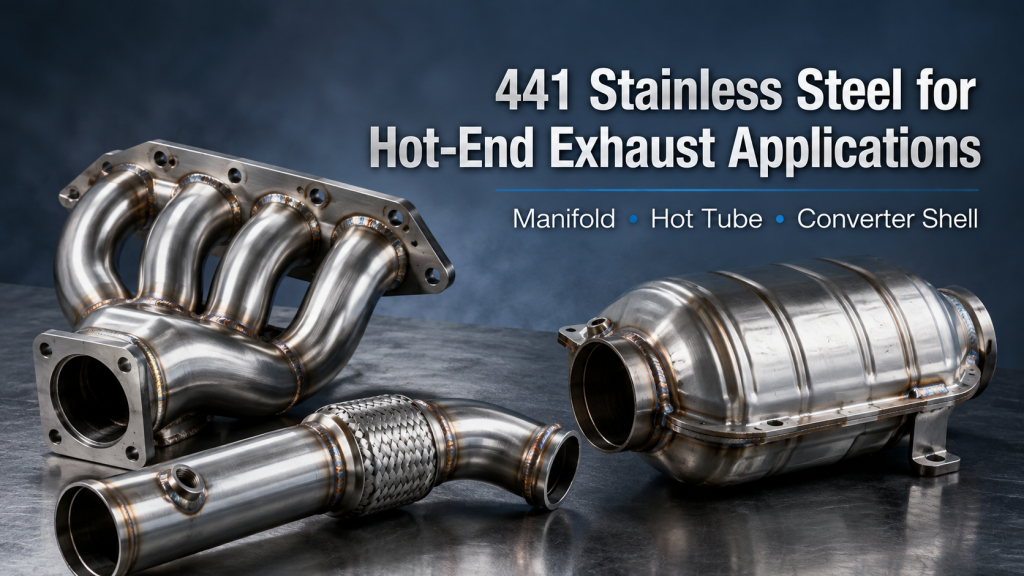
 441 Stainless Steel for Automotive Exhaust Systems: Manifolds, Tubes, Converter Shells and Hot-End Components
441 stainless steel occupies a particularly important position in automotive exhaust manufacturing when components require a combination of ferritic thermal behavior, weldability, formability, corrosion resistance and greater high-temperature capability than lower-alloy exhaust grades.
Commercial 441 / 1.4509 stainless steels were developed with exhaust-system requirements in mind. Exhaust-focused products are used for components such as manifolds, tubes, catalytic-converter shells and, where technically justified, muffler shells.
The most useful question for an exhaust manufacturer is therefore not simply:
“What is 441 stainless steel?”
It is:
Which automotive exhaust parts justify 441, what raw-material specification should be purchased, and when would 409, 439 or a molybdenum-alloyed ferritic grade be a better choice?
Quick Answer: What Automotive Exhaust Components Use 441 Stainless Steel?
441-type ferritic stainless steel is commonly considered for the following automotive exhaust products when required by the OEM material specification:
- fabricated exhaust manifolds;
- hot-end exhaust tubes;
- front pipes;
- selected downpipes;
- catalytic-converter shells and casings;
- selected high-temperature exhaust housings;
- connecting tubes exposed to elevated temperature;
- muffler shells when additional temperature or durability margin justifies the material;
- other welded exhaust components exposed to repeated thermal cycling.
441 should not be interpreted as the mandatory grade for every exhaust component. Cooler mufflers, rear pipes and cost-sensitive exhaust sections may be adequately served by 409 or 439, depending on corrosion, temperature and OEM requirements.
What Makes 441 Stainless Steel Different?
441 belongs to the ferritic stainless steel family and is associated with EN 1.4509 / X2CrTiNb18 and ASTM Type 441 products.
Commercial exhaust-focused 441 materials typically contain approximately 17–18% chromium and use stabilizing additions such as niobium or titanium plus niobium, depending on the exact product variant.
The stabilization system is important because exhaust components must often tolerate:
- welding;
- repeated heating and cooling;
- high-temperature exposure;
- forming;
- oxidation;
- vibration.
For current JUDE product information, see:
441 Stainless Steel
.
Procurement rule:
Do not order only “441.” State the governing ASTM, EN, JIS or OEM specification and verify the exact UNS designation on the MTC.
Why Was 441 Developed for Exhaust-System Applications?
High-Temperature Strength
441-type ferritic stainless steels are designed to maintain useful mechanical performance at temperatures where lower-alloy exhaust grades may provide less margin.
Oxidation Resistance
The chromium level and stabilized ferritic structure provide useful resistance to high-temperature oxidation for qualified exhaust-system applications.
Low Thermal Expansion
Ferritic stainless steels generally expand less than conventional austenitic stainless steels during heating, which is useful in thermally cycled exhaust assemblies.
Thermal Conductivity
Ferritic stainless steels generally provide greater thermal conductivity than common austenitic grades, influencing heat distribution through exhaust components.
Weldability
Stabilization improves the suitability of 441-type products for welded manifolds, tubes and shells when qualified production procedures are used.
Formability
441 can be formed into tubes, shells and manifold components using appropriate tooling, material condition and process control.
441 Stainless Steel Standards and Identification
| System | Common Reference | Relevant Standard | Buyer Note |
|---|---|---|---|
| ASTM | Type 441 | ASTM A240/A240M-26 | Confirm exact UNS and chemistry on the MTC. |
| UNS | S43932 commonly used for ASTM 441 exhaust products | As specified by the governing material standard | Some commercial 441/1.4509 variants use other UNS designations such as S43940. |
| EN | 1.4509 / X2CrTiNb18 | EN 10088-2:2024 | Confirm stabilization and delivery condition. |
| JIS | Customer-specified Japanese designation | JIS G 4304 / JIS G 4305 as applicable | Do not assume automatic ASTM-to-JIS equivalence. |
Cross-reference warning:
Type 441, UNS S43932, S43940 and EN 1.4509 belong to closely related commercial and standards families, but they should not be treated as automatically interchangeable without reviewing chemistry, stabilization and customer requirements.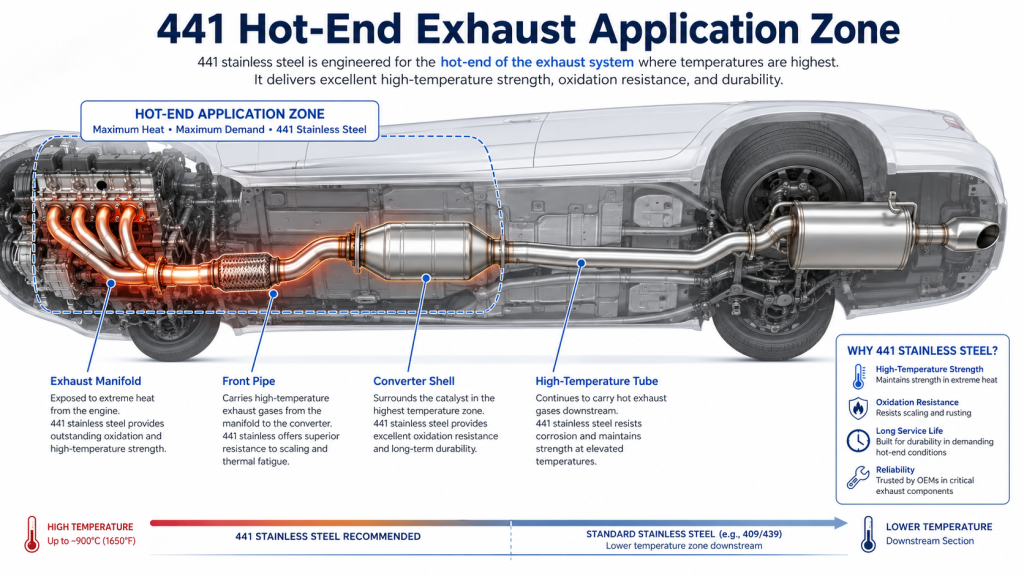
Where Does 441 Fit in an Automotive Exhaust System?
| Exhaust Area | Typical Components | Main Challenge | 441 Selection Logic |
|---|---|---|---|
| Very hot zone | Manifold and close-engine tubes | Oxidation, hot strength and thermal fatigue | One of the principal areas where 441 should be evaluated. |
| Hot / intermediate zone | Front pipe, converter shell and connecting tubes | Thermal cycling, welding and oxidation | Strong application area for suitable 441 exhaust products. |
| Cold end | Rear pipe, resonator and muffler | Condensate and road-salt corrosion | 441 can be used, but 409, 439 or corrosion-focused ferritic grades may provide better economic optimization. |
441 Stainless Steel for Exhaust Manifolds
Exhaust manifolds are among the most technically demanding stainless steel components in a vehicle.
They can experience:
- high exhaust-gas temperature;
- rapid heating during acceleration;
- cooling after engine shutdown;
- thermal expansion and contraction;
- vibration;
- welded joints;
- thermal fatigue.
These conditions explain why stabilized ferritic stainless steels with improved high-temperature strength are attractive for fabricated manifold designs.
441-type exhaust grades may be processed into:
- formed manifold shells;
- manifold tubes;
- welded collectors;
- connecting sections;
- formed hot-end components.
Design validation:
A material grade that performs well in one manifold design may not be suitable for another engine. Peak temperature, wall thickness, geometry and thermal cycle must be validated by the OEM or component designer.
441 Stainless Steel for Hot-End Exhaust Tubes
Tube manufacturing is another important application for 441.
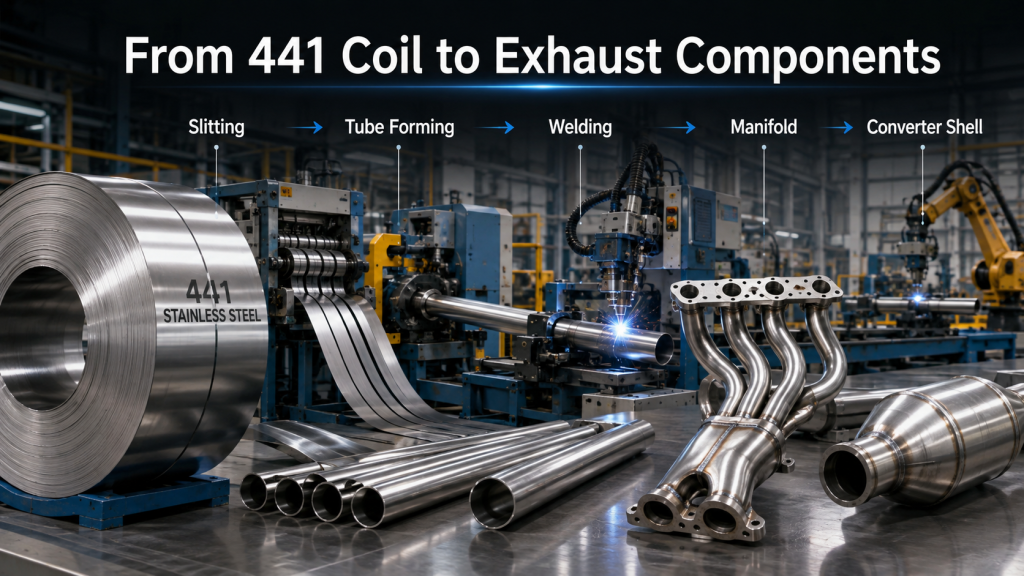
The raw material typically starts as coil or slit strip and may pass through:
- precision slitting;
- continuous forming;
- longitudinal seam welding;
- sizing;
- cutting;
- bending;
- end forming;
- assembly welding.
For high-temperature tube applications, purchasers should control:
- wall thickness;
- slit width;
- camber;
- edge burr;
- welding consistency;
- surface cleanliness;
- coil shape.
441 Stainless Steel for Front Pipes and Downpipes
Front pipes operate closer to the engine than rear exhaust pipes and can experience greater thermal cycling.
441 may be justified where:
- temperature exceeds the preferred range of a lower-alloy exhaust material;
- thermal fatigue is important;
- the component is extensively welded;
- oxidation resistance is a design requirement;
- the OEM specification identifies a 441-type material.
441 Stainless Steel for Catalytic Converter Shells
Catalytic-converter shells are another established application for exhaust-focused 441 / 1.4509 materials.
Manufacturing can involve:
- blanking;
- shell forming;
- rolling;
- seam welding;
- neck forming;
- assembly welding.
Converter-shell material must tolerate not only corrosion but also heating and cooling as the catalyst reaches operating temperature.
441 for Selected After-Treatment Housings
Modern emission-control systems can contain several metal housings operating at very different temperatures.
441 may be evaluated for suitable high-temperature housings, but material selection must not be based only on the name of the after-treatment component.
The engineering review should include:
- maximum metal temperature;
- temperature distribution;
- regeneration events where applicable;
- thermal cycling;
- condensate chemistry;
- weld configuration;
- required design life.
Can 441 Be Used for Muffler Shells?
Yes. Exhaust-focused 441 products are used for muffler-shell applications.
However, this does not mean every muffler requires 441.
A rear muffler often experiences lower temperature than a manifold, and its major durability challenge can instead be internal condensation and external road-salt exposure.
In such cases, a manufacturer should compare:
- 409 for cost-sensitive exhaust applications;
- 439 for improved cold-end corrosion and welding performance;
- 441 when thermal performance or the OEM specification justifies the upgrade;
- 436-type material when additional corrosion resistance is important.
When May 441 Be Over-Specified?
Higher material capability does not automatically produce the lowest total component cost.
441 may be unnecessary when:
- the component operates permanently in the cooler rear section;
- 409 already satisfies the required durability;
- 439 provides sufficient cold-end corrosion performance;
- the design does not experience significant high-temperature loading;
- the OEM specification allows a lower-cost material.
The objective is to select sufficient material capability—not the highest grade available.
How Hot Can 441 Stainless Steel Operate?
Some exhaust-specific commercial 441 / 1.4509 products publish high-temperature oxidation capability approaching approximately 950°C under defined producer test conditions.
This value should be treated as material-reference information rather than a universal continuous component service-temperature guarantee.
Real exhaust-component durability also depends on:
- temperature cycle;
- time at temperature;
- wall thickness;
- welds;
- stress;
- exhaust atmosphere;
- component geometry.
Do not write “441 works continuously at 950°C” into a customer quotation unless the customer’s engineering specification explicitly supports that statement.
Thermal Cycling and Exhaust-System Fatigue
Peak temperature is only one part of exhaust-material selection.
A manifold or converter housing may repeatedly cycle from ambient temperature to several hundred degrees Celsius and back again.
Repeated dimensional change can create:
- thermal stress;
- weld stress;
- local distortion;
- fatigue cracks;
- joint movement.
Ferritic stainless steel’s relatively low thermal expansion is one reason stabilized ferritic grades are attractive for these components.
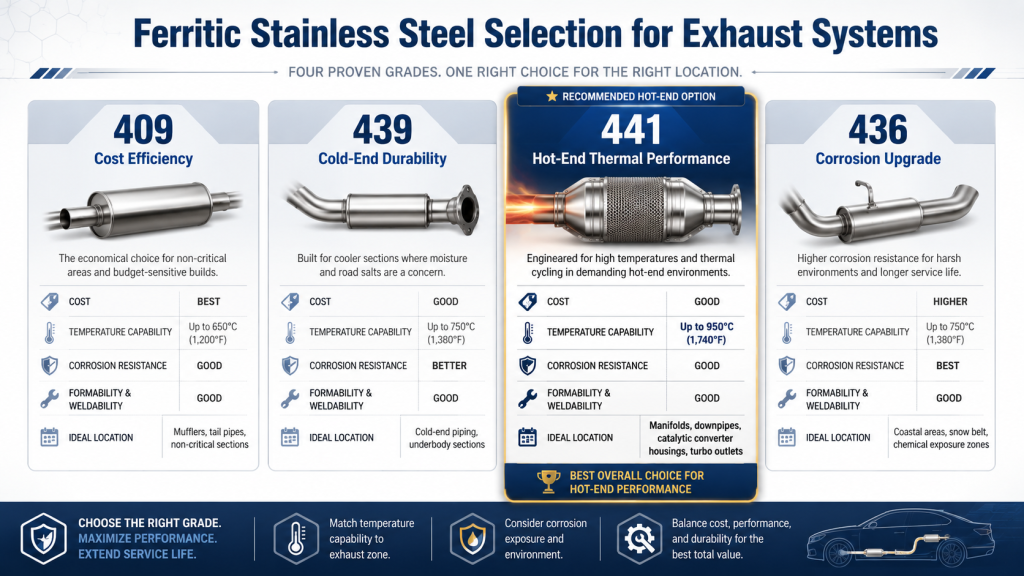
409 vs 441 Stainless Steel for Exhaust Systems
| Selection Factor | 409-Type Stainless | 441-Type Stainless |
|---|---|---|
| Primary positioning | Cost-effective exhaust material | Higher-temperature exhaust material |
| Chromium level | Lower | Higher, approximately 17–18% family |
| Stabilization | Commonly Ti stabilized | Nb or Ti+Nb stabilized depending on variant |
| High-temperature strength | Suitable for many exhaust applications | Greater margin for demanding thermal service |
| Typical component focus | Pipes, mufflers and general exhaust components | Manifolds, hot tubes, converter shells and demanding exhaust sections |
| Purchasing logic | Cost-performance balance | Temperature and thermal-cycle performance |
For JUDE’s lower-alloy exhaust material, see
409L Stainless Steel
.
439 vs 441 Stainless Steel
439 and 441 should not be viewed simply as competing grades.
They often solve different engineering problems.
| Factor | 439 | 441 |
|---|---|---|
| Primary exhaust focus | Cold-end and moderate-temperature durability | Hotter and thermally demanding exhaust sections |
| Stabilization | Primarily Ti stabilized | Nb or Ti+Nb depending on variant |
| Key purchasing reason | Corrosion, welding and cold-end durability | High-temperature strength and oxidation margin |
| Common examples | Mufflers, rear pipes and tubes | Manifolds, hot tubes and converter shells |
See JUDE’s
439 Stainless Steel
page for additional grade information.
436 vs 441 Stainless Steel
436-type stainless steel contains molybdenum and is generally considered when corrosion resistance becomes a greater priority.
441 is more strongly positioned around high-temperature exhaust performance.
This creates a useful engineering distinction:
- 441: prioritize high-temperature strength, oxidation and thermal cycling;
- 436: evaluate when chloride, condensate or external corrosion requires additional margin.
See:
436 Stainless Steel
.
 Should Manufacturers Buy 441 Sheet, Coil or Strip?
441 Stainless Steel Coil
For high-volume automotive manufacturing,
stainless steel coil
is usually the most efficient raw-material format.
It supports:
- tube production;
- continuous blanking;
- manifold-shell production;
- converter-shell production;
- automatic stamping lines.
441 Stainless Steel Sheet
stainless steel sheet
can be useful for:
- prototypes;
- forming trials;
- low-volume shells;
- custom exhaust components;
- cut blanks.
441 Stainless Steel Strip
stainless steel strip
is particularly relevant to tube mills and manufacturers requiring narrow-width feedstock.
Important strip parameters include:
- width tolerance;
- camber;
- edge burr;
- coil ID;
- coil weight;
- surface condition.
Manufacturing 441 Exhaust Tubes From Coil
A typical tube-production route may include:
- Incoming coil inspection
- Precision slitting
- Rewinding
- Tube forming
- Longitudinal seam welding
- Weld inspection
- Sizing
- Cutting
- Bending
- End forming
- Final exhaust assembly
JUDE provides
stainless steel strip processing
for customized width requirements.
Forming 441 Exhaust Components
The forming requirement differs significantly between a straight tube, converter shell and complex manifold.
Important variables include:
- thickness;
- forming radius;
- drawing depth;
- blank orientation;
- tool geometry;
- lubrication;
- surface condition;
- springback;
- final weld geometry.
For complex hot-end parts, a production forming trial should be considered before committing to high-volume material purchases.
Welding 441 Stainless Steel
441 is widely associated with welded components, but a stabilized chemistry does not eliminate the need for process control.
Manufacturers should control:
- heat input;
- weld speed;
- joint fit-up;
- shielding;
- filler strategy where applicable;
- surface cleanliness;
- penetration;
- distortion.
The welding procedure should be validated for the actual material thickness and component geometry.
Surface, Edge and Coil Requirements
| Parameter | Why It Matters | Relevant Process |
|---|---|---|
| Thickness tolerance | Influences forming, hot strength and weld consistency | All components |
| Width tolerance | Affects tube forming and material yield | Slit strip |
| Camber | Can cause tracking problems | Tube mills |
| Edge burr | Can affect seam welding and forming | Slit strip |
| Surface cleanliness | Important for welding and contamination control | All welded exhaust parts |
| Flatness | Affects blanking and shell forming | Converter and manifold shells |
441 Corrosion Limitations
441 provides useful corrosion resistance, but it should not be described as immune to corrosion.
Risk can increase with:
- chloride road salts;
- acidic exhaust condensate;
- crevices;
- trapped moisture;
- iron contamination;
- damaged surfaces.
For components where chloride and condensate corrosion dominate rather than high temperature, a molybdenum-containing ferritic grade may provide a more appropriate material strategy.
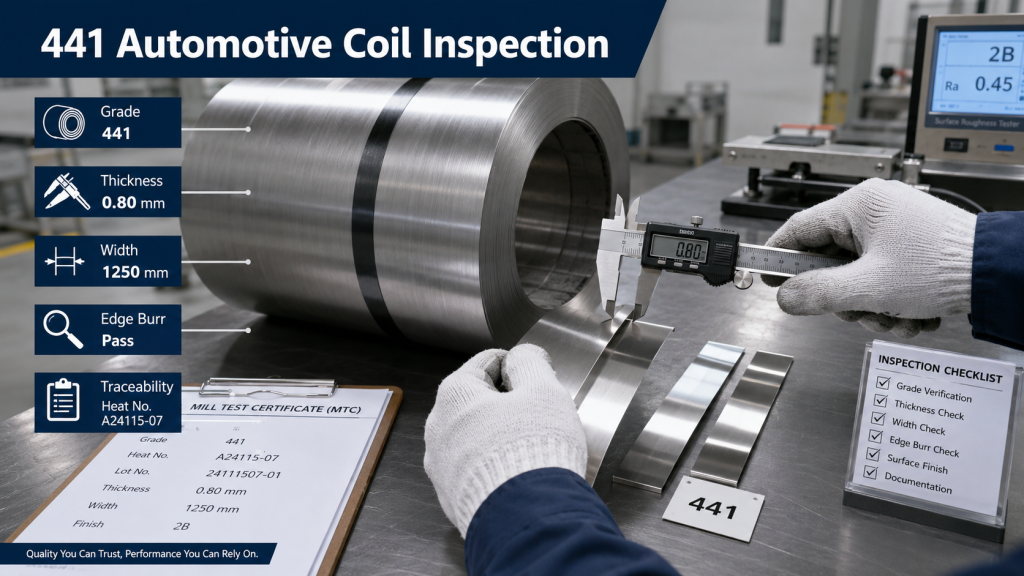
Incoming Inspection of 441 Automotive Stainless Steel
- Verify the exact grade and governing standard.
- Review the MTC.
- Match the heat number and coil number.
- Measure thickness.
- Measure width.
- Check flatness or coil shape.
- Check camber where required.
- Inspect slit-edge burr.
- Inspect surface condition.
- Perform welding or forming trials when required.
JUDE publishes selected
stainless steel inspection reports
,
including SUS441-related documentation.
 Common 441 Stainless Steel Purchasing Mistakes
Mistake 1: Ordering only “441.”
State the governing standard, UNS where required and OEM material specification.
Mistake 2: Assuming every 1.4509 product has identical stabilization.
Commercial 441/4509 variants can differ in stabilizer system and UNS designation.
Mistake 3: Writing 950°C as a universal service-temperature guarantee.
Producer oxidation data does not replace component thermal validation.
Mistake 4: Using 441 in every muffler simply because it is a higher-performance grade.
409 or 439 may provide a better economic solution in cooler exhaust sections.
Mistake 5: Selecting only by chemistry.
Exhaust performance also depends on forming, welding, thickness, geometry and thermal cycling.
Mistake 6: Ignoring OEM specifications.
Automotive customer material specifications take priority over generic online grade comparisons.
Mistake 7: Ignoring strip geometry.
Tube manufacturers need width, camber and edge-burr control as well as correct chemistry.
JUDE 441 Stainless Steel Supply Options
JUDE lists 441 within its 400-series stainless steel portfolio and supplies stainless steel flat products for downstream manufacturing.
441 Stainless Steel
— grade information.
Stainless Steel Coil
— for tube mills and high-volume exhaust production.
Stainless Steel Sheet
— for shells, blanks and prototypes.
Stainless Steel Strip
— for narrow-width tube and formed-component feedstock.
Strip Processing
— for customized slit widths.
Exact 441 standard, UNS designation, thickness, width, coil weight, surface, tolerances and availability should be confirmed for each automotive project.
441 Stainless Steel Automotive Exhaust RFQ Checklist
- Final component:
manifold, front pipe, exhaust tube, converter shell, muffler shell or another component. - Vehicle:
passenger car, commercial vehicle, truck, motorcycle or off-road equipment. - Exhaust-system zone:
hot end, intermediate or cold end. - OEM material specification:
provide the exact document or grade code where available. - Material designation:
ASTM Type 441, required UNS, EN 1.4509 or another specified designation. - Product standard:
ASTM A240/A240M, EN 10088-2 or applicable customer standard. - Product form:
coil, sheet, strip or cut blank. - Thickness:
nominal thickness and tolerance. - Width:
coil or strip width and tolerance. - Coil ID and OD:
state equipment-compatible dimensions. - Coil weight:
minimum and maximum acceptable weight. - Camber:
state maximum permitted value for tube-feed strip. - Edge condition:
mill edge, slit edge or deburred edge. - Burr:
state maximum permitted burr where critical. - Surface condition:
state hot-rolled, cold-rolled, 2D, 2B or another required surface. - Forming route:
tube forming, stamping, drawing, bending or shell forming. - Welding:
state the intended welding process. - Normal operating temperature:
provide when available. - Peak metal temperature:
provide when available. - Thermal cycle:
describe severe repeated heating if relevant. - Corrosion environment:
road salt, exhaust condensate, humidity and required life. - Inspection:
MTC, heat/coil traceability, dimensional inspection or third-party inspection. - Quantity:
trial order, coil quantity or annual demand. - Destination:
country, port, Incoterm and required delivery date.
Frequently Asked Questions
Is 441 stainless steel used for automotive exhaust systems?
Yes. Exhaust-focused 441 / 1.4509 products are used for vehicle exhaust components including manifolds, tubes, catalytic-converter shells and selected muffler shells.
Why is 441 used for exhaust manifolds?
441 offers useful high-temperature strength, oxidation resistance, ferritic thermal behavior and weldability for suitably designed manifold applications.
Can 441 stainless steel be used for catalytic-converter shells?
Yes. Converter shells are an established application for exhaust-focused 441 / 1.4509 materials, subject to the actual OEM temperature and durability specification.
Can 441 operate at 950°C?
Some producer-specific 441 / 1.4509 exhaust grades publish oxidation-resistance data approaching 950°C. This should not be interpreted as a universal continuous component service-temperature guarantee.
What is the difference between 409 and 441 stainless steel?
409 is a lower-alloy cost-effective exhaust grade, while 441 provides greater high-temperature and oxidation capability for more demanding exhaust components.
What is the difference between 439 and 441?
439 is strongly associated with cold-end corrosion durability and exhaust tubing, while 441 is more strongly positioned for hotter components requiring improved thermal performance.
Is 441 always better than 439?
No. The correct grade depends on the component. A cold-end muffler may benefit more from 439’s cost and corrosion balance, while a hot-end manifold may justify 441.
Does 441 stainless steel rust?
It can corrode under sufficiently aggressive conditions. Road salt, exhaust condensate, crevices and contamination should still be considered.
Should an exhaust manufacturer buy 441 sheet or coil?
Coil or strip is normally more efficient for high-volume tube and shell production. Sheet is useful for prototypes, blanks and lower-volume fabrication.
What information should I provide for a 441 stainless steel quotation?
Provide the component drawing, OEM specification, exact material designation, thickness, width, coil dimensions, forming process, welding method, temperature conditions, inspection requirements, quantity and destination.
Conclusion
441 stainless steel should not be viewed simply as another 400-series grade.
Its strongest automotive value lies in exhaust applications where temperature, oxidation resistance, thermal cycling, welding and dimensional stability become more demanding.
Typical components include exhaust manifolds, hot-end tubes, front pipes, catalytic-converter shells and other thermally loaded exhaust parts.
The correct material-selection logic is:
Component → Exhaust Zone → Temperature → Thermal Cycle → Corrosion → Grade → Product Form → Forming → Welding → Inspection.
409 can remain the most economical solution for many general exhaust components. 439 can provide an attractive cold-end durability upgrade. 441 becomes particularly relevant when thermal performance increases, while 436-type molybdenum-bearing ferritic stainless steel can provide additional corrosion margin.
The final automotive OEM specification always takes priority over generic online material comparisons.
Request 441 Stainless Steel for Automotive Exhaust Production
Send JUDE your manifold, tube, converter or exhaust-component drawing together with the OEM material specification, grade, thickness, coil width, surface, edge requirement, forming method, welding process, normal and peak temperature, annual quantity and destination.
For tube-production orders, also provide coil ID, coil weight, maximum camber, width tolerance and edge-burr requirement.
