
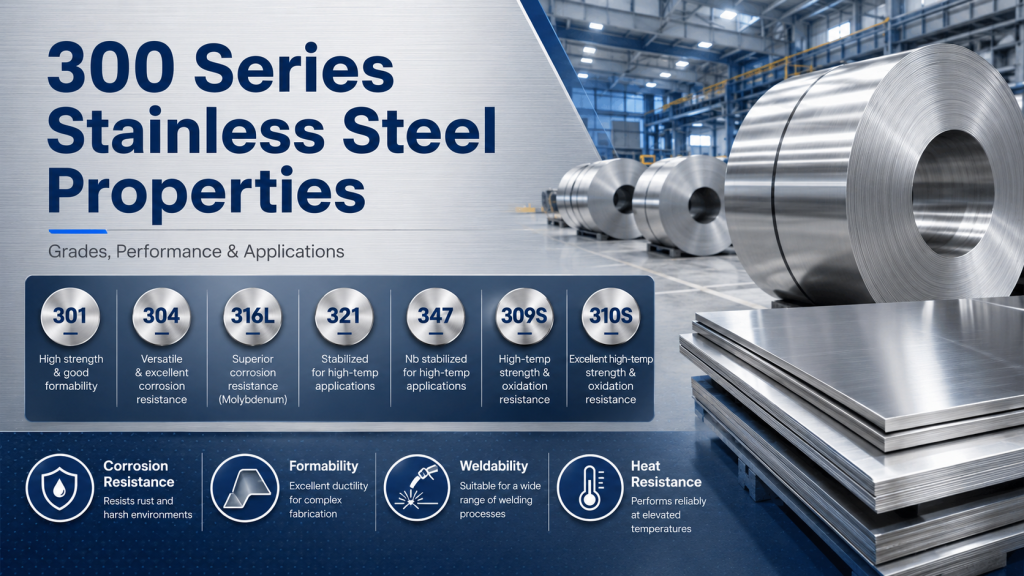
300 series stainless steel is a predominantly austenitic family of chromium-nickel alloys valued for its combination of corrosion resistance, ductility, formability, weldability and toughness. The family includes general-purpose grades such as 304, molybdenum-alloyed grades such as 316L, cold-work-strengthened grades such as 301, stabilized grades such as 321 and 347, and heat-resistant grades such as 309S and 310S.
However, there is no single set of properties that applies to every 300 series grade. Corrosion resistance, strength, magnetism, welding behavior and high-temperature performance change with chemical composition, carbon level, cold-work condition, product form, thickness, surface finish and service environment.
This guide explains the most important 300 series stainless steel properties and helps engineers, manufacturers and international buyers select the correct grade, product form and purchasing specification.
Quick Answer: What Are the Main Properties of 300 Series Stainless Steel?
- Austenitic microstructure:
most 300 series grades have an austenitic structure in the solution-annealed condition. - Good corrosion resistance:
chromium forms a passive surface film, while nickel, molybdenum and other alloying elements modify performance in different environments. - High ductility and formability:
many grades can be deep drawn, bent, rolled, stamped and stretched. - Good weldability:
low-carbon and stabilized variants are available for welded structures. - Strong work hardening:
cold forming can significantly increase strength, especially in grade 301. - Generally low magnetic response when annealed:
cold working or welding can create measurable magnetism in some grades. - Good low-temperature toughness:
austenitic grades retain useful toughness at sub-zero and cryogenic temperatures. - Grade-dependent heat resistance:
309S and 310S are designed for high-temperature oxidation service, while 304 and 316L are primarily general corrosion-resistant grades.
Important:
“300 series stainless steel” is a material family, not a complete purchasing specification. A purchase order should identify the exact grade, standard, product form, dimensions, finish, processing condition and inspection requirements.
What Is 300 Series Stainless Steel?
The 300 series is a group of mainly austenitic stainless steels alloyed principally with chromium and nickel. Many grades also contain molybdenum, titanium, niobium, nitrogen, silicon or controlled carbon levels to provide specific corrosion, welding, forming or temperature properties.
The term austenitic describes the steel’s face-centered cubic crystal structure. This structure contributes to:
- High ductility
- Good toughness
- Strong forming performance
- Good weldability
- High work-hardening capacity
- Useful low-temperature behavior
Unlike many martensitic stainless steels, standard austenitic grades cannot be substantially hardened by conventional quenching and tempering. Their strength is normally increased through cold working or by selecting a specially designed higher-strength grade.
The 300 series includes much more than 304 and 316. Common industrial grades include 301, 303, 304, 304L, 304H, 316, 316L, 316Ti, 317L, 321, 347, 309S and 310S.
How Alloying Elements Control 300 Series Properties
| Alloying Element | Primary Function | Practical Purchasing Effect |
|---|---|---|
| Chromium | Forms and supports the passive oxide film | Important for general corrosion and oxidation resistance |
| Nickel | Stabilizes the austenitic structure | Supports ductility, toughness, forming and weldability |
| Molybdenum | Improves localized corrosion resistance | Makes 316L and 317L more suitable than 304 for many chloride-bearing environments |
| Carbon | Influences strength, carbide precipitation and high-temperature behavior | L grades reduce sensitization risk; H grades support high-temperature strength |
| Titanium | Stabilizes carbon | Used in grades such as 321 and 316Ti for welded or elevated-temperature service |
| Niobium | Stabilizes carbon and supports high-temperature properties | Used in 347 and 347H |
| Sulfur | Improves chip breaking and machinability | Used in free-machining grades such as 303, with trade-offs in corrosion and welding |
| Silicon | Can support oxidation resistance in heat-resistant alloys | Important in selected furnace and high-temperature grades |
Chemical composition limits should be taken from the governing product standard. A mill’s typical composition should not be treated as the contractual acceptance range unless it is written into the purchase agreement.
Common 300 Series Stainless Steel Grades
| Grade | Common UNS | Defining Property | Typical Applications | Main Limitation |
|---|---|---|---|---|
| 301 | S30100 | Very high work-hardening capacity | Springs, clips, stampings, transport and structural components | Corrosion resistance is generally below 304 in comparable conditions |
| 303 | S30300 | Free-machining behavior | Fasteners, shafts, fittings and precision machined parts | Reduced welding and corrosion performance compared with 304 |
| 304 | S30400 | General-purpose balance of corrosion resistance and fabrication | Food equipment, tanks, appliances, architecture and general fabrication | Limited resistance in aggressive chloride environments |
| 304L | S30403 | Low-carbon 304 variant | Welded tanks, piping and fabricated equipment | Does not provide the molybdenum-enhanced chloride resistance of 316L |
| 304H | S30409 | Controlled carbon for elevated-temperature strength | Boilers, heat exchangers and high-temperature pressure equipment | Not a direct substitute for low-carbon 304L in corrosion-sensitive weldments |
| 316 / 316L | S31600 / S31603 | Molybdenum-enhanced localized corrosion resistance | Chemical, pharmaceutical, food, pulp and paper, and selected coastal equipment | Not immune to severe seawater, hot chlorides or crevice corrosion |
| 316Ti | S31635 | Titanium-stabilized molybdenum grade | Elevated-temperature welded components and process equipment | Surface finishing and availability may differ from standard 316L |
| 317L | S31703 | Higher molybdenum than 316L | Chemical processing, pulp and paper, valves and aggressive process equipment | Higher cost and lower availability than 304 or 316L |
| 321 | S32100 | Titanium-stabilized grade | Exhaust systems, welded pressure equipment and elevated-temperature components | Not selected primarily for improved chloride resistance |
| 347 | S34700 | Niobium-stabilized alternative to 321 | Expansion joints, exhaust manifolds, high-temperature gaskets and chemical equipment | Not a universal replacement for 316L in chloride service |
| 309S | S30908 | Improved high-temperature oxidation resistance | Furnace equipment, annealing boxes, thermowells and baffles | Optimized for heat rather than aggressive aqueous corrosion |
| 310S | S31008 | High chromium and nickel for oxidation resistance | Industrial furnaces, heat-treatment baskets, boilers and thermowells | Higher cost and limited aqueous-corrosion advantage |
This table is a selection guide rather than a full grade-equivalency chart. The exact grade, UNS number and governing standard should be specified in the purchase order.
Corrosion Resistance Properties
The corrosion resistance of 300 series stainless steel begins with chromium. In a suitable oxygen-containing environment, chromium supports a thin passive film that separates the underlying alloy from the surrounding medium.
The passive film can reform after minor mechanical damage, provided the surface is clean and the environment allows repassivation. Stainless steel is therefore corrosion resistant, not corrosion proof.
304 and 304L
304 stainless steel
is a general-purpose choice for atmospheric exposure, food equipment, fresh water, household products and many mildly corrosive industrial environments.
304L stainless steel
provides broadly similar general corrosion behavior while reducing sensitization risk in welded sections.
316L
316L stainless steel
contains molybdenum and normally offers better resistance than 304 to pitting and crevice corrosion in many chloride-bearing environments.
This does not make 316L universally suitable for seawater. Temperature, chloride concentration, crevices, deposits, flow, surface condition and cleaning frequency all affect performance.
317L and Higher-Alloy Options
317L stainless steel
contains more molybdenum than 316L and can provide an additional corrosion margin in selected process environments.
When 317L is insufficient, buyers may need to evaluate 904L, super-austenitic stainless steel, duplex, super duplex or nickel alloys rather than assuming every problem can be solved within the conventional 300 series.
Fabrication Effects on Corrosion
Corrosion performance can be reduced by:
- Welding heat tint
- Iron contamination
- Grinding damage
- Rough surface condition
- Uncleanable crevices
- Chloride deposits
- Incorrect pickling or passivation
- Incompatible cleaning chemicals
The selected alloy, fabrication quality and service design must therefore be evaluated together.
Mechanical Properties and Work Hardening
300 series stainless steels normally combine moderate annealed yield strength with good tensile strength, elongation and toughness.
Mechanical values vary according to:
- Grade
- Product standard
- Sheet, plate, strip, bar or tube form
- Thickness
- Annealed or cold-worked condition
- Temper designation
- Testing direction
- Operating temperature
Cold Work Strengthening
Austenitic stainless steel work hardens during deformation. Rolling, drawing, bending and stamping can significantly increase tensile and yield strength while reducing elongation.
Grade
301 stainless steel
is particularly important where high strength must be developed through cold work. It is commonly supplied in annealed, quarter-hard, half-hard, full-hard or spring-temper conditions.
A buyer should never compare annealed mechanical properties with cold-rolled temper properties without confirming the delivery condition.
Can 300 Series Stainless Steel Be Hardened by Heat Treatment?
Standard austenitic 300 series grades cannot be hardened in the same way as martensitic stainless steel by conventional quenching and tempering.
Solution annealing is used to restore ductility, dissolve certain precipitates and establish the required microstructure. Strength is normally increased through cold working rather than conventional hardening heat treatment.
Formability and Fabrication Properties
Many 300 series grades are selected because they can undergo substantial deformation without cracking.
Deep Drawing
304, 304L and selected high-nickel grades provide strong deep-drawing performance for sinks, cookware, containers and complex housings.
Bending and Roll Forming
Sheet and coil can be bent and roll formed into panels, channels, tanks, tubes and architectural components.
Cold-worked grades require greater forming force and more generous bend planning than fully annealed material.
Springback
Austenitic stainless steel generally exhibits more springback than mild carbon steel. Tooling, bend allowance and over-bending must be adjusted for the grade, thickness and temper.
Surface Protection
Decorative sheet should remain protected during cutting, forming, welding, handling and installation. Grain direction should be identified before nesting and bending No.4 or hairline panels.
Welding Properties
Most standard 300 series stainless steels can be welded using TIG, MIG, resistance, plasma and other qualified processes.
Good welding results require control of:
- Base-metal grade
- Filler-metal selection
- Heat input
- Joint design
- Shielding and backing gas
- Interpass temperature
- Distortion
- Heat-tint removal
- Post-weld cleaning
Low-Carbon Grades
304L and 316L restrict carbon to reduce the risk of chromium-carbide precipitation and intergranular corrosion in welded heat-affected zones.
The L suffix does not mean that the alloy is automatically superior in every application. It specifically identifies a low-carbon variant.
Stabilized Grades
321 uses titanium and 347 uses niobium stabilization. These grades are selected for welded and elevated-temperature applications where microstructural stability is important.
Free-Machining Grades
Sulfur-containing grades such as 303 are not the first choice for welded structures. When welding is a major project requirement, another grade should normally be evaluated.
JUDE can support projects requiring
custom stainless steel sheet-metal processing,
including cutting, bending and fabricated components.
Are 300 Series Stainless Steels Magnetic?
300 series stainless steel is often called non-magnetic, but that description requires qualification.
In the fully solution-annealed condition, common grades such as 304 and 316L generally have a low magnetic response. However, cold working can transform part of the austenitic structure into deformation-induced martensite.
As a result:
- Cold-worked 301 can become noticeably magnetic.
- Formed or rolled 304 may attract a magnet.
- 316L normally develops less magnetic response than 301 or 304 under comparable cold work.
- Weld metal may show some magnetic response depending on its ferrite content.
A magnet test cannot confirm the exact alloy grade or determine whether stainless steel is genuine. Grade verification should rely on the material certificate, heat-number traceability and, where necessary, PMI or laboratory analysis.
High- and Low-Temperature Properties
High-Temperature Service
Not all 300 series grades are heat-resistant grades.
304 and 316L can be used at elevated temperatures in suitable conditions, but they are normally selected primarily for general corrosion resistance and fabrication.
309S and 310S contain higher chromium and nickel and are designed for improved oxidation resistance and strength in high-temperature equipment. Typical applications include furnace parts, baffles, heat-treatment baskets, thermowells and industrial heating systems.
321 and 347 provide stabilization advantages in welded and intermittently heated equipment. Their suitability still depends on load, atmosphere, exposure time and the exact temperature cycle.
High-temperature selection must consider:
- Continuous or intermittent exposure
- Oxidizing or reducing atmosphere
- Sulfur-bearing gases
- Carburizing or nitriding conditions
- Creep strength
- Thermal cycling
- Scale formation and spalling
- Mechanical loading
Low-Temperature Toughness
Austenitic 300 series grades generally maintain useful toughness at low and cryogenic temperatures.
This makes selected grades suitable for LNG equipment, cryogenic tanks, low-temperature piping and cold-storage systems.
For pressure or safety-critical equipment, the governing code, product form, impact-testing requirements and design temperature must be confirmed before ordering.
Machining Properties
Standard austenitic stainless steels are generally more difficult to machine than carbon steel because of work hardening, toughness, lower thermal conductivity and the tendency to form long chips.
Successful machining requires:
- Rigid machines and fixtures
- Sharp tools designed for stainless steel
- Positive and continuous cutting
- Correct feeds and cutting speeds
- Adequate coolant
- Effective chip control
Grade 303 is designed specifically for improved machinability, but its sulfur addition changes corrosion, hot-working and welding behavior.
Where corrosion performance and machinability are both important, buyers can also evaluate specially processed machinability-enhanced versions of 304L or 316L rather than selecting 303 automatically.
Surface Finish Options
| Finish | General Appearance | Typical Use | Purchasing Note |
|---|---|---|---|
| No.1 | Hot-rolled, annealed and pickled | Plate, tanks and industrial fabrication | Functional rather than decorative |
| 2B | Smooth cold-rolled finish | General equipment and fabrication | Common base finish for further processing |
| BA / 2R | Bright annealed | Appliances and decorative components | Confirm reflectivity and flatness |
| No.4 | Brushed satin | Kitchen equipment, elevators and architecture | Approve grit pattern and grain direction |
| Hairline | Fine continuous directional grain | Interior panels and architectural work | Adjacent panels should use the same grain direction |
| Mirror | Highly reflective polished surface | Decorative and display applications | Requires strong control of polishing and flatness |
Surface finish affects more than appearance. It can influence cleanability, contamination retention, corrosion initiation, friction and inspection acceptance.
300 Series Applications by Industry
Food and Beverage Equipment
304 and 304L are widely used for tanks, worktables, sinks, conveyors and food-processing equipment in suitable environments. 316L may be selected for more aggressive cleaning chemicals, salts or chloride exposure.
“Food grade” is not guaranteed by the alloy name alone. Final suitability depends on fabrication, surface condition, cleaning, maintenance and applicable regulations.
Chemical and Pharmaceutical Processing
316L and 317L are commonly considered for vessels, piping, valves, pumps and pharmaceutical equipment. The exact chemical, concentration, temperature and contamination limits must be reviewed.
Architecture and Interior Design
304 is widely used for cladding, handrails, elevators and decorative panels. Coastal or de-icing-salt exposure may justify 316L or another higher-alloy option.
Automotive and Transportation
301 is used for springs, clips and high-strength formed components. 304 is used for trim and fabricated structures, while stabilized grades can be used for exhaust and elevated-temperature parts.
High-Temperature Equipment
309S, 310S, 321 and 347 are evaluated for furnace parts, exhaust systems, pressure equipment, heat-treatment fixtures and other thermal applications.
Cryogenic Equipment
Selected austenitic grades are used for low-temperature vessels, piping and LNG systems because of their low-temperature toughness.
300 Series vs 200 and 400 Series Stainless Steel
| Feature | 200 Series | 300 Series | 400 Series |
|---|---|---|---|
| Typical structure | Mainly austenitic Cr-Ni-Mn | Mainly austenitic Cr-Ni or Cr-Ni-Mo | Mainly ferritic or martensitic |
| Nickel content | Usually reduced | Generally higher | Often low or absent |
| Formability | Grade dependent | Generally very good | Generally lower than austenitic grades |
| Magnetic response | Low when annealed; can increase after cold work | Low when annealed; can increase after cold work | Usually magnetic |
| Cost structure | Often lower alloy cost | Generally higher nickel-related cost | Often lower nickel-related cost |
| Best use | Cost-sensitive austenitic applications | Balanced corrosion resistance and fabrication | Appliances, exhausts, wear or hardness applications |
No stainless steel series is universally superior. The correct choice depends on the actual corrosion environment, strength, magnetic behavior, forming, welding, temperature and lifecycle requirements.
Available Product Forms
300 series stainless steel is supplied in different forms according to the manufacturing process and final component.
Stainless steel sheet and plate
for tanks, panels, equipment housings, architectural products and fabricated structures.
Stainless steel coil
for continuous production, cut-to-length processing, roll forming and high-volume fabrication.
Stainless steel strip
for springs, clips, stampings, precision parts and narrow formed products.- Bars, rods and profiles for machined parts, fasteners, valves and structural applications.
- Pipes and tubes for fluid systems, heat exchangers, sanitary equipment and structural use.
- Custom-fabricated components produced according to drawings and inspection requirements.
Common 300 Series Purchasing Mistakes
1. Ordering Only “300 Series Stainless Steel”
The family name does not define corrosion resistance, carbon content, molybdenum, stabilization or strength condition.
2. Assuming All Grades Are Non-Magnetic
Cold-worked 301 and 304 can show measurable magnetic attraction. Magnetism alone is not a reliable grade-identification method.
3. Treating 316L as Universally Marine-Proof
316L has improved chloride resistance compared with 304, but severe seawater or hot chloride service may require a higher-alloy material.
4. Using Typical Values as Guaranteed Values
Typical mill chemistry and mechanical data are not automatically the contractual acceptance criteria.
5. Ignoring the Delivery Condition
Annealed, quarter-hard, half-hard and full-hard materials have significantly different strength, elongation and forming behavior.
6. Mixing ASTM, EN and JIS Requirements
Similar grade designations are not necessarily exact one-to-one equivalents. One governing product standard should be identified.
7. Ignoring the Surface Finish
A grade can meet its chemistry requirement and still fail the project because of scratches, inconsistent grain, poor flatness or an unsuitable surface.
8. Failing to Specify Welding and Inspection
The supplier needs to know whether the material will be welded, formed, polished or used in a critical pressure or corrosion application.
Inspection and Material Documentation
A professional receiving inspection may include:
- Grade and product-standard verification
- Mill test certificate review
- Heat-number or batch traceability
- PMI or XRF testing when required
- Thickness measurement
- Width and length inspection
- Flatness inspection
- Surface-finish comparison
- Grain-direction confirmation
- Edge-condition inspection
- Protective-film review
- Packaging and marking inspection
The material certificate should be traceable to the delivered material. A certificate with correct values is not sufficient if its heat number or batch information cannot be matched to the goods.
Buyers can review selected JUDE
stainless steel inspection reports
when evaluating quality documentation and traceability requirements.
300 Series Stainless Steel RFQ Checklist
Include the following information when requesting a quotation:
- Exact grade:
301, 303, 304, 304L, 304H, 316L, 316Ti, 317L, 321, 347, 309S or 310S. - UNS or EN designation:
Include the required designation where applicable. - Product standard:
ASTM A240/A240M, ASTM A666/A666M, EN 10088-2 or another applicable standard. - Product form:
Sheet, plate, coil, strip, bar, pipe, tube or fabricated component. - Delivery condition:
Annealed, quarter-hard, half-hard, full-hard or another specified temper. - Dimensions:
Thickness, width, length, diameter and dimensional tolerances. - Surface finish:
No.1, 2B, BA, No.4, hairline, mirror or another approved finish. - Grain direction:
Identify the direction for visible brushed or hairline panels. - Edge condition:
Mill edge, slit edge, deburred, rounded or another requirement. - Service environment:
Chemicals, concentration, chloride content, pH, temperature and cleaning system. - Fabrication:
Cutting, slitting, bending, drawing, welding, machining, polishing or assembly. - Mechanical requirements:
Tensile strength, yield strength, hardness or temper where required. - Documents:
MTC, heat number, PMI, dimensional report or third-party inspection. - Quantity:
Number of sheets, coil weight, total weight or component quantity. - Packaging and delivery:
Protective film, pallets, waterproof packing, destination, Incoterm and required date.
Frequently Asked Questions
What is 300 series stainless steel?
It is a predominantly austenitic chromium-nickel stainless steel family that includes grades such as 301, 304, 316L, 321, 347, 309S and 310S.
What are the main properties of 300 series stainless steel?
Common properties include good corrosion resistance, ductility, formability, weldability, work hardening, toughness and generally low magnetic response in the annealed condition.
Is all 300 series stainless steel non-magnetic?
No. Most grades have a low magnetic response when solution annealed, but cold working and welding can introduce measurable magnetism.
Can 300 series stainless steel be hardened?
It cannot normally be hardened through conventional quenching and tempering, but it can gain substantial strength through cold working.
What is the strongest common 300 series grade?
The answer depends on condition. Cold-worked 301 can reach very high strength, while annealed grades have substantially lower strength and greater ductility.
Is 316L always better than 304?
No. 316L normally provides better localized corrosion resistance in many chloride environments, but 304 is often more economical and fully adequate in milder conditions.
Which 300 series grade is best for welding?
304L and 316L are common choices for welded fabrication. Stabilized grades such as 321 and 347 may be selected for elevated-temperature welded service.
Which 300 series grade is best for high temperatures?
309S and 310S are commonly evaluated for high-temperature oxidation service. 321, 347 and H grades may also be used depending on temperature, load and code requirements.
Which finish is best for food equipment?
The correct finish depends on the process, hygiene requirement and cleaning method. A smooth, correctly fabricated and maintainable surface is generally more important than the finish name alone.
How can buyers verify the stainless steel grade?
Check the MTC, heat number and material markings. PMI or laboratory analysis can be added when the application requires independent grade verification.
Conclusion
300 series stainless steel offers one of the broadest combinations of corrosion resistance, fabrication performance, toughness and application flexibility available within the stainless steel family.
304 and 304L provide a practical general-purpose solution. 316L and 317L improve performance in many chloride and chemical environments. 301 develops high strength through cold working. 321 and 347 support welded and elevated-temperature applications, while 309S and 310S are designed for improved high-temperature oxidation resistance.
The best grade cannot be selected from the series number, price or magnet response alone. Buyers should define the service environment, standard, product form, temper, dimensions, finish, fabrication process and inspection documents before requesting a quotation.
Request a 300 Series Stainless Steel Quotation
JUDE supplies 300 series stainless steel sheet, plate, coil, strip and processed components for food equipment, chemical processing, architectural, automotive and high-temperature applications.
Send the exact grade, standard, product form, dimensions, finish, temper, processing requirements, quantity, inspection documents and destination.
Contact JUDE Steel for material review, processing support and a quotation.
Technical References
