
410 vs 416 Stainless Steel: Machinability, Corrosion Resistance, Hardness & Applications
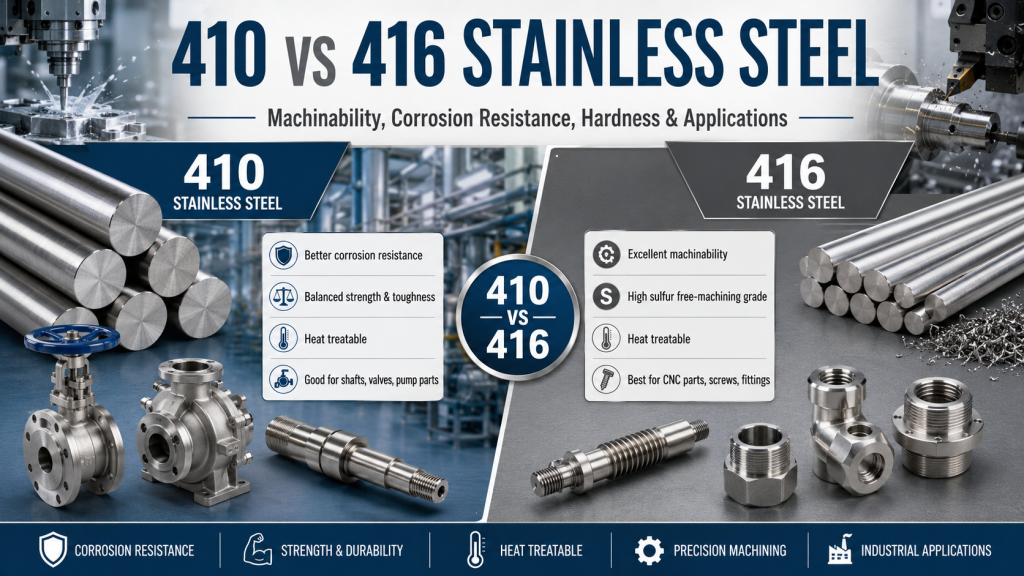
When comparing 410 vs 416 stainless steel, buyers are usually evaluating two martensitic stainless steel grades for shafts, valves, screws, fittings, fasteners, CNC machined parts, industrial hardware and heat-treated components.
Both 410 and 416 stainless steel provide high strength, hardness and heat treatment capability. However, they are optimized for different priorities. 410 stainless steel offers a better balance of corrosion resistance, toughness, wear resistance and weldability. 416 stainless steel is designed for superior machinability, faster cutting speed, shorter chips and high-volume precision machining.
This guide compares 410 and 416 stainless steel in chemical composition, sulfur content, machinability, corrosion resistance, heat treatment, hardness, weldability, cost and application selection. For related products and processing services, visit Stainless Steel Bar, Stainless Steel Sheet, Stainless Steel Coil, Laser Cutting and the Jude Steel Stainless Steel Grade Center.
Fast Comparison: 410 vs 416 Stainless Steel
| Feature | 410 Stainless Steel | 416 Stainless Steel |
|---|---|---|
| Stainless Steel Family | Martensitic stainless steel | Free-machining martensitic stainless steel |
| Main Advantage | Balanced corrosion resistance, strength, toughness and wear resistance | Excellent machinability and high-speed CNC productivity |
| Typical Chromium Content | About 11.5%–13.5% | About 12%–14% |
| Sulfur Content | Low | Higher sulfur for free machining |
| Corrosion Resistance | Better than 416 | Moderate; lower than 410 |
| Machinability | Good | Excellent |
| Hardness | High after heat treatment | High after heat treatment |
| Heat Treatable | Yes | Yes |
| Weldability | Better than 416, but still requires care | Limited and generally not recommended |
| Typical Applications | Shafts, valves, pump components, turbine parts, fasteners, industrial hardware | CNC parts, automatic screw machine parts, bolts, nuts, gears, fittings, precision shafts |
1. What Is 410 Stainless Steel?
410 stainless steel is a general-purpose martensitic stainless steel. It contains chromium and carbon and can be heat treated to achieve higher hardness and strength. It is widely used where moderate corrosion resistance, wear resistance and mechanical strength are required.
Compared with austenitic stainless steels such as 304 or 316L, 410 has lower corrosion resistance but much better heat-treatable hardness. Compared with 416, 410 usually provides better corrosion resistance, toughness and weldability.
Main Characteristics of 410 Stainless Steel
- Martensitic stainless steel structure
- Magnetic
- Heat treatable
- Good strength and hardness after heat treatment
- Moderate corrosion resistance
- Good wear resistance
- Better toughness than 416 in many applications
- Better weldability than 416, but welding still requires careful control
Typical 410 Stainless Steel Applications
- Pump shafts
- Valve components
- Fasteners
- Turbine parts
- Industrial hardware
- Bolts and screws where corrosion resistance is moderately required
- Wear-resistant components
- Heat-treated mechanical parts
2. What Is 416 Stainless Steel?
416 stainless steel is a free-machining martensitic stainless steel. It is based on the 410 stainless steel family but contains added sulfur to improve machinability. The sulfur helps create shorter chips, smoother cutting, faster machining and better productivity on CNC machines and automatic lathes.
The trade-off is that higher sulfur reduces corrosion resistance, toughness and weldability. Therefore, 416 is usually chosen for machined parts rather than welded assemblies or corrosion-critical components.
Main Characteristics of 416 Stainless Steel
- Free-machining martensitic stainless steel
- Magnetic
- Heat treatable
- Excellent machinability
- Shorter chips and better chip control
- Improved cutting speed and tool life
- Good hardness after heat treatment
- Lower corrosion resistance than 410
- Limited weldability
Typical 416 Stainless Steel Applications
- CNC machined parts
- Automatic screw machine parts
- Screws and bolts
- Nuts
- Fittings
- Precision shafts
- Gears
- Valve stems
- High-volume machined components
3. Chemical Composition Comparison
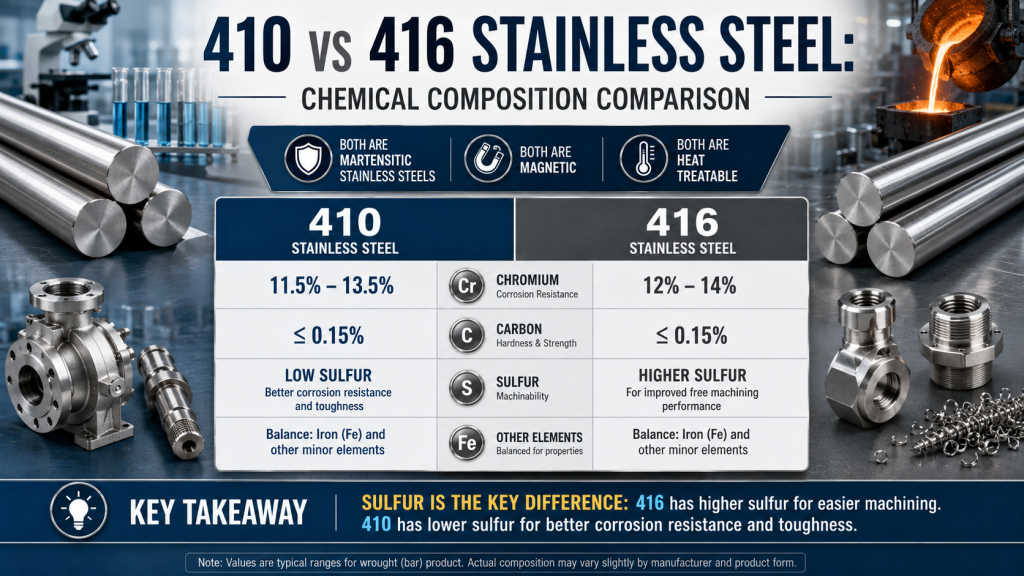
410 and 416 stainless steel are both chromium martensitic stainless steels. Their most important difference is sulfur content. 416 contains higher sulfur to improve machinability, while 410 keeps a lower sulfur level for better toughness and corrosion resistance.
| Element / Feature | 410 Stainless Steel | 416 Stainless Steel |
|---|---|---|
| Chromium | About 11.5%–13.5% | About 12%–14% |
| Carbon | Usually up to about 0.15% | Usually up to about 0.15% |
| Sulfur | Low | Higher for free machining |
| Structure | Martensitic | Martensitic |
| Magnetism | Magnetic | Magnetic |
| Primary Design Focus | Strength, hardness, corrosion resistance and toughness balance | Machinability, chip breaking and high-speed production |
Why Sulfur Matters
Sulfur improves machinability by helping chips break more easily during turning, milling and drilling. This improves productivity, tool life and surface finish in machined parts. However, sulfur can reduce corrosion resistance, toughness and weldability. This is why 416 machines better than 410, while 410 generally performs better in corrosion and toughness-sensitive applications.
4. Machinability Comparison
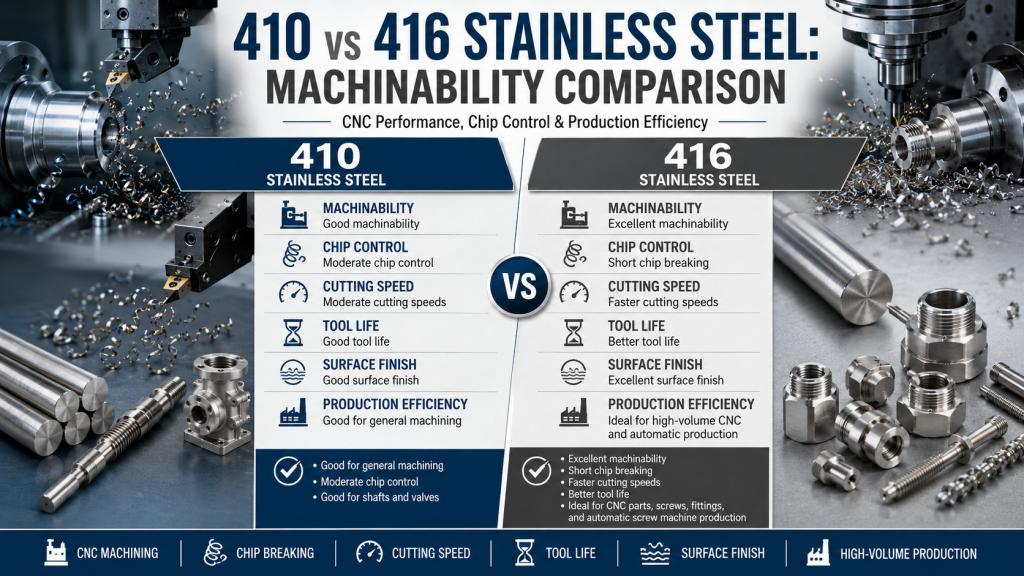
Machinability is the biggest reason engineers choose 416 stainless steel. In high-volume machining, the difference between 410 and 416 can directly affect tool wear, cycle time, chip control, surface finish and total production cost.
| Machining Factor | 410 Stainless Steel | 416 Stainless Steel |
|---|---|---|
| Machinability | Good | Excellent |
| Chip Breaking | Moderate | Excellent |
| Cutting Speed | Moderate | Higher |
| Tool Life | Good, but tool wear can be higher | Better in many machining operations |
| Surface Finish After Machining | Good | Very good |
| High-Volume CNC Production | Usable but less efficient | Preferred |
| Automatic Screw Machine Production | Less ideal | Excellent |
5. Corrosion Resistance Comparison
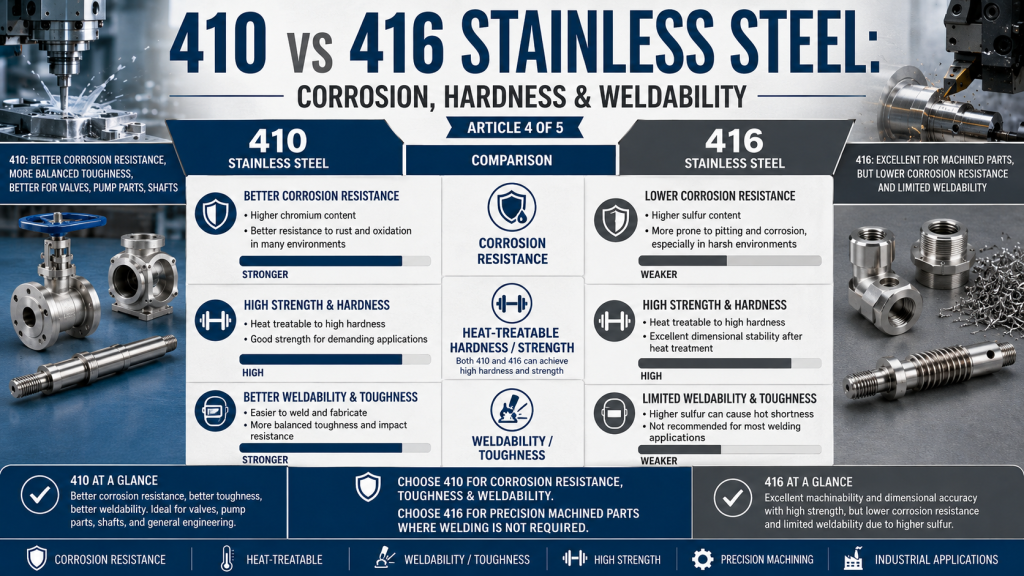
410 stainless steel generally provides better corrosion resistance than 416 stainless steel. The reason is simple: sulfur improves machining, but it also reduces corrosion resistance and toughness.
410 can be used in mild atmosphere, fresh water and general industrial environments. 416 is better suited for dry or mildly corrosive service where machining efficiency matters more than maximum corrosion resistance.
| Environment | Better Choice | Reason |
|---|---|---|
| Mild atmosphere | 410 Stainless Steel | Better corrosion resistance than 416 |
| Fresh water exposure | 410 Stainless Steel | More balanced corrosion performance |
| Dry precision machined components | 416 Stainless Steel | Machinability is more important than corrosion resistance |
| Industrial hardware | 410 Stainless Steel | Better toughness and moderate corrosion resistance |
| Marine or chloride environment | Not recommended | 316L, 2205 or higher alloy should be evaluated |
| Severe chemical corrosion | Not recommended | Higher corrosion-resistant stainless steel or nickel alloy is needed |
6. Hardness and Heat Treatment
Both 410 and 416 stainless steel are heat treatable martensitic grades. Through hardening and tempering, they can achieve higher hardness, strength and wear resistance than many austenitic stainless steels.
410 is often selected for mechanical components where wear resistance, strength and toughness must be balanced. 416 is often selected when the part requires machining first and then heat treatment to obtain final mechanical properties.
| Heat Treatment Factor | 410 Stainless Steel | 416 Stainless Steel |
|---|---|---|
| Heat Treatable | Yes | Yes |
| Hardening Response | Good | Good |
| Strength After Heat Treatment | High | High |
| Wear Resistance | Good | Good |
| Toughness | Better than 416 | Lower than 410 due to sulfur |
| Best Heat-Treated Use | Valves, shafts, pump parts, turbine components | Machined shafts, screws, fittings, precision turned parts |
7. Weldability and Toughness
410 stainless steel has better weldability than 416, but welding martensitic stainless steel still requires care. Preheating, controlled heat input and post-weld heat treatment may be required depending on thickness, design and service condition.
416 stainless steel has limited weldability because sulfur improves machining but harms weld performance. It is mainly intended for machined parts, not welded assemblies.
| Fabrication Factor | 410 Stainless Steel | 416 Stainless Steel |
|---|---|---|
| Weldability | Better than 416, but requires careful control | Limited and generally not recommended |
| Toughness | Better | Lower because of sulfur addition |
| Machined Surface Quality | Good | Excellent |
| Forming | Limited compared with austenitic grades | Limited; mainly used for machining |
| Best Fabrication Use | Moderate corrosion mechanical components and some welded parts | Precision machined components and automatic lathe production |
8. Surface Finish and Product Forms
410 and 416 are often supplied in different product forms depending on their typical application. 410 is commonly available as sheet, plate, bar and industrial components. 416 is especially common as bright bar, round bar and precision machining stock.
| Surface / Product Factor | 410 Stainless Steel | 416 Stainless Steel |
|---|---|---|
| Common Product Forms | Sheet, plate, bar, forged parts, industrial components | Round bar, bright bar, hex bar, machined stock |
| Common Surface Finish | 2B, pickled, ground, polished, industrial finish | Bright bar, turned bar, ground bar, precision machined finish |
| Typical Supply Focus | Mechanical and wear-resistant parts | CNC and automatic machining parts |
| Surface Appearance | Industrial | Machined and bright surface appearance |
| Best Use | Valves, pump shafts, plates, components | Precision shafts, screws, bolts, fittings, gears |
For stainless steel products and processing support, explore Stainless Steel Bar, Stainless Steel Sheet, Stainless Steel Coil, Laser Cutting and Polishing.
9. Cost and Manufacturing Efficiency
410 stainless steel often has a lower material cost than 416. However, 416 may reduce total manufacturing cost when machining time, tool wear, chip handling, surface finish and high-volume production efficiency are considered.
| Cost Factor | 410 Stainless Steel | 416 Stainless Steel |
|---|---|---|
| Raw Material Cost | Usually lower | Often slightly higher |
| Machining Cost | Higher in high-volume production | Lower due to excellent machinability |
| Tool Wear | Higher than 416 | Lower in many machining operations |
| Production Speed | Moderate | Higher |
| Best Cost Scenario | Moderate machining plus better corrosion and toughness needs | High-volume CNC or automatic screw machine production |
10. Real-World Application Comparison
| Application | Better Choice | Reason |
|---|---|---|
| Pump shafts | 410 Stainless Steel | Better corrosion resistance and toughness |
| Valve components | 410 Stainless Steel | Balanced hardness, wear resistance and corrosion performance |
| Turbine parts | 410 Stainless Steel | Good strength and heat treatment capability |
| Industrial hardware | 410 Stainless Steel | Better balanced mechanical performance |
| CNC machined parts | 416 Stainless Steel | Excellent machinability and surface finish |
| Automatic screw machine parts | 416 Stainless Steel | Short chips and high-speed production |
| Bolts, nuts and screws | 416 Stainless Steel | Efficient production of small precision parts |
| Precision fittings | 416 Stainless Steel | Better machining efficiency and dimensional control |
| Welded assemblies | 410 Stainless Steel | Better weldability than 416 |
| Marine or chloride service | Neither is ideal | 316L, 2205 or higher grades should be evaluated |
11. 410 vs 416 Stainless Steel: Selection Guide
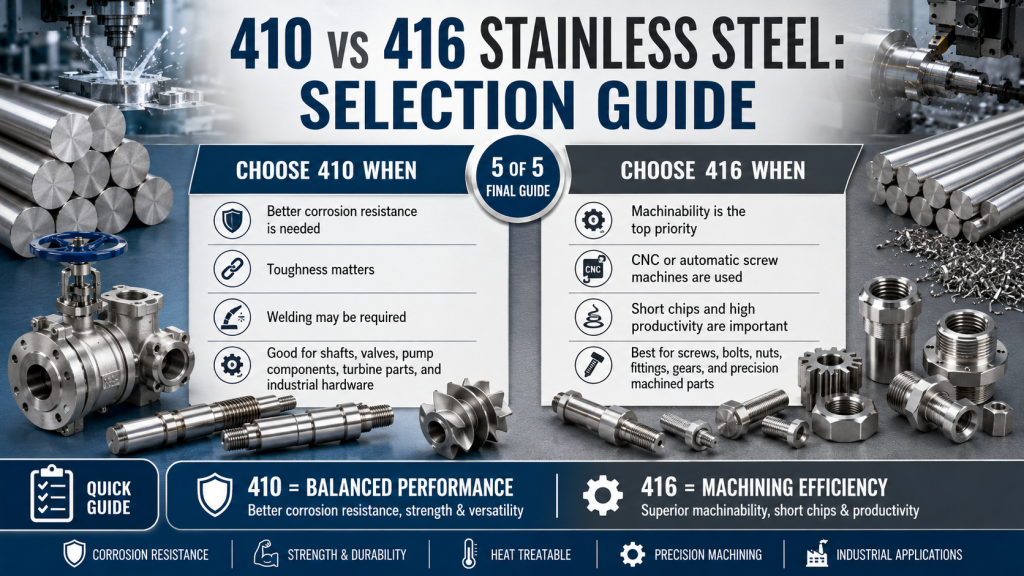
Choose 410 Stainless Steel If:
- Better corrosion resistance is required
- Toughness is important
- Welding may be required
- The part is a shaft, valve, pump component or turbine part
- The application needs heat treatment and wear resistance
- The environment is mildly corrosive
- You need a balanced martensitic stainless steel grade
Choose 416 Stainless Steel If:
- Machinability is the top priority
- The part will be produced by CNC machining
- Automatic screw machines or high-speed turning are used
- Short chips and high productivity are important
- The part is a screw, bolt, nut, fitting, gear or precision shaft
- Welding is not required
- The environment is dry or only mildly corrosive
Consider Other Grades If:
- 304 is needed for better general corrosion resistance and weldability
- 316L is needed for chloride or marine atmosphere
- 420 is needed for higher hardness and wear resistance
- 431 is needed for higher strength and better corrosion resistance than 410
- 440C is needed for very high hardness and wear resistance
- 17-4PH is needed for high strength with better corrosion resistance
12. Common Buyer Mistakes to Avoid
- Choosing 416 only because it machines faster without checking corrosion requirements
- Choosing 410 for high-volume machining when 416 could reduce production cost
- Using 416 in welded assemblies without evaluating weldability risk
- Using either grade in marine or chloride environments without considering 316L or duplex stainless steel
- Ignoring heat treatment condition and final hardness requirements
- Comparing only raw material cost instead of finished part cost
- Assuming martensitic stainless steel has the same corrosion resistance as 304 or 316L
- Not confirming bar condition, hardness, tolerance and material certificate before purchase
Frequently Asked Questions
What is the main difference between 410 and 416 stainless steel?
410 stainless steel is a general-purpose martensitic stainless steel with better corrosion resistance, toughness and weldability than 416. 416 stainless steel is a free-machining martensitic stainless steel with added sulfur for faster machining, shorter chips and improved production efficiency.
Is 416 stainless steel easier to machine than 410?
Yes. 416 stainless steel is much easier to machine because sulfur improves chip breaking, cutting speed, surface finish and tool life. It is widely used for CNC machining and automatic screw machine production.
Which has better corrosion resistance, 410 or 416 stainless steel?
410 stainless steel generally has better corrosion resistance than 416 because 416 contains higher sulfur, which improves machinability but reduces corrosion resistance and toughness.
Are 410 and 416 stainless steel heat treatable?
Yes. Both 410 and 416 stainless steel are martensitic grades and can be heat treated to increase hardness, strength and wear resistance.
Are 410 and 416 stainless steel magnetic?
Yes. Both 410 and 416 are martensitic stainless steels and are magnetic.
Can 416 stainless steel be welded?
416 stainless steel can be welded, but weldability is limited and generally not recommended for critical welded assemblies. 410 is usually the safer choice when welding is required.
Which grade is better for CNC machining?
416 stainless steel is better for CNC machining, automatic screw machine production, precision fittings, screws, bolts and parts where machining speed and chip control are critical.
Conclusion
410 and 416 stainless steel are both martensitic stainless steels with high strength, hardness and heat treatment capability. The best choice depends on whether your project values balanced performance or machining productivity.
Choose 410 stainless steel when corrosion resistance, toughness, welding, valves, pump components, shafts and industrial hardware are the main requirements. Choose 416 stainless steel when machinability, CNC efficiency, short chips, tool life, screws, bolts, fittings and high-volume production are more important.
Jude Steel supplies stainless steel sheets, coils, strips, bars and customized processing services for global buyers. Explore more at Judesteel.com, or visit our product pages for stainless steel bar, stainless steel sheet, stainless steel coil and stainless steel strip.
